
In the field of industrial machinery, the squeezing axle is a critical and consumable component in screw-type oil presses. Traditionally, these axles have been produced using metal mold casting to create a bimetallic composite of white cast iron and carbon steel. While this method yielded cost-effective products favored by users, manufacturers grappled with high rejection rates and short mold lifespans, leading to elevated production costs. To address these challenges, I explored an alternative approach: sand casting using sodium silicate-bonded sand. This shift not only mitigates the drawbacks of metal molds but also enhances the performance and economic viability of the squeezing axle. Throughout this article, I will delve into the comprehensive sand casting process, emphasizing material adjustments, design calculations, and practical applications, with a focus on the repeated use of sand casting techniques to achieve optimal results.
The core of the bimetallic squeezing axle consists of a prefabricated carbon steel shaft core overlaid with white cast iron squeezing screws. In metal mold casting, the rapid cooling rate ensures a fine microstructure, but the high scrap rate and mold wear prompted a transition to sand casting. Sand casting, particularly with sodium silicate-bonded sand, offers greater flexibility, lower tooling costs, and improved yield, making it ideal for medium-batch production. However, the reduced chilling effect of sand casting compared to metal molds necessitated adjustments in the white cast iron composition to maintain hardness and wear resistance. This article details my journey in optimizing the sand casting process, from material science to practical implementation, showcasing how sand casting can revolutionize the production of bimetallic components.
In sand casting, the molding material plays a pivotal role. I employed sodium silicate-bonded sand, commonly known as water glass sand, due to its excellent collapsibility and environmental benefits. The sand mixture was formulated to ensure adequate strength and permeability. The typical composition included 100% base sand, 3.5% to 4.5% sodium silicate, and 0.35% to 0.40% MDT organic ester as a hardener. The base sand was 70/140 mesh washed quartz sand with a moisture content below 1%, and the sodium silicate had a modulus of 2.2 to 2.5. The mixing procedure involved blending the base sand with the organic ester for 1 to 1.5 minutes, then adding sodium silicate and mixing for another 1 to 1.5 minutes before discharge. This sand casting mixture ensures quick hardening and good dimensional accuracy, which are crucial for the complex geometry of the squeezing axle.
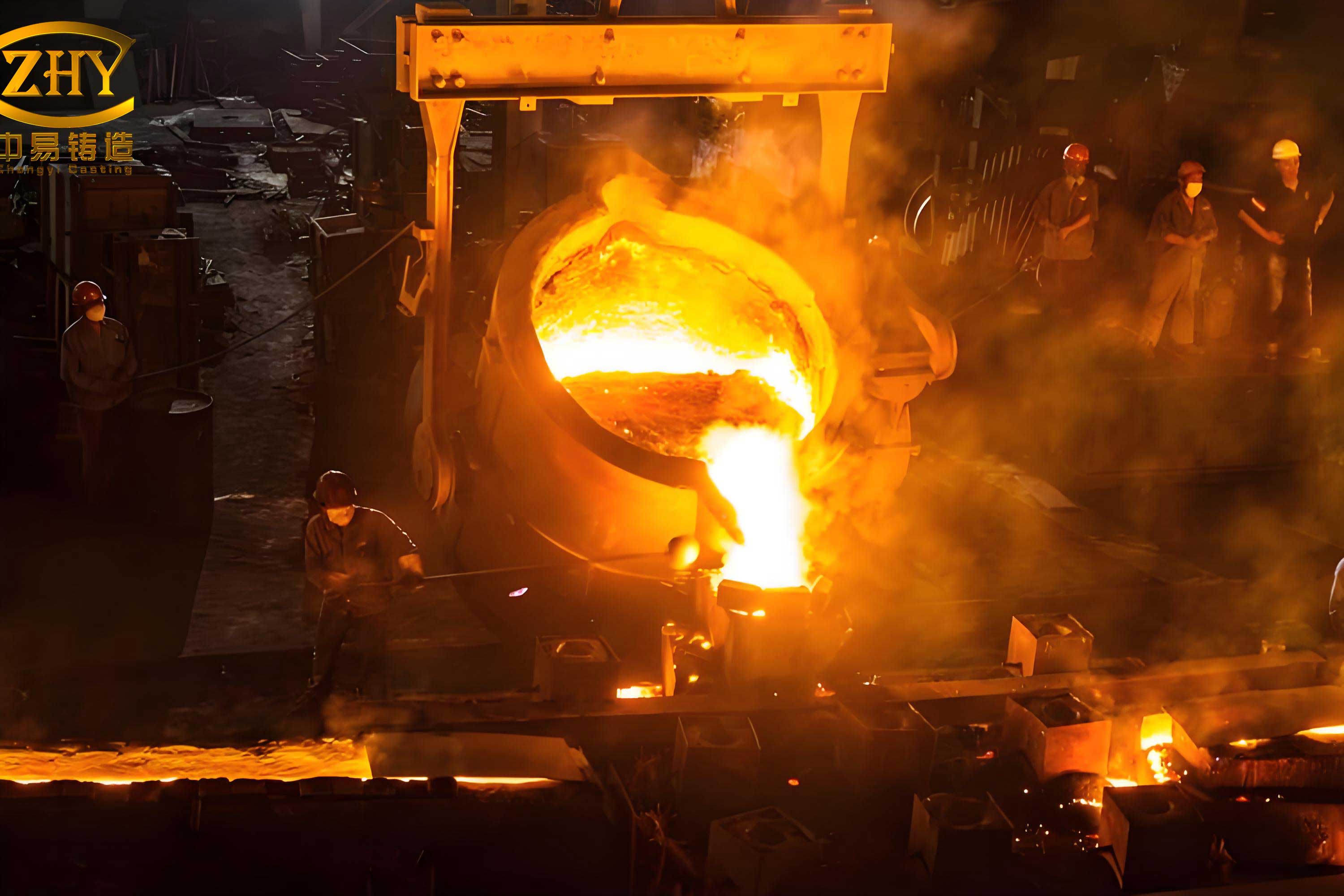
The white cast iron used for the squeezing screws required compositional adjustments to compensate for the slower cooling in sand casting. In metal mold casting, the original composition had higher silicon and phosphorus levels, which could lead to graphite formation in sand casting, reducing hardness. To counteract this, I increased the chromium content from 0.4%–0.6% to 1.0%–1.2%. Chromium enhances hardenability, promotes carbide formation, and improves wear resistance. Additionally, I performed a composite modification treatment by adding small amounts of 1# rare earth (RE) and boron-iron (B-Fe) during molten iron tapping. This refinement step helps in grain size reduction, further boosting strength and hardness. The adjusted chemical composition is summarized in Table 1, highlighting the changes tailored for sand casting.
| Element | Original Range (Metal Mold) | Adjusted Range (Sand Casting) | Effect of Adjustment |
|---|---|---|---|
| C | 3.2–3.6 | 3.2–3.6 | Maintains carbide content |
| Si | 0.8–1.2 | 0.6–0.9 | Reduces graphite formation risk |
| Mn | 0.5–0.8 | 0.5–0.8 | Stabilizes microstructure |
| P | ≤0.3 | ≤0.2 | Minimizes brittleness |
| S | ≤0.1 | ≤0.1 | Controls impurities |
| Cr | 0.4–0.6 | 1.0–1.2 | Enhances hardenability and wear resistance |
| RE | – | 0.05–0.10 | Refines grains |
| B | – | 0.005–0.02 | Improves hardenability and strength |
The composite modification treatment can be quantified using the following formula to estimate grain refinement efficiency: $$ \Delta d = k \cdot \frac{1}{\sqrt{C_{RE} + C_B}} $$ where \(\Delta d\) is the reduction in grain size, \(k\) is a material constant, and \(C_{RE}\) and \(C_B\) are the concentrations of rare earth and boron, respectively. This refinement is critical in sand casting to achieve a fine microstructure despite the lower cooling rate.
For the carbon steel shaft core, design considerations focused on ensuring a strong metallurgical bond with the white cast iron overlay. Based on previous studies on bimetallic sand casting, I treated the white cast iron layer as a thick-walled cylinder under internal pressure. Using the stress state equations and the third strength theory, the condition to prevent cracking at the inner surface of the overlay is given by: $$ d \leq D \sqrt{1 – \frac{2P}{[\sigma]}} $$ where \(d\) is the inner diameter (shaft core diameter), \(D\) is the outer diameter of the overlay, \(P\) is the clamping pressure (taken as 15 MPa), and \([\sigma]\) is the allowable stress of white cast iron (37 MPa). For a 6YL-68 type oil press squeezing axle, the minimum spiral root diameter is 46 mm. Substituting values: $$ d \leq 46 \sqrt{1 – \frac{2 \times 15}{37}} \approx 46 \sqrt{1 – 0.8108} = 46 \sqrt{0.1892} \approx 20 \text{ mm} $$ Thus, the shaft core diameter was set at 20 mm. To enhance bonding strength, two annular protrusions, each 3 mm high and 20 mm wide, were machined onto the shaft core, as illustrated in Figure 1. The entire shaft core was pre-machined to ensure cleanliness and dimensional accuracy.
| Parameter | Value | Description |
|---|---|---|
| Core Diameter (d) | 20 mm | Calculated from strength condition |
| Protrusion Height | 3 mm | Increases interfacial bond strength |
| Protrusion Width | 20 mm | Provides mechanical interlocking |
| Core Material | Carbon Steel (0.45% C) | Ensures compatibility with cast iron |
| Surface Preparation | Cleaned, coated, and preheated | Prevents defects in sand casting |
The sand casting process for the squeezing axle involved meticulous pattern design and molding. Each axle has a mass of 7.8 kg and maximum dimensions of Φ68 mm × 600 mm. To facilitate molding and placement of the prefabricated shaft core, I adopted a horizontal parting line with two castings per mold box. Local sand adhesion issues on the squeezing screws were addressed by adding allowances. The gating system was designed as semi-closed, with cross-sectional area ratios: \( F_{\text{sprue}} : F_{\text{runner}} : F_{\text{ingate}} = 1 : 1.2 : 0.8 \). The sprue was positioned at one end of the runner, near the thicker sections of the squeezing screw. A bottle-shaped riser with a 20 mm neck was placed at the top of the thick section to aid venting and slag collection. The sand casting mold assembly is depicted in Figure 2, showcasing the layout optimized for sand casting efficiency.
During molding, due to the fine sand grain size, multiple vent holes were poked in the cope to prevent gas entrapment. After pattern removal, the mold was allowed to harden naturally for 2 hours before closing and pouring. The shaft core was prepared by cleaning off oil and rust, applying a specialized coating, and preheating in a box furnace at 250°C, then held at 150°C until mold assembly. To maintain process integrity, the core was inserted just before closing and pouring, avoiding overnight storage in the mold. The sand casting procedure emphasized timing to ensure proper sand hardening and core integration.
Melting was conducted in a 500 kg induction furnace, with a tapping temperature of 1400–1420°C. The composite modification treatment was performed in a ladle during transfer, and pouring was done at around 1360°C using small ladles. To enhance casting quality, the mold was tilted by elevating one end by 40 mm during pouring, promoting better slag separation and gas escape. After pouring, the casting was shaken out after 2 minutes, stripped of sand, and air-cooled upright on a rack. A stress-relief annealing treatment followed to minimize residual stresses. This sand casting sequence ensured high integrity and performance of the bimetallic component.
To evaluate the effectiveness of the sand casting process, I conducted comprehensive performance tests on the produced squeezing axles. Hardness was measured directly on the machined squeezing screw tops using a Rockwell hardness tester. Wear resistance was assessed using an MLS-23 rubber wheel abrasion tester under two conditions: dry quartz sand (40/70 mesh) and wet quartz sand (with water), both at a load of 14.7 N. The wear loss \(\Delta W\) was recorded, and wear resistance was expressed as \(\epsilon = \Delta W_i / \Delta W_0\), where \(\Delta W_0\) is the loss from metal mold cast samples. Lower \(\epsilon\) values indicate better wear resistance. Service life was determined through practical operation in oil presses using unprocessed soybeans as the feedstock. Table 3 compares the results between metal mold and sand casting axles, demonstrating the advantages of the sand casting approach.
| Property | Metal Mold Casting | Sand Casting (Adjusted Composition) | Improvement/Comment |
|---|---|---|---|
| Hardness (HRC) | 49.8–52.1 | 49.0–53.2 | Slightly higher range due to modification in sand casting |
| Wear Resistance (ε, dry) | 1.00 (reference) | 0.96 | 4% better in sand casting |
| Wear Resistance (ε, wet) | 1.00 (reference) | 0.85 | 15% better in sand casting, crucial for wet conditions | Service Life (hours) | 3000–3100 | ≥3200 | Extended by ≥3% in sand casting |
| Rejection Rate | High (≈15–20%) | ≤5% | Significant reduction in sand casting |
| Process Yield | 67% | 78% | Higher yield in sand casting due to better design |
The enhanced performance in sand casting can be attributed to several factors. The increased chromium content and composite modification refine the microstructure, as described by the Hall-Petch relationship: $$ \sigma_y = \sigma_0 + \frac{k_y}{\sqrt{d}} $$ where \(\sigma_y\) is yield strength, \(\sigma_0\) and \(k_y\) are constants, and \(d\) is grain diameter. Finer grains improve both strength and toughness. Additionally, chromium boosts oxidation and corrosion resistance, which is beneficial in abrasive environments. Although sand casting provides less chilling than metal molds, the material adjustments compensate effectively, leading to superior wear resistance, especially in wet conditions—a key advantage in oil processing applications.
From an economic perspective, the sand casting process offers substantial cost savings. A detailed cost analysis was performed, accounting for material expenses, labor, and overhead. While sand casting incurs additional costs for sodium silicate sand, alloys, and extra cleaning and machining time—approximately 12 yuan per axle—it eliminates the high costs associated with metal mold fabrication and maintenance. Moreover, the reduction in rejection rate to below 5% and the increase in process yield to 78% result in savings of over 20 yuan per axle. Overall, the sand casting method reduces total production costs by about 10% compared to metal mold casting. This cost efficiency, combined with improved product performance, makes sand casting highly attractive for manufacturers.
| Cost Component | Metal Mold Casting | Sand Casting | Net Difference |
|---|---|---|---|
| Mold/Tooling Cost | 30 | 5 | -25 (savings) |
| Material Cost (Sand, Alloys) | 15 | 27 | +12 (increase) |
| Labor (Cleaning, Machining) | 20 | 25 | +5 (increase) |
| Scrap/Rejection Losses | 18 | 4 | -14 (savings) |
| Process Yield Benefit | 0 | +8 (from higher yield) | +8 (savings) |
| Total Cost | 83 | 69 | -14 (≈10% reduction) |
The economic formula to assess cost-effectiveness can be expressed as: $$ C_{\text{total}} = C_{\text{tooling}} + C_{\text{material}} + C_{\text{labor}} + C_{\text{scrap}} – B_{\text{yield}} $$ where \(C_{\text{total}}\) is total cost, and \(B_{\text{yield}}\) is the benefit from improved yield. For sand casting, the lower tooling and scrap costs outweigh the higher material and labor expenses, resulting in a net reduction. This analysis underscores the viability of sand casting for mass production of bimetallic components.
In practical applications, the sand-cast squeezing axles have been successfully integrated into oil press operations. Field reports indicate consistent performance and durability, with users noting extended service intervals and reduced downtime. The adaptability of sand casting allows for easy scaling and customization, catering to diverse industrial needs. Furthermore, the environmental aspect of sodium silicate-bonded sand—being less polluting than some organic binders—aligns with sustainable manufacturing trends. As sand casting technology evolves, innovations such as automated molding and advanced sand reclamation could further enhance efficiency.
Reflecting on the process, I identify key best practices for sand casting bimetallic axles. First, precise control of sand composition and hardening time is essential to avoid defects like veining or poor surface finish. Second, preheating the steel core to around 150°C ensures better metallurgical bonding by reducing thermal shock during pouring. Third, the gating system must be designed to minimize turbulence and slag inclusion, critical in sand casting for complex shapes. Finally, post-casting treatments like annealing help relieve stresses induced by differential cooling between the cast iron and steel. These steps collectively optimize the sand casting outcome.
Looking ahead, there is potential for further improvement. For instance, incorporating computational simulations to model fluid flow and solidification in sand casting could refine gating designs. Experimenting with alternative sand binders or additives might enhance collapsibility and reduce environmental impact. Additionally, exploring other alloying elements like molybdenum or nickel could push the performance boundaries of white cast iron in sand casting applications. The versatility of sand casting opens avenues for continuous innovation in bimetallic component manufacturing.
In conclusion, the transition to sand casting for producing twin metals composite squeezing axles has proven highly successful. By adjusting the white cast iron composition and employing composite modification, I achieved enhanced hardness and wear resistance, surpassing metal mold counterparts. The sand casting process not only reduces costs through lower tooling expenses and higher yield but also delivers reliable performance in real-world conditions. The integration of sand casting techniques into this application demonstrates how traditional methods can be revitalized with material science and process optimization. As industries seek cost-effective and durable solutions, sand casting stands out as a robust method for manufacturing complex bimetallic parts, paving the way for broader adoption in machinery and beyond.
To encapsulate, the key takeaways from this sand casting endeavor are: the importance of material tailoring for specific cooling rates, the critical role of design calculations in ensuring structural integrity, and the economic and performance benefits of sand casting over metal mold methods. This comprehensive approach not only solves existing production challenges but also sets a precedent for similar applications, reinforcing sand casting as a cornerstone of modern foundry practice.