
The realm of abrasion-resistant materials is perpetually driven by the quest for alloys that combine exceptional hardness with adequate toughness. Among these, high chromium white cast iron stands as a cornerstone, renowned for its superior wear resistance derived from a microstructure rich in hard, chromium-rich carbides embedded within a metallic matrix. The performance of any white cast iron is intrinsically linked to the morphology, size, and distribution of these carbides. While hypoeutectic compositions are widely employed, the hypereutectic high chromium white cast iron, with its higher carbon content, offers the potential for even greater hardness and wear volume. However, this promise is severely undermined by a critical flaw: the presence of coarse, primary M7C3-type carbides that drastically embrittle the material. This brittleness has historically restricted the industrial application of hypereutectic grades. My research focuses on deciphering the solidification mechanisms governing these deleterious carbide structures and developing effective methodologies to control them. Through the application of a Mg-based compound modifier, this investigation delves into the synergistic effects of thermodynamic undercooling and interfacial adsorption, revealing a pathway to refine carbide morphology and unlock the latent potential of hypereutectic high chromium white cast iron.
The experimental journey began with the careful selection and melting of raw materials to achieve the target hypereutectic composition. The base charge consisted of pig iron, scrap steel, and pre-alloyed high chromium iron, meticulously proportioned to yield the final chemistry presented in Table 1.
| C | Si | Mn | Cr | Cu |
|---|---|---|---|---|
| 4.2 | 0.5 | 0.5 | 12 | 0.3 |
Melting was conducted in a 25 kW medium-frequency induction furnace. Upon complete liquefaction, the molten metal was superheated to 1450°C. For the modified series, a proprietary Mg-based compound inoculant was introduced into the melt prior to pouring. The metal was then cast into standard Y-block sand molds, designed to produce specimens for mechanical testing and microstructural analysis. After cooling to room temperature and clearing, the castings were sectioned. Impact toughness was evaluated using a standard impact tester on unnotched specimens (10 mm x 10 mm x 55 mm). Hardness was measured using a Rockwell hardness tester (Scale C). For microstructural characterization, samples were ground, polished, and etched with a 4% nital solution. Analysis was performed using optical microscopy, scanning electron microscopy (SEM), and energy-dispersive X-ray spectroscopy (EDS).
The stark contrast between the unmodified and modified alloys was immediately apparent. The unmodified white cast iron exhibited a microstructure dominated by large, interconnected, and sharply faceted primary carbides, often exhibiting a script-like or hexagonal rod morphology. These carbides formed a nearly continuous network, severely compartmentalizing the metallic matrix. Furthermore, the presence of micro-shrinkage porosity was notable, indicating poor feeding characteristics during solidification. In contrast, the Mg-modified white cast iron revealed a remarkable transformation. The primary carbides were significantly refined and isolated. Their growth appeared more isotropic, leading to a blunted, less interconnected morphology. The script-like network was effectively broken, and the micro-shrinkage was drastically reduced, suggesting improved melt quality and feeding. This microstructural refinement translated directly into enhanced mechanical properties, as quantified in Table 2.
| Condition | Impact Toughness (J/cm²) | Hardness (HRC) |
|---|---|---|
| Unmodified | 6.2 | 59 |
| Mg-Modified | 9.9 | 60 |
While the hardness saw a marginal increase, likely due to reduced porosity and a slightly finer eutectic structure, the impact toughness improved by approximately 60%. This dramatic leap in toughness without sacrificing hardness is the key achievement, making the hypereutectic white cast iron a more viable engineering material.
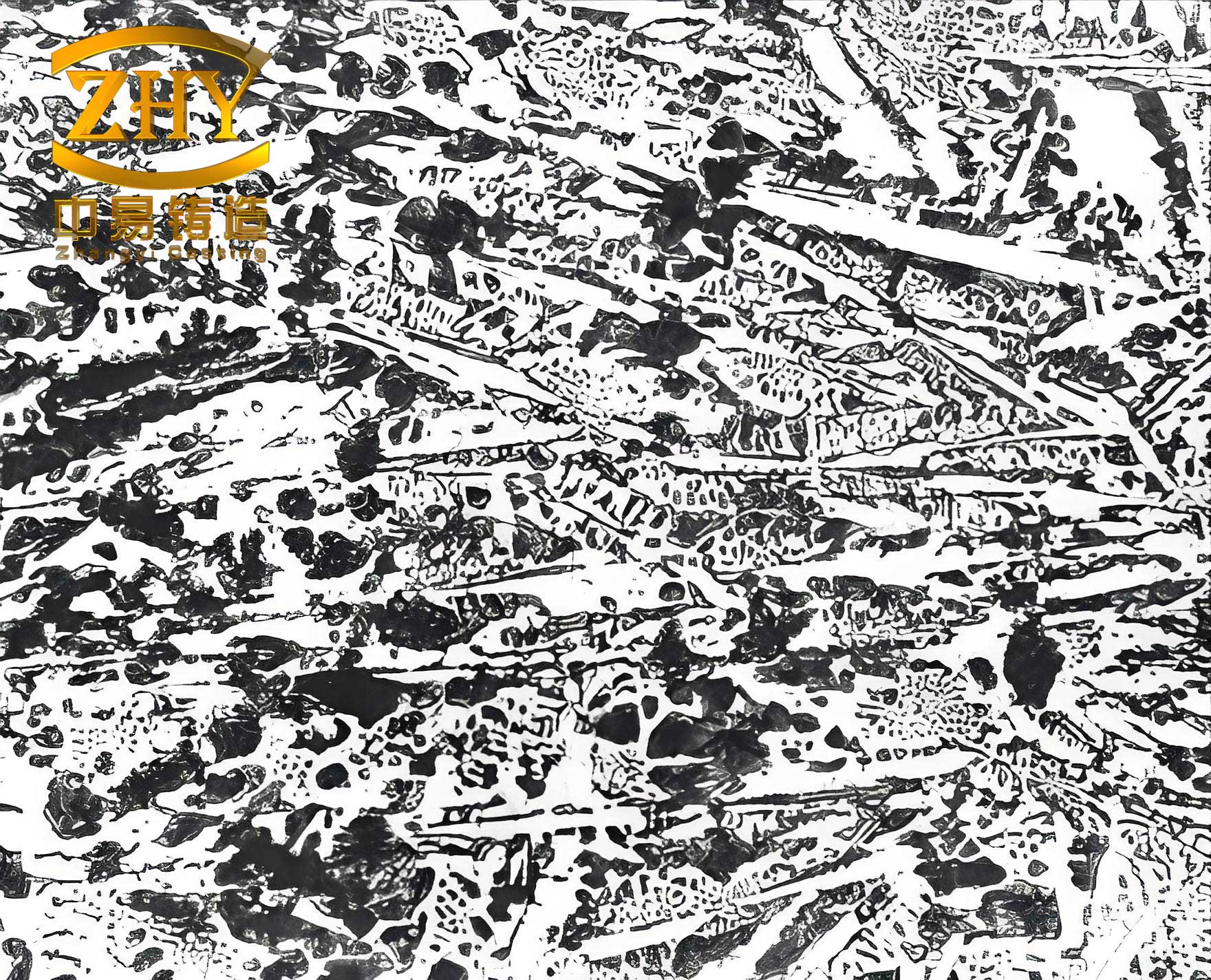
To understand this transformation, one must delve into the solidification dynamics of hypereutectic white cast iron. Upon cooling from the melt, the first phase to solidify is the primary M7C3 carbide. In the Fe-C-Cr system, this carbide typically crystallizes in a hexagonal structure. Crystal growth is highly anisotropic, with the [0001] direction (c-axis) being the preferred growth direction. This leads to the formation of elongated, rod-like, or plate-like crystals, which can easily interconnect to form a brittle skeleton. The modification mechanism of the Mg-based compound operates on two fundamental, synergistic fronts: melt purification/undercooling and selective interfacial adsorption.
First, the modifier acts as a potent melt purifier. Elements like sulfur, phosphorus, oxygen, and nitrogen are common impurities in industrial melts. They can form low-melting-point compounds or act as surfactants. Magnesium actively reacts with these elements, forming stable compounds that can float out or become harmless inclusions. This purification has profound consequences. It removes potential heterogeneous nucleation sites (e.g., oxides, sulfides), forcing solidification to occur at a greater undercooling. Furthermore, the removal of surface-active elements like S and P increases the melt’s surface tension. The interfacial energy between a solid nucleus and the liquid melt, $\gamma_{sl}$, is related to the liquid’s surface tension. An increase in $\gamma_{sl}$ raises the critical free energy barrier for nucleation, $\Delta G^*$:
$$
\Delta G^* = \frac{16 \pi \gamma_{sl}^3}{3 (\Delta G_v)^2}
$$
where $\Delta G_v$ is the volume free energy change. A higher $\Delta G^*$ necessitates a larger undercooling, $\Delta T$, to achieve a viable nucleation rate, $I$:
$$
I = K \cdot \exp\left(-\frac{\Delta G^*}{k_B T}\right)
$$
This combined effect—reduction of nucleants and increased nucleation barrier—creates a significant thermodynamic undercooling. The primary carbide and the subsequent eutectic reaction now occur at lower temperatures. The increased undercooling dramatically boosts the nucleation rate of primary carbides. Instead of a few carbides growing large, numerous carbides nucleate almost simultaneously. This inherently leads to a finer and more dispersed distribution of the primary phase in the white cast iron. The refinement of the primary carbides also influences the eutectic reaction by creating a more finely partitioned liquid region, contributing to an overall refined microstructure.
The second, and perhaps more specific, mechanism is the adsorption effect. Surface-active elements in a melt have a tendency to adsorb at the solid-liquid interface during growth. It is postulated that magnesium, or compounds containing it, preferentially adsorbs onto the specific crystallographic planes of the M7C3 carbide that have the highest growth velocity—namely, the prismatic planes perpendicular to the fast-growing [0001] direction. This adsorption forms a dynamic, yet persistent, layer that acts as a diffusion barrier. The growth of a crystal requires the continuous attachment of atoms (Fe, Cr, C) from the liquid to the solid interface. The adsorbed Mg layer impedes the diffusion and attachment of these atoms, effectively poisoning the growth on these favored planes.
We can model this growth inhibition. The normal growth velocity of a crystal face, $v$, can be related to the driving force (undercooling) and the kinetics of atom attachment. With an adsorbed layer reducing the attachment efficiency by a factor $\alpha$ (where $0 < \alpha < 1$), the effective growth velocity on that face becomes:
$$
v_{eff} = \alpha \cdot v_0 \cdot \Delta T
$$
where $v_0$ is the intrinsic growth rate constant. If adsorption is highly selective for the fast-growing planes, their growth is significantly slowed ($\alpha \rightarrow 0$), while other, less-favored planes continue to grow at a relatively faster rate. This reduces the anisotropy of growth. The crystal can no longer extend rapidly in one direction to form long rods or plates. Instead, growth becomes more isotropic, leading to the observed blunted, equiaxed, or chunkier carbide morphology. This change from a continuous network to isolated particles is the primary reason for the dramatic improvement in the toughness of the white cast iron. The adsorption effect does not necessarily change the nucleation event but fundamentally alters the subsequent growth kinetics and morphology.
The synergy between these two mechanisms is powerful. The thermodynamic undercooling ensures a high number of nucleation events, producing many small carbides. Simultaneously, the adsorption effect ensures that each of these numerous nuclei grows in a more isotropic manner, preventing them from impinging and forming a network. The result is a uniform dispersion of fine, isolated, and rounded carbides within the matrix. EDS analysis performed on the modified carbides often reveals trace amounts of Mg or other modifier elements at the carbide/matrix interface, providing supporting evidence for the adsorption hypothesis, although the exact atomic-scale mechanism warrants further study.
The implications of this microstructural engineering extend beyond simple property enhancement. The refined and isolated carbide structure in this modified white cast iron improves not only toughness but also machinability (in the annealed state), grindability, and potentially fatigue resistance. It allows designers to consider hypereutectic compositions for applications where extreme abrasion is coupled with moderate impact or thermal shock, areas previously dominated by lower-carbon or cemented carbide solutions. The ability to tailor carbide morphology through such modification techniques opens new avenues for alloy development. For instance, one could explore the effect of cooling rate in conjunction with modification, or the role of other alloying elements like Vanadium or Niobium in the presence of Mg-based modifiers. The growth kinetics could be further modeled using phase-field simulations incorporating anisotropic interfacial energies and solute drag effects from adsorbed species.
In conclusion, the challenge posed by the coarse carbide network in hypereutectic high chromium white cast iron can be effectively addressed through a Mg-based compound modification strategy. The mechanism is dual-faceted: it induces a significant thermodynamic undercooling that markedly increases the nucleation density of primary carbides, and it leverages a selective adsorption effect that poisons the preferred growth directions of these carbides, forcing a more isotropic growth morphology. The transformation from a brittle, interconnected carbide skeleton to a microstructure comprising fine, isolated, and rounded carbides is directly responsible for the substantial increase in impact toughness, thereby elevating the hypereutectic high chromium white cast iron from a laboratory curiosity to a material with serious industrial potential. This understanding of carbide growth control provides a foundational principle for advancing the next generation of wear-resistant white cast iron alloys.