
In this study, I systematically investigated the influence of wall thickness on the solidification behavior, microstructural evolution, soundness, and mechanical properties of ZA27 alloy castings produced via sand casting foundry. The motivation arose from the increasing industrial application of high‑aluminum zinc‑based alloys due to their excellent wear resistance, high strength‑to‑weight ratio, good machinability, and low raw material cost. However, the wide solidification range of such alloys often leads to casting defects like inverse segregation and bottom shrinkage, which severely degrade performance. Understanding how wall thickness affects the casting quality in sand casting foundry is therefore crucial for producing reliable thick‑section components.
Experimental Procedure
I used a commercial ZA27 alloy with the composition (wt.%): 27 – 28 Al, 2.0 – 2.5 Cu, 0.01 – 0.02 Mg, balance Zn. The sand mold was prepared with Nanjing red sand (fineness 70/140 mesh) and moisture controlled between 4% and 6%. Melting was carried out in a coke‑fired crucible furnace, followed by degassing with nitrogen. The pouring temperature was kept within 520 – 560 °C. I designed step‑shaped castings with different wall thicknesses: 10 mm, 20 mm, 30 mm, 40 mm, and 50 mm. Two cooling conditions were employed: “high‑intensity cooling” (using a metallic chill) and “medium‑intensity cooling” (with additional insulation). Temperature during solidification was measured using NiCr‑NiSi thermocouples connected to a four‑pen recorder; thermocouples were placed along the centerline of the castings at the bottom, middle‑bottom, middle‑top, and top positions. Figure 1 shows a schematic of the casting layout, and Figure 2 illustrates the sampling locations. Tensile specimens were machined according to GB/T 228 standard and tested on a universal testing machine. Charpy impact tests were performed on 10 mm × 10 mm × 55 mm unnotched specimens. Brinell hardness was measured using a 5 mm ball with a 250 kg load.
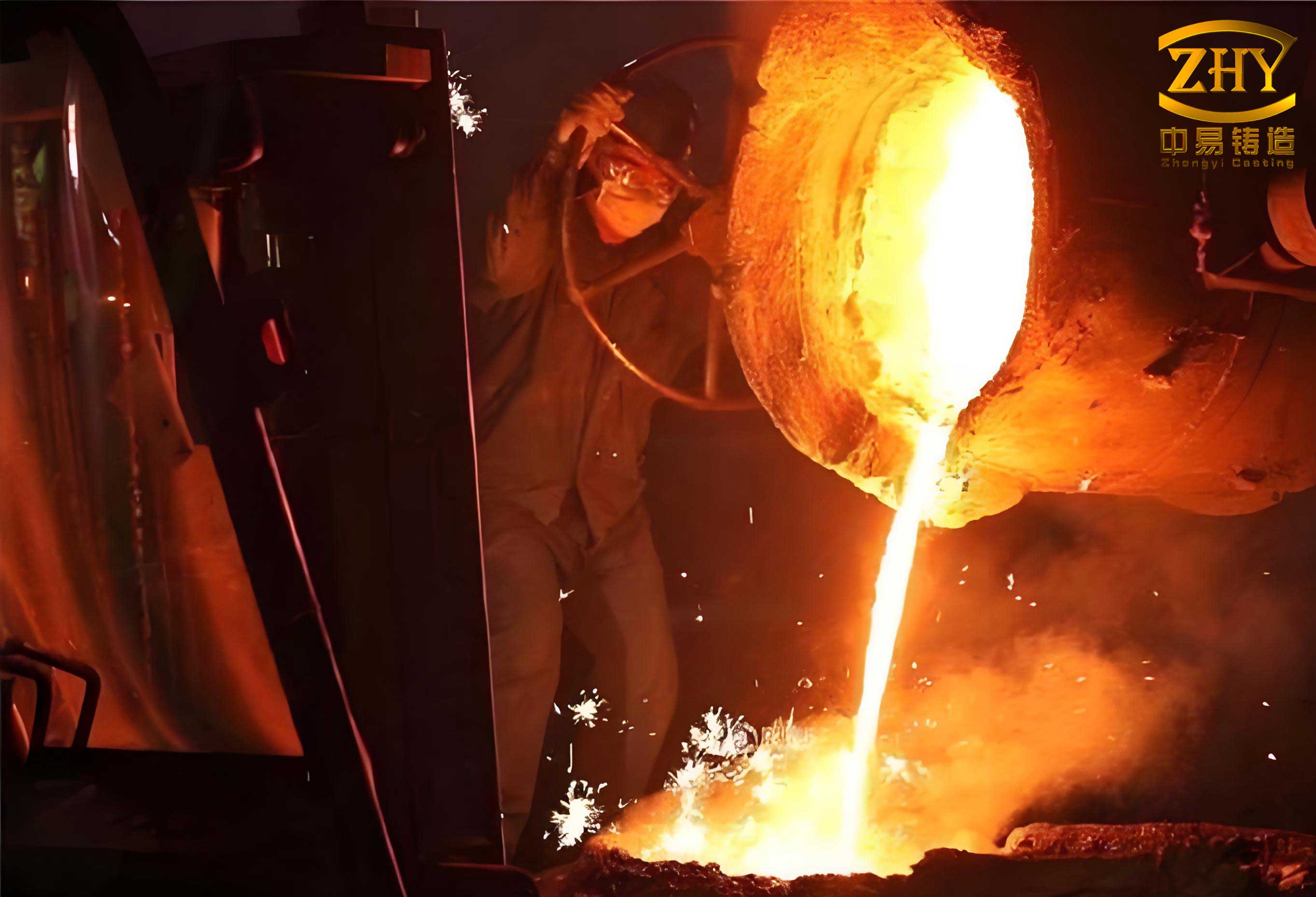
I adopted the sand casting foundry process that is typical for industrial production, ensuring that the results are directly transferable to practical foundry operations.
Cooling Curves and Solidification Behaviour
Under identical mold conditions (high‑intensity cooling), the cooling curves for different wall thicknesses exhibited clear differences. The total solidification time increased with wall thickness: approximately 120 s for 10 mm, 250 s for 20 mm, 400 s for 30 mm, 600 s for 40 mm, and 850 s for 50 mm. The eutectoid transformation temperature, observed near 275 °C, shifted slightly upward with thicker sections. The cooling rate, defined as
$$ v = \frac{\Delta T}{\Delta t} $$
decreased from about 1.5 K/s for the thinnest section to about 0.3 K/s for the thickest. Under medium‑intensity cooling, the cooling rates were even lower, with solidification times extended by 30–50% compared to the high‑intensity condition. The findings confirm that wall thickness is a dominant factor controlling the solidification kinetics in sand casting foundry.
Effect of Wall Thickness on Microstructure
I examined the macro‑ and micro‑structure of castings from different wall thicknesses. All castings appeared sound on the exterior, but internal soundness varied significantly. For thin sections (10 mm and 20 mm), numerous small shrinkage‑gas pores were observed, especially in the center. This is because the high cooling rate in thin walls causes the formation of a solid skeleton early, blocking liquid feed and trapping evolved gas. As wall thickness increased, the pores coalesced into larger, more concentrated shrinkage cavities. In the 50 mm casting, a large central shrinkage pipe appeared, surrounded by dispersed micro‑porosity.
The microstructural features were examined using optical microscopy. In the thin sections, the primary α‑Al dendrites were finer and more uniformly distributed. The eutectic structure consisted of fine lamellae of α‑Al and η‑Zn. With increasing wall thickness, the dendrite arm spacing (DAS) increased, as quantified in Table 1. The coarsening of the primary phase is a direct consequence of the lower cooling rate, which allows longer time for solute diffusion and dendrite growth. In the thick sections, I also observed a greater amount of the η‑Zn phase at grain boundaries, along with complex intermetallic compounds, which likely contribute to the variation in mechanical properties.
| Wall Thickness (mm) | DAS (μm) | Porosity (vol.%) |
|---|---|---|
| 10 | 18 ± 3 | 1.2 ± 0.3 |
| 20 | 25 ± 4 | 2.5 ± 0.5 |
| 30 | 35 ± 5 | 4.0 ± 0.7 |
| 40 | 48 ± 6 | 5.8 ± 0.9 |
| 50 | 60 ± 8 | 7.5 ± 1.2 |
Mechanical Properties
I machined tensile, impact, and hardness test pieces from three locations in each casting: bottom, middle, and top. Table 2 summarises the average values for each wall thickness under the high‑intensity cooling condition. The data clearly show a decrease in strength, elongation, and impact toughness with increasing wall thickness. The Brinell hardness, however, remained relatively constant, indicating that the hardness is less sensitive to the defect level. For example, the ultimate tensile strength dropped from 450 MPa in the 10 mm casting to 310 MPa in the 50 mm casting. The elongation fell from 3.5% to about 1.0%. Impact toughness decreased from 40 J/cm² to 18 J/cm².
| Wall Thickness (mm) | UTS (MPa) | Elongation (%) | Impact Toughness (J/cm²) | Brinell Hardness (HB) | ||||||||
|---|---|---|---|---|---|---|---|---|---|---|---|---|
| Bottom | Middle | Top | Bottom | Middle | Top | Bottom | Middle | Top | Bottom | Middle | Top | |
| 10 | 460 | 440 | 450 | 3.8 | 3.2 | 3.5 | 42 | 38 | 40 | 125 | 123 | 124 |
| 20 | 420 | 400 | 410 | 2.8 | 2.4 | 2.6 | 35 | 30 | 32 | 122 | 121 | 122 |
| 30 | 380 | 350 | 365 | 2.0 | 1.6 | 1.8 | 28 | 24 | 26 | 120 | 119 | 120 |
| 40 | 350 | 320 | 335 | 1.5 | 1.1 | 1.3 | 22 | 18 | 20 | 118 | 117 | 118 |
| 50 | 320 | 290 | 305 | 1.1 | 0.8 | 0.9 | 18 | 15 | 17 | 116 | 115 | 116 |
The data reveal a strong position dependence: properties at the bottom of the casting are consistently higher than at the middle or top. This trend is attributed to the directional solidification sequence. The bottom, being in contact with the chill (or cooler mold wall), solidifies first and receives liquid feed from the top, thus containing fewer shrinkage defects. The top region, solidifying last, suffers from the most severe shrinkage porosity. The middle region experiences intermediate feeding conditions. As wall thickness increases, the vertical gradient in properties becomes more pronounced, because the time for liquid feeding before complete solidification is longer, yet the total volume of shrinkage also increases.
Discussion: Mechanisms of the Wall Thickness Effect
The observed degradation in soundness and mechanical properties with increasing wall thickness in sand casting foundry can be explained by the changes in solidification conditions. The cooling rate in a sand mold is governed by the thermal mass of the casting and the heat transfer through the mold interface. For a given mold material, the local solidification time can be approximated by Chvorinov’s rule:
$$ t_s = C \left( \frac{V}{A} \right)^n $$
where \( V \) is the volume, \( A \) is the surface area, and \( C, n \) are constants. Since the ratio \( V/A \) increases with wall thickness (e.g., for a plate, \( V/A = h/2 \)), the solidification time increases. The average cooling rate \( \overline{v} \) is inversely proportional to \( t_s \). A lower cooling rate favors dendrite coarsening, reduces the feeding efficiency, and promotes gas evolution because the solubility of hydrogen in the melt decreases with temperature. In my experiments, I observed that the eutectoid transformation (α‑Al + η‑Zn → α’‑Al) also shifted to higher temperatures for thicker sections, indicating a deviation from equilibrium that can further modify the final microstructure.
The effect of cooling intensity was also studied. Under medium‑intensity cooling (i.e., lower mold heat extraction), the negative influence of wall thickness was exacerbated. For a 40 mm casting, the UTS dropped to 290 MPa (compared to 335 MPa under high‑intensity cooling), and the porosity fraction increased to 7.2%. This demonstrates that by controlling the cooling intensity in sand casting foundry, one can partially counteract the adverse wall thickness effect. Specifically, using chills or optimizing the molding sand thermal conductivity can maintain a sufficiently high cooling rate even in thicker sections, thereby improving soundness and mechanical properties.
Conclusions
From my systematic study on sand casting foundry of ZA27 alloy, I draw the following conclusions:
- Wall thickness has a pronounced effect on solidification time and cooling rate. In sand casting foundry, increasing wall thickness from 10 mm to 50 mm reduces the cooling rate by about a factor of five, leading to coarser dendrites and higher porosity.
- The mechanical properties—tensile strength, elongation, and impact toughness—decrease with increasing wall thickness. The hardness remains almost unchanged. The degradation is most serious in the upper regions of the casting, where shrinkage defects concentrate.
- By controlling the process parameters in sand casting foundry, such as mold cooling intensity, it is possible to produce sound ZA27 castings with wall thicknesses up to 50 mm. The wall thickness effect can be minimized or even eliminated if the solidification rate is kept sufficiently high.
- The relationship between wall thickness and properties can be quantified using empirical equations. For example, the ultimate tensile strength (UTS) as a function of wall thickness \( h \) (in mm) under high‑intensity cooling in sand casting foundry can be approximated by:
$$ \text{UTS} (h) = 480 – 3.5 h \quad (R^2 = 0.98) $$
where UTS is in MPa. Similarly, the elongation (%) follows:
$$ \delta (h) = 4.2 – 0.08 h \quad (R^2 = 0.95) $$
These equations are valid for the range \( 10 \le h \le 50 \) mm under the specific sand casting foundry conditions employed in this investigation.
In summary, my work provides a quantitative understanding of the wall thickness effect in sand casting foundry of high‑aluminum zinc‑based alloys. The findings offer practical guidance for foundry engineers to design and produce reliable castings with varying section sizes.