
In my many years of working within a manganese steel casting foundry, I have consistently faced the complex task of welding and repairing high manganese steel components. These castings, such as gears, shafts, and bucket teeth, are indispensable in industries like mining, construction, and heavy machinery due to their unparalleled wear resistance and toughness under impact. However, the very properties that make them valuable—such as high hardness and austenitic structure—also render them notoriously difficult to weld. Through trial, error, and refinement, I have developed a comprehensive approach to managing these challenges, ensuring that repaired castings meet rigorous performance standards. This article delves into the intricacies of welding manganese steel castings, blending theoretical insights with hands-on practices from the foundry floor. The role of a specialized manganese steel casting foundry is crucial here, as it involves not only production but also the rehabilitation of damaged parts, extending their service life and reducing downtime.
The foundation of understanding welding challenges lies in the metallurgy of manganese steel. Typically, these castings have a chemical composition centered around high manganese and carbon content. A standard analysis for a common grade like ZGMn13 is presented in Table 1. This composition is designed to achieve an austenitic structure after water toughening—a heat treatment involving heating to 1000–1100°C followed by rapid quenching in water. This process dissolves carbides and yields a single-phase austenite, which is non-magnetic and highly ductile. However, when subjected to impact or pressure, the surface undergoes work hardening, significantly increasing hardness and wear resistance. The strain hardening behavior can be approximated by the Ludwik equation: $$ \sigma = K \epsilon^n $$ where $\sigma$ is the true stress, $\epsilon$ is the true strain, $K$ is the strength coefficient, and $n$ is the hardening exponent. For manganese steel, $n$ is relatively high, indicating pronounced hardening. Yet, this very characteristic complicates welding, as excessive heat input can cause carbide precipitation along grain boundaries, embrittling the material and leading to cracks.
| Element | Content (wt%) | Role in Material Properties |
|---|---|---|
| C (Carbon) | 1.0–1.4 | Enhances hardness and wear resistance; forms carbides if not properly processed. |
| Mn (Manganese) | 11.0–14.0 | Stabilizes austenite structure; key to work-hardening ability. |
| Si (Silicon) | 0.3–0.8 | Deoxidizer; improves fluidity in casting but can increase brittleness if excessive. |
| P (Phosphorus) | ≤0.05 | Impurity; reduces toughness and promotes hot cracking. |
| S (Sulfur) | ≤0.03 | Impurity; forms sulfides that weaken grain boundaries. |
| Cr (Chromium) | ≤0.5 | Optional addition; may improve corrosion and wear resistance. |
| Ni (Nickel) | ≤0.5 | Optional addition; stabilizes austenite and improves toughness. |
The welding of manganese steel castings is fraught with difficulties, primarily due to high thermal expansion coefficient, low thermal conductivity, and sensitivity to heat. In a manganese steel casting foundry, we often encounter scenarios where components like gear shafts or bucket teeth fail in service and require repair. One memorable case involved a gear shaft from a steel plate uncoiler, which snapped under overload conditions. The material was 40Cr steel, quenched and tempered to 250–300 HB, but the principles of repair share similarities with manganese steel in terms of controlling heat input and distortion. For such repairs, we opted for welding with a substitute shaft section, using a V-groove joint design. Preheating to 150–200°C was essential to reduce thermal gradients, and we employed low-hydrogen electrodes (E5015 type) to minimize cracking risk. The welding parameters were carefully selected: initial layers with 3.2 mm diameter electrodes at 90–110 A, followed by 4.0 mm electrodes at 140–160 A, with each layer limited to 3–4 mm thickness. Post-weld, the assembly was slowly cooled in asbestos ash and then stress-relieved at 600–650°C for two hours. This approach ensured adequate shear strength for torque transmission, and the shaft served reliably for over six months. The experience underscored the importance of tailored thermal management, a lesson directly applicable to manganese steel casting foundry operations.
When it comes to pure manganese steel castings, such as the teeth on mining bucket excavators, the challenges amplify. These components are subjected to extreme abrasion and impact, and failures often necessitate on-site welding. In our manganese steel casting foundry, we have refined a protocol for welding high manganese steel (e.g., ZGMn13) after water toughening. The key is to minimize heat input to prevent carbide precipitation and preserve the austenitic matrix. We preheat locally using gas torches to 200–300°C, employ small-diameter electrodes (e.g., 3.2 mm), and use low current (80–100 A) with fast travel speeds. The welding sequence is critical: we practice short-segment multilayer welding, where each segment spans roughly two electrode lengths, and we only fill a portion of the groove cross-section per pass. This allows intermittent cooling and reduces residual stresses. Between layers, we peen the weld bead with a small hammer to relieve stress. Moreover, we alternate welding locations—jumping from one tooth to another—to allow previous welds to cool below 100°C before proceeding. This staggered approach mitigates overheating. For dissimilar joints between manganese steel and carbon steel, we use specialized electrodes like A302 (austenitic stainless type) on the manganese steel side, with the carbon steel side comprising about 30% of the joint. This strategy has yielded crack-free welds with good surface appearance, even in demanding applications.
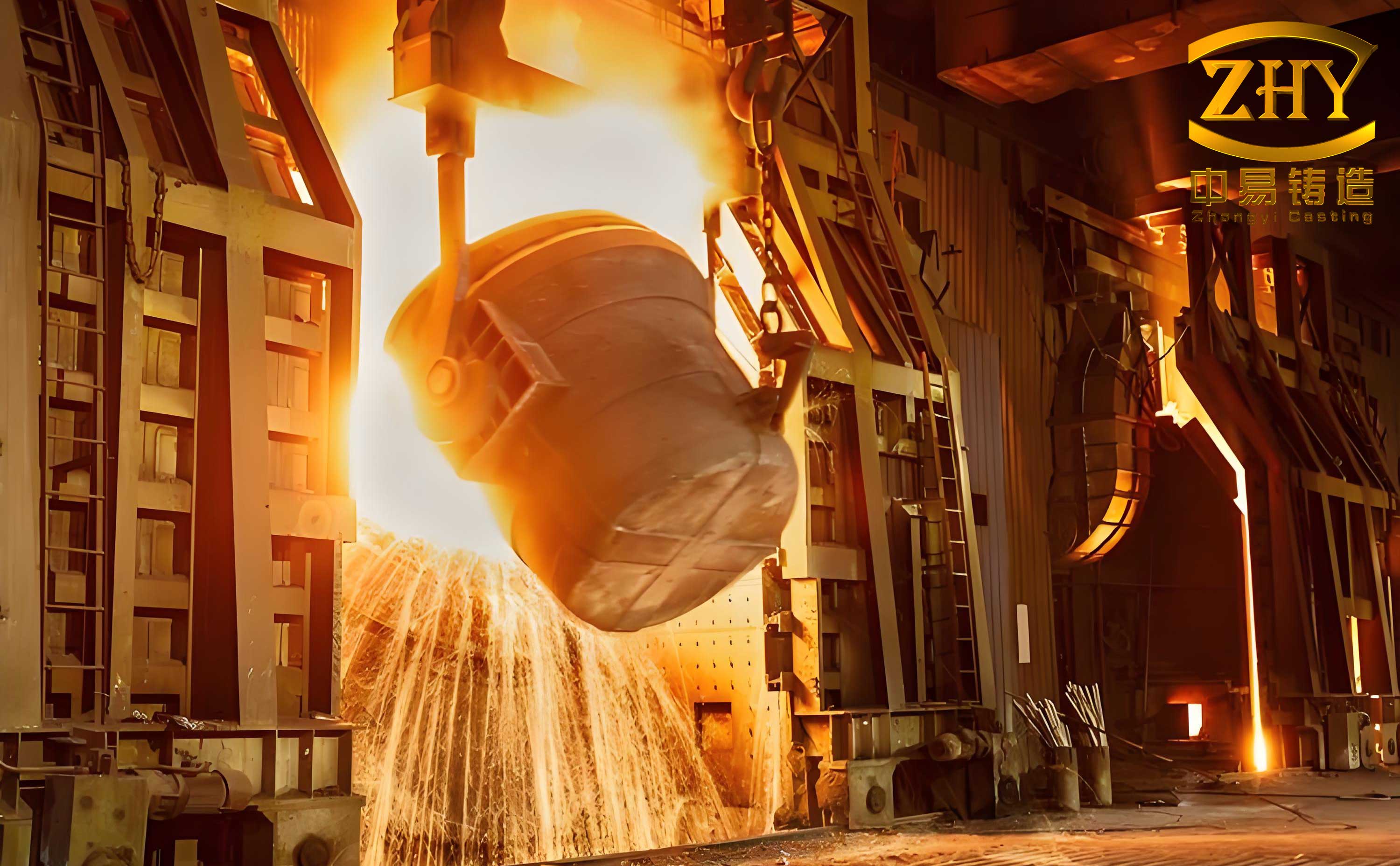
The success of welding in a manganese steel casting foundry hinges on precise control of thermal cycles. The heat input during welding can be calculated using the formula: $$ Q = \frac{\eta \cdot I \cdot V}{v} $$ where $Q$ is heat input (J/mm), $\eta$ is arc efficiency (typically 0.8 for manual arc welding), $I$ is current (A), $V$ is voltage (V), and $v$ is travel speed (mm/s). For manganese steel, we keep $Q$ below 1.5 kJ/mm to avoid excessive heat accumulation. Cooling rate is equally critical; too slow cooling promotes carbide formation. The cooling rate can be estimated with Rosenthal’s equation for thick plates: $$ \frac{dT}{dt} = -2\pi k (T – T_0)^2 / Q $$ where $k$ is thermal conductivity, $T$ is temperature, and $T_0$ is ambient temperature. Practically, we monitor interpass temperature rigorously, ensuring it stays between 100°C and 150°C. Another aspect is stress analysis; welding induces residual stresses that can approach yield strength. The longitudinal stress in a weld can be modeled as: $$ \sigma_x = E \alpha \Delta T \left(1 – \frac{y}{h}\right) $$ where $E$ is Young’s modulus, $\alpha$ is thermal expansion coefficient, $\Delta T$ is temperature change, $y$ is distance from neutral axis, and $h$ is plate thickness. For manganese steel, with $\alpha \approx 18 \times 10^{-6} /°C$ (higher than carbon steel), stresses are magnified, necessitating preheating and post-weld heat treatment.
Selection of welding consumables is paramount. In our manganese steel casting foundry, we evaluate electrodes based on deposit composition and crack resistance. Table 2 compares common electrode types used for manganese steel repairs. Austenitic electrodes like A102 or A302 are preferred for their ability to match the base metal’s austenitic structure and tolerate dilution. However, for heavy-duty repairs where wear resistance is paramount, we sometimes use overlay electrodes like D256 (high manganese type) for build-up. The electrode coating must be low-hydrogen to prevent hydrogen-induced cracking, especially in thick sections. We bake electrodes at 350–400°C for two hours and store them in portable ovens at 100–150°C to maintain dryness. During welding, we maintain a short arc length and use a slight weaving motion to improve fusion at the toe, but avoid excessive agitation that could introduce defects.
| Electrode Type | Classification (AWS) | Key Characteristics | Typical Applications in Foundry |
|---|---|---|---|
| A102 | E308-16 | Austenitic stainless; good crack resistance, moderate strength. | Welding similar manganese steel castings with low stress. |
| A302 | E309-16 | Austenitic stainless; higher Cr and Ni, good for dissimilar joints. | Joining manganese steel to carbon steel in bucket teeth. |
| D256 | EFeMn-A | High manganese deposit; work-hardens, excellent wear resistance. | Build-up on worn surfaces of castings like crusher liners. |
| E5015 | E7015 | Low-hydrogen iron powder; high strength, good for crack repair. | Repairing cracks in gear shafts or structural parts. |
| E7018 | E7018 | Low-hydrogen iron powder; easy arc striking, all-position. | General repair in manganese steel casting foundry for non-critical areas. |
Beyond welding parameters, the overall repair strategy in a manganese steel casting foundry involves thorough inspection and preparation. For instance, when dealing with a large hydraulic press upper beam sleeve made of ZG270-500 cast steel with circumferential cracks, we learned that initial attempts with conventional electrodes (E5015) without preheat led to severe hot cracking and delayed cracks. By switching to alkaline low-hydrogen electrodes (E7015) and implementing a preheat of 200–250°C, we achieved sound welds. The process involved machining a U-groove of 20 mm width and 25 mm depth, using 4.0 mm electrodes at 140–160 A with DC reverse polarity, and applying multi-layer welding with thorough slag removal between passes. Post-weld, we performed stress relief at 600°C for four hours. This case highlights that even non-manganese steels require careful thermal management, but for manganese steel casting foundry work, the stakes are higher due to phase instability.
To systematize our approach, we have developed a set of best practices for welding manganese steel castings. These include: (1) Always conduct non-destructive testing (e.g., dye penetrant or ultrasonic) to map defects before repair. (2) Design joint geometry to minimize stress concentration; for thick sections, a double-V groove with 60–70° included angle is ideal. (3) Use temperature-indicating crayons or infrared thermometers to monitor preheat and interpass temperatures. (4) Employ welding positioners or turntables to maintain flat or horizontal positions, improving deposition control. (5) For large repairs, consider intermediate stress relief cycles after every 4–5 layers. (6) After welding, allow slow cooling in insulating materials like vermiculite or fiber blankets, followed by a full re-austentization and water quench if the component’s service requires restored toughness. This last step is crucial in a manganese steel casting foundry to revert any heat-affected zone back to austenite.
The economic impact of effective welding in a manganese steel casting foundry cannot be overstated. By repairing costly castings, we reduce material waste and downtime for machinery. For example, a single bucket tooth replacement might cost thousands, but welding repair can extend life by months at a fraction of the cost. Moreover, it aligns with sustainable manufacturing principles. However, success depends on continuous training and adherence to procedures. We regularly conduct workshops for welders, emphasizing the unique behavior of manganese steel—such as its non-magnetic nature when properly heat-treated, which can serve as a quick check for quality. In cases where magnetism is detected post-weld, it indicates carbide precipitation, signaling the need for re-heat treatment.
Looking forward, advancements in welding technology offer promise for manganese steel casting foundry operations. Pulsed arc welding, laser cladding, and friction stir welding are being explored for their lower heat input and precision. For instance, laser cladding with manganese-based powders can deposit wear-resistant layers with minimal dilution and heat-affected zone. The process parameters can be optimized using models that balance clad geometry and thermal cycles. Additionally, digital twins of welding processes, incorporating finite element analysis (FEA), can simulate stress distributions and predict cracking risks. These tools will elevate the capabilities of a modern manganese steel casting foundry, enabling proactive repair strategies.
In conclusion, welding manganese steel castings is a nuanced discipline that blends metallurgical knowledge with practical skill. In my experience running a manganese steel casting foundry, I have seen that success hinges on controlling heat, selecting appropriate consumables, and executing meticulous procedures. The cases of gear shaft repair and bucket tooth welding illustrate that even under adverse conditions, robust welds are achievable with the right approach. By embracing both traditional techniques and emerging technologies, a manganese steel casting foundry can not only produce high-quality castings but also extend their lifecycle through effective repair, contributing to industrial efficiency and sustainability. The journey is continuous, with each project offering lessons that refine our craft in this specialized field.