
In my extensive experience working with agricultural machinery, I have consistently observed that cast iron parts are among the most susceptible to damage due to harsh operating conditions and inadequate maintenance. These cast iron parts, which include engine blocks, transmission housings, and various structural components, often suffer from cracks or fractures, necessitating reliable repair techniques. Welding stands out as a primary method for restoring these cast iron parts, but the process is fraught with challenges such as white iron formation, hardening, and cracking. This article delves into the welding process measures specifically tailored for cast iron parts in agricultural machinery, drawing from practical field conditions and emphasizing the use of tables and formulas to summarize key points. Throughout this discussion, the term ‘cast iron parts’ will be frequently referenced to underscore their centrality in repair scenarios.
The foundation of effective welding for cast iron parts lies in understanding their chemical composition and inherent properties. Cast iron is a multicomponent iron-based alloy characterized by a high carbon content, typically above 2%, along with silicon, manganese, phosphorus, and sulfur. The exact composition varies, influencing weldability. For instance, gray cast iron parts have carbon in the form of graphite flakes, while ductile cast iron parts feature spheroidal graphite, offering higher strength. The chemical composition can be summarized using the following expanded table, which provides a detailed breakdown of elements and their effects on weldability.
| Element | Typical Range (%) | Role in Cast Iron Parts | Impact on Welding |
|---|---|---|---|
| Carbon (C) | 2.5–4.0 | Primary hardening agent; forms graphite or cementite | High carbon promotes white iron and cracks; affects heat input |
| Silicon (Si) | 1.0–3.0 | Graphitizer; improves fluidity | Reduces white iron but can lead to brittleness if excessive |
| Manganese (Mn) | 0.5–1.4 | Desulfurizer; enhances strength | Moderates sulfur effects; requires balanced control |
| Phosphorus (P) | 0.01–0.50 | Increases fluidity but reduces ductility | Promotes hot cracking; limits weld pool control |
| Sulfur (S) | 0.02–0.20 | Impurity; forms low-melting sulfides | Strong promoter of white iron and hot cracks; must be minimized |
| Other Alloys (e.g., Cu, Mg) | Trace–2.0 | Enhances specific properties like corrosion resistance | Can alter thermal expansion; requires tailored parameters |
The weldability of cast iron parts is inherently poor due to factors like high carbon equivalent and low ductility. Key defects include white iron formation, where rapid cooling leads to hard, brittle phases; hardening from martensitic transformation; and cracking due to residual stresses. The susceptibility to these defects can be quantified using the carbon equivalent (CE) formula, which helps predict weldability: $$ CE = C + \frac{Si}{3} + \frac{P}{3} $$ For cast iron parts, a higher CE value, often above 4%, indicates increased risk of cracking and white iron. In practice, I have found that maintaining a CE below 4.5% through preheating or filler selection mitigates issues. Additionally, thermal stress during welding can be modeled with the formula: $$ \sigma = E \cdot \alpha \cdot \Delta T $$ where $\sigma$ is the thermal stress, $E$ is Young’s modulus, $\alpha$ is the coefficient of thermal expansion, and $\Delta T$ is the temperature gradient. For cast iron parts, $\alpha$ is relatively high (around 10–12 × 10^{-6}/°C), exacerbating stress buildup. Thus, controlling $\Delta T$ through process measures is critical.
To address these challenges, three primary welding methods are employed for repairing cast iron parts in agricultural machinery: hot welding, cold welding, and heated stress-relief welding. Each method has distinct procedures, parameters, and applications, which I will elaborate on with tables and formulas.
Hot Welding Method: This involves preheating the entire cast iron part or a localized area to 600–700°C, maintaining it above 400°C during welding, and slowly cooling post-weld. The goal is to reduce thermal gradients and stress, thereby preventing white iron and cracks. The heat input required can be estimated using: $$ Q = m \cdot c \cdot \Delta T $$ where $Q$ is the heat energy (J), $m$ is the mass of the cast iron part (kg), $c$ is the specific heat capacity (~500 J/kg·°C for cast iron), and $\Delta T$ is the temperature rise. For a typical cast iron part weighing 10 kg, preheating to 650°C from 25°C requires approximately: $$ Q = 10 \times 500 \times (650 – 25) = 3.125 \times 10^6 \, \text{J} $$ This is often achieved using furnaces or torches. The welding parameters for hot welding are summarized below.
| Parameter | Range | Rationale |
|---|---|---|
| Preheat Temperature | 600–700°C | Minimizes thermal stress; prevents rapid cooling |
| Interpass Temperature | >400°C | Maintains ductility; avoids phase transformations |
| Cooling Rate | <50°C/hour | Reduces cracking risk; allows stress relaxation |
| Filler Material | Cast iron rods (e.g., HS401) or electrodes (Z248) | Matches base metal composition; minimizes dilution |
| Heat Input | 1.5–2.5 kJ/mm | Balances fusion and heat affect zone control |
In practice, I use gas welding with a neutral or slightly carburizing flame for thin cast iron parts, and arc welding for thicker sections. The process involves depositing filler metal only after the base metal is fully molten, and adding fluxes like CJ201 to remove oxides. Post-weld, slow cooling in a furnace or under insulating materials is essential to ensure uniform microstructure without cracks.
Cold Welding Method: This method requires no preheating or limited preheating below 300°C, making it suitable for field repairs of cast iron parts where heating equipment is unavailable. However, it demands careful control to avoid defects. The selection of electrodes is crucial; for non-machined surfaces of gray cast iron parts, Z100 electrodes are used, while for high-strength or ductile cast iron parts, Z116 or Z117 electrodes are preferred. The welding parameters must be optimized to minimize heat input, as per the formula: $$ H = \frac{I \times V \times \eta}{v} $$ where $H$ is the heat input (J/mm), $I$ is the current (A), $V$ is the voltage (V), $\eta$ is the arc efficiency (~0.8 for manual welding), and $v$ is the travel speed (mm/s). For cold welding of cast iron parts, I keep $H$ below 1.0 kJ/mm to reduce thermal stress. The parameters are detailed in the following table.
| Parameter | Range | Notes |
|---|---|---|
| Electrode Diameter | 2.5–4.0 mm | Smaller diameters reduce heat input |
| Welding Current | 70–180 A (DCEN) | Lower currents minimize base metal heating |
| Arc Length | 0.5–1.1 × electrode diameter | Ensures stable arc and controlled penetration |
| Travel Speed | 12–15 cm/min | Slow speeds allow better fusion but increase heat |
| Peening | Applied at 800–300°C | Relieves stress; reduces crack susceptibility |
The procedure involves dividing the weld into short segments (10–50 mm), allowing each to cool to room temperature before proceeding. I often use a backstep technique, welding from the center outward, and employ peening with a round-nose hammer to induce compressive stresses. For large cracks in cast iron parts, I drill stop-holes and sometimes insert screws to reinforce the joint, ensuring the total screw cross-sectional area does not exceed 25% of the crack area. The stress intensity factor $K$ for a crack in a cast iron part can be approximated as: $$ K = \sigma \sqrt{\pi a} $$ where $\sigma$ is the applied stress and $a$ is the crack length. By reducing $\sigma$ through welding techniques, $K$ is kept below the fracture toughness of the cast iron part.
Heated Stress-Relief Welding Method: This innovative approach involves heating specific “stress-relief zones” on the cast iron part during welding, rather than the entire component. These zones are selected to allow free expansion and contraction of the weld area, thus minimizing residual stresses. The selection criteria include: zones that hinder weld expansion, areas with high strength and limited connectivity, and regions whose deformation does not affect other parts. The temperature distribution can be modeled using the heat conduction equation: $$ \frac{\partial T}{\partial t} = \alpha \nabla^2 T $$ where $\alpha$ is the thermal diffusivity of the cast iron part. By heating stress-relief zones to 400–500°C, I achieve a more uniform temperature field, reducing $\Delta T$ in the weld zone. This method is particularly effective for complex cast iron parts like engine blocks or differential housings, where full preheating is impractical.
To illustrate the application of these methods, consider the repair of a cracked cylinder head, a common cast iron part in agricultural machinery. The crack length and depth dictate the choice of method. For instance, if the crack is superficial and in a non-critical area, cold welding may suffice, but for deep cracks in high-stress zones, hot welding or heated stress-relief welding is preferred. The following table compares the three methods for such cast iron parts.
| Method | Preheating Requirement | Best for Cast Iron Part Types | Advantages | Disadvantages |
|---|---|---|---|---|
| Hot Welding | High (600–700°C) | Thick sections; machinable surfaces | Minimizes white iron; good strength | Energy-intensive; slow cooling needed |
| Cold Welding | None or low (<300°C) | Thin sections; field repairs | Convenient; fast | High crack risk; requires skill |
| Heated Stress-Relief | Localized (400–500°C) | Complex geometries; large parts | Reduces stress; versatile | Requires zone identification; setup time |
Beyond method selection, specific welding requirements must be adhered to for cast iron parts. These include using properly baked electrodes (e.g., at 250°C for 1 hour to remove moisture), employing low welding speeds to reduce thermal shock, and implementing multi-pass techniques with layer overlap to anneal underlying beads. For defects like pores or inclusions, the area should be enlarged before welding to ensure sound fusion. The weld bead geometry can be optimized using the formula for dilution: $$ D = \frac{A_b}{A_b + A_f} \times 100\% $$ where $D$ is the dilution percentage, $A_b$ is the cross-sectional area of base metal melted, and $A_f$ is the area of filler metal. For cast iron parts, I aim for $D$ below 30% to prevent excessive carbon pickup from the base metal. Additionally, when welding cracks, I orient the weld beads perpendicular to the crack propagation direction to counteract stress concentrations, as per the principle: $$ \tau_{\text{max}} = \frac{\sigma}{2} \sin(2\theta) $$ where $\tau_{\text{max}}$ is the maximum shear stress and $\theta$ is the angle between weld and crack. By setting $\theta = 90^\circ$, $\tau_{\text{max}}$ is minimized.
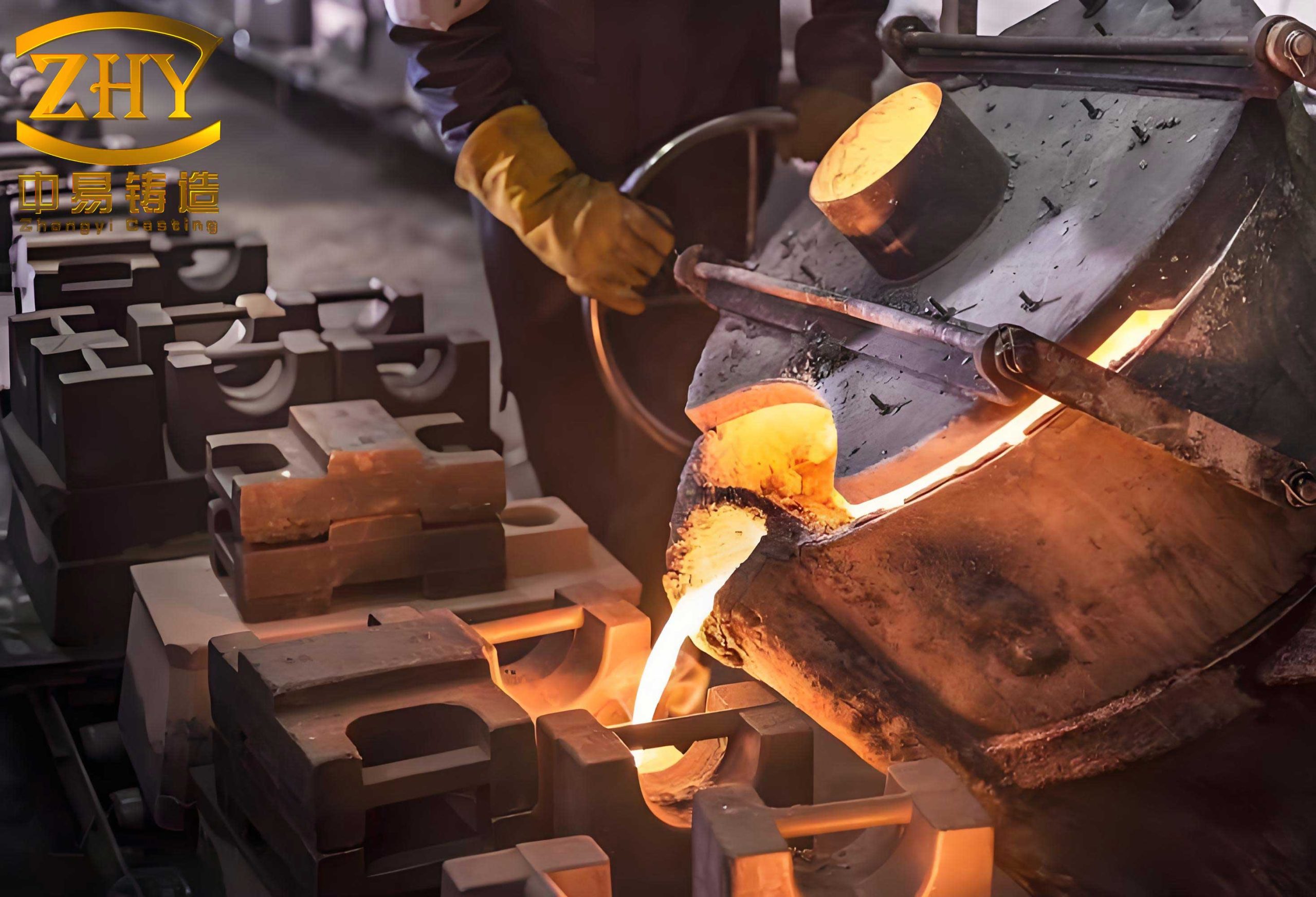
In real-world scenarios, the visual inspection of cast iron parts before welding is crucial. For example, examining the surface for defects can inform the repair strategy. Below is an image that showcases typical cast iron parts, which can aid in identifying common failure points and planning welding repairs. This image is inserted here to emphasize the practical context of working with cast iron parts in agricultural machinery.
Furthermore, advanced techniques like temper bead welding can be applied to cast iron parts to improve heat-affected zone toughness. This involves depositing a sequence of beads where subsequent beads temper the previous ones, reducing hardness. The tempering effect can be quantified with the Hollomon-Jaffe parameter: $$ P = T (\log t + C) $$ where $P$ is the tempering parameter, $T$ is temperature (K), $t$ is time (hours), and $C$ is a constant (~20 for cast iron). By controlling $P$ through interpass temperature and time, I achieve a balanced microstructure in cast iron parts. For large-scale repairs, such as on plow frames or harvester components, I often combine methods—using hot welding for main cracks and cold welding for ancillary fixes—to optimize efficiency and strength.
In conclusion, the welding of cast iron parts in agricultural machinery demands a nuanced approach based on composition, defect type, and field constraints. Through hot welding, cold welding, and heated stress-relief welding, coupled with rigorous parameter control and adherence to best practices, durable repairs can be achieved. The frequent mention of ‘cast iron parts’ throughout this discussion highlights their critical role. By leveraging tables for parameter summaries and formulas for theoretical underpinnings, welders can enhance their decision-making and execution. As I reflect on my experiences, the key to success lies in continuous adaptation and a deep understanding of the material behavior of cast iron parts under thermal cycles. Future innovations may introduce automated welding systems tailored for cast iron parts, but for now, these manual measures remain indispensable in keeping agricultural machinery operational.