
Automotive crankshafts are critical components in internal combustion engines, requiring high fatigue resistance to withstand bending, torsional stresses, and cyclic impacts. This study explores the application of sand casting with green sand molds for producing ductile iron (QT900-2) crankshafts, emphasizing defect mitigation strategies to enhance production efficiency and product quality.
1. Material Selection and Sand Composition
Ductile iron (QT900-2) is preferred for crankshafts due to its balanced mechanical properties and cost-effectiveness. The sand composition for green sand molds significantly impacts casting quality. A typical sand mixture includes:
| Component | Percentage (wt%) | Function |
|---|---|---|
| Recycled Sand | 95% | Base material |
| Fresh Sand | 5% | Maintain permeability |
| Bentonite | 1-2% | Binder |
| Water | 3-4% | Activate binder |
The sand’s compactness (C) is optimized using the relationship:
$$
C = \frac{\rho_{\text{compact}} – \rho_{\text{loose}}}{\rho_{\text{compact}}} \times 100\%
$$
where $\rho$ denotes sand density. A compactness of 70-75% ensures adequate mold strength while maintaining gas permeability.
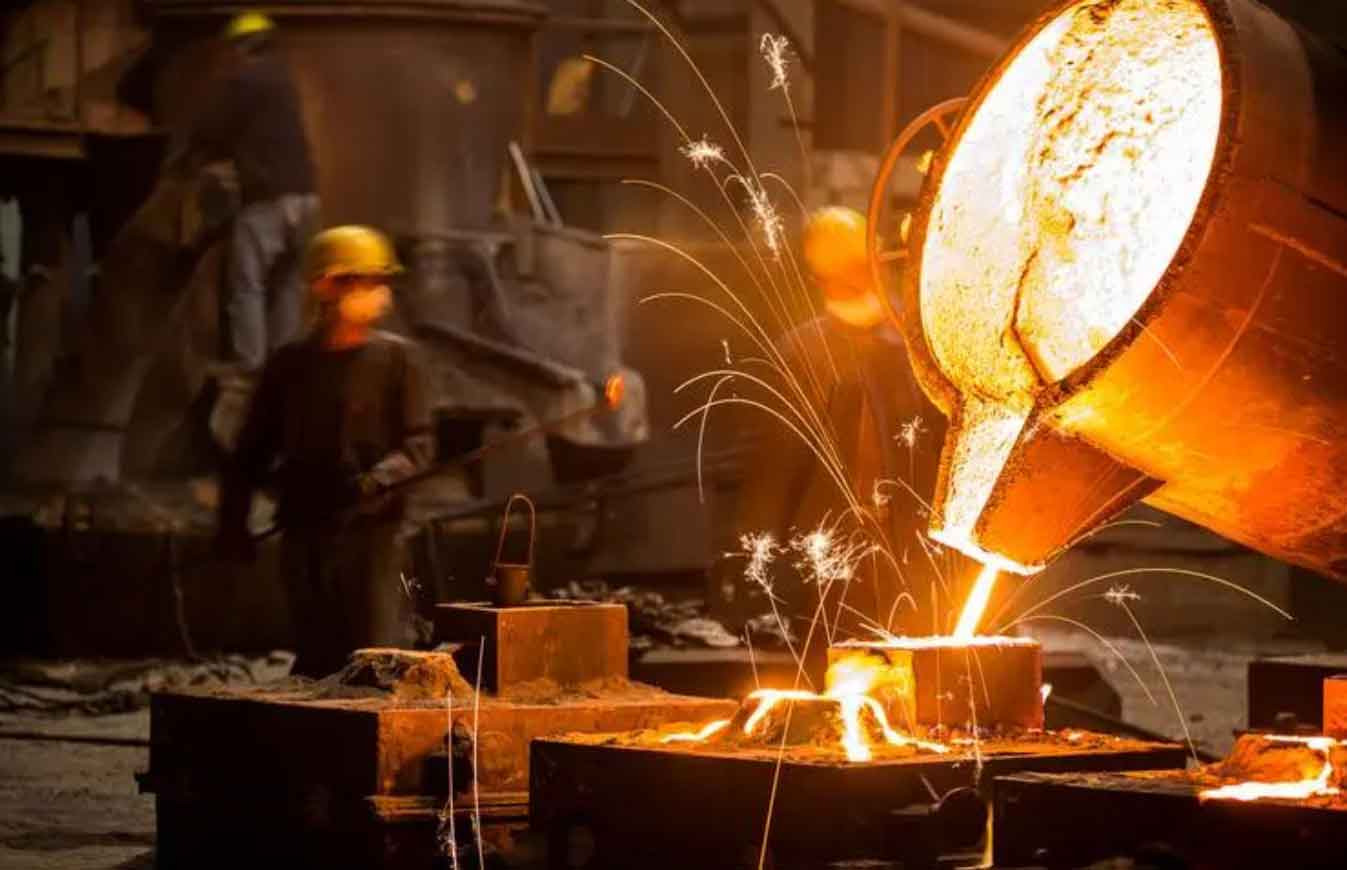
2. Sand Casting Process Design
The sequential solidification strategy minimizes shrinkage defects in sand-cast crankshafts. Key parameters include:
- Pouring temperature: 1,380–1,420°C
- Gating ratio (sprue:runner:gate): 1:1.5:2
- Filter mesh placement at gate intersections
The thermal gradient (∇T) during solidification is governed by:
$$
\nabla T = \frac{T_{\text{pour}} – T_{\text{mold}}}{t_{\text{solidification}}}
$$
where $T_{\text{mold}}$ is maintained at 80–120°C through controlled sand moisture.
3. Defect Analysis and Mitigation
3.1 Sand Inclusion Defects
Sand erosion in sand casting accounts for 12–18% of scrap. Countermeasures include:
- Implementing dual-layer ceramic filters (mesh size: 10 ppi)
- Optimizing runner geometry to limit metal velocity < 0.8 m/s
3.2 Gas Porosity
Nitrogen-induced porosity is minimized by:
| Parameter | Target |
|---|---|
| N content in iron | < 80 ppm |
| Vent area ratio | 0.15–0.25% of mold volume |
| Sand permeability | 80–100 (AFS) |
3.3 Shrinkage Defects
Feeding distance (L) for riser design follows:
$$
L = 4.5 \times \sqrt{A_{\text{section}}}
$$
where $A_{\text{section}}$ is the cross-sectional area (mm²). Chills with thermal conductivity > 40 W/m·K are applied at critical junctions.
4. Process Optimization
Key improvements in sand casting operations:
- Carbon equivalent control: 4.2–4.6% (CE = C + 0.3Si)
- Mg residual: 0.03–0.05% post-inoculation
- Sand testing frequency: Every 30 minutes for moisture and compactness
5. Quality Validation
Post-optimization results showed:
| Defect Type | Reduction Rate |
|---|---|
| Sand inclusions | 62% |
| Porosity | 48% |
| Shrinkage | 55% |
Mechanical properties met QT900-2 specifications:
- Tensile strength: 910–940 MPa
- Elongation: 2.2–2.8%
- Hardness: 280–310 HB
6. Conclusion
Green sand casting remains a viable method for high-volume crankshaft production when integrated with:
- Precision sand composition control
- Thermodynamic modeling of solidification
- Real-time process monitoring
The implemented strategies reduced defect-related scrap by 41%, demonstrating sand casting’s adaptability for critical automotive components. Future work will focus on AI-driven sand quality prediction systems to further enhance process stability.