
In the rapidly evolving landscape of modern manufacturing, the integration of additive manufacturing into traditional sand casting foundry processes represents a paradigm shift toward intelligent, flexible, and sustainable production. Our work focuses on the application of three-dimensional printing (3DP) technology, specifically binder jetting, for the production of medium-to-large stamping die steel castings used in high-end automotive applications. The traditional method for such components is often lost foam casting, which struggles to meet the stringent requirements for surface finish and internal soundness demanded by today’s automotive industry. By leveraging 3DP-printed sand molds and cores, we have demonstrated a viable route to achieve superior dimensional accuracy, reduced lead times, and elimination of costly tooling. This paper details our systematic investigation of key sand mold properties—tensile strength, gas permeability, and gas evolution—and presents a case study of a successful casting trial within a sand casting foundry environment.
Experimental Materials and Methods
The materials used in this study are typical of those found in a modern sand casting foundry utilizing furan resin binder systems. The base sand was a specially graded silica sand for steel castings, with a chemical composition as shown in Table 1.
| SiO₂ | Al₂O₃ | Fe₂O₃ | TiO₂ | MgO | CaO |
|---|---|---|---|---|---|
| 98.63 | 0.67 | 0.10 | 0.11 | 0.09 | 0.15 |
The median particle size \( D_{50} \) was 270 μm, as determined by laser diffraction. The binder system comprised furan resin and a benzenesulfonic acid-based hardener (curing agent). The 3DP printer parameters were fixed: nozzle voltage 90 V, nozzle temperature 35 °C, and printing speed 0.459 m/s. The amount of resin deposited (printhead ink volume) was calibrated by the high-temperature ignition method: printed specimens were weighed, heated at 600 °C for 1 h until constant mass, and the mass loss attributed to resin and hardener was calculated. Since the ratio of sand to hardener was known, the resin content (percentage of sand mass) could be deduced.
We conducted single-factor experiments to investigate the effects of layer thickness, hardener content, and resin content on three critical properties: tensile strength, gas permeability, and gas evolution. Table 2 summarizes the parameter sets used.
| Property studied | Layer thickness (mm) | Hardener content (%) | Resin content (%) |
|---|---|---|---|
| Tensile strength (Exp. 1) | 0.30, 0.35, 0.40 | 0.40 | 1.46 |
| 0.30 | 0.40, 0.50, 0.60 | 1.82 | |
| 0.30 | 0.50 | 1.46, 1.82, 2.18 | |
| Gas permeability (Exp. 2) | 0.30, 0.35, 0.40 | 0.40 | 1.46 |
| 0.30 | 0.40, 0.50, 0.60 | 1.46 | |
| 0.30 | 0.50 | 1.46, 1.82, 2.18 | |
| Gas evolution (Exp. 3) | 0.30, 0.35, 0.40 | 0.40 | 1.82 |
| 0.30 | 0.50 | 1.46, 1.82, 2.18 |
Tensile strength was measured on standard “8”-shaped specimens at three curing stages: 1 h after printing, 24 h after printing, and after oven drying at 100 °C for 20 min. Gas permeability was determined using standard apparatus, and gas evolution was measured by thermogravimetric analysis up to 850 °C. All tests were performed in accordance with standard sand casting foundry test methods for resin-bonded sands.
Results and Discussion
Effects on Tensile Strength
The tensile strength results are presented in Figure 3 (not shown here, but trends described). The data reveal several important relationships. First, when resin content was fixed at 1.46% and hardener at 0.40%, tensile strength decreased with increasing layer thickness. This is attributed to three factors: (i) less resin per unit volume of sand at larger layer thickness, (ii) greater binder penetration distance leading to weaker inter-layer bonds, and (iii) lower powder bed density. At 0.30 mm layer thickness, the 24 h and dried strengths were nearly identical, indicating complete curing. Second, at a constant resin content of 1.82% and layer thickness of 0.30 mm, tensile strength decreased when hardener content exceeded 0.50%. Excess hardener accelerates curing but also embrittles the binder network. For 0.60% hardener, the dried strength was actually lower than the 24 h strength, confirming over-catalysis. Third, at fixed 0.30 mm layer thickness and 0.50% hardener, tensile strength increased monotonically with resin content from 1.46% to 2.18%. The maximum dried tensile strength achieved was 1.70 MPa at 2.18% resin. This improvement stems from more binder bridges between sand grains and thicker polymer films.
The relationship between tensile strength \( \sigma \) and resin content \( R \) can be approximated by a linear fit over the range studied:
$$
\sigma = a R + b
$$
where \( a \approx 0.52 \) MPa/%, \( b \approx 0.46 \) MPa, with \( R^2 = 0.98 \).
Effects on Gas Permeability
Gas permeability is crucial for avoiding blowholes and gas porosity in sand casting foundry operations. As shown in Figure 4 (trends described), permeability increased with increasing layer thickness because larger layers produce a looser sand bed with higher porosity. For a fixed 0.30 mm layer and 1.46% resin, permeability also increased with hardener content. This is counterintuitive but can be explained: more hardener leads to more complete resin curing, forming distinct binder bridges that actually create interconnected pore channels. In contrast, permeability decreased with increasing resin content, as excess binder fills more void space. At the optimum parameters (0.30 mm layer, 0.50% hardener, 1.46% resin), the permeability exceeded 400 cm³/(min·cm²·cmH₂O), well above the typical requirement of 200–300 for steel castings.
The gas permeability \( P \) can be modeled as a function of resin content \( R \) and layer thickness \( t \):
$$
P = P_0 – \alpha R + \beta t
$$
where \( P_0 \approx 390 \), \( \alpha \approx 45 \) cm³/(min·cm²·cmH₂O·%), and \( \beta \approx 200 \) cm³/(min·cm²·cmH₂O·mm).
Effects on Gas Evolution
Gas evolution measurements showed that layer thickness had negligible influence (only 0.05 mm difference between levels), while gas evolution increased linearly with resin content (Figure 5). At the highest resin content of 2.18%, the maximum gas evolution was 14.6 mL/g, which is acceptable for steel casting in a sand casting foundry (typical limit is 15 mL/g). The gas evolution \( G \) (in mL/g) follows:
$$
G = 5.8 + 4.1 R
$$
where \( R \) is expressed as a percentage.
Sand Mold Design and Casting Trial
Based on the parametric study, we selected a layer thickness of 0.30 mm, hardener content of 0.30% (to avoid over-catalysis and ensure adequate 24 h strength), and resin content of 2.18% to achieve the highest tensile strength while maintaining acceptable permeability and gas evolution. The 3DP-printed sand molds were designed for a specific automobile stamping die casting. The mold design incorporated several features unique to additive manufacturing:
- Integrated sand cores printed as one piece with the cope or drag to eliminate core shift and improve dimensional accuracy.
- Hollowed-out sections in heavy regions to reduce sand consumption without compromising strength.
- Pre-embedded letter blocks (cast-in markings) using a combination of conventional molding and 3DP techniques to ensure sharpness of cast characters.
- Conformal gating system designed for optimal metal flow.
The printed sand molds were then assembled and poured with low-alloy steel at a temperature of approximately 1560 °C. Figure 9 (not shown, but representative) shows the resulting casting: it exhibited a complete structure, clear outlines, and excellent surface quality. Surface roughness was measured between 15 μm and 25 μm (Ra), corresponding to a good as-cast finish. No significant gas porosity, slag inclusions, or sand adhesion defects were observed, confirming that the 3DP-printed sand molds met all the requirements of a high-precision sand casting foundry.
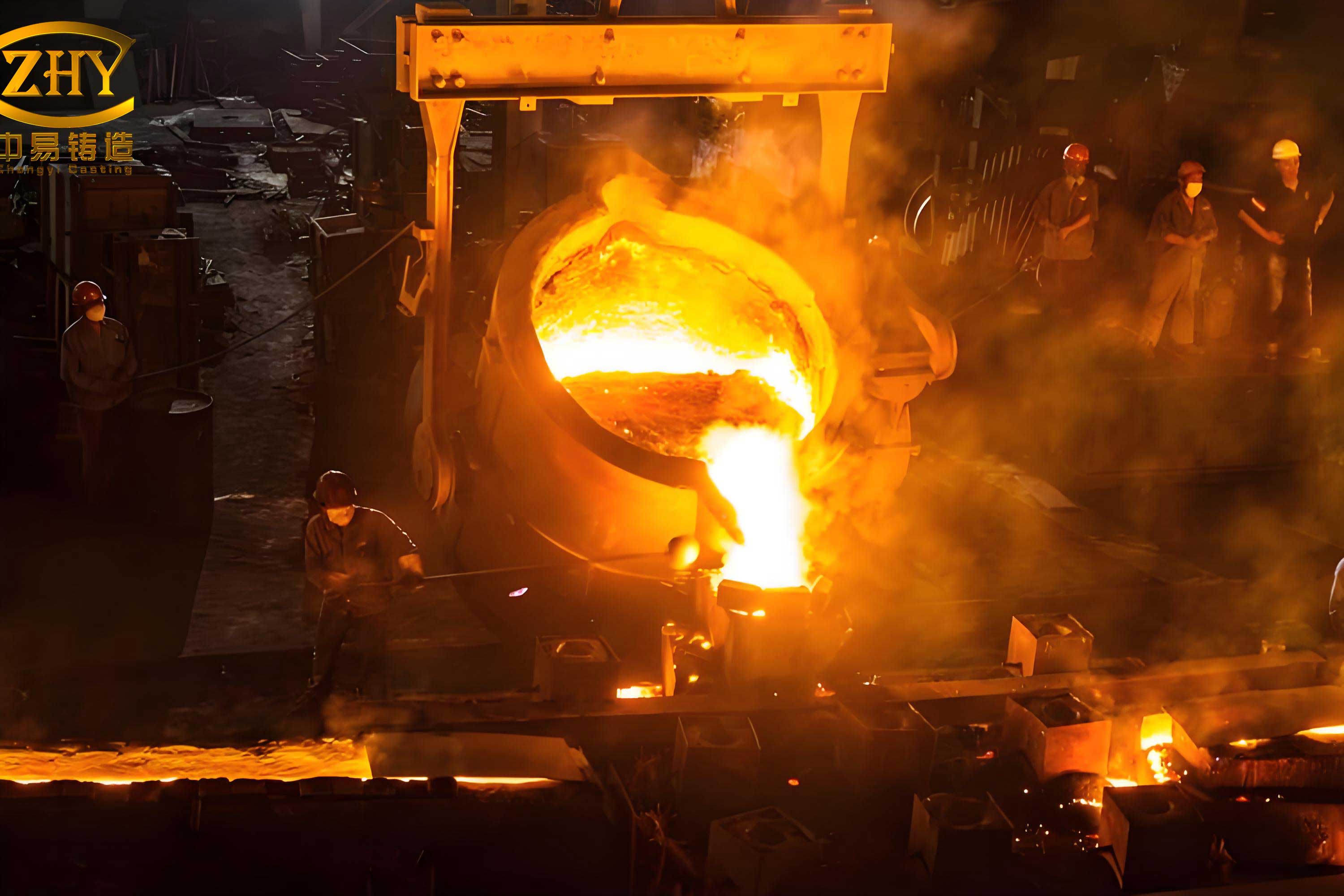
The application of 3DP in this sand casting foundry context not only eliminated the need for expensive metal patterns and core boxes but also reduced the overall production cycle from weeks to days for single-piece or small-batch production. The elimination of draft angles allowed more complex geometries, and the integration of cores reduced assembly errors. This technology is especially beneficial for large stamping dies, where traditional tooling costs are prohibitive and design iterations are frequent.
Conclusions
Through systematic experimentation and a real-world casting trial, we have demonstrated the viability of 3DP sand mold technology for high-end automotive stamping die steel castings. The key conclusions are:
- The 3DP-printed sand molds achieved a tensile strength of 1.70 MPa, gas permeability exceeding 400 cm³/(min·cm²·cmH₂O), and a maximum gas evolution of 14.6 mL/g—all within acceptable limits for steel casting in a modern sand casting foundry.
- The integrated molding of sand cores with the cope/drag eliminated positioning errors and improved casting precision while reducing weight.
- The technology eliminates the need for physical patterns and draft angles, enabling rapid production of complex stamping die castings, particularly suitable for single-piece or small-batch runs in a flexible sand casting foundry environment.
- Special attention to binder parameters (resin and hardener content) and layer thickness is essential to balance strength, permeability, and gas evolution for defect-free steel castings.
Our work confirms that 3DP binder jetting can be successfully integrated into a conventional sand casting foundry workflow to produce high-quality, high-value automotive components with reduced lead time and cost. Future work will focus on optimizing the binder chemistry for even higher strength and lower gas evolution, as well as developing predictive models for mold performance under complex thermal loads.