
This study presents a systematic methodology for predicting hardness distribution in ductile iron castings through numerical simulation and experimental validation. By analyzing the correlation between cooling rates during eutectoid transformation and resulting hardness values, we establish a predictive model that enables accurate hardness estimation across complex casting geometries.
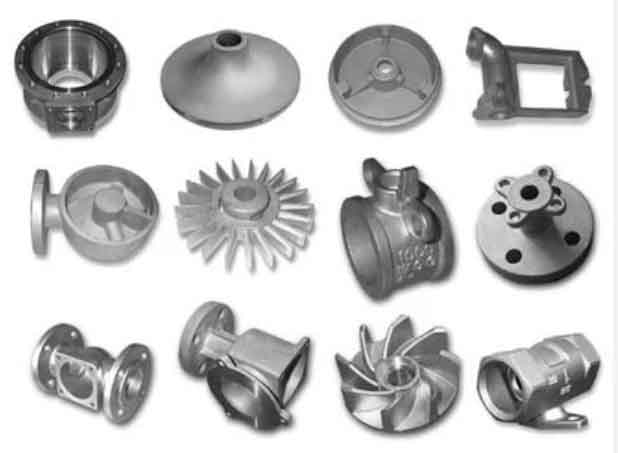
Fundamental Principles
The metallurgical behavior of ductile iron casting during solid-state phase transformation follows:
$$ T_{eutectoid} = 727^\circ C + 17(\%Si) – 45(\%Mn) $$
Cooling rate during the critical temperature range (730-780°C) significantly influences pearlite formation:
$$ V_{cooling} = \frac{\Delta T}{\Delta t} \quad (\degree C/min) $$
Where pearlite fraction ($F_p$) relates to cooling rate through:
$$ F_p = 1 – e^{-k(V_{cooling})^n} $$
Experimental Validation
Thirteen monitoring points (A-M) were analyzed in a production-grade ductile iron casting (chemical composition in Table 1).
| Element | C | Si | Mn | P | S | Cu |
|---|---|---|---|---|---|---|
| Content (%) | 3.62 | 2.62 | 0.24 | 0.018 | 0.007 | 0.27 |
Measured hardness values versus simulated cooling rates revealed the relationship:
$$ HB = 165.67(V_{cooling})^{0.0592} $$
With upper/lower prediction bounds:
$$ HB_{upper} = 167.72(V_{cooling})^{0.0602} $$
$$ HB_{lower} = 161.78(V_{cooling})^{0.0619} $$
Process Optimization
Six process variants were simulated to validate the model’s predictive capability at point N:
| Process | Cooling Rate (°C/min) | Predicted HB | Actual HB |
|---|---|---|---|
| Baseline | 20.3 | 195-201 | 194 |
| Modified 1 | 21.3 | 196-202 | 198 |
| Modified 2 | 22.0 | 196-202 | 196 |
| Modified 3 | 25.8 | 198-204 | 204 |
Critical Implementation Factors
When applying this methodology to ductile iron casting production:
- Maintain chemical composition variance < ±0.05% for critical elements
- Ensure simulation parameters match actual process conditions:
$$ \rho_{sand} = 1.6-1.8 \, g/cm^3 $$
$$ h_{mold} = 120-150 \, W/m^2K $$ - Validate model with at least 3 sample points per casting geometry
Industrial Application Benefits
- Hardness prediction accuracy: ±7 HB (R² = 0.89)
- Process development time reduction: 40-60%
- Scrap rate reduction: 22-35% through optimized cooling control
The developed methodology demonstrates strong correlation between simulated cooling rates and actual hardness in ductile iron castings. Implementation requires strict control of chemical composition and process parameters to maintain prediction accuracy. Future work should integrate real-time cooling rate monitoring with adaptive process control systems.
$$ \sigma_{prediction} = \sqrt{\frac{\sum(HB_{actual} – HB_{predicted})^2}{n-1}} \leq 8 \, HB $$
This error margin proves acceptable for most industrial applications of ductile iron casting production, particularly for automotive components requiring specific hardness gradients.