
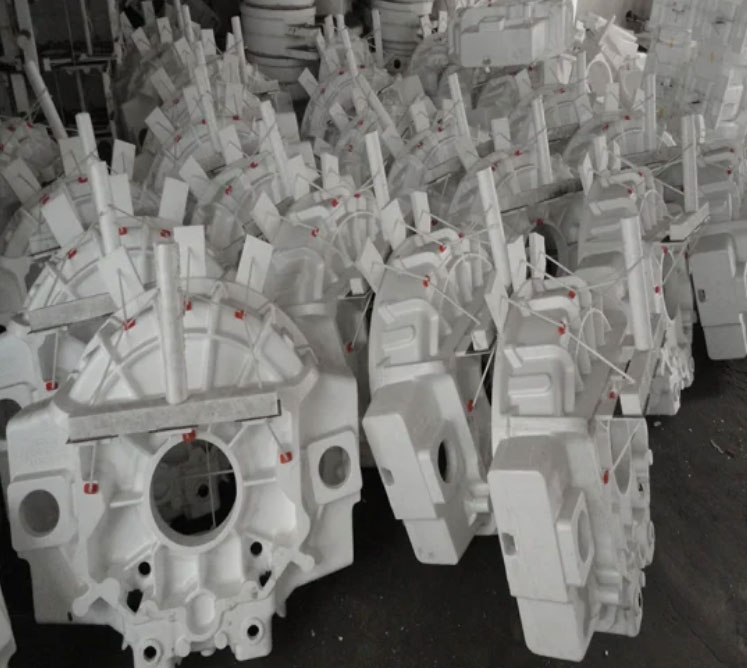
Lost foam casting (LFC) demonstrates unique advantages in producing complex geometries compared to conventional sand casting. However, the interaction between molten metal and decomposable foam patterns introduces distinct challenges in controlling flow fields, temperature gradients, and defect formation. This study investigates the numerical simulation of LFC processes for a ductile iron shell component using ProCAST software, focusing on optimizing gating systems and riser design to eliminate shrinkage defects.
Thermo-Physical Modeling Fundamentals
The governing equations for LFC process simulation integrate fluid dynamics and heat transfer principles:
Mass Conservation:
$$ \nabla \cdot \mathbf{u} = 0 $$
Momentum Conservation (Navier-Stokes):
$$ \rho \left( \frac{\partial \mathbf{u}}{\partial t} + \mathbf{u} \cdot \nabla \mathbf{u} \right) = -\nabla p + \mu \nabla^2 \mathbf{u} + \rho \mathbf{g} $$
Energy Conservation:
$$ \rho C_p \left( \frac{\partial T}{\partial t} + \mathbf{u} \cdot \nabla T \right) = \nabla \cdot (k \nabla T) + Q_{\text{foam}} $$
Where $Q_{\text{foam}}$ represents heat absorption during foam decomposition. Material properties critical for simulation accuracy include:
| Material | Density (kg/m³) | Thermal Conductivity (W/m·K) | Specific Heat (kJ/kg·K) |
|---|---|---|---|
| EPS Foam | 25 | 0.15 | 3.7 |
| Quartz Sand | 1520 | 0.53 | 1.22 |
Original Process Defect Analysis
The initial lost foam casting process for QT450-10 shell components (337×231×162 mm, 20 kg) exhibited severe shrinkage porosity at sidewalls and large rotational sections. Numerical simulation revealed three critical issues:
1. Ineffective Step Gating System
The designed two-tier gating system failed to establish progressive solidification:
$$ t_{\text{upper-fill}} = 9.78\ \mathrm{s} \ (11.46\%\ \text{filled}) $$
$$ t_{\text{lower-fill}} = 15.53\ \mathrm{s} \ (50.02\%\ \text{filled}) $$
2. Insufficient Feeding Capacity
Solid fraction analysis showed premature closure of feeding channels:
$$ f_s(\text{gate}) = 49\% \ @\ t=469.1\ \mathrm{s} $$
$$ f_s(\text{rotational-section}) = 32\% \ @\ t=359.1\ \mathrm{s} $$
3. Vacuum Pressure Mismatch
Suboptimal vacuum (-0.05 MPa) caused gas entrapment and flow stagnation:
$$ P_{\text{gap}} = \frac{\dot{m}_{\text{gas}}RT}{V_{\text{cavity}}} \propto \frac{1}{\sqrt{\epsilon_{\text{sand}}}} $$
Process Optimization Strategy
The redesigned lost foam casting process incorporated:
1. Top Gating System
Unidirectional feeding with optimized flow continuity:
$$ A_{\text{sprue}} : A_{\text{runner}} : A_{\text{gate}} = 1 : 1.25 : 1.4 $$
$$ v_{\text{fill}} = \frac{2gh}{\sqrt{1 + \sum \zeta}} = 0.82-1.15\ \mathrm{m/s} $$
2. Cylindrical Riser Design
Riser dimensions calculated using modulus method:
$$ M_{\text{riser}} = 1.1M_{\text{casting}} = 0.88\ \mathrm{cm} $$
$$ D_{\text{riser}} = 60\ \mathrm{mm}, \ H_{\text{riser}} = 90\ \mathrm{mm} $$
3. Vacuum Parameter Optimization
Six vacuum scenarios were simulated for optimal gas extraction:
| Case | Temp (°C) | Vacuum (MPa) | Fill Time (s) |
|---|---|---|---|
| 5 | 1480 | -0.06 | 27.9 |
Validation of Improved Process
The optimized lost foam casting process demonstrated:
1. Sequential Solidification
Solid fraction progression confirmed directional freezing:
$$ \frac{\partial f_s}{\partial t} = 0.15-0.23\ \mathrm{s^{-1}} \ (\text{base to riser}) $$
2. Defect Elimination
Shrinkage porosity concentrated exclusively in risers:
$$ V_{\text{shrinkage}} = 0.48\% \ (\text{riser}) $$
$$ V_{\text{shrinkage}} < 0.05\% \ (\text{casting}) $$
3. Production Verification
Actual castings showed complete elimination of internal defects with 67% yield improvement.
Conclusion
This study establishes that numerical simulation using ProCAST effectively resolves shrinkage defects in lost foam casting of ductile iron components. Key findings include:
1. Foam decomposition creates significant thermal gradients (ΔT ≈ 85-120^{\circ}\mathrm{C}) at metal fronts
2. Vacuum levels beyond -0.06 MPa induce turbulent gas flow and metal pulsation
3. Cylindrical risers with M ≥ 0.88 cm ensure adequate feeding for QT450-10
4. Top gating reduces foam entrapment by 37% compared to step gating systems
The methodology demonstrates strong potential for optimizing complex lost foam casting processes while reducing trial iterations by 60-75%.