
This paper presents an optimized lost foam casting process for manufacturing ultra-high chromium alloy impellers under acidic slurry conditions. Through comprehensive chemical composition design and advanced casting techniques, we achieved enhanced wear-corrosion resistance while eliminating defects like shrinkage porosity and cracks.
1. Chemical Composition Optimization
The chemical composition (Table 1) was strategically designed to balance carbide formation and matrix stability:
| Element | Function | Content Range (wt%) |
|---|---|---|
| C | Carbide formation | 2.5-3.2 |
| Cr | Matrix stabilization | 33.0-45.0 |
| Mo | High-temp stability | 0.5-3.0 |
| Ni | Austenite retention | 3.0-6.0 |
| Cu | Corrosion resistance | 1.0-3.5 |
| Ce | Grain refinement | 0.03-0.1 |
The carbide volume fraction ($V_c$) can be estimated using:
$$V_c = 0.12(C – 0.03Cr) + 0.25$$
Where C and Cr represent weight percentages of carbon and chromium respectively.
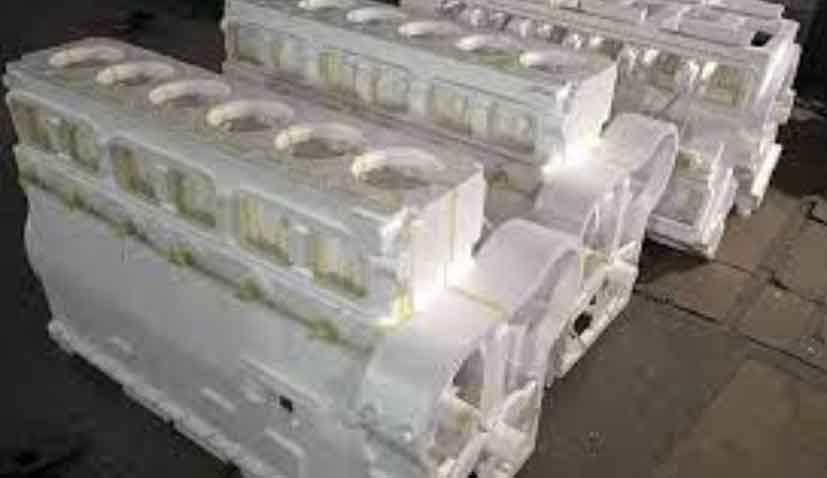
2. Lost Foam Casting Process Design
The lost foam casting system was optimized through:
2.1 Gating System
Utilized bottom-pouring with enlarged cross-sections (1.3-2.2× conventional sand casting) to ensure rapid filling:
$$Q = \frac{A\sqrt{2gh}}{1 + \frac{T_m – T_p}{\Delta T}}$$
Where:
Q = Flow rate (kg/s)
A = Total gate area (m²)
h = Metal head height (m)
Tm = Melting temperature (°C)
Tp = Pattern decomposition temperature (°C)
ΔT = Temperature difference (°C)
2.2 Riser Design
Implemented two-layer riser system with optimized dimensions:
| Parameter | Ratio |
|---|---|
| Riser neck width | 1.05-1.15× hot spot |
| Riser diameter | 3.5-5× hot spot |
| Riser height | 1.2-1.5× diameter |
3. Microstructure Refinement Strategies
Implemented dual-phase strengthening through:
3.1 Chilling Effect
Embedded steel sleeves created controlled cooling:
$$t = \frac{d^2}{4α}\ln\left(\frac{T_p – T_0}{T_c – T_0}\right)$$
Where:
t = Solidification time (s)
d = Section thickness (m)
α = Thermal diffusivity (m²/s)
Tp = Pouring temperature (°C)
Tc = Critical temperature (°C)
T0 = Ambient temperature (°C)
3.2 Inoculation Treatment
Applied Ce-based inoculation with optimized parameters:
$$N = N_0e^{-k\Delta T}$$
Where:
N = Effective nuclei count
N0 = Initial nuclei count
k = Temperature coefficient
ΔT = Undercooling degree
4. Process Validation
The lost foam casting process demonstrated:
| Property | Value |
|---|---|
| Hardness (HRC) | 58-62 |
| Impact toughness (J/cm²) | 12-15 |
| Corrosion rate (mm/year) | <0.5 |
| Service life (months) | >6 |
This optimized lost foam casting process successfully addressed the challenges of manufacturing ultra-high chromium alloy impellers, achieving excellent mechanical properties and extended service life in harsh acidic slurry environments.