
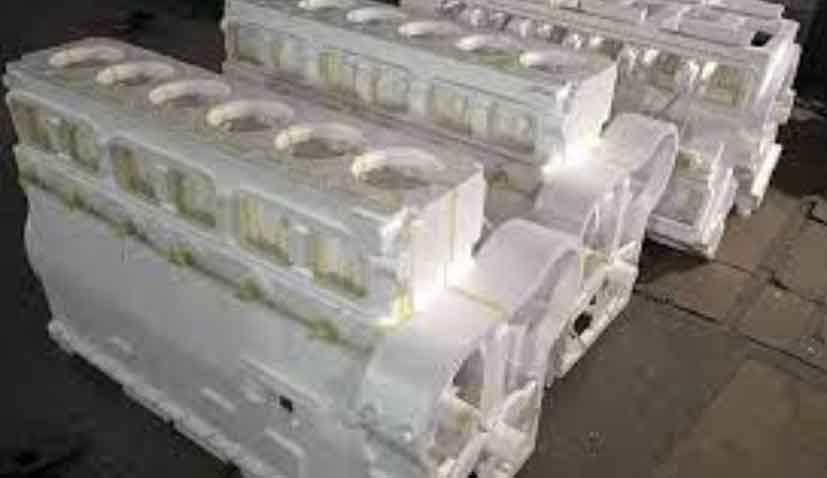
Lost foam casting (LFC) has revolutionized metal casting with advantages including design flexibility, dimensional accuracy, and environmental sustainability. However, defects like carbon deposition and elephant skin in cast iron components remain persistent challenges. This study systematically develops a water-based coating system to address these issues through optimized refractory aggregate combinations and binder formulations.
1. Material Composition and Methodology
The coating system employs bauxite (Al2O3·2H2O) as the primary refractory aggregate (325 mesh), supplemented with secondary aggregates:
| Component | Chemical Formula | Function |
|---|---|---|
| Kaolin | Al2Si2O5(OH)4 | Suspension enhancement |
| Wollastonite | CaSiO3 | Needle-like structure reinforcement |
| Talc | Mg3Si4O10(OH)2 | Lubrication & thermal stability |
The binder system combines colloidal silica (24-30% SiO2) and polyvinyl alcohol (PVA) in a 4:1 ratio, with sepiolite (Mg4Si6O15(OH)2·6H2O) and carboxymethyl cellulose (CMC) as composite suspension agents.
2. Experimental Design and Performance Metrics
An L9(34) orthogonal array evaluated three critical factors:
$$ \text{Coating Performance} = f(A,B,C) = \alpha A + \beta B + \gamma C + \varepsilon $$
| Factor | Level 1 | Level 2 | Level 3 |
|---|---|---|---|
| A: Kaolin (%) | 20 | 30 | 40 |
| B: Wollastonite (%) | 10 | 20 | 30 |
| C: Talc (%) | 10 | 15 | 20 |
Key performance parameters were quantified through:
- Suspension stability: ASTM D869-85
- Coating strength: $$ S_c = \frac{F_{abrasion}}{A_{contact}} $$
- Gas evolution: STZ-A gas analyzer
3. Results and Optimization
Range analysis revealed critical factor influences:
| Parameter | Dominant Factor | Optimal Level |
|---|---|---|
| Suspension (24h) | Kaolin (R=5.7) | A3 (40%) |
| Coating Strength | Wollastonite (R=90.0) | B2 (20%) |
| Gas Evolution | Talc (R=9.4) | C1 (10%) |
The optimized formulation demonstrates superior performance:
$$ \text{Optimal Composition} = 100\text{Bauxite} + 40\text{Kaolin} + 20\text{Wollastonite} + 10\text{Talc} $$
| Property | Value | Improvement |
|---|---|---|
| Suspension Stability | 93% | ↑18% vs baseline |
| Coating Strength | 364g | ↑151% vs A1B1C1 |
| Gas Evolution | 21.2 mL/g | ↓35% vs worst case |
4. Industrial Validation
Production trials with automotive brake components (HT250 cast iron) confirmed:
- Zero carbon deposition defects at 1,450°C pouring temperature
- Surface roughness Ra ≤ 12.5μm without post-processing
- Coating autostripping ratio: 92.7%
The developed water-based lost foam casting coating successfully addresses historical challenges in iron casting while maintaining environmental and economic advantages inherent to the LFC process. Future work will focus on computational modeling of gas transport mechanisms during metal filling.