
Through analyzing the current development status of lost foam casting in China, this study identifies critical challenges and proposes systematic countermeasures. The following sections explore technological constraints, defect mechanisms, and future directions through theoretical models and empirical data.
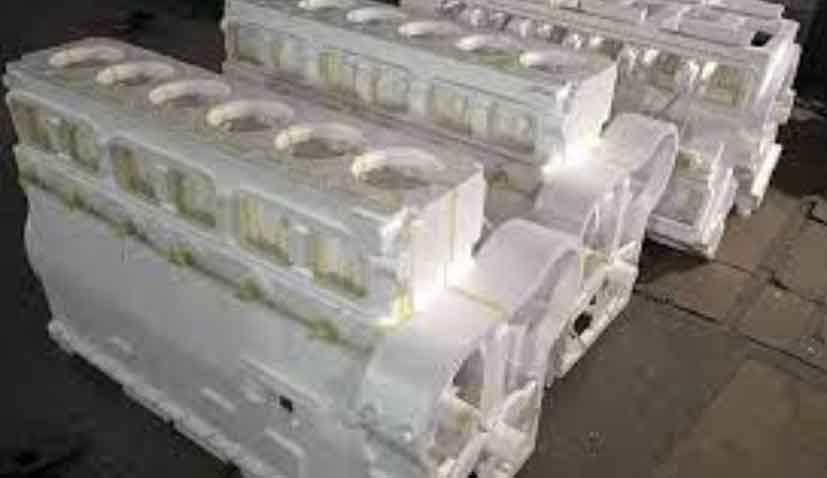
1. Critical Challenges in Lost Foam Casting
The production efficiency of lost foam casting follows a compound probability model. For N sequential processes with individual success rate $p_i$, the total yield $Y$ is expressed as:
$$ Y = \prod_{i=1}^{N} p_i $$
Typical process parameters and defect probabilities are summarized below:
| Process Stage | Key Parameters | Defect Contribution (%) |
|---|---|---|
| Pattern Assembly | EPS density (18-25 kg/m³) | 12-18 |
| Coating Application | Viscosity (30-45 s) | 22-35 |
| Sand Compaction | Vibration frequency (50-70 Hz) | 15-28 |
| Pouring Control | Vacuum (-0.04~-0.06 MPa) | 30-42 |
2. Defect Formation Mechanisms
The carbon deposition mechanism during foam decomposition follows first-order kinetics:
$$ \frac{dC}{dt} = k(T)(C_0 – C) $$
Where $C$ represents carbon concentration, $k(T)$ is temperature-dependent reaction rate constant, and $C_0$ initial carbon content.
2.1 Slag Inclusion Dynamics
Slag formation probability $P_s$ relates to gas flow velocity $v_g$ and metal front velocity $v_m$:
$$ P_s = 1 – e^{-\lambda(v_g/v_m)^2} $$
Where $\lambda$ is material constant (0.15-0.35 for cast iron).
3. Process Optimization Strategies
| Defect Type | Root Causes | Corrective Measures |
|---|---|---|
| Carbon Buildup | Incomplete pyrolysis | STMMA patterns |
| Sand Penetration | Coating cracks | Zircon-based coatings |
| Mold Collapse | Vacuum instability | Distributed vacuum system |
| Gas Porosity | Moisture content >0.5% | Infrared drying |
4. Technical Specifications for Different Alloys
The optimal process window varies significantly with material properties:
$$ T_{pour} = T_{liquidus} + \Delta T_{superheat} + \alpha \cdot \delta_{coating} $$
Where $\alpha$ = 8-12°C/mm for ferrous alloys, 3-5°C/mm for aluminum.
| Material | Pattern Density (kg/m³) | Vacuum (MPa) | Coating Thickness (mm) |
|---|---|---|---|
| Gray Iron | 20-22 | -0.045 | 0.8-1.2 |
| Ductile Iron | 18-20 | -0.055 | 1.0-1.5 |
| Carbon Steel | 16-18 | -0.065 | 1.2-1.8 |
| Aluminum | 14-16 | -0.025 | 0.5-0.8 |
5. Future Development Trends
The technological evolution of lost foam casting will focus on three key areas:
- Advanced pattern materials: Development of low-residue polymers with decomposition kinetics matching different alloy systems
- Intelligent process control: Real-time monitoring of vacuum distribution using IoT sensors
- Environmental integration: Implementation of closed-loop gas treatment systems with efficiency >95%
Through systematic parameter optimization and equipment innovation, lost foam casting demonstrates significant advantages in complex component manufacturing. The continuous improvement of process stability and defect control mechanisms will further expand its industrial applications.