
Application of Bucket Tooth Detection System in Open-Pit Coal Mining Shovels
Electric shovels are fundamental equipment in open-pit coal mining operations, prized for their low blasting requirements, strong environmental adaptability, high operational efficiency, and mature domestic technology. These machines primarily handle overburden stripping and coal excavation. At our Heidaigou Open-Pit Coal Mine, we operate 12 electric shovels, with two dedicated to coal mining using a semi-continuous process (single-bucket shovel – dump truck – crusher station – belt conveyor) and the remaining ten handling rock stripping via a discontinuous process (single-bucket shovel – dump truck).
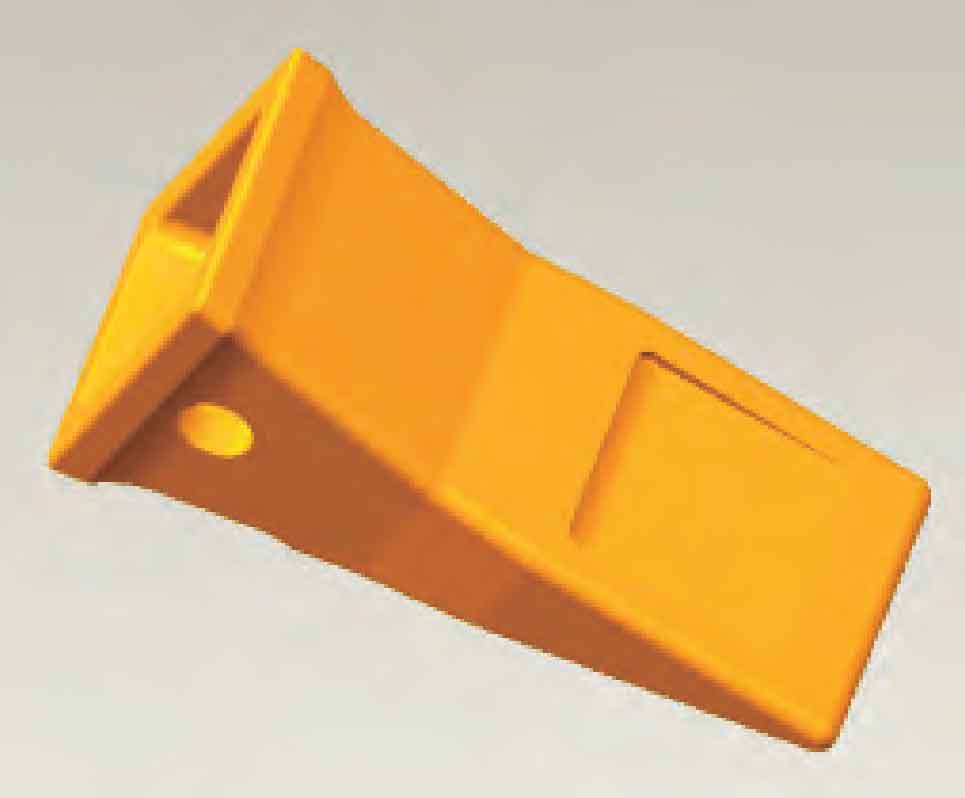
During excavation, bucket teeth—manufactured from high-manganese or alloy steel—bear the initial impact when the bucket penetrates material under combined lifting and pushing forces. These critical components experience extreme stress concentrations at their engagement points, making them prone to fracture or dislodgement from their sockets. Unaddressed bucket tooth loss triggers severe operational consequences: accelerated wear of the bucket lip (significantly shortening bucket lifespan and reducing efficiency), and catastrophic downstream equipment damage. Dislodged bucket teeth transported to crusher stations can cause crusher blockages, mechanical failures, or belt tears, resulting in substantial production losses exceeding $500,000 per incident and posing serious safety hazards to personnel.
Traditional inspection methods relying on manual visual checks during shovel downtime proved inadequate. Operators couldn’t monitor bucket tooth integrity during operation, leading to delayed detection of missing teeth. Initial technological solutions involved basic video monitoring systems (HD cameras + displays), but these failed in Heidaigou’s dusty, humid, and low-visibility conditions. Subsequent iterations employed infrared cameras, improving nighttime imaging but still requiring manual oversight and remaining vulnerable to environmental interference. The adoption of infrared thermal imaging cameras represented significant progress, providing consistent imaging unaffected by dust or lighting variations. However, the persistent need for human monitoring introduced reliability issues and operator fatigue.
Evolution of Bucket Tooth Monitoring Technologies in Chinese Mining (2008-2018)
| Timeframe | Mine Location | Technology | Key Limitations | Detection Accuracy |
|---|---|---|---|---|
| 2008 | Baorixile Open-Pit Mine | HD Camera + Display | Severe dust interference, poor image quality, manual monitoring | < 50% |
| 2011 | Benxi Iron Mine | Far-IR Camera | Improved night vision, but persistent dust issues and manual dependency | ~60% |
| 2013-2016 | Taiyuan Steel/Iron Mines, Anshan Iron Mines | IR Thermal Imaging Camera | Dust/light immunity, but still required manual image interpretation | ~70% |
| 2016 | Dexing Copper Mine (Initial) | Computer Vision (Pattern Recognition) | Vulnerable to obstructions (rocks, cables) | ~70% |
| 2017 | Dexing Copper Mine (Upgraded) | Advanced Computer Vision (Tooth Counting) | Improved obstruction handling | ~96% |
| 2018 | Heidaigou Open-Pit Mine (This Work) | IR Thermal Imaging + Deep Learning (CNN) | Optimized for coal mining conditions, full automation | > 98% |
System Architecture and Hardware Implementation
Our deployed bucket tooth detection system integrates thermal imaging with deep learning-based computer vision, specifically designed for WK-35 coal mining shovels at Heidaigou. The hardware configuration comprises three core components:
- Mounted centrally between the boom sheaves on the shovel’s main arm using a specialized anti-vibration bracket. This positioning provides an optimal, consistent view of the bucket teeth during the digging cycle. The camera operates within the LWIR spectrum (8-14 μm), capturing temperature differentials between the metallic bucket teeth and surrounding material regardless of visible light levels or airborne dust. Integrated thermoelectric cooling maintains sensor stability across the mine’s operational temperature range (-30°C to +55°C).
- Industrial Control Computer (JD1001B(K)): Housed within the shovel’s electrical compartment. Equipped with a 500GB SSD for robust data storage, an Intel i7 processor, and 16GB RAM, it handles real-time image acquisition (10 fps), video logging, and computationally intensive deep learning inference. Ruggedized construction ensures reliability amidst high vibration and dust ingress (IP65 rating).
- Touchscreen Display (VM-104T): Installed within the operator’s cab on a VESA-compliant mount. Provides real-time thermal imagery, system status, and immediate visual/audible alarms upon detecting missing bucket teeth. The 10.4″ sunlight-readable display features a capacitive touch interface for status checks and diagnostic access.
Heavy-duty polyurethane-sheathed cabling (CVXLPCC30MA for power/data, CVXLMFP8MA for audio, CVXLMFC8MA for video) connects the components, ensuring resilience against mechanical abrasion, moisture, and electromagnetic interference prevalent in mining environments. Power is supplied via a dedicated CLG150-12A industrial power module.
| Component | Model/Specification | Quantity | Key Features/Purpose |
|---|---|---|---|
| Thermal Imager | FLIR JD1001B(R) | 1 | LWIR Spectrum (8-14μm), 640×480 resolution, ±2°C accuracy, Integrated Thermo-electric Cooler |
| Controller | JD1001B(K) | 1 | Intel i7, 16GB RAM, 500GB SSD, IP65 Enclosure |
| Touchscreen Display | VM-104T | 1 | 10.4″ Sunlight Readable, Capacitive Touch, 1000-nit Brightness |
| Power Supply | CLG150-12A | 1 | 24VDC Output, 150W, Over-voltage/Current Protection |
| Imager Mount | DCT-01 | 1 | Stainless Steel, Vibration Damping (>90% isolation) |
| Cabling | CVXLPCC30MA | 30m | Heavy-duty PUR sheath, EMI shielded |
| Software | BTMD V2.6.3 | 1 | Integrated Haar+CNN Algorithm, Real-time Processing |
Algorithmic Core: Two-Stage Bucket Tooth Detection
The software (BTMD V2.6.3) employs a sophisticated two-stage pipeline to achieve robust bucket tooth detection under challenging mining conditions. This addresses the inherent variability in bucket tooth position, orientation, and potential obstructions.
Stage 1: Bucket Tooth Region Localization using Viola-Jones Haar Cascade
This initial stage rapidly isolates regions containing potential bucket teeth, reducing computational load for subsequent processing. The Viola-Jones framework utilizes rectangular Haar-like features computed efficiently via integral images ($II(x,y)$):
$$II(x,y) = \sum_{x’ \leq x, y’ \leq y} I(x’,y’)$$
where $I(x’,y’)$ is the pixel intensity at position $(x’,y’)$. Features represent differences in summed intensities between adjacent rectangular regions, sensitive to edges and ridges characteristic of bucket teeth edges. A cascaded classifier structure, trained on 80 positive samples (aligned bucket teeth) and 500 negative samples (background), rapidly discards non-tooth regions:
- Feature Calculation: Compute Haar-like features across the thermal image at multiple scales.
- Cascade Evaluation: Apply a sequence of increasingly complex classifiers. Regions failing early simple classifiers are immediately discarded.
- Region Proposal: Surviving regions at the final cascade stage are identified as potential bucket tooth rows. Parameters: scale factor = 1.1, minimum neighbors = 5.
The output defines a coarse Region of Interest (ROI) encompassing the detected bucket tooth row.
Stage 2: Missing Bucket Tooth Classification via Convolutional Neural Network (CNN)
Each potential bucket tooth segment within the Stage 1 ROI is analyzed by a custom 7-layer CNN to determine presence/absence:
$$f(\mathbf{X}) = \text{Softmax}\left(\mathbf{W}_2 \cdot \text{ReLU}\left(\mathbf{W}_1 \cdot \text{Flatten}\left(\text{MaxPool}_2\left(\text{Dropout}_{0.5}\left(\text{ReLU}\left(\text{Conv}_{64}\left(\text{MaxPool}_2\left(\text{ReLU}\left(\text{Conv}_{32}\left(\text{MaxPool}_2\left(\text{ReLU}\left(\text{Conv}_{32}\left(\mathbf{X}\right)\right)\right)\right)\right)\right)\right)\right)\right)\right)\right)$$
Network Architecture:
- Input: Normalized 30×30 pixel segment ($\mathbf{X} \in \mathbb{R}^{30\times30}$)
- Convolutional Layers (3):
- Conv2D-1: 32 filters (3×3 kernel), ReLU activation
- MaxPooling2D-1: 2×2 pool size
- Conv2D-2: 32 filters (3×3 kernel), ReLU activation
- MaxPooling2D-2: 2×2 pool size
- Conv2D-3: 64 filters (3×3 kernel), ReLU activation
- MaxPooling2D-3: 2×2 pool size
- Regularization: Dropout (rate=0.5)
- Fully Connected: Flatten layer followed by Dense layer (128 units), ReLU
- Output: Dense layer (2 units – “Present”/”Missing”), Softmax activation
Training & Optimization:
- Dataset: 5,000 augmented segments (including rocks, cable occlusion, dust artifacts) generated via Keras ImageDataGenerator (rotation=20°, width/height shift=0.2, shear=0.2, horizontal flip=True).
- Preprocessing: Pixel normalization ($\mathbf{X} = \mathbf{X}/255.0$)
- Optimizer: Adam (learning rate = 0.0001)
- Batch Size: 15 segments
- Epochs: 2000 (early stopping upon validation loss plateau)
Decision Logic & Alerting:
- Segmentation & Classification: The Stage 1 ROI is divided into $N$ segments ($N$ = expected bucket teeth count). Each segment is classified by the CNN.
- Consensus Filtering: A dynamic array tracks missing tooth IDs over a 1-second window (10 consecutive frames).
- Alert Trigger: If a specific bucket tooth ID is flagged missing in ≥80% of frames within the window, a high-confidence missing tooth event is declared. The system triggers a cab-mounted audible alarm and visual alert on the touchscreen display, specifying the missing tooth position. Logs recording timestamp, tooth ID, and thermal image are saved to the SSD.
Operational Workflow and Performance Metrics
The system operates autonomously at 10 Hz (100ms cycle time):
- Image Acquisition: Thermal imager captures frame.
- Frame Buffering: Frame stored in a rolling buffer (8 frames = 1 second of video).
- Processing: Stage 1 (Haar Cascade) executes (~15ms), followed by Stage 2 (CNN) on proposed segments (~70ms).
- Decision & Logging: Alert triggered if consensus reached. Video snippets (30min duration) saved continuously.
Performance validation over 18 months of operation on WK-35 shovels demonstrated:
- Detection Accuracy: 98.7% (validated against 1,842 manual ground-truth inspections)
- False Positive Rate: < 1.2% (primarily due to extreme bucket lip deformation)
- Mean Time Between Failures (MTBF): > 2,500 hours
- Impact: Zero crusher blockages or damage events attributed to missing bucket teeth since deployment, eliminating associated downtime costs (~$150,000 avoided per potential incident).
System Advantages and Operational Impact
The integration of infrared thermal imaging with deep learning-based computer vision delivers transformative benefits:
- Environmental Immunity: Consistent performance unaffected by total darkness, dense dust clouds, fog, rain, or snow – conditions prevalent in 24/7 mining operations. Thermal contrast between metal bucket teeth and coal/rock provides reliable segmentation.
- Automation & Reduced Workload: Eliminates the need for manual inspection during breaks or shift changes. Operators receive immediate, unambiguous alerts, freeing cognitive load for primary digging tasks.
- Enhanced Obstruction Handling: The CNN’s ability to learn features from partially obscured bucket teeth (by rocks, cables, or mud) significantly outperforms earlier rigid pattern-matching techniques, maintaining high accuracy even in cluttered digging scenarios.
- Predictive Maintenance Data: Logged missing tooth events and thermal images provide valuable data for analyzing wear patterns, optimizing tooth replacement schedules, and identifying potential issues with tooth retention systems.
- Cost Savings & Safety: Prevention of crusher damage and associated downtime (estimated savings >$1.5M annually at Heidaigou). Elimination of catastrophic failure risks enhances personnel safety near crushers and conveyors.
Conclusion
The implementation of this “Infrared Thermal Imaging + Computer Vision” bucket tooth detection system on WK-35 coal mining shovels represents a critical advancement in operational reliability and cost management for open-pit mining. By leveraging the complementary strengths of Haar cascades for efficient region proposal and CNNs for robust, occlusion-invariant classification, the system achieves near-perfect detection accuracy under the harshest real-world conditions. The complete automation of bucket tooth integrity monitoring eliminates human error and operational delays inherent in manual checks. The dramatic reduction in crusher damage incidents underscores its economic and safety value. Future development will focus on integrating bucket tooth wear quantification using similar thermal imaging and deep learning approaches, further optimizing shovel maintenance and component lifecycle management.