
In my research, I explore the application of computer simulation technology in lost foam casting, focusing on the optimization of casting processes for complex ductile iron components. Lost foam casting is a near-net-shape manufacturing method that uses foam patterns to create intricate metal parts, offering advantages such as high dimensional accuracy, reduced machining requirements, and environmental benefits. However, the process involves complex thermophysical interactions during filling and solidification, which can lead to defects like shrinkage porosity, gas entrapment, and carbon-related issues. To address these challenges, I employ numerical simulation tools like ProCAST and Visual Environment to model the entire casting process, enabling accurate prediction of defects and guiding process improvements without the need for costly physical trials.
The lost foam casting process begins with the creation of a foam pattern that replicates the final part, including gating systems and risers. This pattern is coated with a refractory material and embedded in unbonded sand within a flask. Under vacuum conditions, molten metal is poured, causing the foam to vaporize and be replaced by the metal, which then solidifies to form the casting. The key advantage of lost foam casting lies in its ability to produce complex geometries with minimal draft angles and no cores, making it ideal for components like automotive parts and pipe fittings. However, the decomposition of the foam pattern during filling introduces unique phenomena, such as gas back-pressure and heat absorption, which complicate the fluid flow and heat transfer compared to traditional sand casting. My work aims to leverage simulation to better understand these aspects and optimize the process for ductile iron, which exhibits graphite expansion during solidification that can influence shrinkage behavior.
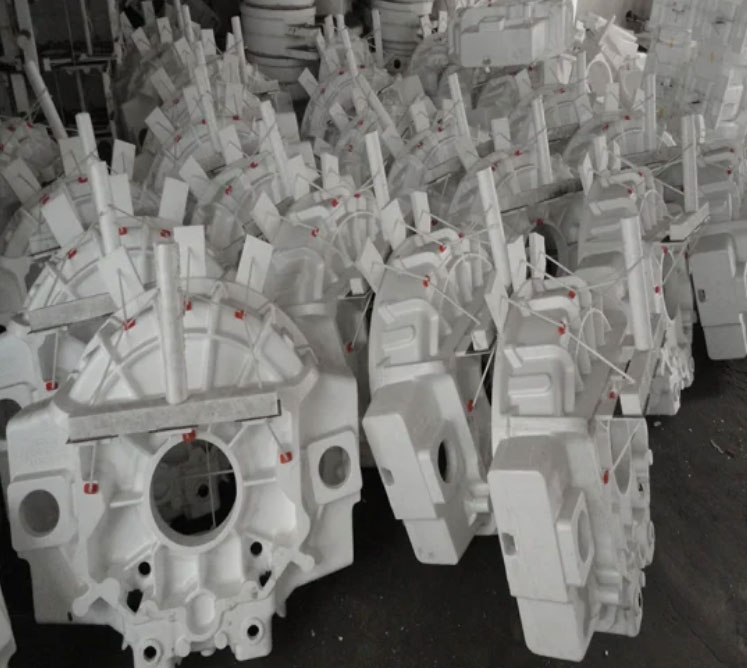
To simulate the lost foam casting process, I base my approach on fundamental mathematical models that describe the filling and solidification stages. The filling phase involves solving the conservation equations for mass, momentum, and energy, accounting for the interaction between the molten metal and the decomposing foam. The continuity equation for an incompressible fluid is given by:
$$\frac{\partial u}{\partial x} + \frac{\partial v}{\partial y} + \frac{\partial w}{\partial z} = 0$$
where \( u \), \( v \), and \( w \) are the velocity components in the x, y, and z directions, respectively. The momentum conservation is described by the Navier-Stokes equations:
$$\frac{\partial u}{\partial t} + u \frac{\partial u}{\partial x} + v \frac{\partial u}{\partial y} + w \frac{\partial u}{\partial z} = -\frac{1}{\rho} \frac{\partial P}{\partial x} + \nu \nabla^2 u + F_x$$
$$\frac{\partial v}{\partial t} + u \frac{\partial v}{\partial x} + v \frac{\partial v}{\partial y} + w \frac{\partial v}{\partial z} = -\frac{1}{\rho} \frac{\partial P}{\partial y} + \nu \nabla^2 v + F_y$$
$$\frac{\partial w}{\partial t} + u \frac{\partial w}{\partial x} + v \frac{\partial w}{\partial y} + w \frac{\partial w}{\partial z} = -\frac{1}{\rho} \frac{\partial P}{\partial z} + \nu \nabla^2 w + F_z$$
Here, \( \rho \) is the density, \( P \) is the pressure, \( \nu \) is the kinematic viscosity, and \( F_x, F_y, F_z \) are body forces. For energy conservation, I consider the equation that includes heat transfer and phase change:
$$\rho C_p \frac{\partial T}{\partial t} = \lambda \nabla^2 T + \rho L \frac{\partial f_s}{\partial t}$$
where \( T \) is temperature, \( C_p \) is specific heat, \( \lambda \) is thermal conductivity, \( L \) is latent heat, and \( f_s \) is the solid fraction. In lost foam casting, the foam decomposition introduces additional terms, such as gas pressure in the gap between the metal and foam, which I model using empirical relations. For instance, the gas pressure \( P_g \) can be expressed as a function of foam density and filling velocity, derived from experimental data.
For solidification simulation, I focus on the Fourier heat conduction equation with phase change:
$$\frac{\partial T}{\partial t} = \alpha \nabla^2 T + \frac{L}{C_p} \frac{\partial f_s}{\partial t}$$
where \( \alpha \) is the thermal diffusivity. The boundary conditions include convection and radiation at the mold surfaces, and I use the enthalpy method to handle latent heat release. For ductile iron, the graphite expansion during eutectic solidification is critical, as it can compensate for shrinkage. I incorporate micro-modeling to account for this, using parameters like graphite degree and fading effects to adjust the density changes. The governing equation for micro-segregation includes:
$$\frac{\partial \rho}{\partial t} = – \nabla \cdot (\rho \mathbf{v}) + S$$
where \( S \) represents source terms due to phase transformations. By coupling thermal and micro-modules, I predict shrinkage porosity accurately.
| Parameter | Description | Typical Value |
|---|---|---|
| FOAMHTC | Heat transfer coefficient between metal and foam | 0.02 W/m²K |
| BURNZONE | Distance for foam degradation | 1.0 cm |
| GASFRAC | Fraction of foam converted to gas | 0.1 |
| GRAPHITE | Degree of graphite expansion | 0.8-1.0 |
| FADING | Graphite fading effect | 0.5-1.0 |
In my simulation setup, I use ProCAST software, which employs finite element methods to solve these equations. The process involves creating a 3D geometric model of the casting, gating system, and mold using CAD software like UG, then generating a mesh for numerical analysis. I define material properties, such as those for ductile iron QT600-3, with a liquidus temperature of approximately 1150°C and solidus around 1090°C. The foam is modeled as a solid material that decomposes upon contact with molten metal, and the sand mold is assigned properties like permeability and thermal conductivity. Special parameters for lost foam casting include interface heat transfer coefficients and gas back-pressure settings, which I calibrate based on experimental data to ensure accuracy.
For the case study, I investigate a ductile iron lift arm component, which has a complex geometry with multiple thickness variations and thermal hotspots. The initial trials used bottom-gating and top-gating systems, but both resulted in significant shrinkage defects. Through simulation, I analyze the filling patterns and solidification sequences. For example, in the bottom-gating system, the metal fills the mold progressively from the bottom, leading to longer filling times and potential gas entrapment in upper regions. The solidification analysis shows isolated liquid zones in thick sections, where shrinkage occurs due to inadequate feeding. I use the following criterion to predict shrinkage porosity, based on the Niyama method:
$$G / \sqrt{R} \leq C$$
where \( G \) is the temperature gradient, \( R \) is the cooling rate, and \( C \) is a constant. By adjusting gating designs and adding risers, I optimize the process to minimize defects.
| Gating System | Filling Time (s) | Shrinkage Defects | Remarks |
|---|---|---|---|
| Bottom-Gating | 24.08 | Severe in lower arm | Poor feeding due to early freezing |
| Top-Gating | 23.94 | Severe in upper arm | Better temperature gradient but slag issues |
| Step-Gating | 16.64 | Minimal shrinkage | Improved feeding with multiple inlets |
Based on the simulation results, I develop an improved step-gating system that introduces metal from multiple levels, ensuring a more uniform temperature distribution and better feeding during solidification. The simulation predicts a reduction in shrinkage porosity, and physical trials confirm this, with only minor dispersed porosity in critical areas. To further enhance the process, I propose embedding chromite sand cores in hotspot regions to increase cooling rates and disperse shrinkage. This optimization is validated through additional casting tests, showing that lost foam casting can achieve high-quality ductile iron components with minimal defects when supported by accurate simulation.
In conclusion, my research demonstrates that computer simulation is a powerful tool for optimizing lost foam casting processes, particularly for complex ductile iron parts. By establishing accurate thermophysical models and adjusting key parameters, I can predict defects like shrinkage porosity and guide design changes effectively. The use of simulation reduces the need for physical trials, saving time and resources. Future work should focus on refining material properties databases and expanding simulation capabilities to include stress analysis and microstructure prediction. Overall, the integration of lost foam casting simulation into industrial practice holds great potential for advancing manufacturing efficiency and product quality in the foundry industry.