
In modern manufacturing, lost foam casting has emerged as a pivotal technique for producing complex metal components with high precision and minimal environmental impact. As a researcher deeply involved in this field, I have explored the intricacies of lost foam casting through numerical simulation, focusing on optimizing process parameters to mitigate defects such as shrinkage porosity and cold shuts. Lost foam casting involves replacing a foam pattern with molten metal, which decomposes upon contact, leading to unique fluid dynamics and thermal behaviors. This process distinguishes itself from traditional sand casting by eliminating the need for cores and reducing post-processing, but it introduces challenges like gas evolution and heat loss at the metal-foam interface. Through this study, I aim to demonstrate how numerical simulation tools, like ProCAST, can revolutionize lost foam casting by providing insights into filling and solidification patterns, ultimately enhancing product quality and reducing trial-and-error cycles.
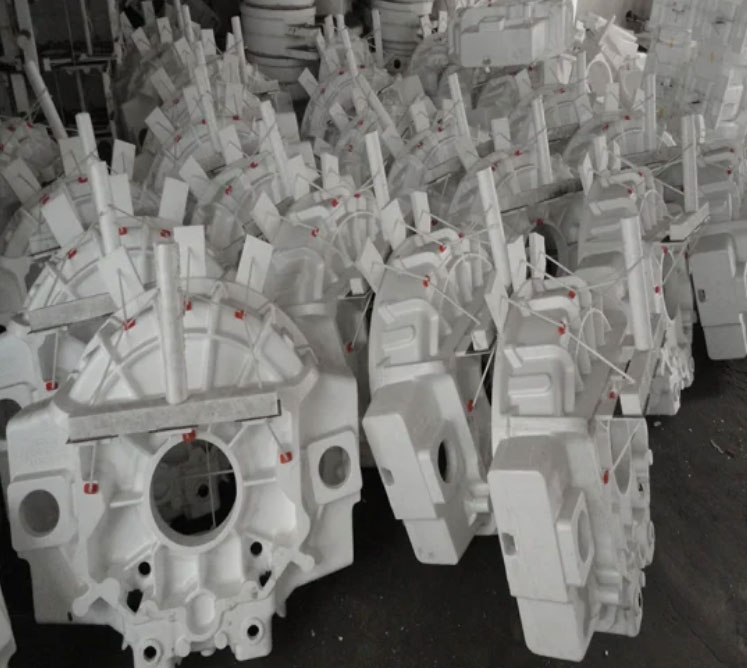
The lost foam casting process begins with creating a foam pattern, typically from expandable polystyrene (EPS), which is coated with a refractory material and placed in a flask filled with unbonded sand. Upon pouring molten metal, the foam vaporizes, allowing the metal to fill the cavity. This method offers advantages such as reduced machining requirements and the ability to produce intricate geometries. However, the interaction between the metal and foam during filling introduces complexities in fluid flow and heat transfer, making process control critical. For instance, the decomposition of the foam generates gaseous and liquid by-products that must escape through the coating, influencing metal flow and temperature distribution. Understanding these phenomena is essential for optimizing lost foam casting, and numerical simulation serves as a powerful tool to visualize and analyze these dynamics.
Numerical simulation of lost foam casting relies on solving fundamental equations governing fluid dynamics and heat transfer. The filling process is modeled using the Navier-Stokes equations for incompressible flow, accounting for mass and momentum conservation. The continuity equation ensures mass balance: $$ \frac{\partial u}{\partial x} + \frac{\partial v}{\partial y} + \frac{\partial w}{\partial z} = 0 $$ where \( u, v, w \) are velocity components. The momentum equations incorporate viscous effects and pressure gradients: $$ \frac{\partial u}{\partial t} + u \frac{\partial u}{\partial x} + v \frac{\partial u}{\partial y} + w \frac{\partial u}{\partial z} = -\frac{1}{\rho} \frac{\partial p}{\partial x} + \gamma \left( \frac{\partial^2 u}{\partial x^2} + \frac{\partial^2 u}{\partial y^2} + \frac{\partial^2 u}{\partial z^2} \right) + g_x $$ with similar expressions for the y and z directions. Here, \( p \) is pressure, \( \rho \) is density, \( \gamma \) is kinematic viscosity, and \( g \) represents gravitational acceleration. For heat transfer, the energy equation includes conduction and convection terms: $$ \rho C_p \frac{\partial T}{\partial t} = \lambda \nabla^2 T – \rho C_p \mathbf{v} \cdot \nabla T + S $$ where \( T \) is temperature, \( C_p \) is specific heat, \( \lambda \) is thermal conductivity, \( \mathbf{v} \) is velocity vector, and \( S \) accounts for phase change effects like latent heat release. In lost foam casting, additional factors such as foam decomposition and gas pressure at the metal front require specialized boundary conditions, which I incorporated into simulations using ProCAST software.
To illustrate the application of numerical simulation in lost foam casting, I conducted a case study on a ductile iron shell component. The original process used a step-gating system intended to promote bottom-up filling, but practical trials revealed shrinkage defects in thicker sections and side walls. Through simulation, I modeled the filling and solidification stages, identifying that the gating system did not achieve the desired thermal gradient, leading to inadequate feeding. The table below summarizes key material properties used in the simulation, derived from experimental measurements to ensure accuracy:
| Material | Density (kg/m³) | Thermal Conductivity (W/m·K) | Specific Heat (kJ/kg·K) | Latent Heat (kJ/kg) |
|---|---|---|---|---|
| Foam Pattern | 25 | 0.15 | 3.7 | 100 |
| Sand Mold | 1520 | 0.53 | 1.22 | N/A |
| Ductile Iron | 7100 | 40 | 0.65 | 270 |
The simulation results highlighted that the original gating design caused premature solidification in the feeders, exacerbating shrinkage. For example, the filling time was prolonged due to foam decomposition, and the temperature drop at the metal front reached up to 50°C, as calculated using the energy equation. To quantify the solidification behavior, I employed the fraction solid approach, where the phase change is modeled as: $$ f_s = \frac{T_l – T}{T_l – T_s} $$ with \( T_l \) and \( T_s \) as liquidus and solidus temperatures. The original process showed isolated liquid pools in the shell’s rotational areas, leading to porosity, as predicted by the Niyama criterion: $$ G / \sqrt{R} \leq C $$ where \( G \) is temperature gradient, \( R \) is cooling rate, and \( C \) is a constant. This criterion helped pinpoint defect-prone zones, aligning with practical observations.
Based on these insights, I redesigned the lost foam casting process by adopting a top-gating system and cylindrical risers to enhance feeding. The new design aimed to establish directional solidification from the bottom toward the riser, minimizing shrinkage. Key parameters were optimized through iterative simulations, as shown in the table below, which compares different process schemes for filling behavior and defect formation:
| Scheme | Pouring Temperature (°C) | Vacuum Level (MPa) | Filling Time (s) | Filling Behavior |
|---|---|---|---|---|
| 1 | 1450 | -0.04 | 28.31 | Severe metal hesitation |
| 2 | 1450 | -0.06 | 27.86 | Smooth filling |
| 3 | 1450 | -0.08 | 28.32 | Metal hesitation |
| 4 | 1480 | -0.04 | 28.62 | Severe metal hesitation |
| 5 | 1480 | -0.06 | 27.93 | Smooth filling |
| 6 | 1480 | -0.08 | 29.26 | Metal hesitation |
Scheme 5, with a pouring temperature of 1480°C and vacuum of -0.06 MPa, provided the most stable filling and reduced defects. The improved lost foam casting process achieved a yield of 67%, and simulations confirmed that solidification progressed sequentially toward the riser, with shrinkage confined to the feeder rather than the casting. The thermal analysis during solidification was governed by Fourier’s law: $$ q = -\lambda \frac{\partial T}{\partial n} $$ where \( q \) is heat flux and \( n \) is the normal direction. By applying this, I verified that the riser remained liquid longer than the casting, ensuring effective feeding. Practical trials validated these results, producing defect-free components that met quality standards.
In conclusion, numerical simulation is indispensable for advancing lost foam casting technology. By integrating fluid dynamics and heat transfer models, I successfully optimized a real-world process, highlighting how simulation can predict and prevent defects like shrinkage porosity. The lost foam casting method, with its environmental and economic benefits, can be further refined through such computational approaches, paving the way for broader industrial adoption. Future work should focus on enhancing model accuracy for foam decomposition and expanding simulations to include stress analysis, ultimately making lost foam casting more reliable and efficient.