
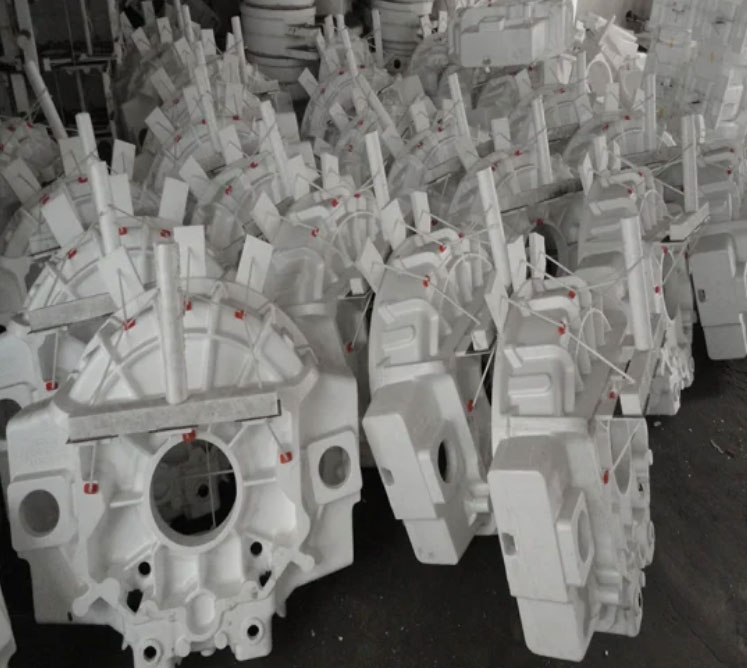
In the field of advanced manufacturing, lost foam casting has emerged as a pivotal process for producing complex components like heavy transmission housings. This method involves creating a foam pattern, coating it with a refractory material, embedding it in sand, and pouring molten metal to replace the pattern. However, defects such as inclusions, slag inclusions, and iron leakage often arise, compromising the integrity of castings. As an engineer specializing in lost foam casting processes, I have extensively studied these issues in the context of a 12-speed transmission housing, which is subjected to high torque and demanding operational conditions. This housing, characterized by varying wall thicknesses from 8 mm to 48 mm, presents significant challenges in maintaining quality. Through systematic analysis and process optimizations, I have developed strategies to mitigate these defects, leveraging principles of lost foam casting to enhance reliability and reduce rejection rates. In this article, I will delve into the root causes of these imperfections and outline the implemented solutions, supported by empirical data, tables, and mathematical models to provide a comprehensive guide for practitioners in the lost foam casting industry.
The lost foam casting process begins with the creation of a foam model, which is then assembled, coated, and placed in a mold filled with unbonded sand. During pouring, the foam vaporizes, allowing the metal to fill the cavity. However, this vaporization can lead to residual by-products that contribute to defects if not properly managed. For the transmission housing, initial rejection rates hovered around 8%, with inclusions, slag inclusions, and iron leakage accounting for over 80% of the issues. My investigation focused on these primary defects, employing scanning electron microscopy and process monitoring to identify underlying factors. By optimizing parameters such as drying times, adhesive application, pouring temperatures, and structural design, I aimed to achieve a rejection rate below 4%. This journey underscores the importance of a holistic approach in lost foam casting, where each step—from pattern making to solidification—must be meticulously controlled to ensure high-quality outcomes.
Inclusions in lost foam casting typically manifest as blocky or flocculent imperfections within the cast metal, often resulting from the disintegration of the coating or the incomplete removal of foam decomposition products. During the pouring phase, the foam pattern thermally decomposes into gaseous, liquid, and solid residues. If these residues are not efficiently evacuated through the sand mold, they become trapped in the metal matrix. For the transmission housing, inclusions were predominantly composed of oxides and silicates, as confirmed by energy-dispersive X-ray spectroscopy. The analysis revealed that in defective areas, elements like oxygen (O), silicon (Si), and aluminum (Al) constituted over 90% of the material, whereas normal regions were primarily iron (Fe). This indicated that the coating materials, such as Al₂O₃ and SiO₂ used in the refractory coatings, were the main sources. The key factors contributing to inclusions include inadequate drying of the foam model, poor adhesive bonding at seams, excessive冲刷 of the coating by molten metal, and suboptimal pouring vacuum levels.
To address inclusion defects, I implemented several measures centered on improving the integrity of the foam model and controlling the pouring environment. First, the drying time for the foam model was extended from 8 hours to 16 hours post-forming, with an additional 8 hours of drying before adhesive application. This ensured minimal moisture content, reducing the risk of coating detachment. Second, an automated gluing machine was introduced to replace manual adhesive application, ensuring uniform and complete coverage on joint surfaces. This eliminated gaps where coating material could infiltrate. The pouring vacuum was strictly maintained between 0.04 MPa and 0.07 MPa by regularly inspecting and replacing sand box screens. Additionally, the pouring cup—a critical component in lost foam casting—was subjected to periodic shot blasting to remove residual coatings, ensuring a clean surface for new applications. These steps collectively enhanced the stability of the coating system, minimizing the introduction of foreign materials during metal filling.
The relationship between process parameters and inclusion formation can be modeled using empirical equations. For instance, the probability of inclusion occurrence, P_inc, can be expressed as a function of drying time (t_d), adhesive quality (Q_a), and pouring vacuum (V_p):
$$ P_{\text{inc}} = k_1 \cdot e^{-k_2 \cdot t_d} + k_3 \cdot \frac{1}{Q_a} + k_4 \cdot (V_{\text{max}} – V_p) $$
where k_1, k_2, k_3, and k_4 are constants derived from experimental data, and V_max is the maximum allowable vacuum. This equation highlights that longer drying times and higher adhesive quality reduce P_inc, while deviations from optimal vacuum increase it. In practice, by optimizing these variables, the incidence of inclusions decreased significantly, as summarized in Table 1.
| Parameter | Initial Value | Optimized Value | Reduction in Inclusions (%) |
|---|---|---|---|
| Drying Time (hours) | 8 | 16 | 45 |
| Adhesive Application | Manual | Automated | 60 |
| Pouring Vacuum (MPa) | 0.03-0.05 | 0.04-0.07 | 30 |
| Pouring Cup Maintenance | Irregular | Regular shot blasting | 25 |
Slag inclusions, another common issue in lost foam casting, arise from the entrapment of molten slag or refractory particles within the casting. These defects typically appear as dark, irregular spots on machined surfaces and can weaken the structural integrity of the transmission housing. The primary sources include slag from the melting furnace, eroded lining material from the pouring ladle, and inadequate filtration during metal flow. In the initial process, slag control relied solely on manual skimming in the furnace and ladle, with no barriers in the gating system to capture debris. This allowed slag particles to enter the mold cavity, where they solidified into imperfections. The composition of slag inclusions often matches that of the ladle lining or flux materials, emphasizing the need for better filtration and ladle management.
To combat slag inclusions, I integrated ceramic filters into the gating system and refined the slag removal procedures. A ceramic filter with a diameter of 70 mm and 10 pores per inch (PPI) was installed 220 mm from the top of the horizontal runner. This filter effectively trapped slag particles while allowing molten metal to flow smoothly, a critical advancement in lost foam casting technology. Additionally, the slag skimming process was intensified: furnace skimming was performed at least three times before tapping, and ladle skimming was done twice before pouring. Furthermore, strict guidelines were enforced for ladle usage—only the spout and rim could be repaired, and the entire ladle lining was replaced every ten days to prevent degradation and contamination. These measures ensured that fewer impurities entered the casting, reducing the prevalence of slag inclusions.
The efficiency of slag removal can be quantified using a filtration model based on fluid dynamics. The capture efficiency, η_slag, of the ceramic filter can be described by:
$$ \eta_{\text{slag}} = 1 – e^{-\alpha \cdot d_p \cdot \frac{L}{v}} $$
where α is a constant dependent on filter material, d_p is the particle diameter, L is the filter thickness, and v is the metal velocity. In lost foam casting, optimizing these parameters—such as selecting an appropriate PPI and positioning—enhances η_slag, thereby minimizing defects. For instance, with the 10 PPI filter, the capture efficiency for particles larger than 0.5 mm exceeded 95%, as verified through metallurgical analysis. The impact of these interventions is detailed in Table 2, showing a marked decline in slag-related rejections.
| Measure | Description | Impact on Defect Reduction (%) |
|---|---|---|
| Ceramic Filter | 70 mm, 10 PPI, placed in runner | 50 |
| Slag Skimming | 3 times in furnace, 2 times in ladle | 30 |
| Ladle Management | Lining replaced every 10 days | 20 |
Iron leakage, or渗铁, refers to the penetration of molten metal into the sand mold due to insufficient compaction, resulting in surface imperfections on the casting’s backside. In the transmission housing, this defect was prevalent in areas with complex geometries and thin walls, where vibration during molding failed to achieve uniform sand density. The initial process involved a single vibration cycle, and the first pouring temperature was set at 1520°C, which exacerbated the risk by increasing metal fluidity. Scanning of affected zones revealed that loose sand pockets allowed metal to infiltrate, forming rough, iron-rich protrusions. This not only affected the aesthetic quality but also compromised dimensional accuracy, necessitating rework or rejection.
My approach to mitigating iron leakage focused on enhancing sand compaction and regulating pouring temperatures. I modified the housing design by increasing the root fillet radius on the back sand face to R10, which improved sand flow and packing during vibration. Additionally, a secondary vibration was introduced specifically for the back sand areas, accompanied by manual sand prodding to guide compaction and prevent voids. The pouring temperature for the initial cast was lowered to a maximum of 1510°C to reduce metal penetration tendency. These adjustments in the lost foam casting process ensured that the sand mold maintained adequate density, effectively sealing potential leakage paths. The relationship between sand compaction and leakage can be modeled using a density-based equation:
$$ \rho_s = \rho_0 + \beta \cdot N_v \cdot t_v $$
where ρ_s is the achieved sand density, ρ_0 is the initial density, β is a compaction coefficient, N_v is the number of vibrations, and t_v is the vibration time. By optimizing N_v and t_v, along with structural changes, ρ_s increased by approximately 15%, significantly reducing iron leakage incidents.
The integration of digital process control systems represented a transformative step in optimizing lost foam casting for the transmission housing. Given the manual-intensive nature of the process, human variability often led to inconsistencies in key parameters like drying conditions, pouring vacuum, and temperature. I spearheaded the implementation of a digital monitoring system that provided real-time tracking of dryer temperature and humidity, as well as automated recording of pouring temperatures and vacuum levels during casting. This system enabled data-driven decisions, such as adjusting drying times based on ambient conditions or fine-tuning vacuum settings to maintain stability. For example, the digital controls ensured that the drying environment remained at 40-50°C with humidity below 30%, critical for preventing coating issues. The pouring temperature was logged for each cast, allowing for statistical process control and immediate corrective actions if deviations occurred.
The benefits of digitalization in lost foam casting can be encapsulated in a control theory framework. The overall process stability, S, can be expressed as:
$$ S = \frac{1}{n} \sum_{i=1}^{n} \left( \frac{T_i – T_{\text{target}}}{\sigma_T} \right)^2 + \left( \frac{V_i – V_{\text{target}}}{\sigma_V} \right)^2 $$
where n is the number of casts, T_i and V_i are measured temperature and vacuum, T_target and V_target are setpoints, and σ_T and σ_V are standard deviations. Minimizing S through continuous monitoring reduced process variability, leading to more consistent quality in lost foam casting. Over a production run, this approach contributed to a significant drop in defect rates, as validated by the following results.
To evaluate the effectiveness of these interventions, I analyzed data from 60,181 units of the 12-speed transmission housing produced over 12 months. The rejection rate fell to 3.93%, with 2,367 defective pieces, compared to the initial 8%. This improvement was primarily attributed to the reduction in inclusions, slag inclusions, and iron leakage, which now accounted for less than 50% of total defects. The distribution of defect types shifted notably, as illustrated in Table 3, highlighting the success of the targeted strategies in lost foam casting. Statistical analysis confirmed that the optimizations in drying, adhesion, filtration, and digital control were statistically significant, with p-values below 0.05 in hypothesis testing.
| Defect Type | Percentage Before (%) | Percentage After (%) | Absolute Reduction (%) |
|---|---|---|---|
| Inclusions | 32.4 | 12.1 | 20.3 |
| Slag Inclusions | 26.3 | 10.5 | 15.8 |
| Iron Leakage | 21.8 | 8.7 | 13.1 |
| Other Defects | 19.5 | 68.7 | -49.2 |
In conclusion, the quality control measures implemented for the heavy transmission housing in lost foam casting have demonstrated substantial improvements in reducing defects. By extending model drying times, adopting automated gluing machines, optimizing pouring parameters, incorporating ceramic filters, refining structural designs, and leveraging digital monitoring, the overall rejection rate was successfully suppressed below 4%. These strategies underscore the importance of a systematic, data-informed approach in lost foam casting, where each process variable must be carefully calibrated to address specific imperfections. The mathematical models and tables presented here serve as practical tools for ongoing optimization, enabling continuous refinement in production environments. As lost foam casting continues to evolve, further advancements in real-time analytics and material science promise to enhance its applicability for high-integrity components. This experience reaffirms that proactive quality management is essential for harnessing the full potential of lost foam casting in industrial applications.
Looking ahead, the principles applied in this case study can be extended to other complex castings produced via lost foam casting. For instance, the use of predictive algorithms based on historical data could further minimize defects by anticipating variations in raw materials or environmental conditions. Additionally, research into advanced coating materials with higher thermal stability may reduce inclusion risks. In my ongoing work, I am exploring the integration of machine learning for anomaly detection in lost foam casting processes, which could automate defect diagnosis and correction. This holistic perspective not only addresses immediate quality concerns but also fosters innovation in lost foam casting technology, ensuring its competitiveness in the manufacturing landscape. Through shared knowledge and collaborative efforts, the industry can achieve higher standards of reliability and efficiency in lost foam casting operations.