
As an expert in the field of lost foam casting, I have observed that this process has reached a critical juncture in its development. Lost foam casting, while offering significant advantages, presents numerous challenges that require a deep understanding of its underlying mechanisms. In this article, I will delve into the adaptive conditions and practical strategies for lost foam casting, drawing from extensive experience and analysis. The process involves creating a foam pattern that is embedded in dry sand, with molten metal poured to replace the pattern, resulting in a precise casting. However, the complexity of lost foam casting lies in its multi-faceted nature, where each step must be meticulously controlled to avoid defects.
The current state of lost foam casting is characterized by a mix of successes and struggles. Many enterprises, especially small and medium-sized ones, face high rejection rates and inconsistent quality. This is often due to a lack of adherence to fine operational details and an over-reliance on cost-cutting measures. Lost foam casting is not a one-size-fits-all solution; it demands a tailored approach based on the specific cast part, material, and production conditions. I will explore the common issues, defect mechanisms, and effective countermeasures, using tables and formulas to summarize key points. The goal is to provide a comprehensive guide that emphasizes the importance of precision and stability in every stage of lost foam casting.
One of the core challenges in lost foam casting is the disruption of traditional casting principles due to the application of vacuum pressure. In conventional sand casting, metal flow and solidification follow predictable patterns governed by gravity and thermal dynamics. However, in lost foam casting, the vacuum introduces turbulent flow and wall adhesion effects, which can lead to defects like slag inclusion and carbon deposition. For instance, the metal flow velocity in lost foam casting can be described by the equation: $$ v = \frac{\Delta P}{\mu L} $$ where \( v \) is the flow velocity, \( \Delta P \) is the pressure difference due to vacuum, \( \mu \) is the dynamic viscosity of the molten metal, and \( L \) is the characteristic length of the flow path. This equation highlights how vacuum pressure alters flow behavior, making it essential to optimize process parameters.
| Defect Type | Primary Causes | Impact on Casting Quality |
|---|---|---|
| Slag Inclusion | Leaks in mold cavity, foam residue, coating penetration | Internal imperfections, reduced mechanical strength |
| Carbon Deposition | Low-quality foam, poor gas venting, high moisture | Surface wrinkles, orange peel appearance |
| Sand Adhesion | Weak coating, inadequate sand compaction, gas entrapment | Rough surface, difficult cleaning |
| Deformation | Foam distortion during handling, uneven sand filling | Dimensional inaccuracies, scrap parts |
| Porosity | High gas generation, low coating permeability, moisture | Internal voids, reduced integrity |
| Collapse | Unbalanced vacuum, thermal shocks, poor sand support | Catastrophic failure, safety hazards |
To address these defects, it is crucial to understand the interplay of factors in lost foam casting. For example, the gas generation from foam decomposition can be modeled using the Arrhenius equation: $$ k = A e^{-E_a / RT} $$ where \( k \) is the reaction rate constant, \( A \) is the pre-exponential factor, \( E_a \) is the activation energy, \( R \) is the gas constant, and \( T \) is the temperature. This formula helps in predicting the rate at which the foam pattern vaporizes, which directly affects gas venting and defect formation. In lost foam casting, controlling this reaction is key to minimizing carbon-related issues.
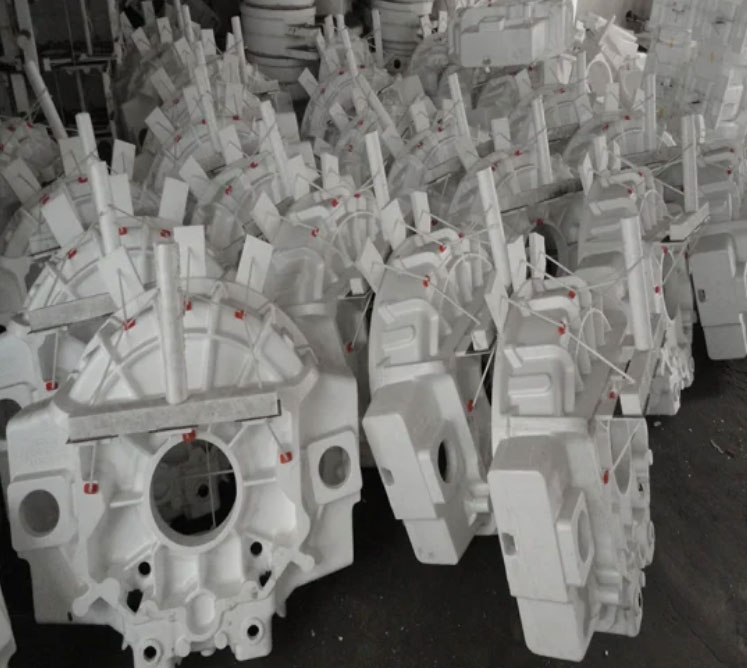
The adaptability of lost foam casting to different materials and part geometries is a significant advantage, but it requires careful consideration. I have found that lost foam casting is most suitable for gray iron castings, followed by ductile iron, steel, and aluminum. The table below summarizes the optimal conditions for lost foam casting based on material and structure, which can guide practitioners in selecting appropriate applications.
| Material Type | Recommended Part Structures | Weight Range (kg) | Key Considerations |
|---|---|---|---|
| Gray Iron | Uniform wall thickness, complex shapes (e.g., housings) | 10-500 | Minimize slag inclusion through proper venting |
| Ductile Iron | Similar to gray iron, but with attention to carbon defects | 10-300 | Use low-carbon foam materials |
| Steel | Non-machined parts, wear-resistant components | 5-200 | Enhance coating high-temperature strength |
| Aluminum | Simple structures, low pouring temperature applications | 1-50 | Avoid foam liquefaction and gas porosity |
In lost foam casting, the vacuum pressure plays a pivotal role in mold stability and metal flow. The pressure distribution within the mold can be approximated using the Laplace equation for potential flow: $$ \nabla^2 P = 0 $$ where \( P \) represents the pressure field. Solving this equation for complex part geometries helps in designing effective vacuum systems that prevent collapse defects. For instance, in large castings, maintaining a uniform vacuum is critical; any imbalance can lead to sand movement and subsequent failure. I recommend using computational fluid dynamics (CFD) simulations to optimize vacuum settings for specific lost foam casting applications.
Another critical aspect is the foam pattern itself. The density and composition of the foam directly influence gas generation and residue. The relationship between foam density and gas volume can be expressed as: $$ V_g = \rho_f \cdot V_f \cdot k_g $$ where \( V_g \) is the gas volume produced, \( \rho_f \) is the foam density, \( V_f \) is the foam volume, and \( k_g \) is a gas yield constant. Lowering foam density reduces residual carbon, but it must be balanced with sufficient mechanical strength to prevent deformation during handling and sand filling. In lost foam casting, using co-polymer materials like STMMA instead of EPS can significantly reduce carbon defects, as they have lower carbon content and better thermal properties.
Coating quality is equally vital in lost foam casting. The coating must exhibit high permeability, strength, and refractoriness. The permeability \( K \) can be related to coating thickness \( t \) and pore structure by the Kozeny-Carman equation: $$ K = \frac{\phi^3}{k_c (1 – \phi)^2 S^2} $$ where \( \phi \) is the porosity, \( S \) is the specific surface area, and \( k_c \) is a constant. This equation underscores the importance of coating formulation in ensuring efficient gas escape during pouring. In practice, I advocate for automated coating application to achieve uniform thickness and consistency, which are crucial for defect-free lost foam casting.
When it comes to defect mitigation, a systematic approach is necessary. For slag inclusion, the strategy involves sealing, venting, and dispersion. This can be summarized in a formula for defect probability: $$ P_d = 1 – \prod_{i=1}^{n} (1 – p_i) $$ where \( P_d \) is the overall defect probability, and \( p_i \) is the defect probability at each process step. If each of the ten main steps in lost foam casting has a 90% success rate, the overall yield is only about 34.9%. Improving each step to 99% raises the yield to over 90%, highlighting the cumulative impact of precision in lost foam casting.
| Process Step | Key Parameters | Recommended Practices | Defect Risks if Neglected |
|---|---|---|---|
| Foam Pattern Making | Density, bead size, molding pressure | Use low-density, high-strength foams; optimize mold design | Deformation, carbon deposition |
| Pattern Assembly | Adhesive type, joint accuracy | Automate bonding; ensure precise alignment | Leaks, slag inclusion |
| Coating Application | Thickness, permeability, drying | Apply uniformly; control drying temperature and time | Sand adhesion, gas porosity |
| Sand Filling and Compaction | Vibration frequency, amplitude, sand flow | Use advanced vibrators for uniform compaction | Deformation, collapse |
| Pouring | Pouring rate, temperature, vacuum level | Maintain steady flow; monitor vacuum stability | Slag inclusion, porosity |
| Solidification and Cooling | Cooling rate, vacuum duration | Control cooling to minimize stresses | Shrinkage, cracking |
For carbon deposition defects, the focus should be on reducing carbon sources and enhancing venting. The carbon content in the foam can be linked to the defect severity through a simple mass balance: $$ m_c = \rho_c \cdot V_c $$ where \( m_c \) is the mass of carbon residue, \( \rho_c \) is the carbon density in the foam, and \( V_c \) is the volume of foam decomposed. By selecting low-carbon foams and ensuring thorough drying of patterns and coatings, the risk of carbon-related issues in lost foam casting can be minimized. Additionally, incorporating venting channels and overflow risers helps in expelling carbon-rich gases.
In the case of sand adhesion, the mechanical interlocking of sand grains with the metal surface can be analyzed using shear strength models. The critical stress for adhesion \( \tau_c \) can be expressed as: $$ \tau_c = \sigma_n \tan(\phi) + c $$ where \( \sigma_n \) is the normal stress, \( \phi \) is the friction angle, and \( c \) is the cohesion. In lost foam casting, improving coating strength and sand compaction reduces the likelihood of coating failure and sand penetration. For steel castings, where chemical bonding may occur, using high-refractoriness coatings is essential.
Deformation defects in lost foam casting often stem from inadequate support during pattern handling and sand filling. The strain \( \epsilon \) in a foam pattern under load can be modeled with Hooke’s law for viscoelastic materials: $$ \sigma = E \epsilon + \eta \frac{d\epsilon}{dt} $$ where \( \sigma \) is the stress, \( E \) is the elastic modulus, \( \eta \) is the viscosity, and \( t \) is time. To prevent deformation, it is crucial to use supportive fixtures during drying and transportation, and to optimize vibration parameters for even sand distribution. In lost foam casting, investing in high-quality vibration equipment with multi-directional capabilities can significantly reduce deformation risks.
Porosity formation is closely tied to gas evolution and venting efficiency. The ideal gas law can be applied to estimate the gas volume: $$ PV = nRT $$ where \( P \) is pressure, \( V \) is volume, \( n \) is the number of moles of gas, \( R \) is the gas constant, and \( T \) is temperature. In lost foam casting, ensuring high coating permeability and proper vacuum levels allows gases to escape before metal solidification. Pre-drying patterns and coatings to eliminate moisture is also critical, as water vapor can significantly increase gas volume and porosity.
Collapse defects, or mold溃型, are among the most severe in lost foam casting. They occur when vacuum imbalances cause sand to shift, creating voids. The stability of the sand mold can be assessed using the factor of safety \( F_s \) against collapse: $$ F_s = \frac{\text{resisting force}}{\text{driving force}} $$ where the resisting force includes sand cohesion and vacuum support, and the driving force comes from metal pressure and thermal effects. Maintaining a uniform vacuum distribution and adequate sand compaction are key to preventing collapse in lost foam casting. For large castings, incorporating internal vacuum aids within complex cavities can enhance stability.
Looking ahead, the future of lost foam casting lies in technological advancements and deeper theoretical understanding. I believe that research should focus on elucidating the fundamental principles of metal-foam interactions under vacuum. For example, developing comprehensive models that integrate fluid dynamics, thermodynamics, and material science could transform lost foam casting from an experience-based art to a predictive science. The equation for overall process efficiency \( \eta \) in lost foam casting might be expressed as: $$ \eta = f(Q_m, V_v, T_p, C_s) $$ where \( Q_m \) is metal quality, \( V_v \) is vacuum control, \( T_p \) is process timing, and \( C_s \) is coating stability. By optimizing these variables, lost foam casting can achieve higher consistency and broader applicability.
In conclusion, lost foam casting is a powerful yet demanding process that requires meticulous attention to detail. Through the integration of robust process controls, advanced materials, and empirical insights, the challenges of lost foam casting can be overcome. I am confident that by embracing a culture of precision and continuous improvement, the industry will unlock the full potential of lost foam casting, leading to higher quality castings and sustainable growth. The journey may be complex, but the rewards of mastering lost foam casting are well worth the effort.