
In modern foundry practices, the demand for high-quality, large-scale ductile iron castings has driven the adoption of advanced processes like lost foam casting, particularly using resin sand molds. This method, often referred to as full mold casting or EPC (Expendable Pattern Casting), combines the benefits of foam pattern elimination with the robustness of resin-bonded sand, making it ideal for producing complex and heavy components. Our experience in developing this process for a heavy ductile iron table casting, weighing approximately 18,350 kg with critical dimensions and thick sections up to 450 mm, highlights the effectiveness of lost foam casting in achieving precise geometries and minimizing defects. The integration of resin sand enhances mold stability and surface finish, while the EPC approach simplifies pattern handling and reduces production time. In this article, we delve into the detailed methodology, including pattern design, gating system optimization, and process controls, to demonstrate how lost foam casting can be tailored for challenging applications. By leveraging empirical data, mathematical models, and practical insights, we aim to provide a comprehensive guide for implementing this technique in similar heavy-section castings, emphasizing the repeated application of lost foam casting and EPC principles to ensure reproducibility and quality.
The structural complexity of the table casting, characterized by irregular assembly surfaces and deep internal features, necessitated a meticulous approach to pattern fabrication and mold assembly. Lost foam casting, with its foam patterns that vaporize during pouring, eliminates the need for traditional cores and complex parting lines, thereby reducing errors and labor. However, this advantage comes with challenges such as gas evolution and potential defects like slag inclusion or shrinkage, which must be addressed through careful工艺 design. Our process began with creating a foam pattern that mirrored the final casting, incorporating allowances for machining and shrinkage. The pattern was segmented into modules for ease of manufacturing and assembled with precision, ensuring dimensional accuracy. The use of high-density polystyrene foam (20–22 g/L) provided the necessary strength to withstand molding pressures. After assembly, the pattern was dried and coated with multiple layers of refractory coatings to control gas permeability and prevent metal penetration. This foundational step in lost foam casting sets the stage for a successful casting process, as any imperfections in the pattern can propagate into the final product.
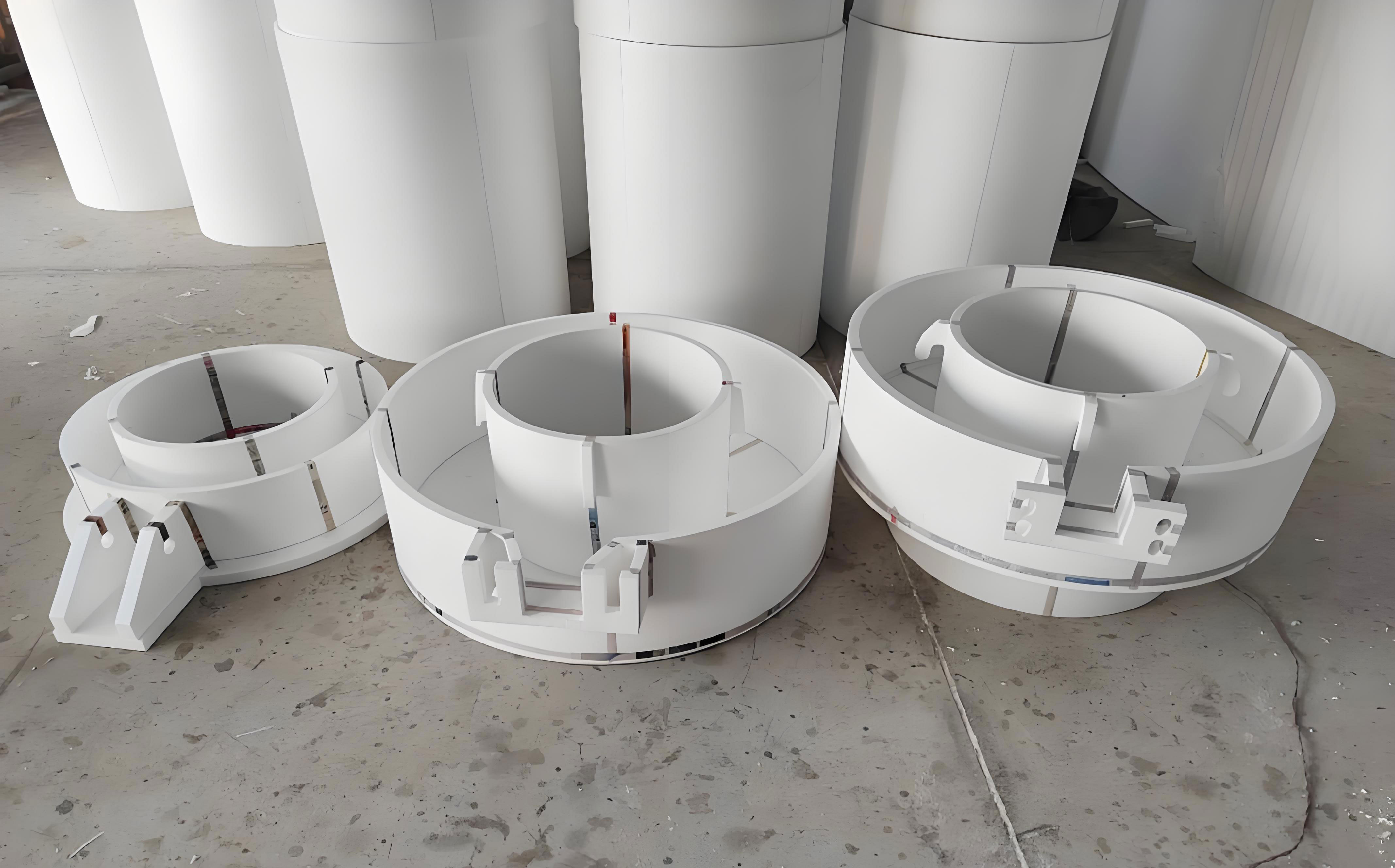
To support the large cavity in the pattern during molding, a dedicated foam support structure was employed, which acted as a temporary bolster to prevent deformation under sand compaction forces. This auxiliary tool, reusable across multiple cycles, exemplifies the adaptability of lost foam casting in handling bulky geometries. The molding process involved using furan resin sand with a controlled binder ratio of 0.9% to 1.2%, ensuring adequate strength and collapsibility. Key to this stage was the strategic placement of venting channels and pre-formed ceramic cores for internal features, which facilitated gas escape and maintained dimensional integrity. The design of the gating system played a pivotal role in managing fluid flow and solidification, critical for heavy-section ductile iron castings prone to issues like graphite flotation and shrinkage porosity.
The gating system was engineered as an open two-tier stepped configuration, with bottom gates for initial filling and top gates for slag removal and feeding. This design aligns with the principles of lost foam casting, where rapid and continuous pouring is essential to minimize pattern degradation byproducts. The浇注 time was calculated based on empirical formulas for gray iron, adjusted for ductile iron’s characteristics. For instance, the浇注 time \( t \) was derived using the equation:
$$ t = S_2 \sqrt[3]{G_L} $$
where \( G_L \) represents the total weight of metal in the mold (19,945 kg) and \( S_2 \) is a wall thickness coefficient (2.2). This yielded an initial time of 310 seconds, which was halved for dual pouring and further reduced to 90 seconds to account for the faster solidification of ductile iron. The choke area \( \sum A_{\text{阻}} \) was determined as:
$$ \sum A_{\text{阻}} = \frac{G_L}{0.31 \mu t \sqrt{H_p}} $$
with a flow coefficient \( \mu \) of 0.5 and metallostatic head \( H_p \) of 40 cm. This resulted in a choke area of 113 cm², leading to the selection of a 120 mm diameter ceramic tube for the sprue. The cross-sectional ratios were maintained at \( A_{\text{直}} : A_{\text{横}} : A_{\text{内}} = 1 : 1.6 : 1.8 \), with rectangular runners and trapezoidal ingates to ensure uniform flow distribution. Such calculations are integral to lost foam casting, as they directly impact the elimination of defects like folds and inclusions common in EPC processes.
| Parameter | Value | Description |
|---|---|---|
| Pattern Material | Polystyrene Foam | Density: 20–22 g/L for strength and stability |
| Coating Thickness | 3–3.5 mm | Applied via dipping and brushing for gas control |
| Drying Temperature | 45–55 °C | Ensures moisture removal without distortion |
| Resin Binder | 0.9–1.2% | Furan resin for mold integrity and collapsibility |
Chill placement was another critical aspect, with external chills used in thick sections to promote directional solidification and prevent shrinkage defects. These chills, made of steel, were surface-treated and coated to avoid oxidation and ensure tight contact with the mold. In lost foam casting, the use of chills complements the vaporization of the foam by accelerating heat extraction in critical zones, thereby enhancing the feeding efficiency of risers. The riser design included ten 280 mm × 400 mm necks positioned atop the casting to collect hot metal and facilitate slag flotation. Venting channels, both internal and external, were incorporated to expedite gas evolution during pouring, a hallmark of effective EPC practices that mitigate porosity risks.
During molding, the pattern was secured with the support structure, and the resin sand was compacted around it. Ceramic cores for deep holes were pre-embedded and fixed with steel reinforcements to prevent displacement during foam decomposition. This step underscores the importance of rigidity in lost foam casting, as any movement could lead to dimensional inaccuracies. After molding, the mold was sealed and prepared for pouring, with emphasis on maintaining a controlled environment to handle the gases released from the foam.
| Process Stage | Key Actions | Impact on EPC Quality |
|---|---|---|
| Pattern Assembly | Module segmentation and adhesive bonding | Ensures dimensional precision and reduces errors |
| Coating Application | Multi-layer refractory coatings | Controls gas permeability and metal penetration |
| Gating System Setup | Dual-tier open design with calculated areas | Minimizes turbulence and slag entrapment |
| Chill Integration | Strategic placement in thick sections | Enhances solidification control and defect reduction |
The metallurgical treatment involved a two-stage process of pretreatment and inoculation to achieve the desired microstructure in ductile iron. Pretreatment with 0.8% silicon carbide enhanced nucleation sites, improving fluidity and reducing shrinkage tendencies. This was followed by ladle treatment using 1.2% ZFCR-7 nodularizing agent and 0.6% YFY-150 inoculant, with multiple inoculation steps to counteract fading effects. The composition was controlled within tight ranges: 3.4–3.6% carbon, 2.3–2.5% silicon, and minimal impurities like sulfur and phosphorus. The residual magnesium was maintained at 0.04–0.06% to ensure spherical graphite formation. Such treatments are vital in lost foam casting for heavy sections, as they influence the final mechanical properties and defect prevalence.
Pouring was conducted simultaneously from two ladles at a temperature of 1,410–1,420 °C, higher than conventional sand casting to compensate for the cooling effect of foam decomposition. The rapid, uninterrupted flow was crucial to prevent cold shuts and ensure complete pattern vaporization. In-stream inoculation at 0.08–0.1% further refined the graphite structure during pouring. The entire process emphasized the principles of lost foam casting, where temperature and flow dynamics are optimized to handle the unique challenges of EPC, such as gas generation and residue management.
Post-pouring, the casting was allowed to cool naturally within the mold for 96 hours, leveraging the insulating properties of resin sand to achieve stress relief and dimensional stability. This slow cooling is a key advantage of lost foam casting, as it reduces thermal stresses and minimizes distortion. After shakeout, the risers and gating systems were removed, revealing a sound casting with minimal surface defects. Mechanical testing and metallographic analysis confirmed the achievement of grade QT500-7 properties, with tensile strengths exceeding 500 MPa and elongation over 7%. The microstructure exhibited well-formed spheroidal graphite with minimal pearlite, attesting to the efficacy of the process controls.
| Sample ID | Tensile Strength (MPa) | Yield Strength (MPa) | Elongation (%) |
|---|---|---|---|
| 1 | 520 | 330 | 7.2 |
| 2 | 508 | 322 | 8.2 |
| 3 | 532 | 332 | 8.0 |
| 4 | 524 | 325 | 7.6 |
The success of this project underscores the potential of lost foam casting for heavy ductile iron components, provided that comprehensive工艺 planning and execution are employed. By integrating resin sand with EPC methodologies, we achieved a balance between efficiency and quality, addressing common defects through systematic design. Future advancements in lost foam casting could focus on optimizing foam compositions and coating technologies to further reduce environmental impacts and enhance performance. As the foundry industry evolves, the adoption of lost foam casting and EPC processes will continue to play a pivotal role in meeting the demands for high-integrity, large-scale castings, reinforcing the importance of continuous innovation in this field.
In conclusion, the resin sand lost foam casting process offers a robust solution for producing heavy ductile iron castings, with demonstrated benefits in accuracy, cost-effectiveness, and defect control. The repeated emphasis on lost foam casting and EPC throughout this discussion highlights their centrality in modern foundry operations. Through rigorous application of the outlined strategies, manufacturers can leverage this technique to overcome the challenges of thick-section castings, paving the way for broader adoption in industrial applications.