
In the field of industrial materials, high manganese steel casting has long been recognized for its exceptional wear resistance and impact toughness, making it ideal for heavy-duty applications such as mining and construction equipment liners. The microstructure and mechanical properties of these castings are highly dependent on the thermal transport and solidification behaviors during the manufacturing process. Over the years, we have extensively studied various casting techniques and numerical simulation methods to optimize the quality and performance of high manganese steel liners. This article delves into the progress in casting processes, including sand casting, metal mold casting, lost foam casting, and V-process casting, as well as the application of numerical simulations like the discrete element method (DEM) and finite element method (FEM). By integrating these approaches, we aim to enhance defect control, microstructure regulation, and overall efficiency in high manganese steel casting. Throughout this discussion, we will emphasize the critical role of process parameters, material properties, and simulation tools, supported by tables and mathematical models to summarize key insights. The ultimate goal is to provide a comprehensive overview that bridges traditional foundry practices with modern computational advances, paving the way for future innovations in high manganese steel casting.
The development of high manganese steel casting dates back to the late 19th century, and its evolution has been driven by the need for durable components in abrasive environments. Traditional high manganese steel compositions, as summarized in Table 1, typically include carbon, silicon, and manganese in specific ranges to achieve the desired austenitic structure and work-hardening characteristics. The casting process directly influences defects such as shrinkage porosity and hot tearing, which can compromise liner performance. In our research, we have focused on optimizing these processes through empirical studies and numerical modeling. For instance, the heat transfer during solidification can be described by the Fourier heat equation: $$ \frac{\partial T}{\partial t} = \alpha \nabla^2 T $$ where \( T \) is temperature, \( t \) is time, and \( \alpha \) is the thermal diffusivity. This equation helps predict temperature gradients and cooling rates, which are crucial for controlling grain size and carbide precipitation in high manganese steel casting. Additionally, we have explored how variations in pouring temperature and mold design affect the final product, leading to improved mechanical properties and longevity. As we proceed, we will examine each casting method in detail, highlighting their unique mechanisms and applicability.
| Element | Range |
|---|---|
| C | 0.9–1.5 |
| Si | 0.3–1.0 |
| Mn | 10–15 |
| S | ≤0.05 |
| P | ≤0.10 |
Sand casting remains one of the most widely used methods in high manganese steel casting due to its versatility and cost-effectiveness for large liners. However, it often faces challenges like shrinkage defects and poor surface finish. In our investigations, we have optimized sand casting by refining riser design and gating systems. For example, the solidification time \( t_s \) can be estimated using Chvorinov’s rule: $$ t_s = k \left( \frac{V}{A} \right)^2 $$ where \( V \) is the volume, \( A \) is the surface area, and \( k \) is a mold constant. By applying this, we have reduced defects through sequential solidification control. Moreover, the use of chill plates and alkaline sands like magnesium olivine has enhanced density and grain refinement. Table 2 compares the properties of traditional and modified high manganese steel from sand casting, showing improvements in tensile strength and impact toughness. Despite these advances, sand casting in high manganese steel casting often results in lower yield rates due to large risers, necessitating further innovations in cutting techniques and process integration.
| Property | Traditional High Manganese Steel | Modified High Manganese Steel |
|---|---|---|
| Tensile Strength (MPa) | 608 | 916 |
| Elongation (%) | 13 | 34 |
| Impact Toughness (J/cm²) | 112 | 1187 |
| Hardness (HBS) | 210 | 224 |
Metal mold casting offers a significant upgrade in high manganese steel casting by replacing sand molds with reusable metal dies, improving dimensional accuracy and surface quality. We have studied the heat exchange between the mold and casting, which is governed by the interfacial heat transfer coefficient (IHTC). The IHTC varies with pouring temperature, as shown in the relationship: $$ h = f(T_p) $$ where \( h \) is the IHTC and \( T_p \) is the pouring temperature. Our experiments indicate that higher pouring temperatures increase the peak IHTC, leading to faster cooling but potential thermal fatigue. To address this, we have adopted sand-coated metal molds, which provide a balanced cooling rate and suppress carbide precipitation. The cooling rate \( \dot{T} \) can be modeled as: $$ \dot{T} = \frac{h (T_m – T_c)}{\rho c_p} $$ where \( T_m \) is the melt temperature, \( T_c \) is the mold temperature, \( \rho \) is density, and \( c_p \) is specific heat. This approach has yielded as-cast structures with fine grains, eliminating the need for heat treatment in some cases. Additionally, coatings with materials like hexagonal boron nitride have improved mold life and reduced environmental impact. However, metal mold casting in high manganese steel casting requires precise control over parameters to avoid defects like cold shuts and sticking, highlighting the need for continuous optimization.
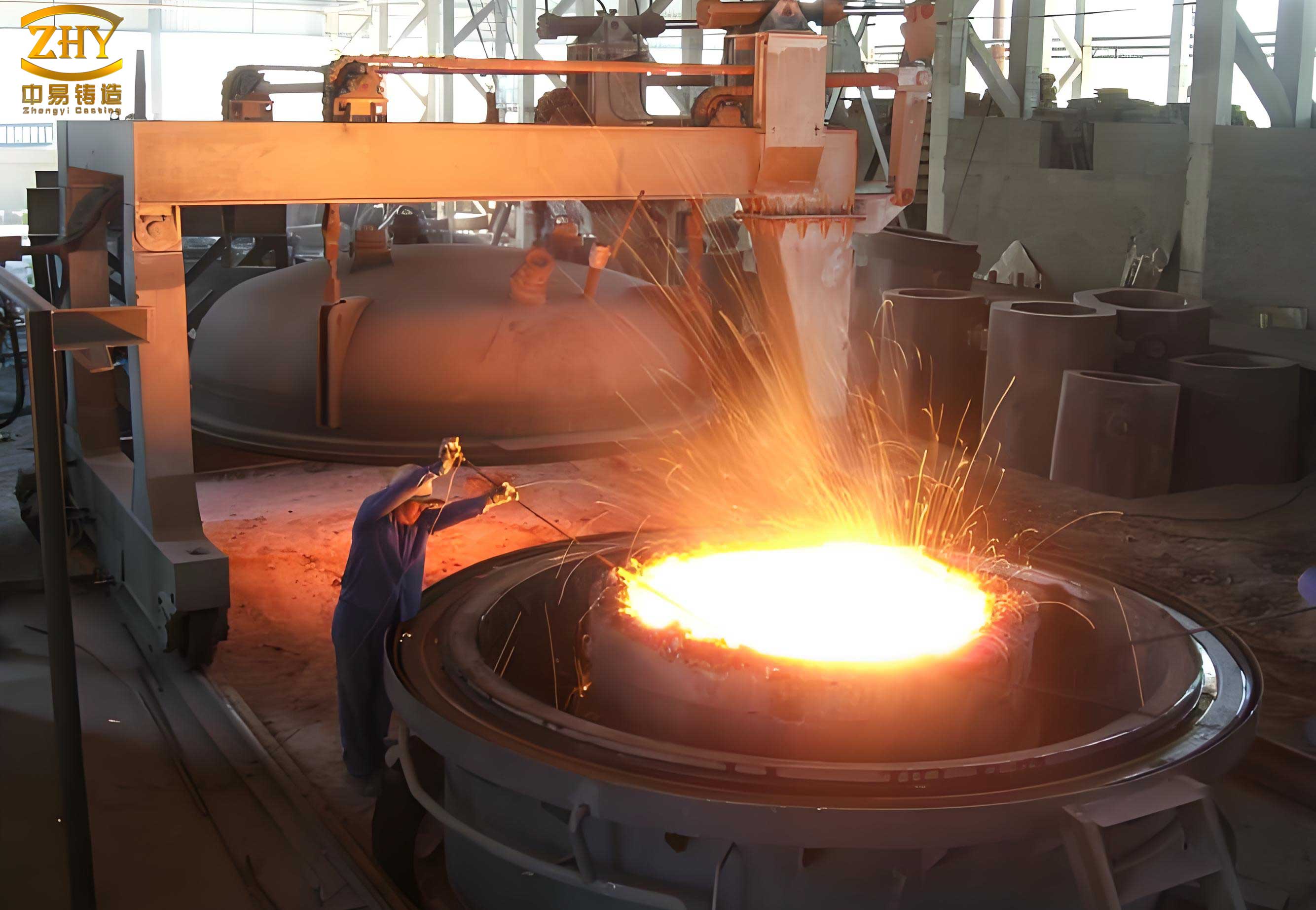
Lost foam casting has revolutionized high manganese steel casting by enabling the production of complex geometries through the vaporization of foam patterns. We have focused on optimizing gating systems and pouring parameters to minimize turbulence and defects. The filling process can be simulated using fluid dynamics equations, such as the Navier-Stokes equations: $$ \rho \left( \frac{\partial \mathbf{v}}{\partial t} + \mathbf{v} \cdot \nabla \mathbf{v} \right) = -\nabla p + \mu \nabla^2 \mathbf{v} + \mathbf{f} $$ where \( \mathbf{v} \) is velocity, \( p \) is pressure, \( \mu \) is viscosity, and \( \mathbf{f} \) is body force. By employing bottom gating and multiple flat gates, we have achieved smoother filling and reduced shrinkage. Pouring temperature plays a critical role; our research shows that around 1480°C optimal for balancing fluidity and grain structure. The relationship between pouring temperature \( T_p \) and impact toughness \( K \) can be expressed as: $$ K = a T_p^2 + b T_p + c $$ where \( a, b, c \) are constants derived from experimental data. Furthermore, coatings with zircon-based materials have enhanced surface finish by preventing sand adhesion. Despite its advantages, lost foam casting in high manganese steel casting demands careful control of pattern density and vacuum levels to avoid gas porosity, underscoring the importance of integrated process design.
V-process casting, or vacuum sealed molding, has emerged as a green alternative in high manganese steel casting, utilizing dry sand and plastic films under vacuum to form molds. We have investigated the effects of vacuum pressure and pouring temperature on defect formation. The vacuum pressure \( P_v \) influences the mold stability, and the optimal range is typically between -0.45 to -0.50 MPa. The heat transfer during solidification can be described by: $$ \frac{\partial}{\partial x} \left( k \frac{\partial T}{\partial x} \right) + \frac{\partial}{\partial y} \left( k \frac{\partial T}{\partial y} \right) + \frac{\partial}{\partial z} \left( k \frac{\partial T}{\partial z} \right) = \rho c_p \frac{\partial T}{\partial t} $$ where \( k \) is thermal conductivity. By maintaining pouring temperatures around 1510°C, we have minimized sand burning and improved filling completeness. Coatings with refractory aggregates like zircon powder have shown better drying performance, as summarized in Table 3, which compares drying times for different particle sizes. The drying rate \( \dot{D} \) can be modeled as: $$ \dot{D} = \frac{k_d (H_e – H_a)}{t} $$ where \( k_d \) is a drying constant, \( H_e \) is equilibrium humidity, and \( H_a \) is ambient humidity. V-process casting in high manganese steel casting offers superior surface finish and reduced binder usage, but it requires precise control over film integrity and vacuum uniformity to handle complex shapes effectively.
| Coating Type | Particle Size (mesh) | Drying Time (min) |
|---|---|---|
| Zircon Powder | 250–320 | 25 |
| Zircon Powder | 320–400 | 20 |
| Zircon Powder | >400 | 15 |
| Quartz Powder | 320–400 | 30 |
Numerical simulation techniques have become indispensable in advancing high manganese steel casting, with discrete element method (DEM) and finite element method (FEM) leading the way. In DEM, we analyze the wear mechanisms of liners by simulating particle interactions. The contact force between particles and the liner can be calculated using: $$ F_c = k_n \delta_n + c_n \dot{\delta}_n $$ where \( k_n \) is the normal stiffness, \( \delta_n \) is the overlap, and \( c_n \) is the damping coefficient. Our DEM studies have revealed that optimizing lifter bar height and angle reduces localized stress and wear. For instance, the wear volume \( V_w \) over time \( t \) can be estimated as: $$ V_w = K_w F_n s $$ where \( K_w \) is a wear coefficient, \( F_n \) is the normal force, and \( s \) is the sliding distance. By adjusting lifter designs, we have extended liner life in ball mills. However, DEM in high manganese steel casting requires careful calibration of material properties to avoid inaccuracies in stress prediction.
Finite element method (FEM) has enabled us to simulate the entire high manganese steel casting process, from filling to solidification and heat treatment. We use coupled thermal-stress analyses to predict defects like shrinkage porosity. The energy equation for solidification is: $$ \rho c_p \frac{\partial T}{\partial t} = \nabla \cdot (k \nabla T) + Q_l $$ where \( Q_l \) is the latent heat release. Our FEM models have optimized gating designs and pouring speeds, reducing defect rates from 35% to below 10% in some cases. For example, the porosity fraction \( \phi \) can be related to the solidification rate \( R \) by: $$ \phi = A e^{-B R} $$ where \( A \) and \( B \) are material constants. In heat treatment simulations, we have analyzed quenching processes to minimize residual stresses, using equations like: $$ \sigma = E \epsilon $$ where \( \sigma \) is stress, \( E \) is Young’s modulus, and \( \epsilon \) is strain. FEM in high manganese steel casting provides insights into microstructure evolution, but it demands high computational resources for complex geometries, urging the development of multi-scale models.
In summary, the integration of advanced casting processes and numerical simulations has significantly propelled the field of high manganese steel casting forward. We have seen how sand casting, metal mold casting, lost foam casting, and V-process casting each offer unique benefits in terms of defect control, microstructure refinement, and economic efficiency. Numerical methods like DEM and FEM have complemented these by enabling predictive optimization and reducing trial-and-error approaches. For instance, the overall quality index \( Q \) for a casting can be expressed as: $$ Q = \sum_{i=1}^n w_i f_i(P) $$ where \( w_i \) are weights, \( f_i \) are functions of process parameters \( P \). Looking ahead, we anticipate that further research in high manganese steel casting will focus on multi-physics simulations, real-time monitoring, and sustainable practices. Challenges such as model accuracy and process integration remain, but by leveraging these tools, we can achieve higher performance liners with longer service lives, ultimately benefiting industries reliant on durable components.