
In my extensive experience within the foundry industry, the lost foam casting process has emerged as a transformative technique for producing intricate and high-quality castings. Originally employed for ductile iron pipe fittings and gray iron components, we have progressively adapted the lost foam casting process to handle challenging materials such as heat-resistant, wear-resistant irons, and even stainless steels. This evolution underscores the versatility of the lost foam casting process, particularly for single-piece or small-batch production where traditional methods face limitations in cost, cycle time, and complexity. The ability to create patterns from expandable polystyrene (EPS) foam without the need for cores or complex molding lines offers significant advantages. In this article, I will delve into the detailed application of the lost foam casting process for several critical industrial castings, analyzing工艺 parameters, encountered challenges, and innovative solutions. Through comprehensive summaries using tables and formulas, I aim to provide a deep understanding of optimizing the lost foam casting process for diverse applications.
The foundational principle of the lost foam casting process involves creating a foam pattern that is coated with a refractory coating, embedded in unbonded sand, and then replaced by molten metal during pouring. The foam vaporizes, leaving a precise cavity that forms the casting. Key advantages include reduced machining allowances, elimination of core-making, and design flexibility. However, successful implementation requires careful control of parameters such as pattern integrity, coating properties, pouring temperature, vacuum assistance, and solidification dynamics. The lost foam casting process is particularly sensitive to these factors, and our work has focused on refining them for large-scale and complex geometries.
To systematically analyze our applications, I will present data in tabular form and employ mathematical models to describe underlying physical phenomena. For instance, the thermal dynamics during foam decomposition and metal filling can be approximated using heat transfer equations. A critical formula in casting is Chvorinov’s rule for solidification time:
$$ t = k \left( \frac{V}{A} \right)^2 $$
where \( t \) is the solidification time, \( V \) is the volume of the casting, \( A \) is its surface area, and \( k \) is a constant dependent on mold material and metal properties. In the lost foam casting process, the presence of the foam and coating modifies this relationship, requiring empirical adjustments. Another relevant formula is for calculating the theoretical pouring temperature \( T_p \):
$$ T_p = T_l + \Delta T_{superheat} + \Delta T_{loss} $$
where \( T_l \) is the liquidus temperature of the alloy, \( \Delta T_{superheat} \) is the necessary overheating for fluidity, and \( \Delta T_{loss} \) accounts for heat loss during transfer. For the lost foam casting process, higher pouring temperatures may be needed to ensure complete foam vaporization but must be balanced against risks like penetration and carbon pickup.
The following table summarizes the basic characteristics of the three primary castings discussed, highlighting the scope of the lost foam casting process applications:
| Casting Name | Material Specification | Net Weight (kg) | Approximate Dimensions (mm) | Average Wall Thickness (mm) | Key Challenges in Lost Foam Casting |
|---|---|---|---|---|---|
| Blast Furnace Column | RQTSi4Mo (Heat-resistant iron) | 1250 | Ø345 × 1670 height | 60 | Pattern strength, sand penetration, low vacuum in cavity |
| Windlass Drum | QT420-5 (Ductile Iron) | 2650 | Ø1194 × 1400 height | 60 (body), 120 (ends) | Large pattern assembly, coating integrity, internal shrinkage |
| Cyclone for Multi-tube Dust Catcher | Wear-resistant Cast Iron | Variable (lightweight) | ~1000 height, conical | 12 | Thin-wall filling, hot tearing, dimensional accuracy |
Each casting presents unique demands on the lost foam casting process, necess tailored工艺 strategies. I will now explore these in detail, integrating formulas and tables to encapsulate our learnings.
Blast Furnace Column: Managing Thick Sections and Cavity Vacuum
The blast furnace column is a cylindrical structure with flanges at both ends, requiring the lost foam casting process to handle its substantial mass and relatively thick walls. Traditional sand casting would involve complex patternmaking with loose pieces, increasing lead time and cost. The lost foam casting process simplified pattern construction using EPS sheets and pre-formed tubes. However, the工艺 required meticulous planning.
Pattern Assembly and Coating Strategy: The pattern was assembled from laminated EPS sheets for the flanges and ribs, and rolled EPS tubes for the main body. To ensure dimensional stability during handling and coating, internal temporary supports were used. A critical aspect of the lost foam casting process for thick sections is coating durability. The coating must withstand the prolonged thermal and mechanical冲击 of molten metal. We applied a primary layer of zircon-based coating followed by secondary layers of silica-based coating, achieving a total thickness \( \delta_c \) of over 2 mm. The coating thickness can be related to its resistance to metal penetration via an empirical relation:
$$ P \propto \frac{1}{\delta_c \cdot \sqrt{t_{contact}}} $$
where \( P \) is the penetration tendency and \( t_{contact} \) is the metal-coating contact time. To further enhance resistance, especially in the lower regions prone to metallostatic pressure, we supplemented with an alcohol-based graphite wash.
Vacuum Assistance and Pouring Parameters: A significant challenge in cylindrical geometries with internal cavities is maintaining adequate vacuum to draw away foam decomposition products. The vacuum pressure \( P_{vac} \) in the cavity can be modeled as:
$$ P_{vac}(x) = P_{system} – \Delta P_{flow}(x) $$
where \( P_{system} \) is the vacuum system pressure and \( \Delta P_{flow} \) is the pressure drop along the sand medium, dependent on distance \( x \) from the vacuum source. To mitigate localized low vacuum, we inserted an auxiliary vacuum tube inside the pattern cavity, dramatically improving gas evacuation. Pouring temperature was carefully controlled. For RQTSi4Mo iron, the liquidus \( T_l \) is approximately 1150°C. We aimed for a pouring temperature \( T_p \) around 1250°C, lower than typical for similar sand castings, to reduce thermal loading on the coating. The gating system was designed with a bottom-pouring approach to ensure tranquil filling.
Production Issues and Corrective Actions: Initial trials revealed two main defects: sand penetration (burn-on) and shrinkage porosity near the top flange. Analysis indicated that the coating, though thick, had localized weaknesses. We increased coating uniformity and introduced a stucco application process. For shrinkage, we modified the feeder design from a simple top riser to a wider padding or “kiss” riser. The effectiveness of riser sizing in the lost foam casting process can be estimated using the modulus method:
$$ M_{riser} \geq 1.2 \times M_{casting} $$
where modulus \( M = V/A \). By increasing the riser’s cross-sectional area, we improved feeding. The table below summarizes the finalized工艺 parameters for the blast furnace column using the lost foam casting process:
| Parameter | Value/Range | Rationale |
|---|---|---|
| Pattern Material | EPS (Expanded Polystyrene) density 20 kg/m³ | Balance of strength and vaporization |
| Coating System | Zircon primer (0.5 mm) + Silica layers (1.5 mm total) + Graphite wash (local) | High refractoriness for thick sections |
| Coating Thickness, \( \delta_c \) | 2.0 – 2.5 mm | Empirical optimum to resist penetration |
| Pouring Temperature, \( T_p \) | 1240 – 1260 °C | Lower than sand casting to protect coating |
| Vacuum Level | 0.04 – 0.05 MPa (main), with internal auxiliary tube | Ensure gas evacuation from internal cavity |
| Feeder Design | Wide padding riser at top flange | Modulus \( M_{riser} \approx 1.5 \times M_{hotspot} \) |
| Sand Type | Dry silica sand, AFS GFN 55 | Good flowability and permeability |
Through these adjustments, the lost foam casting process yielded sound castings with satisfactory surface finish and dimensional accuracy, validating its suitability for heavy-section, cylindrical components.
Windlass Drum: Scaling Up the Lost Foam Casting Process for Massive Castings
The windlass drum, weighing 2.65 tons, represented a significant scale-up for our lost foam casting process capabilities. Its complex geometry—a large cylinder with internal ribs and end plates—posed challenges in pattern assembly, coating integrity, and solidification control. The lost foam casting process was chosen over conventional sand casting to avoid massive core-making and to achieve better surface detail.
Pattern Engineering for Dimensional Stability: Constructing a foam pattern of this size required segmentation to manage deformation. The pattern was divided into the main cylindrical shell, two end discs, and internal rib structures. Assembly sequence was critical: we first joined the end discs to the ribs, then attached the cylindrical shell, aligning all components using reference lines. To counteract warping during drying and handling, strategic reinforcement with EPS braces was employed. The dimensional tolerance of the pattern directly impacts the final casting; any distortion \( \Delta D \) propagates through the process. We maintained \( \Delta D < 0.2\% \) of nominal dimensions through careful sequencing and support.
Advanced Coating and Cooling Techniques: Given the varied wall thickness (60 mm at body, 120 mm at ends), the coating needed exceptional strength. We implemented a multi-layer system: a first coat of zircon-based slurry (high refractoriness), followed by two coats of silica-based slurry, achieving a total thickness \( \delta_c \) of 2–3 mm. The coating’s thermal conductivity \( k_c \) influences the cooling rate; a lower \( k_c \) can help directional solidification. For the lost foam casting process, the effective thermal resistance \( R_{coat} \) is:
$$ R_{coat} = \frac{\delta_c}{k_c} $$
By using zircon in the first layer (\( k_c \) lower than silica), we slightly retarded cooling at the metal-coating interface, reducing thermal shock. In areas of extreme thickness (120 mm), we employed external chills (steel plates) and internal chills (steel rods inserted into the pattern) to promote rapid solidification and avoid shrinkage porosity. The chill effectiveness can be approximated by its chilling modulus \( M_{chill} \):
$$ M_{chill} = \frac{V_{chill}}{A_{chill}} $$
where a higher modulus indicates greater heat extraction capacity.
Vacuum and Feeding Strategy: Similar to the column, an auxiliary vacuum tube was placed inside the drum’s cavity to enhance gas removal. For feeding, a large annular riser was placed atop the central shaft region, supplemented by padding risers at thick sections. The riser volume \( V_{riser} \) was calculated based on the solidification shrinkage of ductile iron (≈5%):
$$ V_{riser} \geq \frac{\varepsilon \cdot V_{casting}}{ \eta } $$
where \( \varepsilon \) is the volumetric shrinkage fraction and \( \eta \) is the feeding efficiency (typically 0.1–0.3 for lost foam due to foam residues). We designed \( V_{riser} \) to be 20% of the casting’s volume to ensure adequacy.
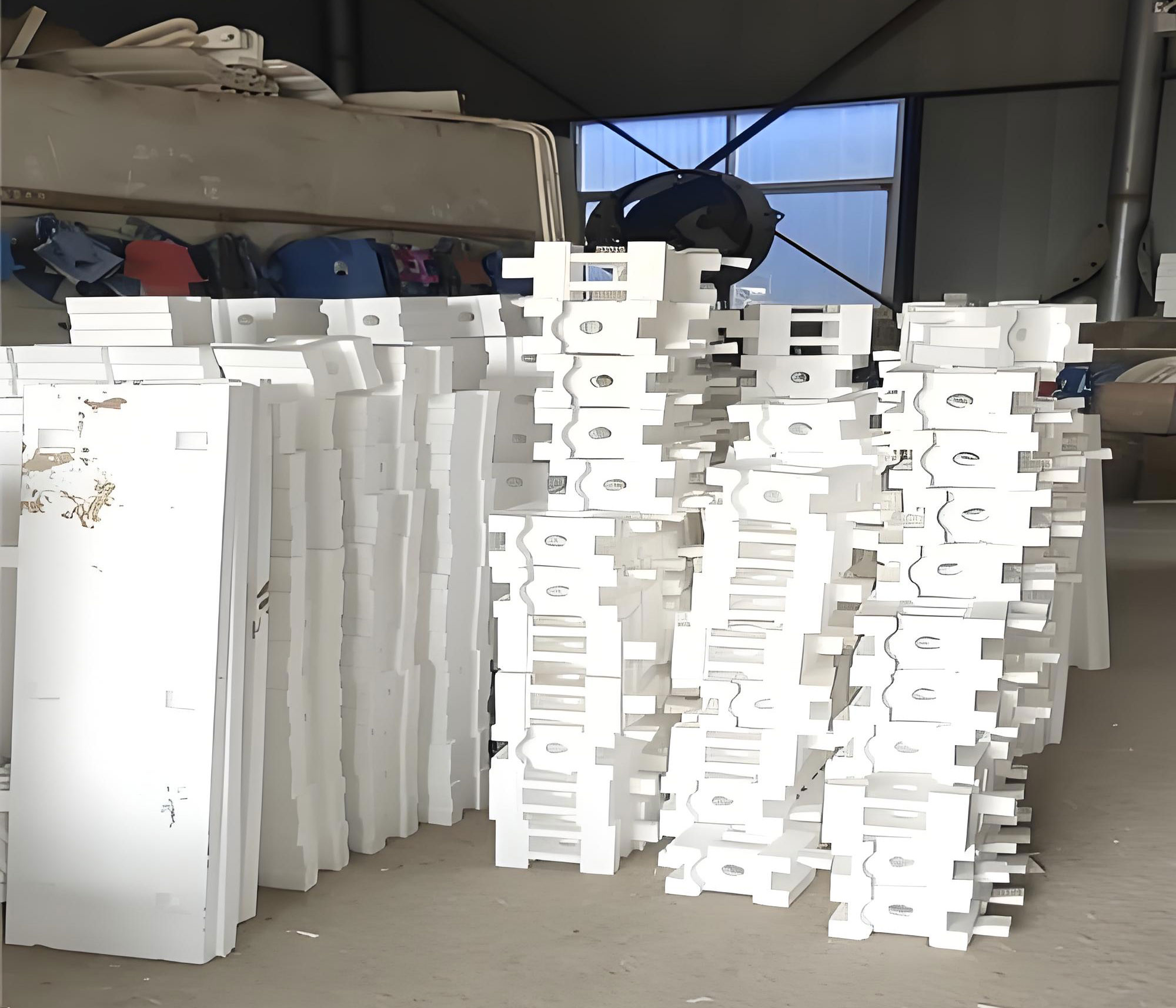
The image above illustrates a typical large foam pattern assembly in the lost foam casting process, similar to the complexity encountered with the windlass drum. It highlights the intricate ribbing and size that the lost foam casting process can accommodate.
Production Outcomes and Lessons: Initial pours revealed minor sand penetration at the bottom regions and some internal shrinkage in the thick end plates. We addressed penetration by increasing coating thickness locally and ensuring proper drying. For shrinkage, we optimized chill placement and increased riser size. The final工艺 parameters are consolidated in the table below, demonstrating the comprehensive approach required for large-scale lost foam casting process applications:
| Aspect | Specification for Windlass Drum | Engineering Principle |
|---|---|---|
| Pattern Segmentation | Cylindrical shell (rolled EPS), End discs (EPS slabs), Ribs (cut EPS) | Manage size-induced deformation; alignment via datum lines |
| Coating Layering | Layer 1: Zircon (0.8 mm), Layers 2 & 3: Silica (1.2 mm each), Graphite touch-up | High-temperature resistance; total \( \delta_c \approx 3.0 \) mm |
| Chill Design | External steel chills on end plates; Internal steel rod chills in thick ribs | Promote directional solidification; \( M_{chill} \) > 5 cm for significant effect |
| Vacuum System | Main vacuum: 0.045 MPa; Auxiliary internal tube (Ø50 mm) connected to grid | Overcome cavity vacuum decay; ensure \( P_{vac}(cavity) < 0.02 \) MPa |
| Pouring Temperature | 1300 – 1320 °C for QT420-5 ( \( T_l \approx 1150°C \) ) | Balance fluidity and reduced carbon pickup; \( \Delta T_{superheat} \approx 150°C \) |
| Feeding System | Annular top riser (modulus 1.8× hotspot) + side padding risers | Compensate for shrinkage in heavy sections; \( V_{riser} \approx 0.2 V_{casting} \) |
| Sand Compaction | Vibratory compaction at 50 Hz for 120 seconds, dry silica sand | Achieve uniform density around pattern; avoid distortion |
This project proved that the lost foam casting process is viable for castings exceeding 2.5 tons, provided that pattern engineering, coating technology, and thermal management are rigorously controlled. The lost foam casting process eliminated the need for extensive core boxes and reduced finishing work, underscoring its economic and technical benefits for large, complex parts.
Cyclone for Dust Catchers: Mastering Thin-Wall and High-Fluidity Demands
The cyclone, a conical thin-walled component used in hundreds per unit, required the lost foam casting process to achieve precise dimensions and smooth surfaces, especially at the flange mouth. The material—wear-resistant cast iron—poses additional challenges due to poor fluidity and high shrinkage tendency, testing the limits of the lost foam casting process.
Pattern Making for Batch Production: To ensure consistency across large quantities, we designed dedicated molds for pattern production. The pattern was split into three modules: a one-piece flange mouth, a two-piece middle section, and a one-piece conical tip. The joints incorporated tongue-and-groove features for accurate assembly. This modular approach in the lost foam casting process allowed for rapid pattern reproduction while maintaining tight tolerances. The flange, being critical for assembly, was reinforced with a resin sand core ring during pattern assembly to prevent distortion during coating and handling.
Optimizing Pouring Parameters for Thin Sections: The primary concern was avoiding misruns and cold shuts in the 12 mm walls. The fluidity of iron in the lost foam casting process is influenced by pouring temperature, coating permeability, and vacuum level. We significantly increased pouring temperature to 1480°C, which is high for cast iron, to enhance fluidity. The required temperature can be estimated considering the foam decomposition endotherm and heat loss through the coating:
$$ T_{p,actual} = T_{l} + \Delta T_{foam} + \Delta T_{coating} + \Delta T_{flow} $$
where \( \Delta T_{foam} \) is the additional heat needed to vaporize the foam (≈100–150°C for EPS), \( \Delta T_{coating} \) is the heat loss through the coating, and \( \Delta T_{flow} \) is the temperature drop along the thin section. Our target of 1480°C ensured that the metal front remained above the liquidus throughout filling.
Addressing Hot Tearing and Solidification Stress: Wear-resistant irons have high shrinkage coefficients, similar to steels, making them prone to hot tearing if contraction is restricted. In the lost foam casting process, the sand mold offers less yield than bonded sand, but vacuum compaction can increase restraint. We modified the molding procedure: while filling the flask with sand, we ensured the internal cavity was filled slightly slower than the exterior, creating a lower compaction density inside. This reduced the hindrance to contraction. Additionally, we released the vacuum shortly after pouring to allow early contraction. The risk of hot tearing \( R_{ht} \) can be qualitatively expressed as:
$$ R_{ht} \propto \frac{E(T) \cdot \alpha \cdot \Delta T_{solid}}{S_{sand}} $$
where \( E(T) \) is the young’s modulus at high temperature, \( \alpha \) is the thermal expansion coefficient, \( \Delta T_{solid} \) is the temperature drop through the solidification range, and \( S_{sand} \) is the sand mold yield strength. By reducing \( S_{sand} \) internally, we minimized \( R_{ht} \).
Coating and Gating for High Temperature: The high pouring temperature necessitated a refractory coating. We used a zircon-based coating as the first layer, topped with silica-based coatings. Each pattern was coated three times, with total thickness around 1.5 mm—thinner than for heavy sections to avoid cracking during drying. The gating system was placed at the mid-height to ensure balanced filling, and two small top risers were added to compensate for shrinkage. For batch efficiency, we arranged three patterns per mold in a triangular layout, optimizing flask utilization. The table below captures the critical工艺 decisions for the cyclone using the lost foam casting process:
| Parameter | Cyclone-Specific Application | Technical Justification |
|---|---|---|
| Pattern Modularity | 3 modules: flange (solid), middle (split), cone (solid) | Enable high-volume production; tongue-and-groove for alignment |
| Flange Reinforcement | Resin sand core ring placed inside flange during assembly | Maintain circularity and dimensional accuracy of critical interface |
| Pouring Temperature, \( T_p \) | 1470 – 1490 °C (wear-resistant iron, \( T_l \approx 1200°C \) ) | Counteract foam endotherm and thin-wall cooling; \( \Delta T_{superheat} \approx 270°C \) |
| Coating System | Zircon base coat (0.4 mm) + Silica top coats (0.6 mm each) = 1.6 mm total | Refractoriness for high \( T_p \); thinner to avoid cracking |
| Molding Technique | Differential sand compaction: internal less dense than external | Reduce contraction resistance; internal \( S_{sand} \approx 0.8 \times \) external |
| Vacuum Management | Vacuum held at 0.05 MPa during pour, released 2 minutes after | Ensure filling, then allow early contraction to reduce stress |
| Gating/Risering | Mid-height gating (1 runner per pattern), 2 small top risers (modulus 1.1×) | Balanced fill for thin walls; minimal risering due to overall shrinkage |
| Pattern Layout per Flask | 3 patterns arranged triangularly, shared pouring basin | Maximize productivity in batch lost foam casting process |
Initial trials showed some misruns and hot cracks. By adjusting pouring speed to be faster and fine-tuning the sand compaction differential, we achieved sound castings. Post-casting, a stress-relief annealing was performed to eliminate residual stresses from the rapid cooling inherent in the lost foam casting process. This case underscores how the lost foam casting process can be adapted for high-volume, thin-wall components with demanding material properties.
Hybrid Process Innovation: Integrating Lost Foam Casting with Conventional Sand Molding
While the lost foam casting process excels in complexity and surface finish, certain limitations—such as carbon pickup, pattern distortion in very large sections, and process instability for specialty steels—prompted exploration of hybrid methods. We developed a novel approach that combines the pattern-making flexibility of the lost foam casting process with the robustness of sand molding. This hybrid lost foam casting process involves creating an EPS pattern, coating and drying it, then using it as a pattern for traditional green sand or resin sand molding, rather than embedding it in unbonded sand under vacuum. This fusion leverages the strengths of both techniques.
Conceptual Framework and Advantages: In this hybrid lost foam casting process, the foam pattern is assembled and coated as usual, but instead of being placed in a flask with loose sand, it is used to produce a sand mold cavity via molding or copying. Essentially, the coated pattern is pressed into or surrounded by bonded sand to create a precise mold impression. After removal of the pattern (or its vaporization during pouring, depending on the variant), the mold cavity is used for pouring. This method mitigates issues like carbon pickup because the foam is not present during pouring (if removed) or is minimal. It also allows use of standard foundry sands and binders, improving mold strength for heavy castings.
Mathematical Modeling of Hybrid Process Benefits: Consider the carbon pickup phenomenon in traditional lost foam casting process. The decomposition of EPS foam releases carbonaceous gases that can dissolve into the molten metal, especially in steels. The carbon increase \( \Delta C \) can be modeled as:
$$ \Delta C = k_{c} \cdot \rho_{foam} \cdot S_{interface} \cdot t_{exposure} $$
where \( k_{c} \) is a rate constant, \( \rho_{foam} \) is the foam density, \( S_{interface} \) is the metal-foam interface area, and \( t_{exposure} \) is the contact time. In the hybrid process, if the foam pattern is removed before pouring, \( t_{exposure} \approx 0 \), eliminating carbon pickup. Even if left in, the mold strength allows for lower foam density, reducing \( \rho_{foam} \).
Another benefit is improved dimensional stability for very large patterns. The foam pattern in pure lost foam casting process can distort under sand compaction forces. In the hybrid lost foam casting process, the pattern is supported by the rigid sand mold during handling. The deflection \( \delta \) of a foam beam under uniform load \( q \) (sand pressure) is:
$$ \delta = \frac{5 q L^4}{384 E_{foam} I} $$
where \( L \) is length, \( E_{foam} \) is foam’s elastic modulus, and \( I \) is moment of inertia. By using the pattern to create a mold and then removing it, the load \( q \) during pouring acts on the sand mold, not the foam, so \( \delta \approx 0 \).
Application Examples: Grate Plates and Pushers: We successfully applied this hybrid lost foam casting process to ZG30Cr20Ni10 grate plates and 3Cr24Ni7SiNRe pushers. For the grate plate, a complex geometry with many apertures, we produced an EPS pattern, coated it with a refractory coating, and then used it to create a resin sand mold. The pattern was removed before closing the mold, resulting in a precise cavity. This avoided carbon contamination critical for stainless grades. For the pusher, the pattern was assembled from EPS segments, coated, and then embedded in green sand with the pattern remaining; however, the bonded sand provided higher mold strength, reducing the risk of wall movement during pouring.
The table below compares the traditional lost foam casting process with the hybrid approach for specialty steel castings:
| Process Characteristic | Traditional Lost Foam Casting Process | Hybrid Lost Foam-Sand Process |
|---|---|---|
| Pattern Fate During Pouring | Foam vaporizes in situ, replaced by metal | Foam may be removed before pouring, or left in but with bonded sand |
| Mold Medium | Unbonded dry sand (e.g., silica) under vacuum | Bonded sand (green sand, resin sand) – no vacuum typically |
| Carbon Pickup Risk | High for steels due to foam decomposition | Low or negligible if pattern removed |
| Mold Strength | Low; relies on vacuum for rigidity | High; conventional mold strength |
| Applicability to Very Large Castings | Limited by pattern stability and vacuum uniformity | Extended; pattern used only for mold making, not during pour |
| Surface Finish | Excellent, replicates foam texture | Excellent, replicates coated pattern surface |
| Process Complexity | Requires vacuum system, careful sand filling | Uses standard molding equipment; extra step of pattern removal |
Future Directions and Formula for Process Selection: The hybrid lost foam casting process opens new avenues for complex castings in alloy steels and large components. A decision formula for choosing between pure lost foam, hybrid, or conventional sand casting can be proposed based on key factors:
$$ Score_{LFC} = w_1 \cdot Complexity + w_2 \cdot \left(\frac{1}{Batch Size}\right) + w_3 \cdot SurfaceFinish – w_4 \cdot Mass – w_5 \cdot CarbonSensitivity $$
where \( w_i \) are weighting factors, and each parameter is normalized. If \( Score_{LFC} \) is high but carbon sensitivity is also high, the hybrid lost foam casting process is recommended. This innovative adaptation demonstrates the dynamic evolution of the lost foam casting process to overcome its inherent limitations, expanding its domain in advanced foundry practice.
Conclusion and Broad Implications of the Lost Foam Casting Process
Through the detailed examination of these castings—blast furnace column, windlass drum, cyclone, and hybrid applications—the lost foam casting process proves to be a highly adaptable and powerful manufacturing technique. The lost foam casting process enables production of intricate geometries with reduced tooling cost and lead time, particularly beneficial for single pieces and small batches. Key to success is the holistic integration of pattern engineering, coating technology, thermal management, and vacuum control. Mathematical models and empirical data, as summarized in tables and formulas throughout this article, provide a framework for optimizing the lost foam casting process for diverse casting scenarios.
The lost foam casting process is not without challenges: sand penetration in thick sections, pattern distortion in large parts, filling issues in thin walls, and carbon pickup in alloy steels. However, as demonstrated, these can be mitigated through targeted措施 such as multi-layer coatings, auxiliary vacuum tubes, controlled pouring temperatures, differential sand compaction, and innovative hybrid approaches. The continuous refinement of the lost foam casting process parameters, guided by scientific principles and practical experience, enhances its reliability and scope.
Looking forward, the lost foam casting process is poised for further integration with digital technologies like 3D printing of foam patterns and simulation of foam decomposition and filling. The formulas presented for solidification, fluidity, and stress analysis can be incorporated into advanced simulation software to predict outcomes before physical trials. Moreover, the hybrid lost foam casting process, blending the best of expendable pattern and permanent mold techniques, offers a promising path for high-performance alloys and extreme-scale castings.
In summary, the lost foam casting process represents a cornerstone of modern casting innovation. Its ability to transform simple foam into complex metal components with precision and efficiency ensures its enduring relevance in industries ranging from metallurgy to machinery. By embracing both its strengths and limitations, foundries can harness the full potential of the lost foam casting process to produce high-quality castings that meet the ever-growing demands of engineering applications. The journey of mastering the lost foam casting process is one of continuous learning and adaptation, driving progress in the art and science of metal casting.