
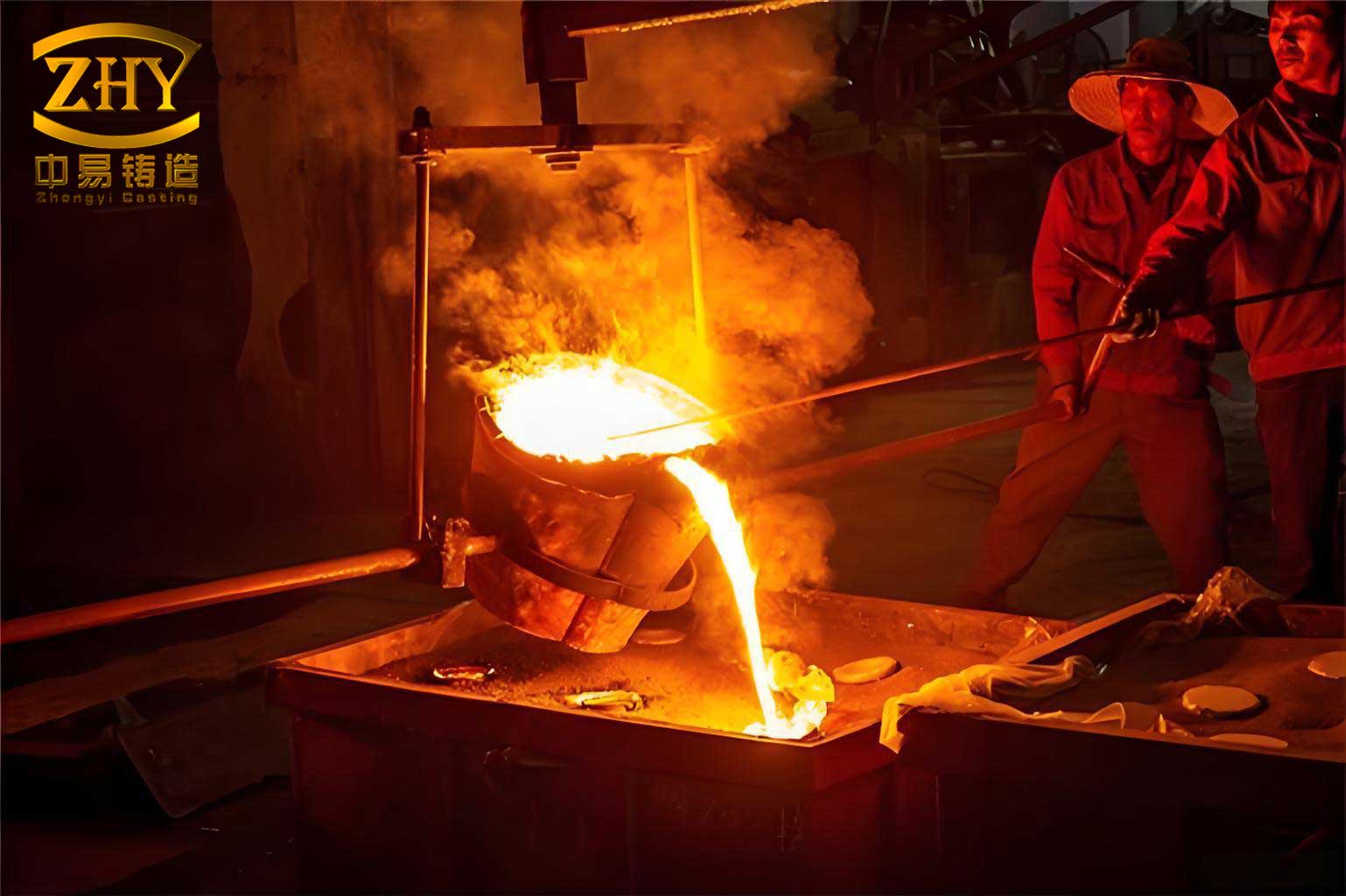
As a researcher focused on advanced manufacturing techniques, I have extensively studied the lost foam casting process, a method hailed as a transformative technology for the 21st century due to its numerous advantages. These include superior casting quality, reduced cost, high dimensional accuracy, excellent surface finish, minimized cleaning requirements, savings in machining, fewer internal defects, and a dense, refined microstructure. The core of the lost foam casting process involves replacing a traditional pattern with a foam polymer model that vaporizes upon contact with molten metal, allowing the metal to fill the exact cavity shape. However, this process is significantly more complex than conventional cavity casting. During filling, the foam pattern undergoes rapid softening, melting, and gasification under the intense heat of the metal, generating various thermal decomposition products. These interacting physical and chemical phenomena make the process sensitive to many parameters, and defects often arise from suboptimal process design. The traditional trial-and-error approach to process optimization is inefficient, costly, and time-consuming, ill-suited for advancing this promising technology. Consequently, computer simulation has become an indispensable tool. In my work, I employ numerical simulation to fundamentally change how we approach the lost foam casting process, using software like ProCAST to analyze filling, solidification, predict defects, and particularly to investigate stress distribution—a critical quality factor for high-integrity components.
This article details my comprehensive numerical investigation into the lost foam casting process for a specific high-chromium iron impeller. The impeller, a critical component in pumping equipment, operates under severe conditions involving high rotational speeds, centrifugal forces, fluid shear, impact loads, and abrasive wear. Its performance and reliability are paramount. Therefore, its key stress-bearing regions must be free from macro-defects like cracks, shrinkage porosity, and excessive residual stress that could lead to deformation or failure. The impeller is characterized as a thin-walled casting with 15 twisted blades radiating from a central ring. The blade thickness is approximately 11 mm, tapering towards the tips, while the junctions between the blades and the central ring constitute the thickest sections. This geometry presents a classic casting challenge: achieving sound solidification in these isolated heavy sections while managing the thermal stresses arising from differential cooling between the thin blades and the thicker hub. Given the complex, multi-bladed, rotational geometry with small features and undercuts, traditional sand casting with cores is difficult and inefficient. The lost foam casting process is ideally suited as it can produce the complete, intricate shape in a single mold, drastically reducing or eliminating secondary machining. However, for such a component within the lost foam casting process, adding conventional feeding risers directly onto the thin blades or small ring is impractical, as they would act as additional stress concentrators and could distort the part. Therefore, process optimization must rely on precise control of pouring parameters and strategic cooling control.
My methodology centers on a fully integrated simulation workflow. I began by creating a precise three-dimensional geometric model of the impeller and its gating system using UG NX software. The system was designed for top pouring to ensure smooth filling. The model included a sprue (50 mm diameter, 150 mm height) and a pouring cup (80 mm major diameter, 70 mm height). This assembly was exported in IGES format and imported into the ProCAST simulation environment. The critical step of finite element mesh generation was performed using the MeshCAST module. To balance computational accuracy and efficiency, I implemented a local refinement strategy. The mesh size for the impeller casting itself was set to 3 mm, while the gating system used a coarser 5 mm size. The final volumetric mesh consisted of 652,484 elements and 135,934 nodes, ensuring sufficient resolution to capture thermal gradients and stress concentrations in the critical blade-root areas. The material properties and process parameters defining this lost foam casting process simulation are summarized in the tables below.
| Material | Property | Value | Units |
|---|---|---|---|
| High-Chromium Iron (Cast) | Liquidus Temperature | 1,280 | °C |
| Solidus Temperature | 1,220 | °C | |
| Density | 7,200 | kg/m³ | |
| Thermal Conductivity (Avg.) | 30 | W/(m·K) | |
| Young’s Modulus | 165 | GPa | |
| EPS Foam Pattern | Density | 10 | kg/m³ |
| Thermal Conductivity | 0.035 | W/(m·K) | |
| Specific Heat | 1.5 | kJ/(kg·K) | |
| Gasification Start Range | 330 – 350 | °C | |
| Coating | Thickness | 1.5 | mm |
| Permeability | 5.0 × 10⁻⁷ | cm²/(Pa·min) |
| Parameter | Value | Units |
|---|---|---|
| Vacuum Level | -0.04 | MPa |
| Ambient Temperature | 25 | °C |
| Heat Transfer Coefficient (Metal-Mold) | 500 | W/(m²·K) |
The thermal and stress analysis in ProCAST solves the fundamental equations governing the lost foam casting process. The energy equation, considering the latent heat of fusion, is central to solidification modeling:
$$ \rho c_p \frac{\partial T}{\partial t} = \nabla \cdot (k \nabla T) + \rho L \frac{\partial f_s}{\partial t} + Q_{foam} $$
where \( \rho \) is density, \( c_p \) is specific heat, \( T \) is temperature, \( t \) is time, \( k \) is thermal conductivity, \( L \) is latent heat, \( f_s \) is solid fraction, and \( Q_{foam} \) represents the heat sink effect due to foam decomposition. For stress analysis, the software solves the equilibrium and constitutive equations. The total strain \( \epsilon_{total} \) is decomposed into elastic, plastic, thermal, and phase transformation strains:
$$ \epsilon_{total} = \epsilon_{el} + \epsilon_{pl} + \epsilon_{th} + \epsilon_{pt} $$
The thermal strain is a primary driver of residual stress and is calculated as \( \epsilon_{th} = \alpha (T – T_{ref}) \), where \( \alpha \) is the coefficient of thermal expansion. The effective (von Mises) stress, a key indicator of potential for yielding or cracking, is derived from the stress tensor \( \sigma_{ij} \):
$$ \sigma_{eff} = \sqrt{ \frac{3}{2} s_{ij} s_{ij} } = \sqrt{ \frac{1}{2} \left[ (\sigma_{11}-\sigma_{22})^2 + (\sigma_{22}-\sigma_{33})^2 + (\sigma_{33}-\sigma_{11})^2 + 6(\sigma_{12}^2+\sigma_{23}^2+\sigma_{31}^2) \right] } $$
where \( s_{ij} \) are the components of the deviatoric stress tensor. My first set of simulations focused on isolating the effect of pouring temperature on the development of these residual stresses within the lost foam casting process. I conducted two simulations with identical geometry and parameters except for the metal pouring temperature: 1350°C and 1400°C.
| Pouring Temperature (°C) | Maximum Effective Stress (MPa) | Stress Reduction vs. 1350°C (%) |
|---|---|---|
| 1350 | 151.3 | 0.0 |
| 1400 | 135.9 | 10.2 |
The results were clear and significant. At a pouring temperature of 1350°C, the maximum effective stress in the solidified impeller reached 151.3 MPa. Increasing the temperature to 1400°C reduced the peak stress to 135.9 MPa, a reduction of approximately 10.2%. The stress contours showed that the highest stresses were concentrated at the constrained blade-root junctions with the central ring. This reduction can be explained through thermal analysis. A higher superheat (pouring temperature minus liquidus) increases the total heat content of the metal. In the lost foam casting process, this extends the fluidity time and, more importantly, reduces the initial cooling rate and the temperature gradient between the thin blades and the thick hub during the early stages of solidification. This leads to a more uniform cooling pattern, thereby lowering the thermal strains and the resultant thermal stresses that become locked in as residual stress. This finding is crucial because excessive residual stress can cause stress-corrosion cracking, reduce fatigue life, or promote distortion during subsequent machining. It is important to note, however, that within the lost foam casting process, an excessively high pouring temperature can lead to other issues such as severe mold erosion (burn-on/penetration) or increased gas generation from the foam, potentially creating other defects. For high-chromium iron, a balance must be struck, and my simulation suggests 1400°C is a favorable point for this specific geometry.
The second phase of my analysis addressed the prediction and mitigation of shrinkage-related macro-defects, specifically porosity. In the base process configuration (with a 1400°C pouring temperature and no additional chilling), the simulation’s porosity prediction module indicated a high risk of shrinkage porosity and micro-voids at the blade-ring junctions. This is classic behavior: these thermally isolated heavy sections are the last to solidify, and without adequate feeding, volumetric shrinkage leads to pore formation. To counteract this inherent weakness in the lost foam casting process for this part, I modified the virtual process by introducing a chilling element. A cylindrical chill (cold iron) with an outer diameter matching the impeller ring’s inner bore (40 mm) and a length of 250 mm was modeled inside the central ring cavity. In a physical lost foam casting process, such a rigid chill might complicate dry sand filling and compaction. A practical alternative, which the simulation conceptually represents, is the use of a high-thermal-capacity chromite sand lining in the core area. The comparative results for defect propensity are summarized below.
| Process Scheme | Maximum Porosity Index | Primary Defect Location |
|---|---|---|
| Without Chill | 0.624 | Blade-Root Junctions (Highly Localized) |
| With Central Chill | 0.312 | Distributed More Evenly in Upper Ring Sections |
The incorporation of the chill dramatically altered the solidification sequence. The chill rapidly extracted heat from the central ring, causing it to solidify first or concurrently with the blade roots. This effectively turned the blade-root junctions from the last-to-freeze hot spots into progressively solidifying zones that could be fed by the still-molten metal in the ring or blades. Consequently, the maximum porosity index was halved, dropping from 0.624 to 0.312. Furthermore, the defect distribution became less concentrated at the critical, high-stress blade roots and more dispersed. This is a profound improvement for the lost foam casting process of this impeller. The blade-root region is the primary load-bearing area, and even minor shrinkage porosity here can act as a crack initiation site under cyclic operational loads, leading to catastrophic failure. By ensuring directional solidification towards the chill or a feeder, the process reliability is significantly enhanced.
To generalize the findings, I formulated a simplified analytical relationship that underscores the interplay between cooling rate, stress, and feeding. The local solidification time \( t_f \) at a point can be approximated by Chvorinov’s rule: \( t_f = B \left( \frac{V}{A} \right)^n \), where \( V/A \) is the volume-to-surface area ratio (modulus), \( B \) is a mold constant, and \( n \) is an exponent (typically ~2). For the blade-root junction, the modulus is high, leading to a long \( t_f \) and making it prone to shrinkage. Adding a chill effectively reduces the local modulus \( M \) for the ring, changing the solidification dynamics. The thermal gradient \( G \) and solidification rate \( R \) are key. A high \( G/R \) ratio favors planar growth and better feeding. The chill increases \( G \) locally. The Niyama criterion, often used to predict shrinkage porosity in simulations, is a function of these parameters: \( N_y = G / \sqrt{\dot{T}} \), where \( \dot{T} \) is the cooling rate. A higher Niyama value indicates a lower risk of shrinkage. The chill, by increasing both \( G \) and \( \dot{T} \) in the ring, pushes the critical junction areas into a higher, safer Niyama regime.
In conclusion, my detailed numerical investigation into the lost foam casting process for a high-chromium iron impeller demonstrates the powerful role of integrated simulation in process design and optimization. Through systematic parameter studies, I determined that an increase in pouring temperature from 1350°C to 1400°C can reduce the maximum residual effective stress by over 10%, promoting a more reliable component less susceptible to stress-induced failure. More importantly, I identified that the inherent solidification characteristics of the geometry within the lost foam casting process lead to a high concentration of shrinkage defects at the critical blade-root junctions. By virtually implementing a strategic chilling technique—simulated as a central chill—I demonstrated a method to radically alter the solidification pattern. This modification halved the predicted porosity index and moved the defect-prone zones away from the highest stress concentration areas. These optimized parameters—a controlled higher pouring temperature and targeted cooling via chills or specialty sands—provide a robust recipe for producing sound, high-integrity impellers via the lost foam casting process. This approach eliminates costly physical trials, shortens development time, and enhances product quality, fully leveraging the potential of the lost foam casting process for complex, high-performance castings.