
In the domain of internal combustion engines, the cylinder block serves as the foundational backbone, housing critical components and withstanding immense operational stresses. The transition from traditional sand casting to more advanced, environmentally conscious methods has been a significant evolution in foundry practice. From my extensive experience in green casting technologies, I have found that the lost foam casting process offers a transformative approach for producing complex, high-integrity components like inline four-cylinder diesel engine blocks. This article details a complete methodology, from pattern creation to solidification, highlighting the technical decisions and calculations that underpin a successful application of the lost foam casting process.
The conventional sand casting method, while cost-effective, presents well-documented challenges: significant dust pollution, high labor intensity, and substantial waste of non-renewable silica sand, with shakeout losses often exceeding 15% for core sand. The lost foam casting process fundamentally reimagines this. It utilizes synthetic, expandable polystyrene (EPS) beads to create a full, gas-permeable foam replica of the part and its gating system. This cluster is coated, dried, and embedded in unbonded, dry sand within a single flask. No binders or additives are required for the sand, which boasts a reclamation rate over 95%. During pouring, the metal replaces the vaporizing foam under a controlled vacuum, yielding a precise casting. The monolithic sand mass forming both the external mold and internal cavities eliminates core shift and related sand inclusion defects common in conventional methods.
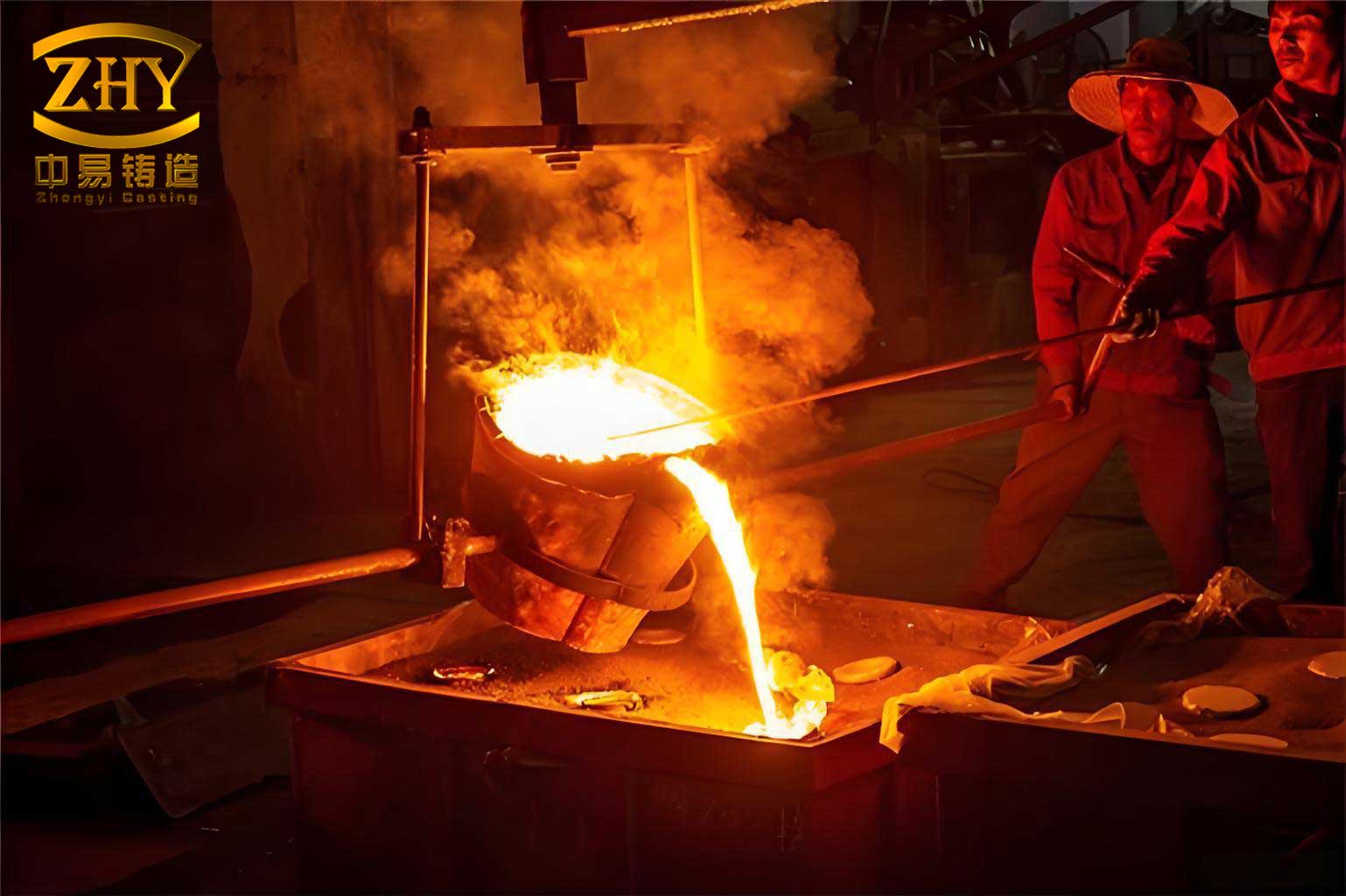
1. Fabrication of the Foam Pattern Cluster
The success of the lost foam casting process is predicated on the quality and design of the expendable pattern. For a complex thin-wall (5 mm primary wall thickness) component like a diesel cylinder block, pattern strategy is paramount.
1.1 Pattern Partitioning and Assembly Strategy
To ensure ease of demolding from the tooling and to maintain structural integrity of the delicate foam pattern, a multi-piece approach is essential. The entire block pattern is divided into four sub-patterns. The initial split is made along the centerline of the four cylinder bores, creating two primary sub-assemblies. Each primary sub-assembly is further divided into two secondary sub-patterns. This strategy accommodates complex internal geometries like the camshaft gallery and the oil cooler cavity.
The selection of raw EPS bead size is critical for wall fidelity and pattern strength. For a 5 mm wall, an initial bead diameter of 0.2 mm is specified. During pre-expansion, the pentane blowing agent causes bead volume to increase. The target pre-expanded bead diameter ($d_{pre}$) is governed by the desired pattern density and wall thickness. A practical range is 0.6 to 0.9 mm. One can estimate the number of beads ($N$) spanning a wall thickness ($T_w$) as:
$$N \approx \frac{T_w}{d_{pre}}$$
For $T_w = 5$ mm and $d_{pre} = 0.7$ mm, $N \approx 7$, ensuring adequate bead packing for uniform density and surface finish. These pre-expanded beads must undergo proper aging (stabilization) to reduce internal vacuum and restore elasticity, which is crucial for subsequent molding and handling.
1.2 Tooling Design for Foam Molding
Separate mold cavities are manufactured for each of the four secondary sub-patterns. Design ingenuity is required to form complex undercuts without compromising the part geometry. For instance, sub-patterns forming the external crankcase walls with internal reinforcing ribs necessitate modular tooling. The core corresponding to each cylinder’s crankcase area is split into three sections: a central fixed core and two side retractable slides. After steam molding, the main tool opens, withdrawing the fixed core. The side slides then retract horizontally, allowing the intricate foam pattern to be released intact. This design minimizes the need for geometric concessions or excessive machining allowances, preserving the component’s functional design and avoiding unnecessary weight gain.
1.3 Pattern Assembly and Integration
Post-molding, the four foam sub-patterns and any auxiliary elements must be assembled into a cohesive cluster. A significant consideration for the diesel block is the long, narrow oil cooler cavity. Relying solely on dry sand to hold this shape during compaction risks local mold collapse. Therefore, a hybrid approach within the lost foam casting process is adopted: a resin-bonded sand core (made via cold-box process) is used to define the oil cooler passage. This core is coated with a refractory graphite-based wash and dried before assembly. Its design includes extended prints for precise location within the foam assembly and for venting gases during pour.
The assembly sequence is methodical: first, the four secondary sub-patterns are glued into two primary sub-assemblies, incorporating the oil cooler core at the relevant stage. These primary sub-assemblies are then joined to form the complete product pattern. Assembly can be manual, semi-automatic, or fully automated using jigs for accuracy. Adhesives can be cold-glue (often with tape reinforcement) or hot-melt, chosen based on production volume. Post-assembly, seams are smoothed, and the cluster undergoes a final stabilization period to ensure adhesive strength and overall rigidity for subsequent handling, coating, and molding operations.
| Sub-Pattern ID | Primary Feature Formed | Tooling Complexity | Key Design Consideration |
|---|---|---|---|
| A | Camshaft Bore Internal Wall | Low (Two-part tool) | Surface finish for camshaft alignment. |
| B | Oil Cooler Cavity External Wall | Low (Two-part tool) | Interface for resin sand core location. |
| C | Camshaft Bore External Wall & Crankcase | High (With retractable slides) | Forming internal rib undercuts. |
| D | Main Block Structure & Oil Cooler Side | High (With retractable slides) | Integrating core prints and main water jacket geometry. |
2. Molding Sand Selection and Mold Compaction
2.1 Evaluation and Selection of Unbonded Sand
The choice of sand in the lost foam casting process is critical as it functions simultaneously as the mold and core material. Its properties directly affect mold stability, permeability for pyrolysis gases, cooling rate, and final casting surface quality. The main options are compared below.
| Sand Type | Typical Density (g/cm³) | Refractoriness (°C) | Primary Composition | Key Advantages | Typical Application |
|---|---|---|---|---|---|
| Silica Sea Sand | 2.65 | ~1670 | >98% SiO₂ | Low cost, good angularity, low clay, high availability. | Cast iron, aluminum alloys. |
| Ceramic Bead (Zirconia/Alumina) | 2.90 – 3.50 | >1800 | Al₂O₃, ZrO₂, SiO₂ | Excellent flowability, low dust, high thermal stability. | High-value steel & iron castings. |
| Magnesium Olivine | 3.27 | >1760 | (Mg,Fe)₂SiO₄ | Neutral pH, low thermal expansion, reduces burn-on. | Manganese steel, high-alloy steel. |
For the HT250 diesel cylinder block, 70/140 mesh (AFS GFN ~105) silica sea sand is selected. This grade offers an optimal balance: sufficient fineness to provide good packing density and surface finish against thin walls, while maintaining adequate permeability. Excessively coarse sand, though higher in permeability, can lead to poor mold strength and penetration defects (burn-in/burn-on), as the sand grains may not pack tightly enough to resist metal infiltration, especially in complex internal passages.
2.2 Mold Filling and Compaction Dynamics
The mold-making sequence in the lost foam casting process is a carefully staged operation to support the fragile pattern cluster and achieve uniform sand density.
- Base Sand Fill: A layer of sand, approximately 150 mm deep, is first placed in the bottom of the flask. This “bedding sand” supports the weight of the pattern cluster and the subsequent metal head pressure.
- Pattern Envelope Fill & Compaction: The pattern cluster is positioned, and sand is filled around it using a rain-flow sand delivery system. This is accompanied by controlled, multi-axis vibration. The vibration parameters—frequency ($f$), amplitude ($A$), and time ($t_v$)—are optimized to achieve high bulk density ($\rho_b$) around the pattern without causing distortion or erosion of the foam. The goal is to fluidize the sand so it flows into all cavities, replicating the pattern’s geometry with high fidelity. The compaction energy ($E_c$) can be conceptually related to these parameters:
$$E_c \propto f \cdot A^2 \cdot t_v$$
This stage is the most critical, as this sand directly defines the casting surface. - Top Sand Fill: Finally, sand is filled over the pattern to cover the sprue and risers, providing top pressure to counteract metallostatic forces and creating a sealed mold for vacuum application.
3. Design and Optimization of the Gating System
The gating design in the lost foam casting process must manage the unique requirement of replacing a decomposing solid (foam) with liquid metal, while adhering to fundamental solidification principles.
3.1 Initial Scheme and Its Limitations (Scheme I)
The initial, intuitive scheme placed the block upright (oil pan face down) with a bottom gating system attached to the pan rails. While this offered stable pattern placement and easy molding, it positioned the critical cylinder bore and head deck surface—areas requiring superior metallurgical soundness—in the upper part of the mold. During pouring in the lost foam casting process, the endothermic decomposition of the foam cools the advancing metal front. Combined with the thermal gradient of a bottom-gated mold, this can lead to premature freezing in the upper sections, potentially trapping liquid pyrolysis products and causing folds or cold shuts. Furthermore, the slow metal rise past the complex crankcase geometry increased the exposure time for the foam, sometimes leading to carbonaceous residue defects in isolated cavities like the oil cooler, as the incomplete burnout products are entrapped by solidifying metal.
3.2 Optimized Scheme Based on Solidification Control (Scheme II)
The optimized scheme inverts the block, placing the critical head deck face and cylinder bores lower in the mold. The gating remains a bottom-fill design attached to what is now the top (formerly the oil pan face). This aligns with the principle of directional solidification towards the feed gates. The foam cluster, including glued-on gating patterns, is reinforced with wooden struts during handling to prevent flexure or breakage.
The gating system is designed through a systematic calculation:
- Casting Weight and Volume: The CAD model gives a part volume ($V_c$) of 8.6 dm³. For HT250 (density $\rho_m \approx 7.35$ g/cm³), the part weight is $W_c = V_c \times \rho_m = 63.21$ kg. Including the gating system (total cluster volume $V_{cluster} = 11.0$ dm³), the total poured weight $W_{total} = 80.85$ kg.
- Pouring Time Calculation: For complex thin-wall iron castings ($W_{total} < 450$ kg), pouring time ($t$) is estimated as:
$$t = S \sqrt{W_{total}}$$
where $S$ is a coefficient based on wall thickness. For walls of 5-15 mm, $S = 2.2$. Thus:
$$t = 2.2 \times \sqrt{80.85} \approx 19.7 \text{ seconds}$$
A target pouring time of 20 seconds is set. - Effective Metallostatic Pressure Head: For a bottom-gated mold where the top of the casting is at the cope level, the average effective head ($H_{avg}$) is:
$$H_{avg} = H_0 – \frac{P^2}{2C}$$
Where $H_0$ is the total sprue height, $P$ is the height of the casting above the parting (equal to total casting height $C$ in this inverted scheme). If $H_0 = 70$ cm and $C = 50$ cm, then:
$$H_{avg} = 70 – \frac{50^2}{2 \times 50} = 70 – 25 = 45 \text{ cm}$$ - Total Choke Area Calculation: Using the basic hydraulic equation (Bernoulli’s principle), the minimum required choke area at the ingate ($A_{choke}$) is:
$$A_{choke} = \frac{W_{total}}{0.31 \cdot \mu \cdot t \cdot \sqrt{H_{avg}}}$$
Where $\mu$ is the total friction factor (accounting for foam resistance, sand permeability, etc.). For a dry sand lost foam casting process mold, $\mu$ is lower; a value of 0.41 is appropriate. Substituting:
$$A_{choke} = \frac{80.85}{0.31 \times 0.41 \times 20 \times \sqrt{45}} \approx \frac{80.85}{0.31 \times 0.41 \times 20 \times 6.708} \approx \frac{80.85}{17.05} \approx 4.74 \text{ cm}^2$$
To enhance stability, promote uniform filling, and reduce localized erosion, the theoretical area is distributed across multiple ingates. The final design features 10 ingates, each with a cross-section of 35 mm x 6 mm, yielding a total area of:
$$A_{actual} = 10 \times (3.5 \text{ cm} \times 0.6 \text{ cm}) = 21.0 \text{ cm}^2$$
This larger area slows the metal velocity at the ingates, promoting a quiescent fill and reducing turbulence, which is crucial for avoiding defect formation in the lost foam casting process. The solidified casting from this scheme shows excellent integrity in critical areas, with a weight reduction of approximately 10% compared to conventional sand casting, achieving a weight tolerance grade of MT7 and a dimensional accuracy grade of CT8.
| Parameter | Scheme I (Upright) | Scheme II (Inverted) | Advantage of Scheme II |
|---|---|---|---|
| Casting Orientation | Head deck up, oil pan down. | Head deck down, oil pan up. | Critical surfaces solidify under favorable thermal gradient. |
| Gating Position | Bottom gates at oil pan. | Bottom gates at top face (inverted oil pan). | Promotes directional solidification towards feeder (gates). |
| Filling Path for Critical Area | Long, circuitous path to head deck. | Short, direct path to cylinder bores/head deck. | Reduces heat loss & foam contact time for critical features. |
| Risk of Defects | Higher risk of cold shuts, folds, carbon residue in upper regions. | Significantly reduced risk of such defects. | Improved metallurgical soundness. |
4. Conclusion
The implementation of the lost foam casting process for diesel engine cylinder blocks demonstrates a viable and superior alternative to traditional green sand molding. By integrating a meticulous pattern partitioning and assembly strategy, selecting appropriate unbonded sand, and rigorously designing the gating system based on solidification science and the unique dynamics of foam replacement, high-quality castings are consistently produced. The advantages are multifaceted: a significant reduction in raw material waste through near-total sand reclamation, elimination of core-making binders and associated emissions, improved working conditions, and the production of lighter, more dimensionally precise castings. This holistic approach to the lost foam casting process effectively aligns component design intent, metallurgical requirements, and sustainable manufacturing principles, solidifying its role in the future of advanced foundry practice for complex engineering components.