
In my extensive work with advanced casting methodologies, I have focused on refining the lost foam casting process for complex components like flywheels. The lost foam casting process, also known as evaporative pattern casting, involves using a foam pattern that vaporizes upon metal pouring, leaving behind a precise metal casting. This technique has evolved over decades, reaching a mature stage where it can produce intricate parts with minimal machining requirements. Through firsthand experimentation and optimization, I have aimed to enhance the quality and yield of flywheel castings, addressing common defects such as distortion, slag inclusion, and sand scabbing. The core principle revolves around meticulous control across all stages—from foam pattern creation to final cooling. This article delves into the technical nuances of applying the lost foam casting process to flywheel production, emphasizing systematic improvements that boosted qualification rates above 85%. By sharing insights from this trial-manufacture endeavor, I hope to underscore the viability of the lost foam casting process for fully machined castings under stringent specifications.
The lost foam casting process begins with designing a foam pattern identical to the desired flywheel. This pattern is typically made from expandable polystyrene (EPS) beads, which are pre-expanded to a controlled density. In my trials, I prioritized maintaining an EPS foam density between 20 and 22 g/L, as deviations could lead to pattern deformation or gas evolution defects during casting. The density control is mathematically expressed by monitoring the pre-expansion bulk density, where optimal pre-expansion ranges from 18 to 20 g/L. The relationship can be modeled as: $$ \rho_{\text{final}} = \rho_{\text{pre}} + \Delta \rho $$ where $\rho_{\text{final}}$ is the final foam density, $\rho_{\text{pre}}$ is the pre-expansion density, and $\Delta \rho$ accounts for additional compaction during molding. Achieving this requires precise temperature and pressure settings in pre-expansion equipment, followed by adequate aging—4 to 8 hours in a conditioning silo—to stabilize the beads’ moisture and blowing agent content.
| Parameter | Target Range | Impact on Casting Quality |
|---|---|---|
| Pre-expansion Density | 18–20 g/L | Ensures uniform foam structure, reduces gas defects |
| Final Foam Density | 20–22 g/L | Minimizes pattern distortion and improves dimensional accuracy |
| Aging Time | 4–8 hours | Allows dissipation of moisture and blowing agents |
| Natural Aging After Molding | 10–15 days | Reduces residual stresses and enhances pattern stability |
Once the EPS beads are prepared, they are molded into the flywheel pattern using hydraulic semi-automatic molding machines. In my approach, I optimized the mold design to enable one-shot成型 of the entire flywheel, eliminating seams that could cause defects. The foam pattern must then undergo prolonged natural aging—10 to 15 days at ambient conditions—to allow further diffusion of moisture and blowing agents. This step is critical in the lost foam casting process, as residual volatiles can lead to porosity or slag formation in the final casting. After aging, patterns are meticulously trimmed to remove flashes and burrs, with dimensional checks ensuring conformity to the flywheel’s specifications. The assembly of patterns and gating systems uses hot-melt adhesives, applied sparingly to minimize gas generation during pouring.
Coating the foam pattern is a pivotal phase in the lost foam casting process, accounting for approximately 30% of the overall success. I selected a commercial coating with excellent refractory properties, applying it in two layers to achieve a thickness of 0.7 to 1.0 mm. The coating serves multiple functions: it reinforces the pattern during handling, provides a barrier between the foam and sand, and facilitates metal flow while preventing sand erosion. The coating thickness ($t_c$) can be correlated with the pattern’s surface area ($A$) and viscosity ($\eta$) of the slurry: $$ t_c \propto \frac{\eta \cdot A}{\text{dipping time}} $$ After each coating application, patterns are dried in a controlled environment at 40 ± 5°C with humidity below 30%, ensuring complete moisture removal. Any cracks detected are repaired promptly with fast-drying coatings to maintain integrity.
The gating system design profoundly influences the outcome in the lost foam casting process. For flywheels, I employed an open gating system characterized by the relationship: $$ F_{\text{直}} > F_{\text{橫}} > F_{\text{內}} $$ where $F_{\text{直}}$, $F_{\text{橫}}$, and $F_{\text{內}}$ represent the cross-sectional areas of the sprue, runner, and ingates, respectively. This configuration promotes smooth metal flow and reduces turbulence. Each gating cluster accommodates 16 flywheel patterns, with a targeted pouring time of 30 to 35 seconds. The ingate placement is strategically positioned to ensure uniform filling and minimize thermal gradients, as illustrated in the accompanying diagram. Computational fluid dynamics simulations can optimize these parameters, but empirical trials validated the design’s efficacy in preventing defects like misruns or cold shuts.
| Component | Design Feature | Purpose |
|---|---|---|
| Sprue | Largest cross-section | Controls initial metal flow rate |
| Runner | Intermediate cross-section | Distributes metal to multiple ingates |
| Ingates | Smallest cross-section, positioned at wheel periphery | Ensures directional solidification and reduces slag entrapment |
| Pouring Time | 30–35 seconds per cluster | Balances fill speed and pattern degradation |
Molding involves using dry silica sand of 30–50 mesh size, which is free of binders due to the lost foam casting process’s reliance on vacuum assistance. In my trials, I utilized specialized flasks equipped with pneumatic frequency-adjustable vibratory tables. After securing the flask, a base sand layer of about 120 mm is added and compacted. The coated pattern cluster is then positioned, ensuring the pouring cup is near the flask edge for accessibility. Sand filling occurs in two stages: first, covering the pattern completely, and second, adding an overhead layer to guarantee sufficient sand thickness. Vibration parameters are fine-tuned—frequency and duration (20–25 seconds)—to achieve optimal compaction without pattern distortion. The final sand surface is leveled, covered with a plastic film, and topped with a 20 mm protective sand layer. Vacuum levels during pouring are maintained between 0.020 and 0.030 MPa, which stabilizes the mold and aids in pattern gas extraction.
Alloy melting and treatment are integral to the lost foam casting process for achieving the desired mechanical properties in flywheels. The material specification is HT250 low-alloy cast iron, requiring precise chemical composition control. I employed a 2.0-ton medium-frequency induction furnace, with tapping temperatures regulated between 1,560 and 1,580°C. The chemical composition ranges are summarized below, alongside inoculation practices to enhance graphite formation.
| Element | Target Range | Role in Microstructure |
|---|---|---|
| Carbon (C) | 3.10–3.30 | Promotes graphite precipitation, improves castability |
| Silicon (Si) | 1.85–2.40 | Strengthens ferrite and controls graphitization |
| Manganese (Mn) | 0.60–0.95 | Counteracts sulfur, enhances pearlite formation |
| Phosphorus (P) | 0.070–0.10 | Improves fluidity but limited to avoid brittleness |
| Sulfur (S) | 0.070–0.10 | Balanced for inoculation response |
Inoculation is performed via stream addition during tapping, using ferrosilicon inoculant at 0.2–0.3% of the melt weight. This step refines graphite morphology, targeting Type A and B graphite with no Type C permitted, as per the flywheel requirements. The hardness specification is 187–241 HB after a 1.5 mm machining layer removal, necessitating controlled cooling. The relationship between cooling rate ($\dot{T}$) and hardness ($H$) can be approximated as: $$ H = k \cdot \dot{T} + H_0 $$ where $k$ is a material constant and $H_0$ is the base hardness. Post-casting, stress relief heat treatment is applied to stabilize dimensions and mitigate residual stresses.
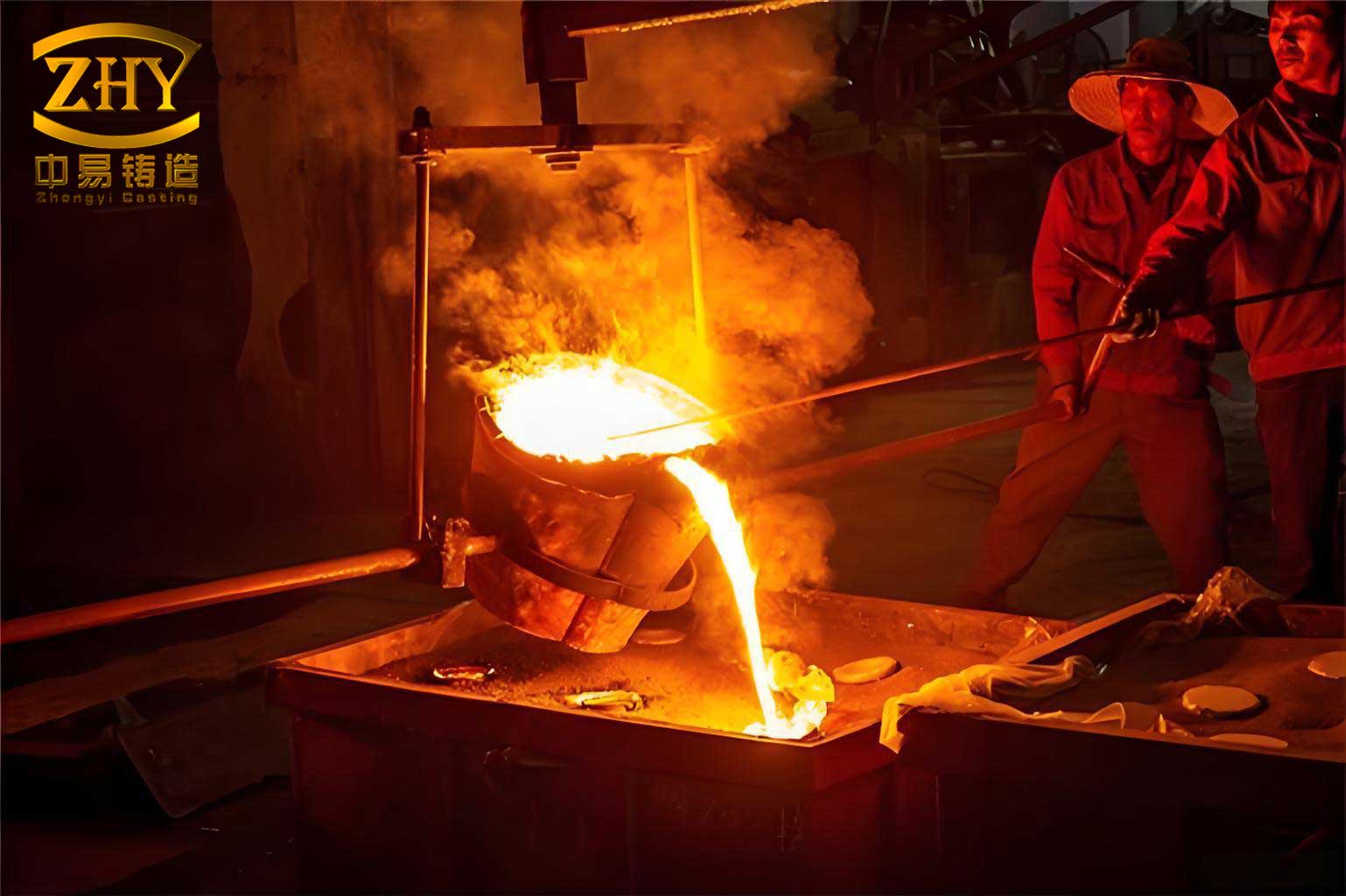
Pouring operations in the lost foam casting process demand careful coordination to avoid defects. I used ladles with spout designs to minimize turbulence, preheating them to a dull red color. Pouring begins with a small stream to initiate pattern vaporization, evidenced by black smoke and a sucking sound from the foam degradation. Once established, the flow is increased to maintain a steady fill, with the final浇注 temperature kept above 1,480°C. The vacuum system plays a crucial role in extracting pyrolysis gases from the decomposing foam; I monitored pressure gauges continuously to ensure the 0.020–0.030 MPa range. After pouring, castings remain in the flask for approximately 1.0 hour to solidify uniformly before shakeout. This cooling period is optimized based on the flywheel’s modulus ($M$), calculated as volume-to-surface area ratio: $$ M = \frac{V}{A} $$ For the flywheel with dimensions Ø274 mm × 32 mm, $M$ influences the solidification time and, consequently, the microstructure.
Defect analysis in the lost foam casting process revealed that distortion, slag inclusion, and sand scabbing were primary concerns. Distortion often stemmed from inadequate foam pattern aging or uneven sand compaction. By enforcing strict aging protocols and vibration control, I reduced distortion significantly. Slag inclusion was mitigated through improved coating integrity and gating design that minimized turbulence. Sand scabbing, caused by metal penetration into the sand, was addressed by optimizing coating thickness and sand grain size distribution. The overall defect rate ($D$) can be modeled as a function of multiple variables: $$ D = f(\rho_{\text{foam}}, t_c, \dot{T}, P_{\text{vac}}) $$ where $\rho_{\text{foam}}$ is foam density, $t_c$ is coating thickness, $\dot{T}$ is cooling rate, and $P_{\text{vac}}$ is vacuum pressure. Empirical data from trial runs allowed iterative refinement of these parameters.
The lost foam casting process for flywheels culminated in a qualification rate exceeding 85%, a substantial improvement from initial trials. This success underscores the process’s capability for fully machined castings with tight tolerances. Key takeaways include the importance of integrated process control—from foam precursor selection to post-casting heat treatment. The lost foam casting process offers distinct advantages, such as reduced machining allowance and design flexibility, but it requires rigorous adherence to each step’s parameters. Future work could explore advanced foam materials like polymethyl methacrylate (PMMA) for enhanced dimensional stability or real-time monitoring systems for vacuum and temperature. In conclusion, the lost foam casting process is a viable and efficient method for producing high-integrity flywheels, provided that holistic optimization and team协作 are maintained throughout production.
To further illustrate the process flow, I have summarized the critical stages of the lost foam casting process in a tabular format, highlighting the control measures implemented during flywheel trial-production.
| Process Stage | Key Activities | Control Parameters | Impact on Defect Prevention |
|---|---|---|---|
| Foam Pattern Production | EPS pre-expansion, molding, aging | Density (20–22 g/L), aging time (10–15 days) | Reduces distortion and gas defects |
| Pattern Coating | Dip coating, drying, inspection | Coating thickness (0.7–1.0 mm), drying temperature (40±5°C) | Prevents sand erosion and metal penetration |
| Gating and Assembly | Cluster assembly with hot-melt glue | Gating ratios ($F_{\text{直}} > F_{\text{橫}} > F_{\text{內}}$), ingate placement | Minimizes slag inclusion and ensures uniform filling |
| Molding and Compaction | Sand filling, vibration, vacuum application | Sand grain size (30–50 mesh), vibration time (20–25 s), vacuum (0.020–0.030 MPa) | Enhances mold stability and pattern degradation control |
| Melting and Pouring | Alloy preparation, inoculation, pouring | Tap temperature (1,560–1,580°C), pouring temperature (>1,480°C), inoculation rate (0.2–0.3%) | Achieves desired microstructure and hardness |
| Cooling and Shakeout | In-flask cooling, shakeout, cleaning | Cooling time (1.0 h), shakeout temperature control | Prevents thermal stresses and facilitates handling |
In summary, the lost foam casting process demands a synergistic approach where each element—foam quality, coating efficacy, gating design, sand dynamics, and metallurgical control—converges to yield defect-free castings. My trials with flywheels have demonstrated that through persistent optimization and attention to detail, the lost foam casting process can meet high standards for automotive components. The integration of quantitative metrics, such as the formulas and tables presented, provides a roadmap for replicating this success in other applications. As the lost foam casting process continues to evolve, its adoption for critical parts like flywheels will likely expand, driven by advancements in materials and process automation.