
Based on extensive practical experience in foundry operations, this article provides a detailed, first-person perspective on the application and control of the lost foam casting process for producing high-integrity, large-scale iron castings, such as machine tool beds. The focus is on the systematic approach required to mitigate defects and ensure dimensional and metallurgical quality.
The fundamental principle of the lost foam casting process involves replacing a traditional pattern with a expendable foam replica, typically made from expanded polystyrene (EPS). This foam pattern, coated with a refractory slurry, is embedded in unbonded or bonded sand. Molten metal is then poured directly onto the foam, which thermally decomposes and is displaced by the advancing metal front. The success of this process hinges on precisely controlling the dynamic interaction between the decomposing foam and the liquid metal. The rate of foam degradation and gas evolution must be carefully balanced with the metal’s filling speed to prevent defects like folds, entrapped slag, or incomplete filling. A simplified representation of the foam decomposition kinetics can be related to the heat flux from the metal:
$$ \frac{dm_{foam}}{dt} = -k \cdot A \cdot (T_{metal} – T_{pyrolysis})^n $$
where $dm_{foam}/dt$ is the rate of foam mass loss, $k$ is a kinetic constant, $A$ is the interfacial area, $T_{metal}$ is the metal temperature, $T_{pyrolysis}$ is the pyrolysis temperature of the foam, and $n$ is an exponent often found empirically.
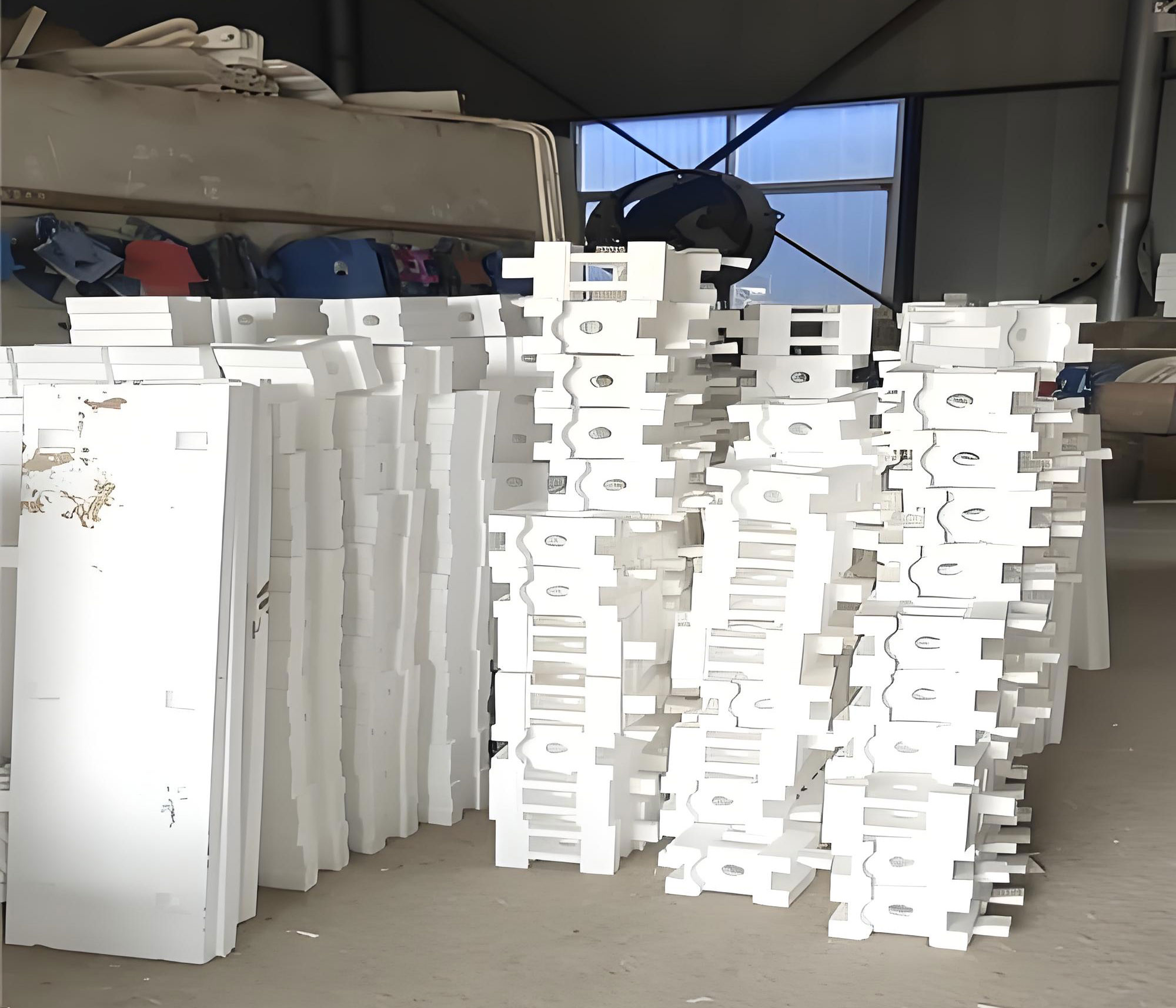
The complete process chain for the lost foam casting process can be summarized in the following key stages:
| Process Stage | Key Activities | Primary Control Objectives |
|---|---|---|
| 1. Pattern Manufacturing | EPS molding, cutting, assembly, and gluing. | Dimensional accuracy, seam quality (< 1.5mm), minimal distortion, and surface finish. |
| 2. Coating Application | Dip or flow coating with refractory slurry, drying. | Uniform coating thickness (0.8-2.0mm), proper permeability, and complete dryness (moisture < 2.5%). |
| 3. Molding & Gating | Placement of coated cluster in flask, installation of gating system, sand filling and compaction. | Adequate and uniform sand compaction, proper support for complex geometries to prevent pattern deformation. |
| 4. Pouring | Melting, alloy treatment, and controlled pouring of molten metal. | Precise pouring temperature and speed to manage foam degradation and cavity fill. |
| 5. Cooling & Shakeout | Solidification cooling, removal of sand from finished casting. | Controlled cooling to achieve desired microstructure, efficient sand recovery. |
Material Selection and Pattern Production for the Lost Foam Casting Process
The selection of foam material is critical. For large castings, different densities of EPS are used strategically. The primary pattern body often uses a lower density foam (e.g., 18-22 kg/m³) to minimize gas generation and cost, while high-density foam (e.g., 30 kg/m³) is used for chills, supports, or fillers in complex sections to provide better resistance to deformation during coating and sand filling. The properties are compared below:
| EPS Density (kg/m³) | Typical Use Case | Relative Gas Volume | Dimensional Stability | Pattern Strength |
|---|---|---|---|---|
| 16-18 | Large, simple sections of the main pattern. | High | Lower | Lower |
| 22-24 | Standard pattern bodies for medium-sized castings. | Medium | Good | Good |
| 28-30 | Fillers, chills, supports, and complex thin sections. | Lower | Excellent | High |
Pattern assembly must ensure glue seams are minimal and flush. Distortion control is paramount; for a pattern exceeding 1500mm in length, allowable distortion should be kept within 2mm. Proper support during all handling stages is non-negotiable to prevent warping or damage.
Coating Technology and Drying in the Lost Foam Casting Process
The refractory coating serves multiple vital functions: it provides a barrier between the sand and the metal, maintains cavity integrity, allows pyrolysis gases to escape, and influences the cooling rate. For ferrous castings, graphite-based aqueous coatings are common. Key controlled parameters include viscosity (often measured as Baume degree) and coating thickness.
The required coating thickness ($\delta_c$) can be empirically derived based on section modulus or local casting thickness ($t$):
$$ \delta_c = \delta_{base} + C \cdot t^m $$
where $\delta_{base}$ is the minimum coating thickness (e.g., 0.8 mm), $C$ is a coefficient, and $m$ is an exponent less than 1, indicating that thickness does not scale linearly with section size. Typical practice is:
- General surfaces: 0.8 – 1.2 mm.
- Corners, fillets, and thermal hotspots: 1.5 – 2.0 mm.
Drying must be thorough to eliminate all free water. Incomplete drying leads to steam explosions, gas porosity, and crusting defects. A controlled drying cycle at 50 ± 2°C for several days (e.g., 72 hours for a large bed) is typical. The final pattern assembly moisture content should be verified to be ≤ 2.5% before molding.
| Coating Parameter | Target Range | Measurement Method | Consequence of Deviation |
|---|---|---|---|
| Baume Degree (°Bé) | 55 – 60 | Baume Hydrometer | Too low: runny coating, poor coverage. Too high: poor flow, uneven build-up. |
| Coating Thickness | See formula above | Wet or dry film gauge | Too thin: metal penetration, burn-on. Too thick: gas entrapment, poor shakeout. |
| Drying Moisture | ≤ 2.5% | Moisture analyzer | Too high: puffing, blows, porosity. |
Molding, Gating, and Pouring System Design in the Lost Foam Casting Process
Successful implementation of the lost foam casting process requires meticulous mold assembly and gating design. The choice of parting line is crucial; it is often advantageous to orient the casting so that critical functional surfaces, like machine tool guideways, are downward in the mold to benefit from superior metallurgical quality. Complex internal cavities necessitate strategic internal supports (fillers) made from high-density foam to withstand sand compaction pressures without deformation.
For exceptionally intricate areas where sand flow and compaction are hindered, the pattern can be designed with removable “live” sections. After compacting sand around the base pattern, these live sections are placed into precision-machined locating slots (e.g., V-grooves) and the remaining sand is compacted. This ensures complete and uniform mold filling even in deeply recessed or multi-chambered internal structures.
The gating system in the lost foam casting process must perform the dual function of delivering metal and facilitating the evacuation of foam pyrolysis products. An open, pressurized, or semi-pressurized system with ceramic filters is commonly employed. Filters are placed at the ingate to trap any residual foam decomposition products. The gating ratio (sprue:runner:ingate cross-sectional area) is critical. A common ratio for gray and ductile iron is 1:2:2, which helps maintain a positive pressure in the runner while minimizing turbulence at the ingates. The required total ingate area ($A_{ingate}$) can be estimated based on the pouring time ($t_p$) and the theoretical filling velocity ($v$):
$$ A_{ingate} = \frac{W}{\rho \cdot t_p \cdot v} $$
where $W$ is the casting weight and $\rho$ is the metal density. Pouring time is often determined empirically based on casting weight and complexity.
Sand compaction is a manual or semi-mechanical process requiring multiple operators working simultaneously to ensure uniform density around the entire pattern cluster, especially in deep pockets and undercuts. Venting is accomplished by placing permeable “chimney” vents at the highest points of the mold to allow gases to escape freely to the atmosphere.
Metallurgical and Process Control for Iron Castings
While the lost foam casting process handles the mold formation uniquely, standard foundry metallurgy controls are still paramount. For gray iron castings like FC300, chemical composition must be tailored to prevent chilling and control shrinkage, while ensuring the required strength and hardness. A higher carbon equivalent (CE) is often beneficial for machinability and vibration damping. CE is calculated as:
$$ CE = \%C + 0.33 (\%Si + \%P) $$
For heavy-section castings, a CE in the range of 3.7% to 3.9% is typical. Inoculation practices remain critical to achieve the desired graphite morphology (Type A, size 4-5 for good mechanical properties).
Pouring temperature is a critical interactive parameter in the lost foam casting process. It must be high enough to provide sufficient superheat to fully decompose the foam and allow for proper filling of thin sections, but not so high as to cause excessive mold erosion or penetration. For large gray iron castings, pouring temperatures are typically 20-40°C higher than in conventional green sand molding to compensate for the energy absorbed by foam degradation. A target range of 1420-1450°C is common.
| Process Parameter | Control Standard | Rationale |
|---|---|---|
| Base Iron Chemistry | C: 3.1-3.3%, Si: 1.7-1.9%, CE: ~3.8% | Ensures fluidity, minimizes chilling tendency, promotes type A graphite. |
| Inoculation | Late stream inoculation with FeSi alloy | Promotes graphite nucleation, refines graphite structure, prevents undercooled graphite. |
| Pouring Temperature | 1430 ± 10°C | Balances foam decomposition energy, fluidity, and minimal sand/metal reaction. |
| Sand Properties (Resin) | AFS GFN: 45-55, LOI: ≤0.8%, Acid Demand: 4-6 | Provides consistent mold strength, low gas generation, and good collapsibility. |
| Pattern to Pour Delay | < 12 hours after mold assembly | Prevents pattern moisture absorption and coating degradation from ambient humidity. |
Defect Analysis and Mitigation in the Lost Foam Casting Process
A systematic understanding of defect formation is essential for robust production using the lost foam casting process. Defects often arise from imbalances in the core process variables: foam characteristics, coating permeability, sand compaction, gating, and pouring parameters.
| Defect Type | Primary Causes | Corrective Actions |
|---|---|---|
| Carbonaceous Inclusions (Kish, Slag) | Incomplete foam pyrolysis; gas entrapment; low pouring temperature/speed. | Increase pouring temperature/speed; improve coating/gating venting; use foam with lower volatile content. |
| Surface Folds (Laps) | Metal front instability; slow filling causing foam degradation ahead of metal; coating collapse. | Optimize gating for rapid, laminar fill; increase coating strength and permeability; ensure proper sand support. |
| Penetration/Burn-on | Coating too thin or cracked; local sand compaction low; pouring temperature too high. | Increase coating thickness/refractoriness at hotspots; improve local sand compaction; adjust pouring temperature. |
| Shrinkage Porosity | Inadequate feeding due to improper risering or low CE; localized hot spots. | Implement foam/ceramic risers; adjust alloy chemistry (increase CE); use internal chills (high-density foam blocks). |
| Pattern Deformation | Insufficient internal supports; excessive sand compaction force; weak glue joints. | Use high-density foam fillers and supports; design pattern with internal bracing; improve gluing technique. |
For thick-section ductile iron castings, which share similar process challenges, additional metallurgical defects like chunk graphite can occur. This degenerate graphite form is linked to slow cooling and specific rare earth levels. Mitigation within the lost foam casting process framework involves controlling cooling through mold design, using effective inoculation, and optimizing magnesium and rare earth residuals.
Case Application: Large Horizontal Machining Center Bed
The production of a large bed casting exemplifies the integration of all aforementioned controls in the lost foam casting process. The component, weighing approximately 8600 kg with dimensions of 3281mm x 2386mm x 1193mm, features complex internal ribbing and critical guideway surfaces.
Process Implementation:
- Pattern & Tooling: The main pattern was produced from low-density EPS. High-density EPS was used for fillers in deep cavities and for the specially designed removable live section at one end, which allowed for proper sand compaction in an otherwise inaccessible internal lattice structure.
- Coating & Drying: A water-based graphite coating was applied via flow coating using a rotating fixture to ensure uniform coverage on all surfaces, including the complex internals. Drying was conducted for 72 hours to achieve the target moisture content.
- Molding: The coated pattern was positioned with the guideways facing down. The gating system was assembled using ceramic foam filters at the ingates. The flask was filled with furan resin sand, compacted systematically with special attention to the areas around the live section. Multiple vent tubes were installed at the highest points.
- Melting & Pouring: Iron was melted to the target chemistry (C: 3.2%, Si: 1.8%, CE: 3.75%) and inoculated. The metal was poured at 1430°C using a carefully controlled pour rate to ensure a steady, non-turbulent advance of the metal front.
The result was a dimensionally accurate casting with sound metallurgical structure on the critical guideways and no major internal defects, validating the comprehensive process design and control measures applied throughout the lost foam casting process.
Conclusion
The lost foam casting process is a highly capable but technically demanding method for producing large, complex castings. Its success is not based on a single factor but on the integrated and precise control of a chain of interdependent parameters: foam quality and assembly, coating application and drying, mold filling and compaction, gating and venting design, and tailored metallurgical practice. For iron castings, this includes careful management of carbon equivalent, inoculation, and pouring temperatures higher than conventional processes. Defect mitigation requires a systemic understanding of the interactions between the decomposing pattern, the refractory coating, the flowing metal, and the sand mold. When these elements are harmonized through rigorous process design and control, the lost foam casting process offers distinct advantages in design flexibility, reduced machining allowance, and the ability to produce intricate internal geometries that are challenging or impossible with other casting methods. The future development of this process lies in further automation of pattern handling and coating, advanced simulation software to predict foam degradation and filling, and the development of new foam and coating materials with enhanced properties.