
In the pursuit of green manufacturing within the foundry industry, our research team embarked on a comprehensive study to develop and optimize the lost foam casting process for producing large-diameter, thin-walled ductile iron water meter shells. Traditional sand casting methods for such components are often characterized by complex procedures, high labor intensity, poor working environments, and significant environmental pollution due to waste sand and cores. The lost foam casting process, recognized as a potentially green technology for the 21st century, offers a compelling alternative. It enables the production of complex, high-precision castings with excellent surface finish, minimal machining allowance, and high metal yield, all while reducing environmental impact. This article details our first-person investigation into the entire process chain, from pattern making to defect analysis, presenting our findings, optimized parameters, and control strategies. We will extensively use tables and formulas to summarize key data and theoretical considerations, ensuring the keyword ‘lost foam casting process’ is central to our discussion.
The target component is a WS-150 water meter shell, a large-flow, high-pressure-resistant housing. Its geometry is complex, featuring internal and external curved surfaces with dimensions of approximately 500 mm in length and 370 mm in height. The traditional sand-cast design had a wall thickness of 8 mm, with flange mounting holes that required post-casting drilling and a machining allowance of 3 mm. Our primary goal with the lost foam casting process was to achieve lightweighting and near-net-shape forming. We successfully reduced the wall thickness to 6.5 mm, cast all flange holes directly, and decreased the machining allowance to 1.5 mm. This represents a potential reduction in machining volume of around 40%, leading to significant material and energy savings. The driving force behind this work was to replace the high-input, high-consumption, and high-pollution traditional method with a streamlined, efficient, and cleaner lost foam casting process.
The first critical step in any lost foam casting process is the creation of the expendable pattern. We selected Expandable Polystyrene (EPS) as our pattern material. While co-polymer STMMA offers lower carbon content, its cost is nearly four times that of EPS. Given that ductile iron has a saturated carbon content, the risk of carbon pickup from the pattern is minimal, making EPS a cost-effective choice. Controlling pattern density is crucial for minimizing residue. For our thin-walled geometry, we targeted a density range to ensure complete vaporization without excessive carbonaceous residue. The density (ρ_eps) is a key parameter influencing gas generation and foam strength. We controlled it within the following range:
$$ 23 \text{ g/L} \leq \rho_{eps} \leq 25 \text{ g/L} $$
Patterns were molded using EPS-4S grade material to achieve this density specification. The next phase involved coating the foam patterns with a refractory wash. The coating serves multiple functions: it provides a barrier between the metal and sand, maintains cavity integrity, and allows gases from pattern decomposition to escape. We employed a dual-layer coating strategy. The primary layer was a graphite-based coating to ensure a smooth casting surface, followed by two layers of an aluminum-silicate based refractory coating for improved resistance to metal penetration and better peel-off characteristics during cleaning. Coating consistency, measured by Baume gravity (°Bé), was meticulously controlled. The coating thickness (δ_c) is vital for its performance. We aimed for:
$$ \delta_c \approx 1.2 \text{ mm} \text{ to } 1.6 \text{ mm} $$
$$ \text{Baume Gravity} \approx 1.8^\circ Bé \text{ to } 1.9^\circ Bé $$
The drying process was equally critical to prevent defects like gas blows or metal penetration. We implemented a staged drying protocol in a controlled oven:
| Stage | Description | Temperature | Duration |
|---|---|---|---|
| 1 | Raw EPS Pattern Drying | 45 ± 5 °C | 48 hours |
| 2 | Drying after 1st Coat (Graphite) | 45 ± 5 °C | 12 hours |
| 3 | Drying after 2nd Coat (Refractory) | 45 ± 5 °C | 12 hours |
| 4 | Drying after 3rd Coat (Refractory) | 45 ± 5 °C | 12 hours |
This careful drying ensured complete moisture removal, which is essential for a stable lost foam casting process. The gating system design is arguably the most crucial aspect of the lost foam casting process. It must facilitate smooth filling, promote the evacuation of pattern decomposition products, and minimize turbulence. For our thin-walled, large-surface-area casting, we opted for a bottom-gating system exclusively. This design helps maintain a steady metal front, reduces turbulence, and allows gases and residues to float upwards towards the vents and risers. We experimented with three distinct gating layouts, designated as Schemes I, II, and III, to empirically determine the optimal configuration for this specific component geometry within the lost foam casting process.
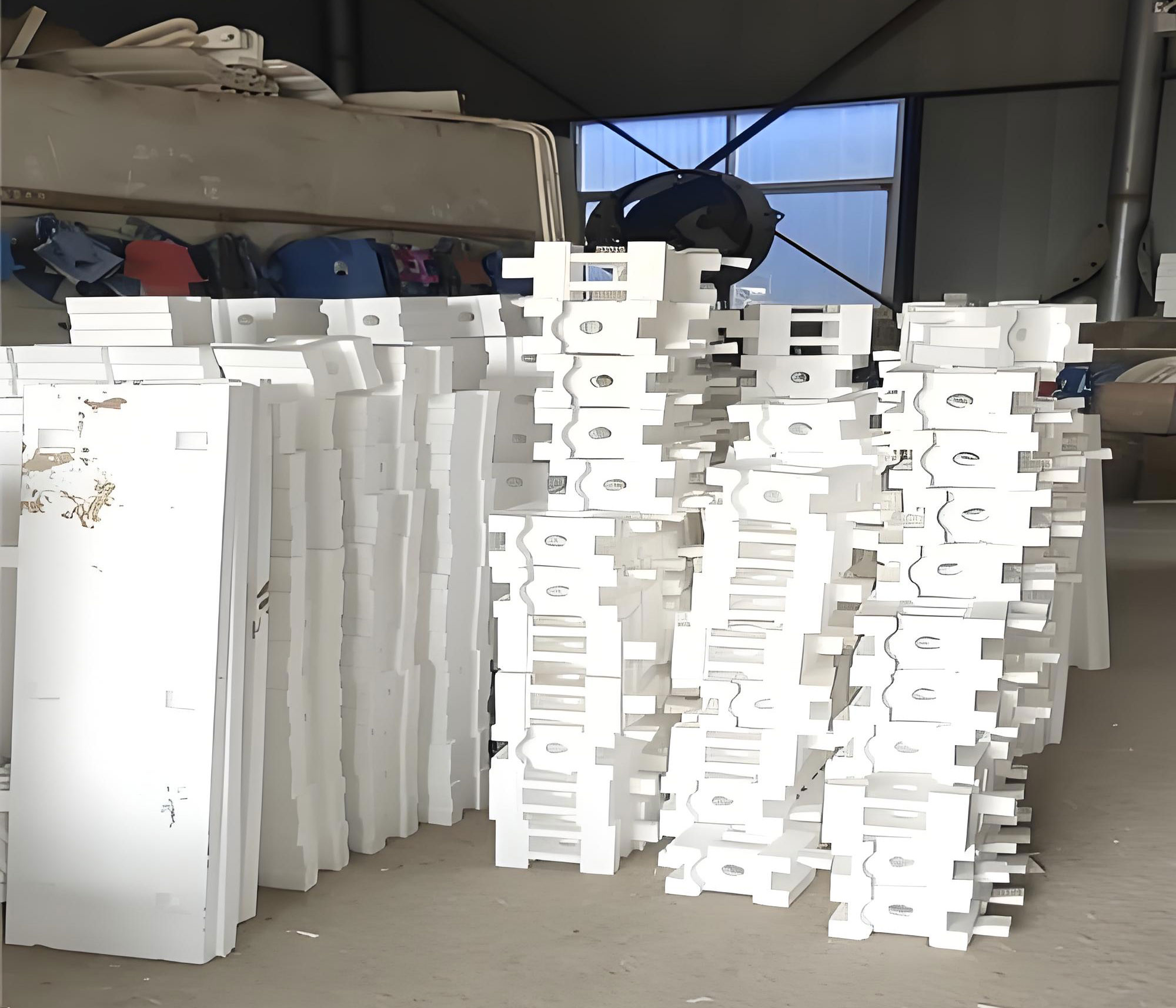
In all schemes, we incorporated top risers on the upper flanges of the casting. These risers served a dual purpose: acting as feeders to compensate for solidification shrinkage and as collection points for pattern pyrolysis residues and entrapped gases. The mold was prepared using unbonded dry silica sand (AFS 20/40 mesh) in a ventilated flask. A rain sanding device and a 3D vibration table were used to ensure uniform and dense sand compaction around the fragile coated patterns without causing distortion. Each flask contained a cluster of four patterns to improve productivity. The melting and treatment of the ductile iron were tailored for the lost foam casting process. The base iron was prepared using A3 steel scrap as the primary charge, with graphite-based carburizers to adjust the final carbon content. The target chemical composition was designed to ensure good fluidity and mechanical properties, as summarized below:
| Element | Target Range (wt.%) |
|---|---|
| C | 3.8 – 3.9 |
| Si | 2.6 – 2.8 |
| Mn | ≤ 0.15 |
| P | ≤ 0.06 |
| S | ≤ 0.05 |
| Cu | ≤ 0.10 |
The high carbon equivalent (CE ≈ 4.5) promotes excellent castability. Nodularization was achieved using a traditional sandwich method with 1.5-1.7% rare-earth magnesium ferrosilicon alloy. Inoculation was performed in two stages: 40% of a silicon-calcium-barium alloy (1.1-1.3% total addition) was added in the ladle, and the remaining 60% was added via stream inoculation during pouring. This practice enhances graphite nucleation, countering any potential chilling effects from the endothermic pattern decomposition. Pouring parameters are critical in the lost foam casting process. The pouring temperature (T_pour) must be high enough to provide sufficient superheat to vaporize the EPS pattern completely and maintain metal fluidity throughout the long, thin sections. However, excessive temperature can cause mold wall instability. We determined an optimal range through initial trials. The vacuum or negative pressure (P_vac) applied to the sand mold is another vital parameter. It strengthens the mold, helps remove decomposition gases through the coating, and can influence fill profile. The required pressure can be related to the permeability of the sand coat (k) and the gas generation rate (G), but in practice, it is set empirically. Our established window was:
$$ T_{pour} = 1500^\circ\text{C} \text{ to } 1520^\circ\text{C} \quad (1377^\circ\text{C} \text{ to } 1387^\circ\text{C} \text{ superheat relative to liquidus}) $$
$$ P_{vac, pouring} = 0.06 \text{ MPa} \text{ to } 0.07 \text{ MPa} (gauge) $$
$$ P_{vac, holding} = 0.03 \text{ MPa} \text{ to } 0.035 \text{ MPa} (gauge), \text{ for } 5-8 \text{ minutes post-pour} $$
Pouring was performed swiftly and continuously to maintain a full pouring cup, preventing air aspiration into the system. The comparative analysis of the three gating schemes under identical production conditions yielded clear results. Scheme I featured the sprue, a horizontal runner above the ingates, and four ingates feeding the bottom of the casting cavities. This configuration proved most effective. Scheme II had a much longer runner system, leading to excessive heat loss and premature metal cooling. Scheme III utilized only a sprue and direct ingates, which caused turbulence and inadequate sand compaction in recessed areas. The performance metrics are quantified below:
| Casting Process Scheme | Process Yield (%) | Rejection Rate (%) | Primary Defects Observed |
|---|---|---|---|
| Scheme I | 79.8 | 0 | None |
| Scheme II | 58.0 | 50 | Wrinkles, Slag Inclusions, Misruns |
| Scheme III | 84.2 | 100 | Metal Penetration (Fins), Sand Erosion |
Scheme I’s superior performance in the lost foam casting process can be attributed to its excellent slag-trapping capability in the upper runner and its promotion of a stable, upward-moving metal front that efficiently purges decomposition products towards the risers. The castings produced via Scheme I were sound, dimensionally accurate, and required minimal finishing. A systematic study of defects was integral to refining the lost foam casting process. The major defects encountered and their root causes, along with derived control equations and measures, are discussed next.
Metal Back-Spray (Reaction Ejection): This hazardous phenomenon occurs when gases from moisture or pattern decomposition build up rapidly at the metal front. The pressure (P_gas) can exceed the metallostatic head (P_metal), causing ejection. It is linked to incomplete drying, low pouring vacuum, or low coating permeability.
$$ P_{gas} = \frac{nRT}{V} \quad \text{(Ideal Gas Law approximation)} $$
where \(n\) is moles of gas, \(R\) is the gas constant, \(T\) is temperature, \(V\) is volume. Control Measures: Ensure complete pattern drying as per the protocol; increase pouring vacuum within the optimal range; use coatings with higher gas permeability (e.g., coarser refractory fillers).
Misruns and Cold Shuts: These occur when the metal solidifies before completely filling the mold. The governing factors are fluidity length (L_f) and actual flow distance (L). Fluidity is a function of superheat (ΔT), composition (CE), and heat absorption by the pattern.
$$ L_f \propto \Delta T \times \frac{\rho_{metal} \cdot H_f}{k_{sand} \cdot (T_{pour} – T_{sand})} \quad \text{(Simplified relation)} $$
where \(H_f\) is latent heat, \(k_{sand}\) is sand thermal conductivity. If \(L > L_f\), misruns occur. Control Measures: Increase pouring temperature (T_pour); pour rapidly and continuously to maintain thermal momentum; optimize gating to reduce flow distance L (as in Scheme I).
Wrinkles (Elephant Skin) and Slag Inclusions: These are classic defects in the lost foam casting process for cast iron, resulting from incomplete pattern vaporization and the entrapment of liquid or solid pyrolysis residues (mainly carbonaceous) in the advancing metal front. The defect severity relates to the ratio of pattern decomposition rate to metal advance rate. Control Measures: Increase pouring temperature to enhance pattern gasification; design gating to ensure residues float to risers (bottom gating with top risers); consider using patterns with lower residue yield (like STMMA for critical applications, though we used EPS successfully).
Shrinkage Porosity: Although ductile iron exhibits expansion due to graphite precipitation, improper feeding can still lead to shrinkage in heavy sections or isolated hot spots. The riser must remain liquid longer than the casting section it feeds. Using Chvorinov’s Rule as a guide:
$$ t_{solidification} = B \times \left( \frac{V}{A} \right)^n $$
where \(V\) is volume, \(A\) is surface area, \(B\) is a mold constant, and \(n\) is an exponent (~2). The riser’s (V/A) ratio must be greater than that of the casting’s hot spot. Control Measures: Ensure adequate riser size and proper neck design to prevent premature freezing; maintain high carbon equivalent for good feeding characteristics; ensure adequate pouring temperature.
To consolidate the optimal process parameters derived from our investigation into the lost foam casting process for large-diameter thin-walled ductile iron castings, we present the following summary table. This table serves as a guideline for implementing this green manufacturing technique for similar components.
| Process Parameter Category | Optimal Value or Range | Remarks / Governing Principle |
|---|---|---|
| Pattern Material & Density | EPS (Grade 4S), ρ = 23-25 g/L | Cost-effective for ductile iron; density minimizes residue. |
| Coating System | 1 Graphite layer + 2 Al-Si Refractory layers | Baume: 1.8-1.9 °Bé; Total thickness: 1.2-1.6 mm. |
| Drying Cycle | 45°C ±5°C for 48h (pattern) + 12h per coat | Critical for removing moisture and binder solvents. |
| Gating Design | Bottom-gated (Scheme I), with top risers | Promotes calm filling and residue evacuation. |
| Sand | Unbonded Silica Sand, AFS 20/40 | Good flowability and thermal stability. |
| Metal Composition (Ductile Iron) | C: 3.8-3.9%, Si: 2.6-2.8%, Low Mn, P, S | High CE (~4.5) for fluidity and feeding. |
| Pouring Temperature (T_pour) | 1500 – 1520 °C | Balances fluidity and pattern gasification energy. |
| Pouring Vacuum (P_vac) | 0.06 – 0.07 MPa during pour | Strengthens mold, removes gases. Hold at 0.03-0.035 MPa. |
| Pouring Practice | Fast, continuous, maintaining full pour cup | Prevents air aspiration and heat loss. |
In conclusion, our detailed investigation validates that the lost foam casting process is exceptionally well-suited for manufacturing large-diameter, thin-walled ductile iron water meter shells. By rigorously controlling pattern density, coating application, drying, gating design (with Scheme I being optimal), and pouring parameters, we achieved a dramatic simplification of the production sequence compared to traditional sand casting. The benefits are multifaceted: significant wall thickness reduction (from 8mm to 6.5mm), near-net-shape forming of features like bolt holes, a drastic reduction in machining allowance (from 3mm to 1.5mm), and consequently, substantial material savings and component lightweighting. Furthermore, the process yield and product qualification rate were significantly enhanced, directly lowering production costs. Most importantly, this shift represents a move towards a more sustainable and environmentally friendly foundry practice, eliminating the need for binders, complex core making, and reducing waste sand generation. The lost foam casting process, as demonstrated here, provides a robust, efficient, and green pathway for producing complex thin-walled iron castings. Future work could focus on further optimizing the coating composition for even better peel-off performance and investigating the use of advanced pattern materials for potentially critical applications requiring ultra-low defect levels.