
In my extensive experience with advanced manufacturing techniques, the lost foam casting process has emerged as a transformative method, particularly for producing high-integrity wind power castings such as those used in pitch and yaw systems. Compared to traditional sand casting, the lost foam casting process offers superior dimensional accuracy, excellent surface finish, design flexibility, elimination of conventional cores, suitability for high-volume production, ease of cleaning, and reduced investment and operational costs. This makes the lost foam casting process increasingly dominant in sectors demanding precision and efficiency. This article synthesizes years of practical knowledge, focusing on the nuanced application of the lost foam casting process for wind turbine components.
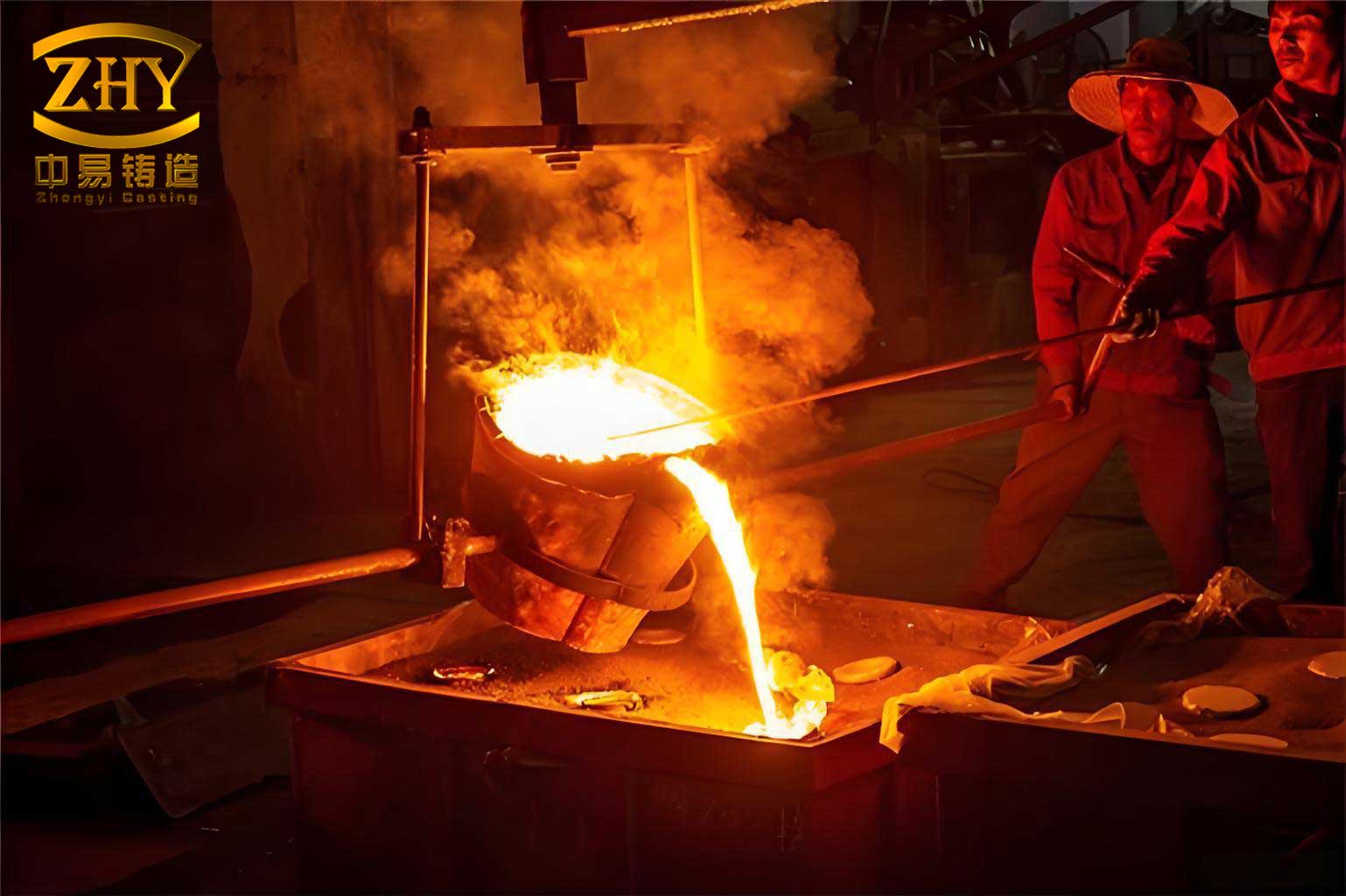
The core principle of the lost foam casting process involves creating a foam pattern of the desired part, coating it with a refractory slurry, embedding it in unbonded sand, and then pouring molten metal. The metal vaporizes the foam, precisely taking its shape. Mastering the lost foam casting process requires meticulous control at every stage to mitigate defects common in complex geometries like wind power castings.
1. Foundry Methodology and Gating System Design
In the lost foam casting process for wind components, gating design is paramount. We typically employ tandem pouring within a single flask to produce multiple castings simultaneously, optimizing productivity. A circular sprue is standard, with a pouring cup enlarged by 20% to 50% compared to conventional sand casting. This design prevents flow interruption, stabilizes the metal head pressure, and ensures smooth mold filling. The relationship between flow rate, sprue area, and metal head can be approximated by:
$$ Q = A \cdot v = A \cdot \sqrt{2gh} $$
where \( Q \) is the volumetric flow rate, \( A \) is the cross-sectional area of the sprue, \( v \) is the flow velocity, \( g \) is gravitational acceleration, and \( h \) is the effective metal head height. Since metal flow in the lost foam casting process is slower than in cavity casting due to foam decomposition, the gating system cross-section must be larger. For wind power castings, we increase the area by approximately 30%. A ceramic filter is placed between the pouring cup and sprue to reduce slag inclusion. Key gating parameters are summarized below:
| Parameter | Typical Value for Wind Power Castings | Rationale |
|---|---|---|
| Sprue Diameter Increase | ~30% vs. Conventional | Compensate for slower foam decomposition flow |
| Pouring Cup Enlargement | 20-50% | Maintain constant metal head, prevent断流 |
| Filter Mesh Size | 10-12 ppi (pores per inch) | Trap macroscopic inclusions |
| Gating Ratio (Sprue:Runner:Ingate) | 1 : 1.2 : 1.5 (Area-based) | Ensure pressurized, turbulent-free filling |
The fill time \( t_f \) for a casting in the lost foam casting process can be estimated considering the foam degradation kinetics:
$$ t_f \approx \frac{V_{mold}}{Q} + \Delta t_{decomp} $$
where \( V_{mold} \) is the mold cavity volume and \( \Delta t_{decomp} \) is an added time factor for foam vaporization, which is a unique consideration in the lost foam casting process.
2. Foam Pattern Production
2.1 Bead Material Selection
The choice of foam material is critical in the lost foam casting process. Two primary expandable bead materials are used: Expanded Polystyrene (EPS) and Co-polymer (EPMMA). For wind power ductile iron castings, EPMMA is strongly preferred. Although EPMMA has a higher instantaneous gas generation rate, its gasification residues are significantly lower than those of EPS. These residues can act as “slag collectors” within the molten metal, adsorbing impurities and amplifying their detrimental effect. This is especially pronounced in sections thicker than 30 mm. The selection fundamentally impacts the quality of the lost foam casting process. The comparative properties are:
| Property | EPS (Expanded Polystyrene) | EPMMA (Co-polymer) | Implication for Lost Foam Casting Process |
|---|---|---|---|
| Density (kg/m³) | 20-25 | 22-28 | Affects pattern strength and buoyancy |
| Gas Generation (cm³/g) | ~1000 (slower) | ~1200 (faster) | Influences backpressure and filling dynamics |
| Carbon Residue (%) | 0.05-0.1 | <0.02 | Key for reducing lustrous carbon defects in iron |
| Decomposition Temperature (°C) | ~400 | ~460 | Affects thermal interaction with metal front |
The gas evolution volume \( V_{gas} \) from a pattern can be modeled as:
$$ V_{gas} = m_{foam} \cdot G \cdot f(T) $$
where \( m_{foam} \) is the foam mass, \( G \) is the specific gas yield (material-dependent), and \( f(T) \) is a temperature-dependent function of the decomposition rate.
2.2 Pattern Assembly and Adhesion
Wind power castings are often rotational symmetric bodies but may require complex pattern assemblies. We manufacture segments separately and bond them. The gating system is also attached via adhesion. The adhesive must exhibit low gas generation, high strength, and rapid curing to meet high-volume demands of the lost foam casting process. We use specialized hot-melt adhesives. The bonding strength \( \tau \) must satisfy:
$$ \tau \geq \frac{F_{drag}}{A_{bond}} $$
where \( F_{drag} \) is the drag force from sand filling and vibration, and \( A_{bond} \) is the bonded area. Careful alignment during bonding is crucial to prevent dimensional inaccuracies.
3. Coating Application and Drying
3.1 Coating Function and Specifications
The refractory coating in the lost foam casting process serves multiple vital functions: it enhances the pattern’s strength and rigidity, improves resistance to sand erosion during filling, prevents pattern deformation during vibration and vacuum application, and ensures dimensional fidelity. The coating must exhibit good liquid adsorbency, and when dried, possess high permeability, strength, crack resistance, and good peel-off behavior post-cast. The permeability \( K \) is a critical parameter, often described by Darcy’s Law in the context of gas evacuation:
$$ v_g = \frac{K}{\mu} \frac{\Delta P}{L} $$
where \( v_g \) is the gas velocity through the coating, \( \mu \) is gas viscosity, \( \Delta P \) is the pressure drop across the coating, and \( L \) is the coating thickness.
| Coating Property | Target Value / Requirement | Test Method / Rationale |
|---|---|---|
| Viscosity (Ford Cup #4, sec) | 35-45 | Ensures uniform dipping and controlled thickness |
| Permeability (AFS units) | 15-25 | Facilitates gas escape without compromising metal barrier |
| Green Strength (MPa) | >0.5 | Resists handling damage before drying |
| Dry Strength (MPa) | >2.0 | Withstands sand compaction and metallostatic pressure |
| Thickness (mm) | 1.0-2.0 (final) | Balances barrier quality and gas permeability |
3.2 Application Methodology and Critical Controls
We utilize a dip-and-pour method for efficiency and uniformity. Due to the low density of foam, buoyancy during dipping is significant. To prevent distortion, we ladle the coating over the pattern, then hang it for drainage before transferring to the drying chamber. Typically, two coats are applied. Drying occurs at 40-50°C for 2 to 10 hours, with adequate air circulation to reduce humidity. It is imperative that each coat is completely dry before the next application; otherwise, entrapped moisture leads to gas defects like blows or porosity during the lost foam casting process. The required drying time \( t_d \) can be estimated from a diffusion model:
$$ t_d \propto \frac{L_c^2}{D_{eff}} $$
where \( L_c \) is the coating thickness and \( D_{eff} \) is the effective moisture diffusivity, which is highly dependent on air flow and temperature.
4. Molding and Sand Compaction
4.1 Sand System Management
The lost foam casting process uses dry, unbonded sand, typically silica. For wind power castings, we select sand with an AFS grain fineness number between 40 and 60. The sand must be clean, cooled (below 50°C to prevent pattern softening), and periodically refreshed to control the Loss on Ignition (LOI). We add about 20% new sand to the system regularly. The sand’s granulometry directly affects permeability and packing density. The optimal sand size distribution can be described by the Andreasen equation for maximum packing density \( \phi_{max} \):
$$ P(d) = \left( \frac{d}{d_{max}} \right)^q $$
where \( P(d) \) is the cumulative fraction smaller than size \( d \), \( d_{max} \) is the maximum particle size, and \( q \) is a distribution modulus (often ~0.3-0.5).
| Sand Property | Specification for Lost Foam Casting Process | Purpose |
|---|---|---|
| AFS Grain Fineness | 40-60 | Balances permeability and surface finish |
| Temperature Limit | < 50 °C | Prevents EPS/EPMMA pattern distortion |
| LOI Control | < 0.5% (maintained) | Minimizes gas generation from sand itself |
| Clay Content | < 0.1% | Prevents agglomeration and reduces permeability |
4.2 Vibration Compaction Dynamics
Vibration fluidizes the sand, enabling it to flow into all pattern cavities and achieve high, uniform density. This step is crucial in the lost foam casting process to support the coating and prevent mold collapse. We use a 3D vibration table with controlled parameters. Vibration acceleration \( a \) should be 10-20 m/s², with an amplitude \( A \) of 0.5-1.5 mm. The fundamental frequency \( f \) is typically 50-60 Hz. The relationship between acceleration, amplitude, and frequency is:
$$ a = (2\pi f)^2 A $$
The placement sequence is vital: a base layer of at least 100 mm of sand is laid before placing the first pattern. Patterns and required chills are placed in layers, with vibration after each layer. Minimum spacing between patterns is 70 mm. Compacting after full embedding is ineffective and risks pattern displacement.
5. Vacuum-Assisted Pouring and Solidification
Pouring under vacuum is a defining feature of the lost foam casting process. It extracts decomposition gases, stabilizes the mold, and increases the pressure head on the solidifying metal. For wind power castings, vacuum pressure \( P_{vac} \) is typically maintained between 0.03 and 0.04 MPa (-0.04 to -0.06 bar gauge), with higher values for heavier sections. The pouring sequence follows a “slow-fast-slow” curve to initially establish a metal seal, then fill rapidly, and finally top off slowly to minimize turbulence. The pouring temperature is 30-50°C higher than in sand casting to compensate for the heat absorbed in vaporizing the foam. The heat balance at the metal-foam interface can be simplified as:
$$ \rho_m C_{p,m} (T_{pour} – T_{liquidus}) \cdot V_{metal\_front} \approx \rho_f L_f \cdot V_{foam\_decomp} + Q_{loss} $$
where \( \rho \) denotes density, \( C_p \) specific heat, \( L_f \) latent heat of foam decomposition, and \( Q_{loss} \) other heat losses. Vacuum must be sustained for 3-5 minutes after pouring until the casting shell is robust. During pouring, gas generation may cause vacuum fluctuation; it must not fall below 0.01 MPa to ensure mold integrity.
6. Analysis and Mitigation of Common Defects
Despite its advantages, the lost foam casting process presents unique defect modes. Understanding their root causes is essential for producing sound wind power castings.
6.1 Porosity and Inclusions
These appear as subsurface voids or slag pockets, often revealed only after machining. Primary sources are foam decomposition gases and residues, inadequate venting or slag trapping in gating, and low pouring temperature. Mitigation strategies within the lost foam casting process framework include enhancing coating permeability, using efficient filters, increasing pouring temperature, and modifying gating to promote directional solidification and gas escape. A quantitative approach involves ensuring the gas evacuation capacity \( Q_{vac} \) exceeds the gas generation rate \( \dot{V}_{gas} \):
$$ Q_{vac} = S \cdot v_g \geq \dot{V}_{gas}(t) $$
where \( S \) is the effective permeable area of the coating.
6.2 Shrinkage Porosity and Cavities
Common in thermal junctions like bolt holes and thick section transitions in ductile iron castings. Countermeasures include adjusting iron composition towards higher carbon equivalent (CE = 4.6-4.8%), implementing post-inoculation, and strategic use of chills. The carbon equivalent is calculated as:
$$ CE = \%C + \frac{\%Si + \%P}{3} $$
The chill design can be optimized using Chvorinov’s rule to balance solidification times between the casting body and the chilled region.
6.3 Metal Penetration (Burning-on)
This occurs in tight corners, dead zones, or near the gating system due to inadequate sand compaction, coating cracks, or excessive thermal load. Solutions involve optimizing coating thickness and refractoriness, controlling vibration force, adjusting vacuum level, and lowering pouring temperature. The critical pressure for metal penetration \( P_{crit} \) through a coating defect can be approximated by the capillary equation:
$$ P_{crit} = \frac{2 \gamma_{lv} \cos \theta}{r_{pore}} $$
where \( \gamma_{lv} \) is the liquid metal surface tension, \( \theta \) is the contact angle, and \( r_{pore} \) is the effective pore radius in the coating or sand matrix.
6.4 “White Defect” (Coating Erosion)
This defect manifests as dispersed sand or coating particles on machined surfaces, resembling a snowflake pattern. It typically originates at junctions in the gating system where coating adhesion is weak or mechanical erosion is high. The primary remedy is to increase coating thickness and strength at these critical locations. The erosive force \( F_e \) from molten metal flow is proportional to the dynamic pressure:
$$ F_e \propto \frac{1}{2} \rho_m v^2 $$
Thus, reducing flow velocity \( v \) at turns and junctions by enlarging channels is beneficial in the lost foam casting process.
| Defect Type | Primary Causes in Lost Foam Casting Process | Corrective Actions & Process Adjustments |
|---|---|---|
| Porosity/Inclusions | High foam gas/residue, poor venting, low temp | Use EPMMA, optimize coating permeability, add filters, increase \( T_{pour} \) |
| Shrinkage Defects | Inadequate feeding in thermal centers | Increase CE, enhance inoculation, apply chills, optimize risering |
| Metal Penetration | Coating failure, high \( T_{pour} \), high \( P_{vac} \), loose sand | Improve coating quality, control compaction, moderate \( T_{pour} \) and \( P_{vac} \) |
| White Defect | Coating erosion at gating junctions | Reinforce coating at high-stress points, redesign gating for smoother flow |
In conclusion, the successful implementation of the lost foam casting process for demanding applications like wind power components hinges on a systems approach. Every element—from bead selection and pattern engineering to coating, sand dynamics, vacuum control, and metallurgy—must be harmonized. The lost foam casting process is not merely a substitution for traditional methods but a distinct technology requiring deep process understanding. Through continuous refinement of these interlinked parameters, the lost foam casting process can reliably produce high-quality, cost-effective castings that meet the rigorous standards of the renewable energy industry. The future of the lost foam casting process lies in further digitization and modeling of foam degradation, gas flow, and heat transfer to predict and eliminate defects proactively.