
In the context of manufacturing and repairing components for heavy-duty mining equipment, the demand for efficient, cost-effective, and high-quality casting methods is paramount. This article details my first-hand experience and technical exploration in adopting the lost foam casting process for producing hinge bearings used in KF60 dump cars. Traditionally, these small but critical components were manufactured using conventional green sand casting, which presented significant challenges including low production efficiency, extended lead times, substantial cleaning workloads, and high overall manufacturing costs. The shift to the lost foam casting process was driven by the need to overcome these limitations and meet stringent repair schedules. The lost foam casting process, characterized by its use of expendable foam patterns surrounded by unbonded sand under a partial vacuum, offers a near-net-shape, precise forming capability that eliminates many traditional molding steps.
The fundamental principle of the lost foam casting process involves creating a pattern from expandable polystyrene (EPS) foam, coating it with a refractory slurry, and placing it in a flask filled with dry, unbonded sand. The sand is compacted through vibration. During pouring, the molten metal vaporizes and replaces the foam pattern, precisely replicating its shape. The application of vacuum throughout the pouring and solidification phases serves a dual purpose: it stabilizes the sand mold, preventing collapse, and assists in evacuating the gaseous and liquid decomposition products from the foam, which is critical for achieving sound castings. This process eliminates the need for cores, parting lines, and draft angles, resulting in castings with excellent surface finish, minimal clean-up, and high dimensional accuracy. The sand is fully reusable, leading to substantial material savings and environmental benefits. For small components like hinge bearings, multiple patterns can be clustered onto a common gating system, significantly boosting productivity per mold.
Component Analysis and Technical Requirements
The hinge bearing is a relatively thin-walled steel casting with overall dimensions of approximately 150mm x 194mm x 36mm. Its geometry, while not overly complex, requires precision on specific functional faces. The primary technical specifications mandated the material to be ZG230-450 (a cast carbon steel grade similar to ASTM A27 Grade 70-40). Key faces designated as A, B, and C required subsequent machining, necessitating sound metal quality and adequate stock allowance in these regions. All other surfaces were required to be smooth and free of casting defects such as gas holes (porosity), cracks, shrinkage porosity, sand inclusion, and slag inclusions. The casting’s weight was approximately 4.8 kg. The primary challenge in applying the lost foam casting process to this steel component lies in managing the decomposition by-products of the foam pattern to prevent the formation of gas-related defects and carbonaceous inclusions.
Design of the Lost Foam Casting Process
The success of the lost foam casting process hinges on a meticulously designed process protocol. The following sections outline the critical steps and parameters developed for the hinge bearing.
1. Process Planning and Parameter Determination
The first step involves defining the casting’s orientation (pouring position) within the mold and establishing fundamental allowances. To ensure the integrity of the critical machined faces (A, B, C), they were oriented to be in a vertical or side position during pouring. This strategy helps prevent slag and gas entrapment on these surfaces, as buoyancy drives lighter defects towards the cope (top) of the casting. Placing the larger flat surfaces vertically also facilitates the upward escape of decomposition gases. For carbon steel, a linear shrinkage allowance of 2.0% was applied. A machining allowance of +6 mm was added to the critical faces. The key process parameters are summarized in the table below:
| Process Parameter | Value or Specification | Rationale | |||
|---|---|---|---|---|---|
| Cast Material | ZG230-450 / ASTM A27 Gr 70-40 | Required mechanical properties for load-bearing component. | |||
| Pattern Material | Expandable Polystyrene (EPS) | Standard, cost-effective material for lost foam casting. | Linear Shrinkage Allowance | 2.0% | Compensates for solidification contraction of carbon steel. |
| Machining Allowance | +6 mm | Provides sufficient stock for finishing critical faces. | |||
| Target Pattern Density | 0.016 – 0.025 g/cm³ (16-25 kg/m³) | Balances strength for handling with minimal gas generation. |
2. Gating and Feeding System Design
The design of the gating system in the lost foam casting process is paramount for controlling metal flow, heat transfer, and the evacuation of pattern degradation products. A bottom-gating system was selected. The ingates were connected to the side of the bearing at its lower edge. This design promotes a calm, upward fill of the mold cavity. The metal front advances in the same direction as the rising decomposition gases, allowing them to be vented through the coating and the sand column above the casting, thereby minimizing the risk of gas entrapment. Given the uniform, relatively thin wall section of the bearing, no separate feeding risers were required; the gating system itself provided sufficient feeding during solidification. The cross-sectional areas of the gating channels were designed in a pressurized ratio:
$$ \sum A_{sprue} : \sum A_{runner} : \sum A_{ingate} = 3.0 : 2.8 : 1.0 $$
This pressurized system helps quickly establish a metallostatic head pressure to counteract the back-pressure from foam decomposition gases and promotes a more uniform fill rate. Multiple bearing patterns were clustered along a common runner to maximize yield and productivity per mold.
3. Pattern Manufacturing and Assembly
Pattern quality is the foundation of dimensional accuracy in the lost foam casting process. EPS boards were first conditioned in a drying oven at 40-50°C for approximately 12 hours to stabilize dimensions and remove moisture. Using CAD-generated templates and a computer-controlled hot-wire cutter, the three-dimensional bearing shape was sliced from the foam block. Complex geometries were often achieved by gluing multiple simpler segments together using a specialized foam adhesive. The density of the EPS foam is a critical variable. It can be related to the potential gas volume generated during pouring. A simplified model for the mass of gas produced is:
$$ m_{gas} = \rho_{foam} \cdot V_{pattern} \cdot C_{decomp} $$
where \( \rho_{foam} \) is the foam density, \( V_{pattern} \) is the pattern volume, and \( C_{decomp} \) is a decomposition coefficient. Therefore, a lower density reduces gas load but may compromise pattern rigidity. The selected range of 0.016-0.025 g/cm³ provided an optimal balance. After assembly, patterns were meticulously hand-finished to remove seams and imperfections, then inspected against master gauges. Finally, the gating system components (ingates, runners) were attached to create the complete pattern cluster.
4. Coating Application and Drying
The refractory coating applied to the foam pattern serves several vital functions: it provides a barrier between the sand and the molten metal, prevents sand erosion, enhances surface finish, and allows the controlled permeation of foam decomposition gases. A water-based zirconia-silicate coating was developed and used. The viscosity was carefully controlled to achieve a consistent layer. Patterns were dipped or brushed to achieve a uniform coating thickness. After each coating application, the patterns were dried in a convection oven at 40-50°C. The final dry coating thickness targeted was 2.0 mm. The drying process must be controlled to prevent pattern distortion; patterns were supported on flat plates or suspended. The permeability of the coating \( k_{coat} \) is a key property, influencing the venting of gases. The required permeability can be conceptually linked to the gas generation rate:
$$ Q_{gas} \propto \frac{k_{coat} \cdot A_{pattern} \cdot \Delta P}{\mu_{gas} \cdot \tau_{coat}} $$
where \( Q_{gas} \) is the gas flow rate, \( A_{pattern} \) is the pattern surface area, \( \Delta P \) is the pressure differential (vacuum), \( \mu_{gas} \) is the gas viscosity, and \( \tau_{coat} \) is the coating thickness. Adequately dried and coated patterns were stored in a low-humidity environment to prevent moisture absorption, which could lead to blow defects.
5. Mold Assembly (Flasking) and Compaction
The prepared pattern clusters were placed into a perforated molding flask. Dry, unbonded silica sand with an AFS grain fineness of approximately 50 (40/70 mesh) was used as the molding medium. The sand must be cool (<40°C) to avoid softening the foam pattern. The flask was filled in stages with intermittent vibration to ensure uniform and adequate compaction around the patterns, especially in internal cavities. A standard sequence involved: placing a base layer of sand (80-120 mm), vibrating and leveling it, positioning the pattern cluster, installing the sprue, backfilling with sand in layers, and vibrating after each layer. Vibration was applied in multiple axes (X, Y, and finally Z) to achieve optimal packing density. The goal is to achieve a uniform bulk density \( \rho_{sand, bulk} \) throughout the flask to resist metal pressure and pattern buoyancy. After final leveling, a plastic film was placed over the flask top and sealed at its edges. The sprue cup was positioned, and the film was covered with a thin layer of sand and a protective steel plate. The vacuum system was then connected to the flask’s plenum.
6> Melting, Pouring, and Solidification Control
Steel melting was conducted in a basic-lined electric arc furnace, aiming for a final chemistry of ZG230-450. A key aspect of the lost foam casting process for steel is the requirement for a higher pouring temperature compared to conventional sand casting. The additional thermal energy is needed to vaporize the foam and heat the resulting gases. The temperature increment \( \Delta T \) can be estimated based on the enthalpy of vaporization of the foam and the specific heat of the metal:
$$ \Delta T \approx \frac{ \rho_{foam} \cdot V_{pattern} \cdot H_{vap, foam} }{ \rho_{metal} \cdot V_{casting} \cdot C_{p, metal} } $$
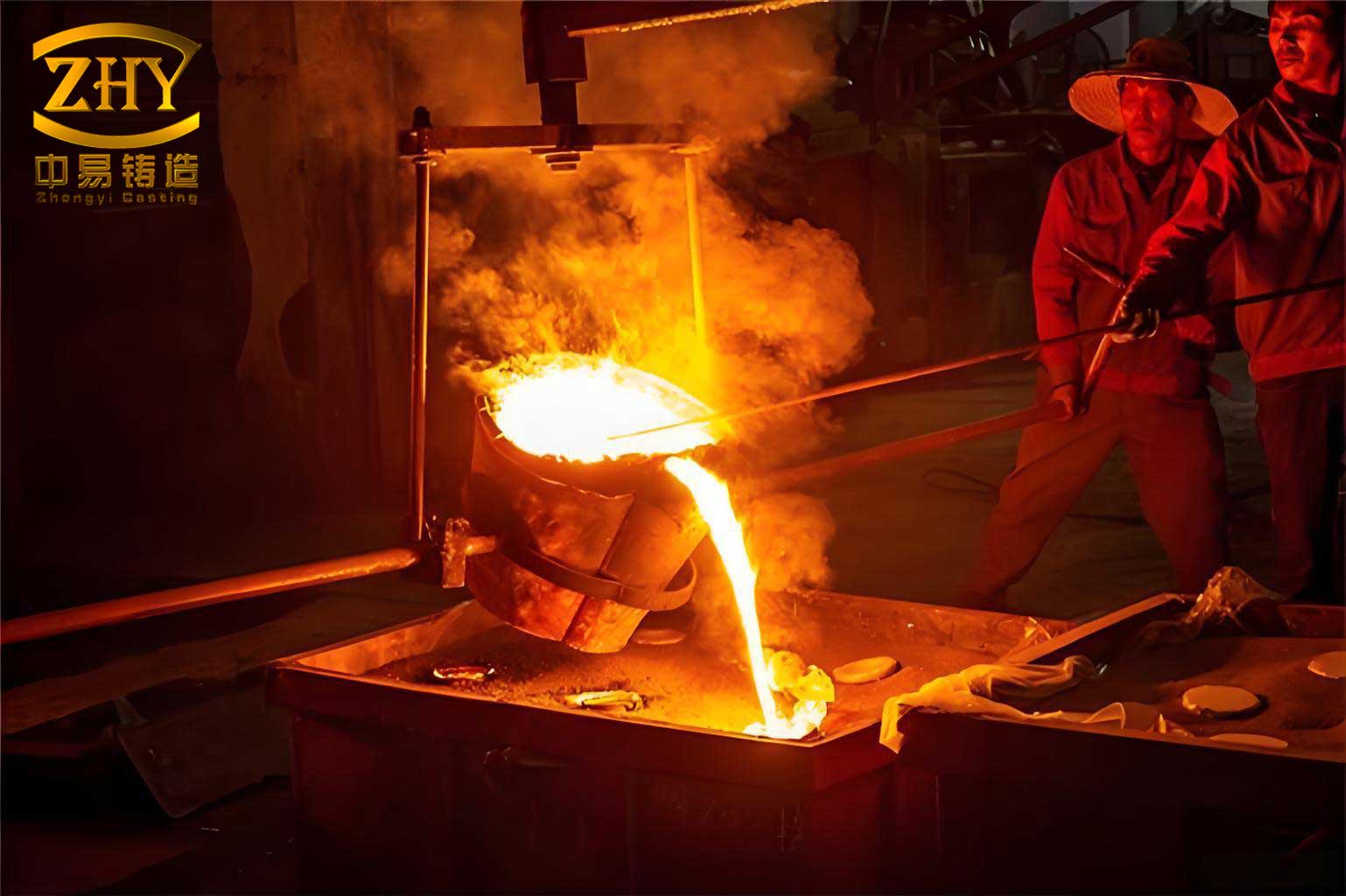
In practice, this translated to a pouring temperature range of 1530-1560°C, which is about 30-50°C higher than typical sand casting practice for this steel grade. The pouring technique is critical. The vacuum pump was activated, achieving a controlled vacuum level of 0.06 – 0.09 MPa (450 – 675 mmHg) in the flask. The pouring sequence followed the “slow-fast-steady” principle:
- Slow Start: Initial pouring was done with a thin stream to slowly fill the sprue and begin vaporizing the foam in the gating system, minimizing the risk of violent reaction or “backfire”.
- Fast Fill: Once the metal stabilized in the sprue and gates, the pour rate was maximized to fill the mold cavity rapidly, maintaining a positive metal head pressure.
- Steady Finish: As the metal approached the top of the cavity, the pour rate was slightly reduced to avoid turbulence and metal eruption.
The pouring cup was kept full throughout to maintain pressure and prevent air aspiration. After pouring, the vacuum was maintained for at least 15 minutes to hold the mold rigid during initial solidification. The vacuum was then released, and the casting was allowed to cool in the mold for an additional 30 minutes or more to prevent the formation of cooling cracks before shakeout.
Quality Results, Defect Analysis, and Mitigation Strategies
A production batch of 80 hinge bearings was manufactured using the described lost foam casting process. Post-shakeout inspection revealed castings with excellent surface finish, requiring minimal cleaning. Dimensional accuracy and chemical composition met all specifications. After machining, the overall yield of sound castings was 98%. The primary defects encountered and their control within the lost foam casting process framework are analyzed below.
| Defect Type | Root Cause in Lost Foam Casting | Preventive/Mitigation Measures |
|---|---|---|
| Gas Porosity (Pinholes/Blows) | Entrapment of foam decomposition gases (mainly hydrocarbons) due to insufficient coating permeability, low vacuum, low pouring temperature, or improper gating. | Optimize coating permeability and thickness. Ensure adequate vacuum level (0.06-0.09 MPa). Increase pouring temperature within the 1530-1560°C range. Use bottom or side gating to facilitate gas escape. Ensure proper pattern density. |
| Carbonaceous Inclusions (Slag/Black Spots) | Incomplete vaporization of the foam, leading to the formation of liquid or pyrolytic carbon residues that are entrapped in the solidifying metal. | Increase pouring temperature to ensure complete pyrolysis. Optimize gating for directional solidification that pushes residues towards non-critical areas or the cope. Ensure adequate vacuum to remove products quickly. Possibly use foam with lower carbon content or additives. |
| Folds or Cold Shuts | Slow metal front advancement causing the leading edge to cool and solidify before the mold is completely filled, often due to low pouring temperature or rate. | Increase pouring temperature and pour rate during the main fill phase. Ensure proper gating design to maintain a continuous, progressive metal front. |
| Sand Collapse or Erosion | Insufficient sand compaction or loss of vacuum during pouring, leading to mold instability. | Implement rigorous multi-axis vibration compaction. Ensure vacuum system integrity and maintain vacuum throughout pouring and early solidification. Use sand with appropriate grain shape and size. |
| Pattern-Related Distortion | Warping of the EPS pattern during coating, drying, or sand filling due to improper handling, heat, or pressure. | Control drying temperature (<50°C). Use proper support fixtures during drying and handling. Control sand filling and vibration intensity to avoid mechanical distortion. |
Economic and Operational Advantages Realized
The implementation of the lost foam casting process for the hinge bearing yielded significant benefits compared to the prior green sand method, which can be quantified across several metrics. The reusable, unbonded sand system eliminates the cost of bentonite, coal dust, and other sand additives, as well as the energy and labor associated with sand reclamation and conditioning. The near-net-shape capability drastically reduces machining stock and subsequent cleaning, grinding, and shot blasting time. The ability to cluster multiple patterns in a single mold dramatically increases unit output per molding operation. Furthermore, the simplification of the process flow—eliminating core making, mold assembly, and parting line finishing—reduces labor skill requirements and cycle time. The process also lends itself to a cleaner working environment with less waste generation.
A simplified cost model comparing the two processes for a batch of 100 castings highlights the differences. Let \( C_{mat} \) represent material costs, \( C_{lab} \) labor costs, \( C_{ener} \) energy costs, and \( C_{cap} \) capital/tooling amortization. While the lost foam casting process has higher initial pattern and tooling costs (\( C_{cap,LFC} > C_{cap,GS} \)), it demonstrates savings in other areas:
$$ \text{Total Cost}_{GS} = C_{mat,GS} + C_{lab,GS} + C_{ener,GS} + C_{cap,GS} $$
$$ \text{Total Cost}_{LFC} = C_{mat,LFC} + C_{lab,LFC} + C_{ener,LFC} + C_{cap,LFC} $$
The economic advantage of the lost foam casting process emerges when:
$$ (C_{lab,GS} – C_{lab,LFC}) + (C_{mat,GS} – C_{mat,LFC}) > (C_{cap,LFC} – C_{cap,GS}) + (C_{ener,LFC} – C_{ener,GS}) $$
In our application, the substantial reductions in cleaning labor (\( C_{lab} \)) and machining material waste (\( C_{mat} \)) far outweighed the incremental costs of pattern production and the slightly higher energy cost for increased pouring temperature.
Conclusion
The successful production of ZG230-450 hinge bearings for mining equipment validates the lost foam casting process as a highly viable and advantageous manufacturing route for small-to-medium sized, precision steel castings. By systematically addressing the core challenges of gas and residue management through integrated design of the gating system, precise control of foam pattern density, application of a permeable refractory coating, optimization of sand compaction, and strict regulation of pouring parameters (temperature, speed, and vacuum), a high-quality yield was consistently achieved. The lost foam casting process demonstrated clear superiority over traditional green sand casting in terms of surface finish, dimensional consistency, reduced post-casting labor, and overall production efficiency for this component type. The economic analysis confirms significant cost savings per unit, primarily derived from reduced machining and cleaning operations. This case study underscores that the lost foam casting process is not merely an alternative but a strategically superior choice for batch production of complex, quality-sensitive cast components where traditional methods fall short on lead time, cost, or quality consistency. Future work could involve further optimization of coating formulations for even better gas permeability and investigating advanced foam materials to reduce the total gas load and carbon residue potential.