
As a modern and innovative casting technique, the lost foam casting process has revolutionized metal forming since its development in the 1980s. This method involves creating a foam pattern that mirrors the final part, coating it with refractory material, drying it, embedding it in dry sand under vibration, and pouring molten metal under vacuum to produce precise castings. In this article, I will delve into the critical quality control aspects of the lost foam casting process, drawing from industrial practices and theoretical insights. My aim is to provide a comprehensive guide that highlights key parameters, best practices, and optimization strategies to ensure high-quality outcomes. Throughout this discussion, the term “lost foam casting process” will be emphasized to reinforce its significance in contemporary manufacturing.
The lost foam casting process begins with pattern making, where expanded polystyrene (EPS) foam is shaped into a replica of the desired component. This step is crucial, as pattern quality directly affects dimensional accuracy and surface finish. With advancements in 3D software like UG, designers can enhance precision and enable complex geometries, making the lost foam casting process ideal for intricate parts. I recall that in many applications, the foam density should be around 18 kg/m³, and pre-drying in a controlled environment for 8–16 hours is recommended to eliminate moisture. During assembly, patterns are bonded using hot-melt adhesive, with minimal glue to avoid defects. A table summarizing pattern preparation parameters is provided below:
| Parameter | Optimal Range | Notes |
|---|---|---|
| Foam Density | 18 kg/m³ | Ensures structural integrity and easy burnout |
| Pre-drying Time | 8–16 hours | At 40–50°C to remove moisture |
| Bonding Adhesive | Hot-melt glue | Minimal application to reduce gas evolution |
| Pattern Finishing | Fine sanding | Eliminates cutting marks for smooth surfaces |
After pattern preparation, the application of refractory coatings is vital. The coating must be tailored to the metal alloy—for instance, different compositions for steel versus iron castings. In the lost foam casting process, coating thickness influences mold strength and gas permeability. I often emphasize that the first two coats should be thin and dilute, followed by thorough drying at 40–50°C for 18–24 hours per layer. The total coating thickness typically ranges from 2–3 mm, with gates and risers requiring up to 3 mm. A common formula for coating effectiveness relates thickness ($$t$$) to thermal stability ($$S$$): $$S = k \cdot t^{-1} \cdot \rho$$, where $$k$$ is a material constant and $$\rho$$ is coating density. This highlights how proper coating control mitigates defects like penetration or erosion.
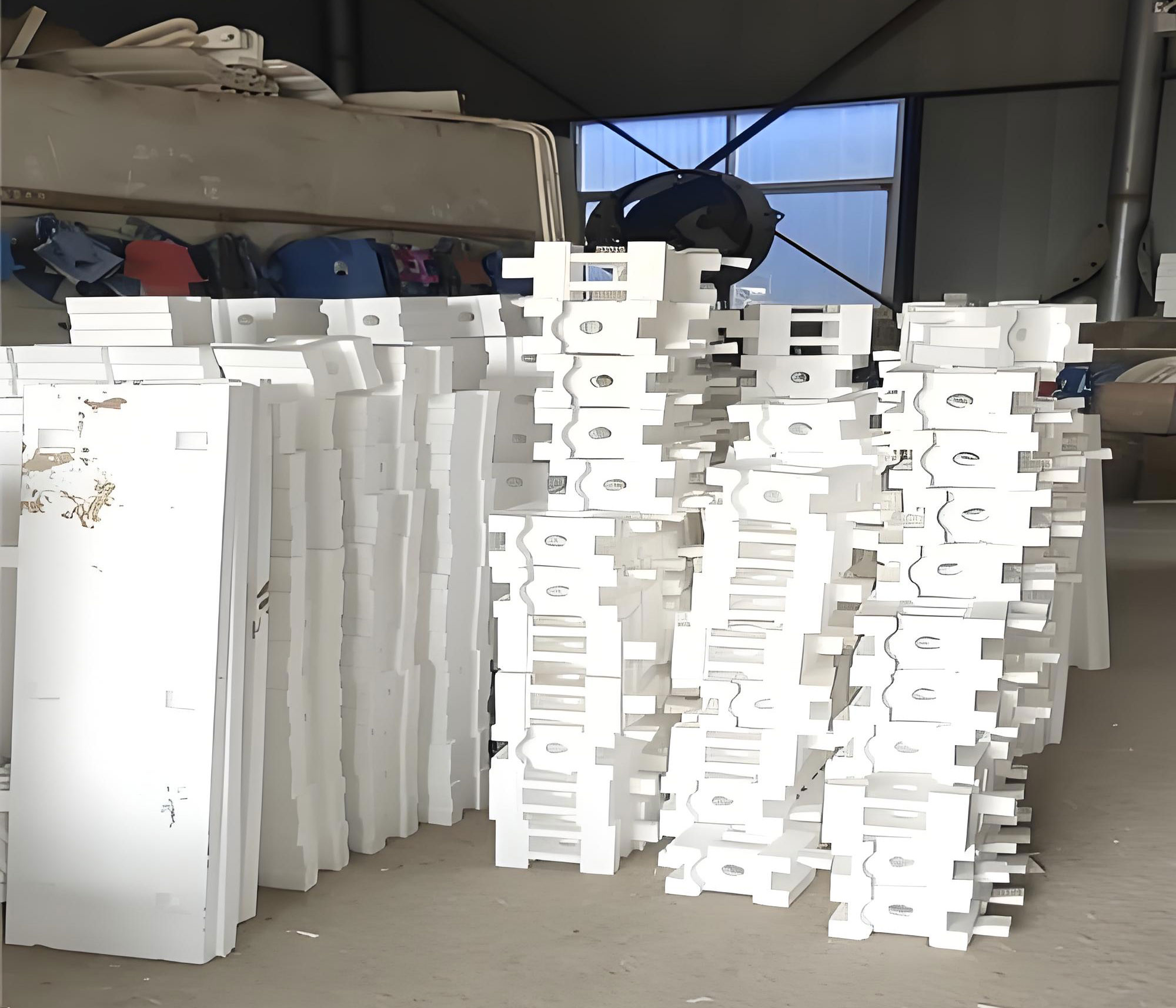
Molding and gating system design are core to the lost foam casting process. Patterns are assembled into clusters, ensuring uniform sizes and adequate spacing—at least twice the wall thickness between parts—to facilitate sand filling and reduce thermal interference. For deep holes (e.g., depth > 40 mm, cross-section < 30 mm), magnesia sand cores are used, while quartz sand suffices for shallow features. During sand compaction, vibration is applied in layers of about 300 mm for 60 seconds each, with manual assistance for hard-to-reach areas. The sand bed dimensions are critical: bottom, sides, and top layers should exceed 200 mm to ensure stability. Below is a table of gating and molding guidelines:
| Aspect | Specification | Rationale |
|---|---|---|
| Pattern Spacing | ≥2 × wall thickness | Prevents thermal interaction and improves sand flow |
| Sand Layer Thickness | ≥200 mm all around | Ensures uniform support and vacuum integrity |
| Vibration Time per Layer | ~60 seconds | Achieves optimal packing density |
| Core Material for Holes | Magnesia sand (deep), quartz sand (shallow) | Maintains dimensional accuracy under heat |
Pouring and vacuum control are perhaps the most dynamic phases in the lost foam casting process. Before pouring, I always verify vacuum system functionality and check for leaks in the flask. The negative pressure must be calibrated: typically, 0.05–0.06 MPa for steel castings and 0.03–0.04 MPa for iron castings. This vacuum aids in removing decomposition gases and stabilizing the mold. Pouring temperature is elevated by 30–50°C compared to sand casting to compensate for foam vaporization. The pouring sequence follows a “slow-fast-slow” pattern: initially tapping the sprue to initiate flow, then rapid filling, and finally slowing as metal reaches risers to enhance feeding. The cooling in the lost foam casting process is bottom-up, improving shrinkage compensation. Post-pouring, a holding pressure of 0.02–0.04 MPa is maintained, with duration scaling with part size—larger castings require longer times. After depressurization, shakeout occurs after 18–24 hours to prevent thermal stress. The relationship between vacuum pressure ($$P_v$$) and casting quality ($$Q$$) can be expressed as: $$Q = \alpha \cdot \ln(P_v) + \beta$$, where $$\alpha$$ and $$\beta$$ are constants derived from material properties.
To optimize the lost foam casting process, mathematical models are invaluable. For instance, the foam degradation rate ($$R_d$$) during pouring influences metal flow and defect formation. It can be modeled as: $$R_d = A e^{-E_a/(RT)}$$, where $$A$$ is a pre-exponential factor, $$E_a$$ is activation energy, $$R$$ is the gas constant, and $$T$$ is temperature. This equation helps predict gas evolution and adjust vacuum settings. Additionally, coating permeability ($$K$$) affects gas escape: $$K = C \cdot \phi^3 / (1 – \phi)^2$$, where $$C$$ is a constant and $$\phi$$ is porosity. Integrating such formulas into process control minimizes issues like porosity or inclusions.
Quality assurance in the lost foam casting process extends to post-casting inspection. Dimensional checks, surface analysis, and non-destructive testing ensure conformance to specifications. I have observed that controlled parameters—foam quality, coating thickness, vacuum levels, and pouring regimes—collectively dictate success. For example, deviations in negative pressure can lead to mold collapse or incomplete filling. The table below summarizes key quality indicators and their targets:
| Quality Indicator | Target Range | Impact on Casting |
|---|---|---|
| Surface Roughness | ≤25 µm | Affects finish and reduces machining needs |
| Dimensional Tolerance | ±0.5% of nominal size | Ensures part interchangeability and fit |
| Internal Porosity | <2% by volume | Prevents weakness and failure under load |
| Coating Adhesion | Full coverage, no peeling | Prevents metal penetration and sand inclusion |
Environmental and economic aspects further underscore the value of the lost foam casting process. Since it uses dry sand without binders, it reduces waste and emissions, aligning with green manufacturing trends. Moreover, the ability to produce near-net-shape components cuts material usage and machining time. However, challenges persist, such as controlling foam decomposition products and ensuring consistent coating performance. Through iterative refinement—leveraging simulation tools and empirical data—the lost foam casting process can achieve higher efficiency and reliability.
In practice, implementing the lost foam casting process requires cross-disciplinary knowledge. From thermodynamics to fluid dynamics, each step involves complex interactions. For instance, the heat transfer during pouring can be described by Fourier’s law: $$q = -k \nabla T$$, where $$q$$ is heat flux, $$k$$ is thermal conductivity, and $$\nabla T$$ is temperature gradient. This principle guides cooling rate adjustments to avoid cracks. Similarly, the Darcy equation for gas flow through sand: $$v = -(k/\mu) \nabla P$$, where $$v$$ is velocity, $$k$$ is permeability, $$\mu$$ is viscosity, and $$\nabla P$$ is pressure gradient, informs vacuum system design. By embedding such fundamentals, practitioners can troubleshoot issues proactively.
Looking ahead, the lost foam casting process is poised for growth with automation and AI integration. Real-time monitoring of parameters like temperature and pressure, coupled with predictive analytics, will enhance quality control. For example, adaptive vacuum systems that adjust based on foam type or metal composition could minimize defects. Additionally, advancements in foam materials—such as biodegradable alternatives—may expand sustainability. I envision a future where the lost foam casting process becomes even more precise and accessible across industries.
To conclude, mastering the lost foam casting process hinges on meticulous attention to detail across all stages—pattern making, coating, molding, pouring, and cooling. By adhering to optimized parameters, employing scientific formulas, and leveraging tabulated data, manufacturers can produce high-integrity castings with excellent surface finish and dimensional accuracy. This process not only supports complex geometries but also promotes eco-friendly production. As I reflect on its evolution, the lost foam casting process remains a cornerstone of modern casting, with continuous improvement driven by innovation and rigorous quality control.
In summary, the lost foam casting process offers a versatile solution for metal casting, and its success relies on a holistic approach to quality management. Through this article, I have outlined critical control points, supported by tables and equations, to guide effective implementation. As the industry advances, further research and practical insights will undoubtedly refine the lost foam casting process, solidifying its role in manufacturing excellence.