
The lost foam casting process offers significant advantages over traditional sand casting methods, including superior surface finish, dimensional accuracy, and internal soundness of castings. It inherently eliminates typical sand casting defects such as sand inclusion, mold shift, and core shift. However, the process, which involves the gasification and decomposition of a foam pattern during metal solidification, introduces its own set of potential defects, including burn-on, folds, inclusions, and collapse. This article delves into the formation mechanisms and control strategies for inclusion defects, drawing from extensive production experience with complex components like transmission housings, a prime application for the lost foam casting process.
The core of the lost foam casting process involves replacing a traditional pattern with a foam replica of the final part. A refractory coating is applied to this foam pattern, which is then embedded in unbonded sand within a flask. Molten metal is poured directly onto the foam, which vaporizes ahead of the advancing metal front, leaving behind the casting. A generalized flowchart for the lost foam casting process is illustrated below.
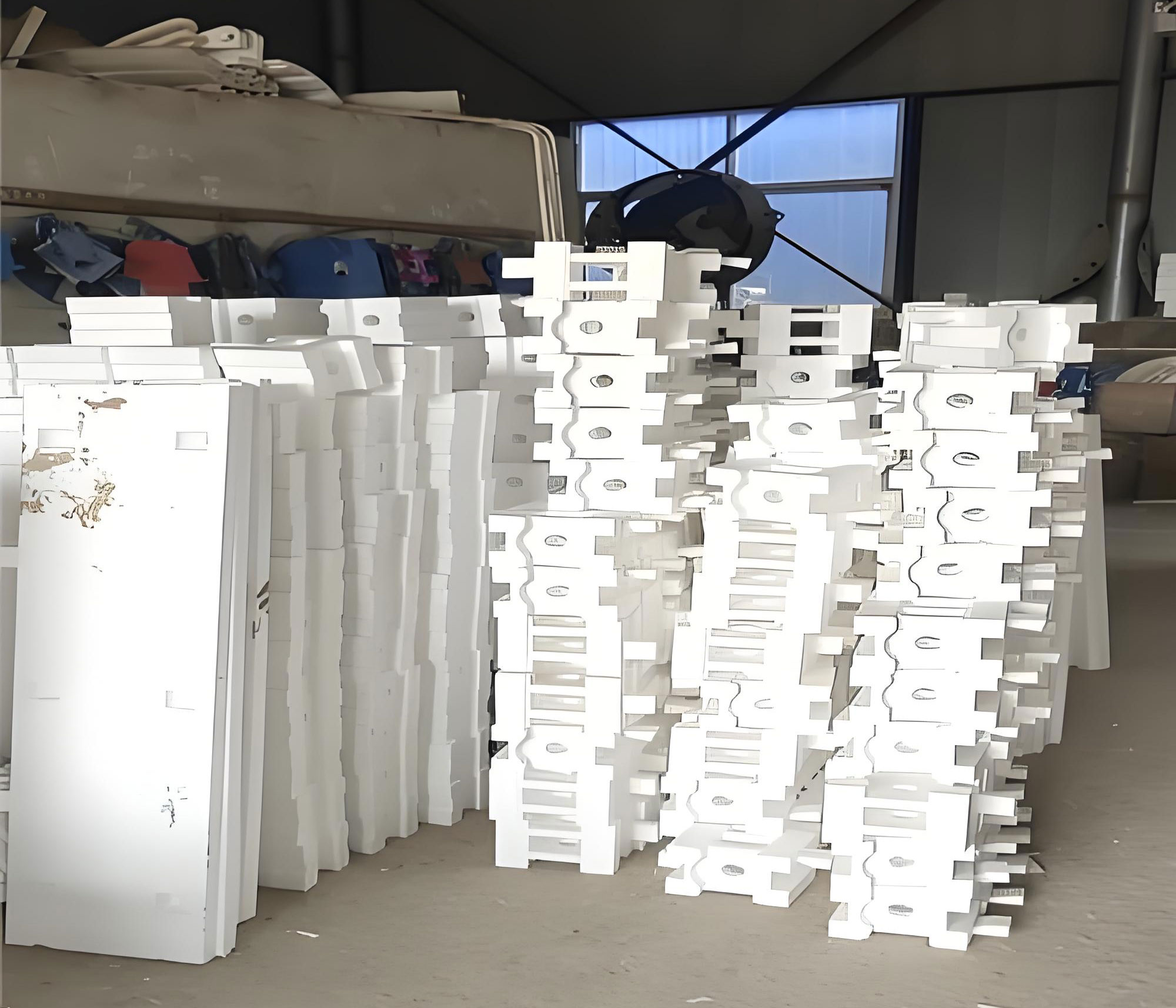
Our focus is on a transmission housing with a nominal weight of 110 kg, dimensions of approximately 600 mm x 550 mm x 350 mm, and a wall thickness of 8 mm, manufactured from HT200 gray iron. The gating system employed was a bottom-gating design to promote smooth, turbulent-free filling. Despite this, persistent inclusion defects were observed, primarily concentrated in the upper-middle sections of the casting, specifically at the junctions between internal ribs (or partitions) and the outer walls.
Post-fettling and shot blasting, these defects manifested as irregular surface pits. Microstructural and compositional analysis via scanning electron microscopy (SEM) and energy-dispersive X-ray spectroscopy (EDS) identified the primary constituents of the inclusions as Silicon (Si), Carbon (C), and Oxygen (O). This composition strongly suggests the entrapment of coating material within the solidifying metal.
Mechanism of Inclusion Formation
The formation of inclusions in the lost foam casting process is intrinsically linked to the dynamics of mold filling and foam degradation. During pouring, the molten metal causes the polystyrene foam to undergo endothermic pyrolysis, producing gaseous and liquid residues. In a bottom-gating system, the metal temperature at the advancing front decreases due to heat loss to the coating, sand, and the energy consumed in decomposing the foam. This leads to an increase in metal viscosity and a corresponding reduction in fluidity and filling velocity.
When this cooler, more viscous metal front reaches complex geometries like rib-wall junctions, flow is further impeded. Any solid particulates present in the metal stream—primarily eroded or entrapped refractory coating particles—are not effectively flushed through these areas. Instead, they become trapped and enveloped by the solidifying metal, resulting in a localized inclusion defect. The key factors influencing this phenomenon can be summarized by the following relationship affecting the cleanliness of the metal front:
$$ \text{Inclusion Tendency} \propto \frac{\text{[Particulate Load] } \times \text{ [Metal Viscosity]}}{\text{[Fluidity]} \times \text{ [Filling Velocity]}} $$
Where:
– Particulate Load is primarily from coating ingress or erosion.
– Metal Viscosity is highly dependent on temperature.
– Fluidity is affected by chemistry and temperature.
– Filling Velocity is driven by metallostatic pressure and the vacuum level applied to the sand mold.
Therefore, the primary influencing factors for inclusion defects in this context are:
1. Pouring Temperature and ensuing temperature of the metal front.
2. Applied Vacuum Level during pouring, which influences filling velocity.
3. Permeability of the Refractory Coating, which affects the removal of pyrolysis products and, indirectly, filling behavior.
4. Pattern Assembly Methodology, specifically the potential for coating slurry to penetrate pattern parting lines.
Systematic Investigation and Control Measures
A series of controlled experiments were conducted to isolate and evaluate the impact of each factor on the occurrence of inclusion defects. The baseline process and the results of the trials are summarized below.
1. Optimization of Pouring Temperature
The standard process specified a pouring temperature range of 1440°C to 1500°C. To assess the effect of superheating, the temperature was increased to a range of 1470°C to 1530°C. The hypothesis was that higher temperature would lower metal viscosity, increase fluidity, and help float or disperse potential inclusions.
| Process Condition | Number of Castings | Inclusion Defect Count (Rate) | Burn-on/ Penetration Defect Count (Rate) |
|---|---|---|---|
| Baseline (1440-1500°C) | 520 | 13 (2.50%) | 3 (0.58%) |
| High Temp (1470-1530°C) | 520 | 8 (1.54%) | 8 (1.54%) |
The results confirmed that increasing the pouring temperature reduced the inclusion defect rate from 2.50% to 1.54%. However, this benefit was counterbalanced by a significant increase in burn-on or metal penetration defects, which rose from 0.58% to 1.54%. This is attributed to the increased thermal load degrading the coating’s integrity at higher temperatures. Conclusion: While effective against inclusions, elevating pouring temperature is not an optimal standalone solution due to the trade-off with other defects.
2. Adjustment of Applied Vacuum Level
Vacuum applied to the sand flask is crucial in the lost foam casting process. It strengthens the unbonded sand mold, accelerates the removal of foam pyrolysis products, and increases the metallostatic pressure head, thereby increasing filling velocity. The filling velocity can be conceptually related to vacuum by:
$$ v \propto \sqrt{P_{\text{atm}} + |P_{\text{vac}}| + \rho g h} $$
where \( v \) is filling velocity, \( P_{\text{atm}} \) is atmospheric pressure, \( P_{\text{vac}} \) is the applied vacuum (negative gauge pressure), \( \rho \) is metal density, \( g \) is gravity, and \( h \) is the sprue height.
The standard vacuum range was -0.03 MPa to -0.07 MPa. Trials were conducted on two different production lines with inherently different vacuum dynamics due to flask size and number of patterns per flask.
| Production Line / Vacuum Condition | Number of Castings | Vacuum Range (MPa) | Inclusion Defect Count (Rate) |
|---|---|---|---|
| Line 1 (Baseline) | 480 | -0.03 to -0.07 | 11 (2.29%) |
| Line 2 (Higher Vacuum) | 480 | -0.45 to -0.07 | 12 (2.50%) |
The results indicate that within the studied ranges, varying the vacuum level did not produce a statistically significant change in the inclusion defect rate. While vacuum critically ensures mold stability and aids gas removal, its direct effect on mitigating the specific mechanism of coating particle entrapment at slow-filling junctions appears limited. Conclusion: Vacuum is a necessary process parameter but not a primary lever for controlling this type of inclusion.
3. Enhancement of Coating Permeability
The refractory coating in lost foam casting process serves multiple functions: providing a barrier between sand and metal, maintaining pattern integrity, and most importantly, allowing the rapid egress of foam degradation gases. Coating permeability is thus a critical property. Low permeability can lead to back-pressure, slowing the metal front and increasing the risk of incomplete decomposition and defect formation.
A water-based coating with quartz flour and bauxite as primary refractories was used. Permeability was measured using a dedicated tester on a dried coating specimen. The target permeability for the second coating layer was modified from the baseline (80-100) to higher ranges.
| Trial Group | Coating Permeability (2nd Layer) | Number of Castings | Inclusion Defect Count (Rate) | Cold Lap Defect Count (Rate) |
|---|---|---|---|---|
| 1 (Baseline) | 80 – 100 | 1500 | 36 (2.40%) | 6 (0.40%) |
| 2 | 90 – 110 | 1500 | 32 (2.13%) | 12 (0.80%) |
| 3 | 100 – 120 | 1500 | 24 (1.60%) | 22 (1.47%) |
| 4 | 110 – 130 | 1500 | 22 (1.47%) | 28 (1.87%) |
The data reveals a clear trend: increasing coating permeability significantly reduces inclusion defects, with the rate dropping from 2.40% to 1.47%. This is attributed to faster gas evacuation, leading to a steadier and potentially slightly faster metal advance, which helps disperse or carry away particulates. However, an upper limit exists. As permeability increases beyond 100-120, the incidence of cold laps (misruns) begins to rise notably (from 0.40% to 1.87%). This is because a more permeable coating has lower insulating properties, causing the metal front to cool and solidify prematurely. Conclusion: Optimizing coating permeability is a highly effective measure. A target range of 100-120 was established, balancing the reduction of inclusions against the risk of cold laps.
4. Implementation of Automated Pattern Assembly
The initial pattern assembly method involved manually gluing foam pattern sections using cold-set adhesive and sealing the parting lines with single-sided paper tape before coating. A potential root cause for coating-derived inclusions is the infiltration of slurry into the gaps or imperfections along these manually sealed parting lines during the dipping process. Once inside, this coating becomes trapped and is later entrained by the metal.
To eliminate this variable, an automated thermo-bonding assembly machine was employed. This system uses heated molds to press pattern sections together, melting the contact surfaces to create a seamless, homogeneous bond without external adhesive or tape. The bonded parting line presents no gap for coating infiltration.
| Assembly Method | Number of Castings | Inclusion Defect Count (Rate) |
|---|---|---|
| Manual Gluing & Taping | 2500 | 40 (1.60%) |
| Automated Thermo-Bonding | 2500 | 13 (0.52%) |
The results were dramatic. The inclusion defect rate fell by approximately 68%, from 1.60% to 0.52%. This provides conclusive evidence that a significant source of inclusions was, indeed, coating material entering through the pattern parting line. The automated process not only improved quality but also enhanced consistency and reduced labor. Conclusion: Controlling coating ingress at the pattern assembly stage is the most impactful single action for eliminating this class of inclusion defect in the lost foam casting process.
Overall Process Control Effectiveness
The synergistic implementation of the two most effective measures—optimizing coating permeability and adopting automated pattern assembly—led to a sustained and significant reduction in the scrap rate due to inclusions over time. The effectiveness of these targeted improvements within the lost foam casting process is clearly demonstrated by the downward trend in defect rates post-implementation. This highlights the importance of a root-cause approach focused on both the fluid dynamics of filling (via coating permeability) and the integrity of the pattern assembly itself.
Summary and Final Conclusions
Through systematic analysis and controlled experimentation within a production environment for transmission housings, the mechanisms and controls for inclusion defects in the lost foam casting process have been elucidated. The primary conclusions are:
- Pouring Temperature is a double-edged sword. While increasing it from a 1440-1500°C range to 1470-1530°C reduced inclusions by about 1%, it concurrently caused a substantial increase in burn-on/penetration defects, making it a non-viable primary solution.
- Applied Vacuum, within the operational ranges tested (-0.03 to -0.07 MPa and -0.45 to -0.07 MPa), did not show a direct correlation with the reduction of the specific inclusion defect studied. Its role remains essential for mold stability and gas removal but is not a key tuning parameter for this issue.
- Coating Permeability is a critical and highly effective parameter. Increasing the permeability of the second coating layer from 80-100 to an optimized range of 100-120 resulted in a ~33% reduction in inclusion defects (from 2.4% to 1.6%). The relationship is non-linear, as excessive permeability (>120) induces cold lap defects due to reduced coating insulation, establishing a clear optimum window.
- Pattern Assembly Methodology proved to be the most significant factor. Replacing manual gluing and taping with automated thermal bonding to create seamless pattern joints directly addressed the root cause of coating ingress. This change yielded the most dramatic improvement, reducing inclusion defects by over two-thirds (from 1.6% to 0.52%).
Therefore, for robust control of non-metallic inclusions in complex, thin-wall castings like transmission housings produced via the lost foam casting process, the highest priority should be given to ensuring a perfectly sealed pattern assembly through methods like thermal bonding, followed by precise optimization of the coating’s permeability to balance gas removal with adequate thermal insulation. This combined approach effectively minimizes the sources and conditions that lead to particulate entrapment during mold filling.