
Based on my extensive experience in foundry engineering, the lost foam casting process represents a significant leap forward in precision forming technology. This method, where a foam pattern is vaporized by molten metal within an unbonded sand mold under vacuum, offers unparalleled design freedom and dimensional accuracy. The successful implementation of this process, particularly for iron castings, hinges on a deep understanding of pattern degradation dynamics and sophisticated solidification control. In this context, the application of Equilibrium Solidification Theory provides a robust and practical framework for designing gating and feeding systems that align perfectly with the unique characteristics of the lost foam casting process.
The fundamental principle of the lost foam casting process involves a complex interplay of heat and mass transfer. Unlike traditional molding, the pattern remains in the mold, undergoing thermal degradation upon contact with the molten metal. For common EPS (Expandable Polystyrene) patterns, this degradation follows distinct thermal zones: softening, liquefaction, gasification, and finally, complete pyrolysis. The metal, typically grey or ductile iron, must displace this decomposing pattern while its own solidification behavior—a mix of skin and mushy freezing—dictates the final soundness of the casting. The slower cooling rate and high mold rigidity inherent in vacuum-assisted lost foam casting process environments enhance the casting’s self-feeding potential, making principles like Equilibrium Solidification particularly effective. The core challenge is to design a system that manages gas evacuation, minimizes turbulence, and provides controlled feeding in harmony with the casting’s inherent contraction and expansion.
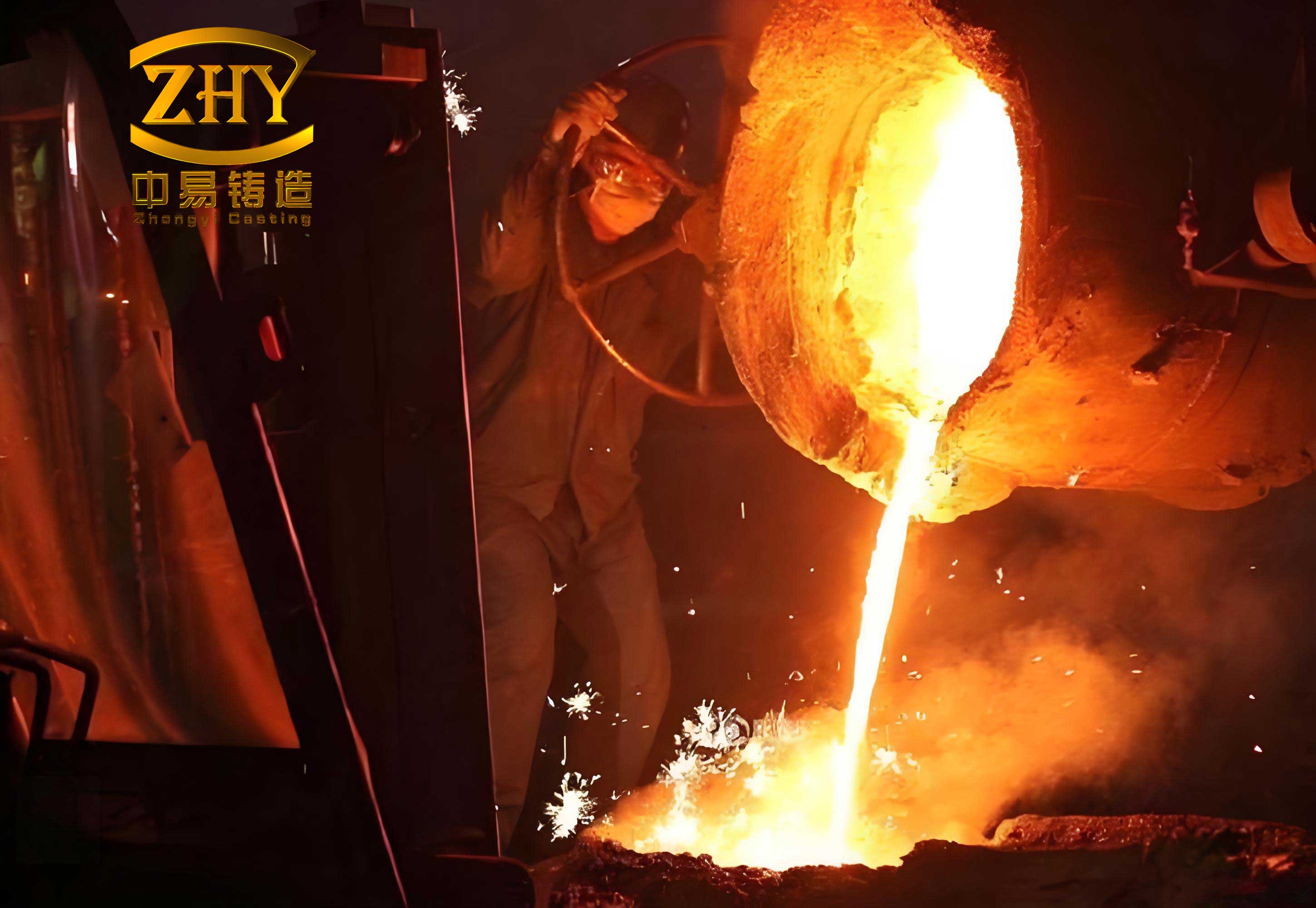
The design philosophy for a lost foam casting process line must therefore be holistic. It integrates the theory of large orifice discharge for gating, specialized riser design principles, and techniques like overflow weirs for slag management. A critical step is the precise calculation of the pouring time, which balances the need for rapid filling to prevent pattern collapse against the need for quiescent flow to avoid entrainment. The basic pouring time ($t$) can be estimated using the formula:
$$ t = k \cdot \sqrt{W} $$
where $W$ is the casting weight in kg and $k$ is an empirical coefficient dependent on casting geometry and desired pouring rate (typically ranging from 1.8 to 2.2 for medium-section iron castings). However, in the lost foam casting process, this must be adjusted for the back-pressure from pattern gasification.
Equilibrium Solidification and Gating Design: The Large Orifice Discharge Theory
The cornerstone of effective gating design in the lost foam casting process is the application of the Large Orifice Discharge Theory derived from Equilibrium Solidification principles. Traditional gating calculations often result in undersized ingates, which are inadequate to overcome the significant gas pressure generated inside the mold cavity during foam decomposition. This leads to defects like mistruns and cold shuts. The large orifice theory recalibrates the relationship between the pressure head at the ingate ($H_i$), the sprue’s static head ($H_s$), and their respective cross-sectional areas ($A_i$ and $A_s$). The goal is to achieve high flow volume with low velocity, ensuring a smooth, non-turbulent fill. The modified flow equation for the lost foam casting process considers an effective discharge coefficient ($C_{d_{eff}}$) that accounts for gas back-pressure:
$$ Q = C_{d_{eff}} \cdot A_i \cdot \sqrt{2gH_i} $$
where $Q$ is the volumetric flow rate. The gating ratio is designed to be more open than in conventional sand casting. For top-poured box-type castings under approximately 650 mm in height, a ratio of $A_s : A_{tr} : A_i = 1 : 1.8 : 1.6$ (where $A_{tr}$ is total runner area) has proven successful. This design ensures sufficient metal delivery to rapidly displace the foam while maintaining a calm flow front, which is paramount in the lost foam casting process to prevent slag and fold defects.
Feeding System Design: Pressurized Side Risers and Edge Gates
Equilibrium Solidification Theory emphasizes limited, efficient feeding that works with the casting’s natural contraction and expansion cycles. For ductile iron, which exhibits significant graphite expansion, this is crucial. The design focuses on risers that provide liquid metal for the period of net contraction but are isolated before the expansion phase begins to avoid back-feeding. In the lost foam casting process, we primarily use blind (unpressurized) side risers or edge gates.
A pressurized side riser system is highly effective. Here, metal flows through the riser body before entering the casting cavity. This design offers multiple advantages: it keeps the riser metal hotter, it acts as an excellent slag trap as velocity drops in the enlarged riser cavity, and it features a short, wide, and thin neck. The neck dimensions are critical; they must remain open long enough to feed the casting’s liquid shrinkage but freeze quickly to “shut off” before the casting’s graphite expansion begins, preventing metal from being pushed back into the riser. The neck freezing time ($t_{neck}$) should be slightly longer than the casting’s net contraction time ($t_{shrinkage}$):
$$ t_{neck} \ge t_{shrinkage} $$
The riser neck’s modulus ($M_{neck}$), a measure of its solidification time, can be approximated by its volume-to-surface area ratio and must be carefully calibrated. Similarly, simple edge gates function as both an entry point and a small feeding source, ideal for many grey iron castings where massive feeding is not required but controlled directional solidification is beneficial. The key parameters for these feeding elements in the lost foam casting process are summarized below:
| Component | Primary Function | Key Design Principle (Equilibrium Theory) | Typical Feature in Lost Foam |
|---|---|---|---|
| Pressurized Side Riser | Feeding, Slag Trapping | Short, Wide, Thin Neck; Located near thermal center | Blind, often spherical top for efficiency |
| Edge Gate (Feeding) | Gating & Limited Feeding | Controlled contact area to enable early freeze-off | Integrated with pattern cluster |
| Overflow Weir | Slag/Cold Metal Collection | Placed at topographical highs & end of flow path | Small, blind cavity attached to casting |
Slag Management and Overflow Technology
A major concern in the lost foam casting process is the entrainment of pattern decomposition residues (liquid pyrolysis products and carbonaceous slag). While a properly designed gating system with slag traps helps, dedicated overflow weirs are a direct and powerful technique. These are small, blind cavities attached to the casting at strategic locations—typically at the highest points, far corners, or the end of the metal flow path. Their purpose is to collect the first, cooler, and often slag-laden metal to enter a section of the mold, along with any loose coating sands. By providing a “dump” for this contaminated metal, the casting body is filled with cleaner, hotter metal from the main flow. This significantly improves surface quality and reduces subsurface slag defects. The volume of an overflow weir ($V_{overflow}$) is typically a small fraction of the local casting section volume it protects:
$$ V_{overflow} \approx 0.1 \cdot V_{local\_section} $$
Analysis and Mitigation of Common Defects in Lost Foam Casting
Despite a sound theoretical design, practical challenges arise. The most common defects in the iron lost foam casting process are carbon defects, sand inclusion/slag, burn-on/penetration, and dimensional inaccuracies. Their causes are interlinked but can be systematically addressed.
| Defect | Primary Causes | Root Issue Related to Process | Preventive Measures Based on Design & Control |
|---|---|---|---|
| Carbon Defect (Black Scab/Slag) | Incomplete pattern pyrolysis; Liquid EPS degradation; Low pouring temp. | High C/H ratio of EPS; Poor coating permeability; Low vacuum or high sand density. | Use STMMA patterns for critical castings; Optimize coating permeability & thickness; Increase pouring temperature; Ensure adequate and stable vacuum. |
| Sand Inclusion / Slag | Cracked coating; Turbulent filling; Erosion of gating coating. | Weak coating strength; Improper gating design (high velocity); Improper sand filling/sealing. | Ensure high coating strength, esp. in gating; Apply Large Orifice theory for calm flow; Use pouring basins/filters; Careful sand filling to avoid coating damage; Implement overflow weirs. |
| Burn-on / Metal Penetration | Metal infiltration into sand grains. | Coating failure (cracks, low refractoriness); Excessive vacuum; Coarse sand. | Use high-refractoriness coatings; Double coat vulnerable areas (deep holes); Control vacuum level; Use finer, rounded sand (e.g., AFS 50-70). |
| Dimensional Inaccuracy / Distortion | Pattern shrinkage variation; Pattern handling damage; Mold rigidity issues. | Unstable foam aging; Poor cluster gluing; Non-uniform sand compaction. | Control pre-foam bead aging and molding parameters; Use sturdy fixtures for clustering; Optimize sand filling and vibration sequence for uniform density. |
The mitigation of carbon defects is particularly nuanced. The carbon from the decomposing foam (EPS: C/H = 92/8) must be evacuated as gas. If the coating permeability is too low, the vacuum insufficient, or the pouring temperature too low, liquid pyrolysis products can be baked into solid carbonaceous deposits. The propensity is higher for ductile iron and thin sections. The key control parameters form a balancing act, which can be conceptualized by an inequality for clean casting production:
$$ \frac{Permeability_{coating} \times Vacuum \times T_{pour}}{Sand\_Density \times Section\_Thinness} > K_{critical} $$
where $K_{critical}$ is an empirical threshold. Similarly, sand inclusion often originates from the gating system. The joint between the sprue plug and the pattern cluster must be perfectly sealed with coating. Any gap or weak spot becomes a direct entry point for dry sand into the metal stream.
Conclusion
The successful implementation of the lost foam casting process for high-quality iron castings is a sophisticated engineering endeavor that moves beyond simple pattern replication. It demands a synthesis of materials science (foam behavior, coating technology), fluid dynamics (gating design), and solidification science. The Equilibrium Solidification Theory provides an exceptionally suitable foundation for this synthesis. Its principles—such as designing for limited, timed feeding using risers with short necks, employing large orifice gating for rapid yet calm filling, and strategically placing overflows for slag management—align perfectly with the physiological demands of the lost foam casting process. By rigorously applying these principles and maintaining strict control over pattern quality, coating integrity, sand compaction, and process parameters like pouring temperature and vacuum, the common defects of carbon, slag, penetration, and distortion can be systematically mitigated. This integrated approach transforms the lost foam casting process from a promising technology into a reliable and highly efficient production method for complex, near-net-shape iron castings.