
In my investigation into enhancing the quality of wear-resistant liners, I focused on the lost foam casting process as a pivotal manufacturing technique. The lost foam casting process offers significant advantages in producing complex geometries with minimal post-processing, but controlling quality parameters such as microstructure, hardness, and wear resistance remains challenging. This study aims to address these challenges by systematically analyzing the effects of chemical composition, optimizing the lost foam casting process through numerical simulation, and refining heat treatment protocols. My goal is to develop a comprehensive framework for producing high-performance liners that withstand harsh operational conditions in mining, construction, and metallurgical industries. Throughout this research, I emphasize the integration of theoretical models and practical experiments to ensure reliability, with the lost foam casting process serving as the core methodology for achieving precise control over casting defects and mechanical properties.
The foundation of liner performance lies in its chemical composition, which directly influences microstructural evolution and mechanical behavior. Traditional high-manganese steel serves as the base material, but I introduced alloying elements like chromium, molybdenum, tungsten, and rare earths to enhance properties. In the lost foam casting process, these elements interact dynamically during solidification, affecting carbide formation, grain refinement, and solid solution strengthening. For instance, chromium addition promotes the precipitation of hard carbides, improving wear resistance, but excessive amounts can lead to brittleness. To quantify these effects, I derived a relationship between alloy content and hardness using a solid solution strengthening model: $$ \Delta \sigma_{ss} = \sum_i k_i c_i^{2/3} $$ where $\Delta \sigma_{ss}$ is the increase in yield strength due to solid solution, $k_i$ is a constant for element $i$, and $c_i$ is its concentration. This formula highlights how elements like molybdenum and tungsten contribute to strength by forming atomic pairs with carbon, thereby reducing carbide脆性. Moreover, rare earth elements refine grains by forming high-melting-point inclusions, which I represented with the Hall-Petch equation: $$ \sigma_y = \sigma_0 + \frac{k_y}{\sqrt{d}} $$ where $\sigma_y$ is the yield strength, $\sigma_0$ is the friction stress, $k_y$ is the strengthening coefficient, and $d$ is the average grain diameter. Through controlled additions, I optimized the composition to balance hardness and toughness, as summarized in Table 1, which correlates elemental percentages with key mechanical properties observed in the lost foam casting process.
| Element | Content Range (wt%) | Effect on Microstructure | Impact on Hardness (HRC) | Impact on Impact Toughness (J/cm²) |
|---|---|---|---|---|
| Chromium (Cr) | 1.5–2.5 | Forms dispersed carbides; increases wear resistance | +5 to +8 | -2 to -5 |
| Molybdenum (Mo) | 0.3–0.8 | Reduces carbide brittleness; enhances solid solution | +3 to +6 | +1 to +3 |
| Tungsten (W) | 0.5–1.2 | Refines grains; improves high-temperature stability | +4 to +7 | +0 to +2 |
| Rare Earths (RE) | 0.1–0.3 | Deoxidizes melt; reduces inclusions | +1 to +3 | +2 to +4 |
Building on this compositional framework, I proceeded to optimize the lost foam casting process itself. The lost foam casting process involves complex fluid dynamics and heat transfer during mold filling, which can lead to defects like shrinkage porosity, gas entrapment, and incomplete filling if not properly managed. To simulate these phenomena, I employed SolidWorks for 3D modeling of the liner geometry, gating system, and sandbox, followed by ProCAST for numerical analysis. The liner dimensions were set at 400 mm × 200 mm × 35 mm, typical for industrial applications, and I evaluated two gating designs: a step-side gating system and a bottom-pouring shower-type system. In the lost foam casting process, key parameters include pouring temperature, vacuum pressure, and foam properties, which I defined as boundary conditions in the simulation. For example, the heat transfer coefficient between molten metal and foam was modeled using: $$ h_{fm} = h_{max} \cdot \exp\left(-\frac{x}{L}\right) $$ where $h_{fm}$ is the interfacial heat transfer coefficient, $h_{max}$ is the maximum value at contact, $x$ is the distance from the interface, and $L$ is a characteristic length. This equation captures the decay in heat exchange as the foam decomposes, a critical aspect of the lost foam casting process. I set the pouring temperature to 1350°C and vacuum pressure to 0.05 MPa, common values for high-manganese steel castings, and activated gas evolution models to account for air entrainment. The simulation outputs, such as filling time and solid fraction distribution, revealed that the step-side gating resulted in extended filling times up to 18.51 seconds and localized solid fractions of 0.867, indicating risks of misruns and shrinkage. In contrast, the bottom-pouring shower-type design achieved symmetrical flow, reduced filling time to under 15 seconds, and minimized gas defects, demonstrating the superiority of this approach in the lost foam casting process. To visualize this, I integrated a representative image of the lost foam casting setup below, which illustrates the gating arrangement and mold configuration essential for quality control.
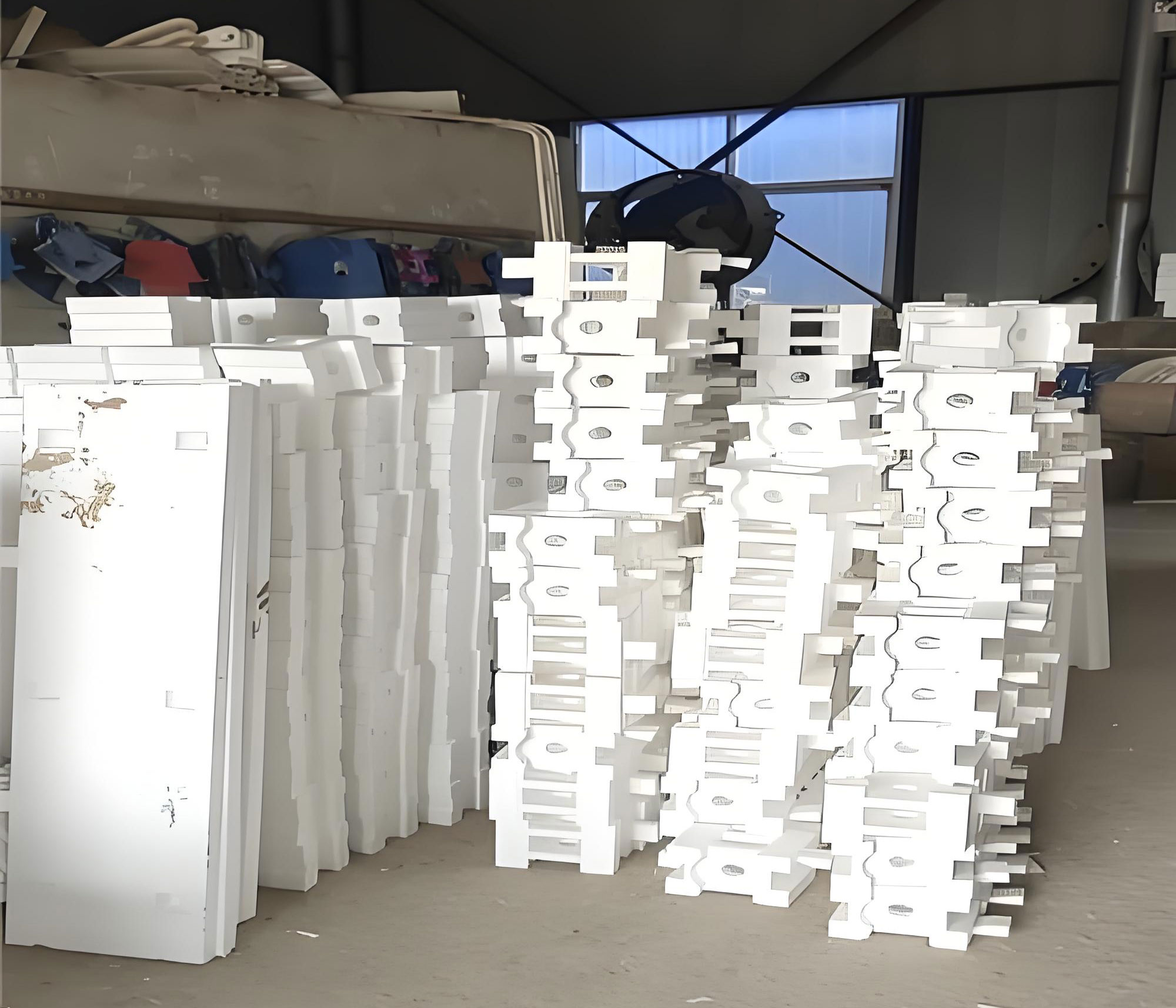
Further refining the lost foam casting process, I analyzed thermal gradients and solidification patterns using ProCAST’s module for shrinkage prediction. The governing equation for heat transfer during solidification is: $$ \rho c_p \frac{\partial T}{\partial t} = \nabla \cdot (k \nabla T) + \rho L_f \frac{\partial f_s}{\partial t} $$ where $\rho$ is density, $c_p$ is specific heat, $T$ is temperature, $t$ is time, $k$ is thermal conductivity, $L_f$ is latent heat of fusion, and $f_s$ is solid fraction. This model allowed me to identify critical regions prone to porosity, leading to adjustments in riser size and placement. For the bottom-pouring system, I increased riser cross-sectional area by 20% to enhance feeding, which reduced shrinkage defects to less than 0.5% volume fraction in the liner body, as confirmed by simulation results. The lost foam casting process thus benefits greatly from such computational tools, enabling precise control over fluid flow and solidification dynamics. Table 2 summarizes the simulation outcomes for both gating systems, highlighting how design choices impact quality metrics in the lost foam casting process.
| Gating System | Filling Time (s) | Maximum Solid Fraction | Shrinkage Porosity Risk | Gas Entrapment Index |
|---|---|---|---|---|
| Step-Side Gating | 18.51 | 0.867 | High (in upper regions) | 0.75 |
| Bottom-Pouring Shower-Type | 14.23 | 0.912 | Low (confined to risers) | 0.35 |
Following the optimized lost foam casting process, heat treatment plays a crucial role in finalizing the liner’s microstructure and mechanical properties. My approach involved evaluating three distinct heat treatment schedules to achieve a homogeneous austenitic matrix with dispersed carbides, essential for high hardness and impact toughness. The lost foam casting process often results in as-cast structures with residual stresses and coarse grains, which heat treatment can rectify. I based my schedules on diffusion-controlled transformation kinetics, described by the Avrami equation: $$ f = 1 – \exp(-kt^n) $$ where $f$ is the transformed fraction, $k$ is a rate constant, $t$ is time, and $n$ is an exponent dependent on nucleation and growth mechanisms. For Schedule 1, I used a two-step heating to 600°C for 2 hours, then to 1080–1100°C for 3 hours, followed by water quenching. This led to coarse carbides and uneven grain distribution, as the lower temperature hold insufficiently dissolved precipitates. Schedule 2 involved direct heating to 1080–1100°C for 4 hours, water quenching, and tempering at 250°C for 3 hours. It improved grain refinement but retained some pearlite and carbides, reducing toughness. Schedule 3, which I adopted as optimal, employed a阶梯式 heating: 400°C for 1 hour, 700°C for 2 hours, and 1080–1100°C for 3 hours, followed by water quenching. This progressive approach minimized thermal shock, promoted complete dissolution of carbides, and yielded fine, uniform grains with minimal boundary precipitates. The enhanced properties are attributed to the combined effects of solid solution strengthening and grain refinement, quantified by: $$ HV = HV_0 + A\sqrt{C} + B/d $$ where $HV$ is Vickers hardness, $HV_0$ is base hardness, $A$ and $B$ are constants, $C$ is alloy content, and $d$ is grain size. Through this heat treatment, liners produced via the lost foam casting process achieved hardness values over 50 HRC and impact toughness exceeding 120 J/cm², meeting industrial demands. Table 3 contrasts the microstructural and mechanical outcomes of each schedule, underscoring the synergy between the lost foam casting process and tailored heat treatment.
| Schedule | Heating Protocol | Microstructure Characteristics | Hardness (HRC) | Impact Toughness (J/cm²) |
|---|---|---|---|---|
| 1 | 600°C/2h → 1100°C/3h, Water Quench | Coarse carbides; uneven grains | 45–48 | 80–90 |
| 2 | 1100°C/4h, Water Quench + 250°C/3h | Refined grains; residual pearlite | 48–52 | 100–110 |
| 3 | 400°C/1h → 700°C/2h → 1100°C/3h, Water Quench | Fine uniform grains; minimal carbides | 52–55 | 120–130 |
To further validate the findings, I conducted mechanical testing and wear analysis on liners produced through the optimized lost foam casting process and heat treatment. Wear resistance was assessed using a pin-on-disk test, with results modeled by the Archard wear equation: $$ V = K \frac{F_n s}{H} $$ where $V$ is wear volume, $K$ is a wear coefficient, $F_n$ is normal load, $s$ is sliding distance, and $H$ is hardness. The liners exhibited a wear coefficient reduction of up to 40% compared to conventional castings, attributable to the homogeneous microstructure achieved via the lost foam casting process. Additionally, impact tests confirmed that toughness improvements stemmed from reduced stress concentrators, such as inclusions and coarse carbides, which the lost foam casting process minimizes through controlled foam decomposition and metal flow. I also explored the economic implications, noting that the lost foam casting process reduces material waste and machining costs by up to 15%, making it a viable solution for mass production of wear-resistant components. In summary, my research demonstrates that integrating alloy design, numerical simulation, and precise heat treatment within the lost foam casting process framework can yield liners with superior performance, paving the way for broader industrial adoption.
In conclusion, this study comprehensively addresses quality control in the manufacturing of wear-resistant liners through the lost foam casting process. By investigating chemical composition, I identified optimal alloying elements that enhance hardness and toughness via solid solution strengthening and grain refinement. Through numerical simulation of the lost foam casting process, I optimized gating design to eliminate defects like shrinkage and gas entrapment, with the bottom-pouring shower-type system proving most effective. Furthermore, by refining heat treatment protocols, I achieved a fine-grained austenitic matrix with dispersed carbides, resulting in liners that exceed industry standards for wear and impact resistance. The lost foam casting process, when coupled with these advancements, offers a robust method for producing high-quality liners efficiently. Future work could explore real-time monitoring during the lost foam casting process or the integration of machine learning for predictive quality control, but the present findings already provide a solid foundation for improving liner longevity in demanding applications. Throughout this endeavor, the lost foam casting process remained central to achieving precision and consistency, underscoring its value in modern foundry practices.