
In the pursuit of green and environmentally friendly foundry practices, I have dedicated significant effort to optimizing the lost foam casting process for complex components. This article delves into the detailed design and implementation of a lost foam casting process specifically for a loader gearbox housing, a critical part in construction machinery. The lost foam casting method, known for its near-net-shape capabilities, eliminates the need for cores, core sand preparation, mold removal, and extensive finishing, thereby reducing waste and energy consumption. However, the challenge lies in managing the pyrolysis products from the foam pattern during casting, which can affect surface quality and internal integrity. Through careful process design, I have developed a robust methodology that ensures high-dimensional accuracy, defect-free surfaces, and minimal environmental impact. The following sections elaborate on the production conditions, step-by-step process flow, and theoretical underpinnings that guide this successful application of lost foam casting.
The gearbox housing, as a key component in loaders, features a multi-chambered, stepped structure with varying wall thicknesses. The primary wall thickness is 12 mm, while thermal hotspots can reach 40–50 mm. Critical functional surfaces, such as those interfacing with pumps, valves, and piston mechanisms, must be free from defects like inclusions, sand holes, distortions, cold shuts, and cracks. To meet these demands, I selected lost foam casting due to its ability to produce intricate geometries with high precision. The base material is HT200 gray iron, melted in a 5-ton medium-frequency furnace. The foam patterns are made from expandable polystyrene (EPS) beads with a density of 0.02 g/cm³, cut using hot-wire techniques. The overall dimensions of the casting are 1,086 mm × 490 mm × 605 mm, with machining allowances of 6 mm on the top and 5 mm on the sides and bottom.
The lost foam casting process begins with pattern-making, a critical phase that influences final quality. Given the housing’s complexity—with numerous bosses, flanges, and internal cavities—I opted for a segmented approach. The foam pattern is divided into nine sections along parallel planes to facilitate molding and bonding. This segmentation strategy, as visualized in the accompanying image, allows for precise formation of each segment using foam molding dies. The segments are then assembled using hot-melt adhesive, ensuring tight seals at joints. To prevent deformation during subsequent steps, I reinforced the foam pattern with bamboo strips at open faces, which enhance rigidity without interfering with casting. This reinforcement is crucial, as foam patterns are prone to distortion under handling and coating loads. The entire assembly is inspected for dimensional accuracy and bond integrity before proceeding.
Coating the foam pattern is essential to create a barrier that prevents sand erosion and facilitates gas evacuation during casting. For this lost foam casting application, I selected a commercial coating known as Guilin No. 5, which offers good permeability and thermal stability. The coating is applied via brushing, as immersion could distort the delicate foam structure. A uniform thickness of 1.5–2.0 mm is maintained across the pattern. After coating, the pattern is air-dried at room temperature to remove surface moisture, then transferred to a drying chamber. The drying parameters are controlled at 50–55°C with relative humidity below 40%, coupled with forced air circulation to accelerate water removal. This step minimizes coating defects and ensures pattern stability. Throughout coating and drying, I monitor for deformation, correcting any deviations through careful adjustment and positioning.
The next phase involves molding and gating system design, which directly impacts metal flow and solidification. The coated pattern is placed in a flask with a base sand layer of 200 mm, compacted via vibration to ensure uniformity. The gating system is designed to promote smooth filling and minimize turbulence. As shown in the layout, it consists of a sprue, runner, and ingates. The sprue cross-section is 70 mm × 70 mm, the runner is 60 mm × 60 mm, and the ingates are 40 mm × 70 mm with a length of 100 mm. Two ingates are positioned to distribute metal evenly into the cavity. I adopted an inclined pouring approach without risers, leveraging the lost foam casting principle where the foam pattern vaporizes to create the cavity. To prevent sand collapse, resin sand is pre-placed around critical areas, and wire hooks with straw ropes are used to secure the mold. The key parameters for this lost foam casting process are summarized in Table 1.
| Parameter | Value | Rationale |
|---|---|---|
| Pouring Temperature | 1,470 ± 5 °C | Ensures complete foam vaporization and fluidity |
| Pouring Negative Pressure | 0.05 MPa | Facilitates gas removal and mold stability |
| Negative Pressure Hold Time | 3 minutes | Allows for solidification under controlled conditions |
| Pattern Coating Thickness | 1.5–2.0 mm | Balances gas permeability and mechanical strength |
| Drying Temperature | 50–55 °C | Prevents pattern distortion and coating cracks |
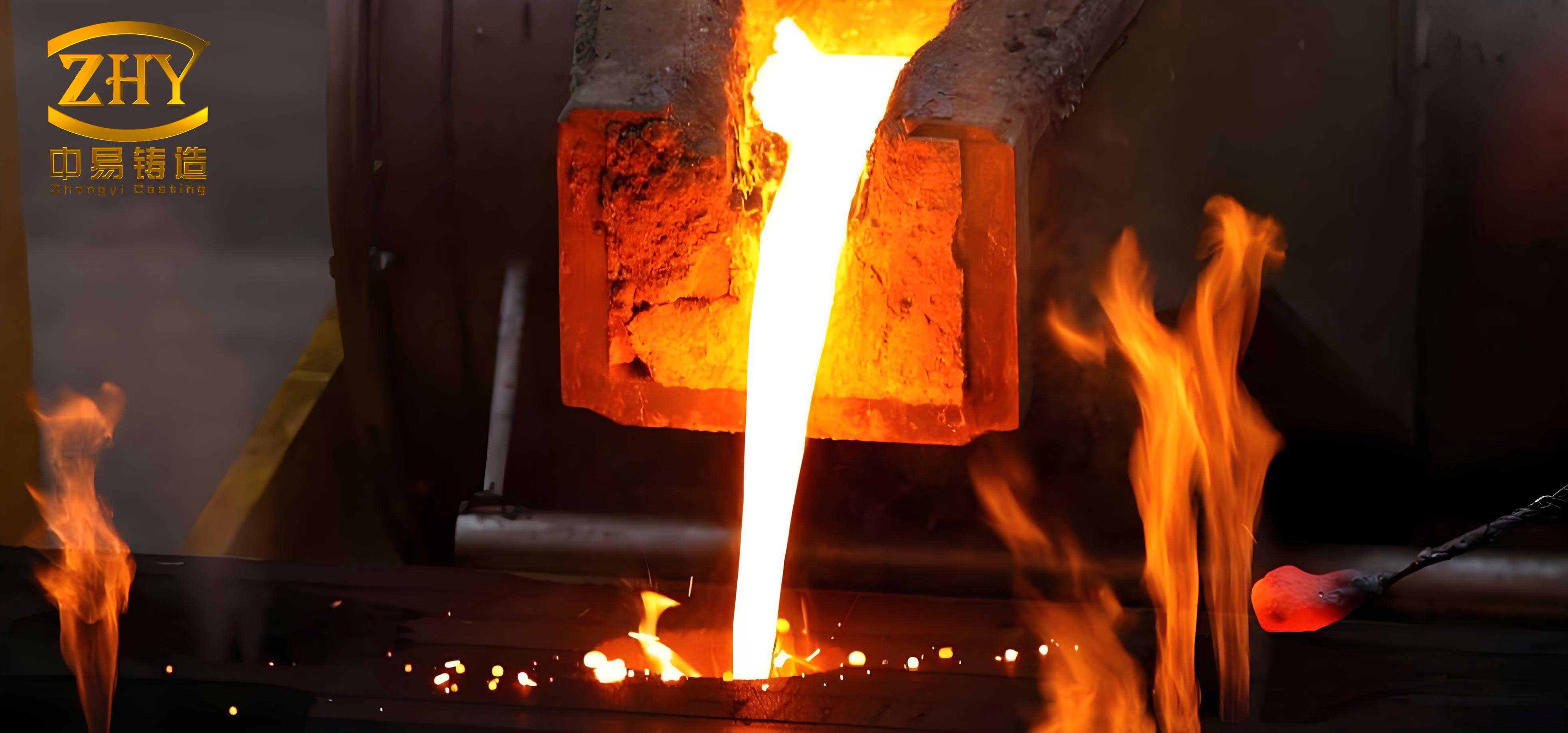
The melting and pouring stages are critical in lost foam casting, as they govern the interaction between molten metal and the decomposing foam. I use scrap steel as the primary charge material, melted in a medium-frequency furnace to produce pearlitic gray iron. The pouring temperature is tightly controlled at 1,470 ± 5 °C to optimize foam degradation and metal flow. During pouring, a negative pressure of 0.05 MPa is applied to the mold to extract pyrolysis gases and maintain mold integrity. This negative pressure is sustained for 3 minutes after pouring to support solidification. The underlying physics can be described using a simplified model for gas evolution in lost foam casting: $$ \frac{dG}{dt} = k \cdot A \cdot (T_m – T_v) $$ where \( G \) is the gas volume generated, \( k \) is a reaction constant, \( A \) is the foam surface area, \( T_m \) is the metal temperature, and \( T_v \) is the vaporization temperature of the foam. This equation highlights the importance of temperature control in minimizing residual gases that could cause defects.
After pouring, the casting is held in the mold for 180 minutes to allow gradual cooling and reduce thermal stresses. This is followed by shakeout, where the sand is removed, and the casting is extracted for further processing. To relieve residual stresses and improve dimensional stability, I subject the casting to a stress-relief annealing heat treatment. The thermal cycle involves heating to 550 °C, holding for 4 hours, and controlled cooling at 50 °C per hour to room temperature. This process, summarized in Table 2, ensures that the gearbox housing meets mechanical property requirements. The entire lost foam casting workflow, from pattern-making to heat treatment, is designed to minimize human intervention and maximize repeatability.
| Step | Temperature (°C) | Time (hours) | Cooling Rate (°C/h) |
|---|---|---|---|
| Heating | 20 to 550 | 2 | — |
| Holding | 550 | 4 | — |
| Cooling | 550 to 200 | 7 | 50 |
| Final Cooling | 200 to 20 | Natural | — |
Inspection of the final castings reveals no detectable defects such as flashes, burrs, porosity, or inclusions. The dimensional accuracy is within ±0.5 mm of the design specifications, underscoring the precision of lost foam casting. The surface finish is smooth, reducing the need for extensive machining. This outcome validates the process design, particularly the gating configuration and parameter optimization. To further analyze the effectiveness, I consider the yield efficiency, defined as the ratio of casting weight to total metal poured. For this lost foam casting process, the yield exceeds 85%, significantly higher than traditional sand casting methods. This efficiency stems from the minimal gating system and absence of risers, which are hallmarks of advanced lost foam casting techniques.
The rationality of using lost foam casting for the gearbox housing is evident from multiple perspectives. Compared to conventional sand casting, which requires core-making, assembly, and complex molding, lost foam casting simplifies the workflow to pattern assembly, coating, and pouring. This reduction in steps lowers labor intensity, minimizes environmental pollution from sand disposal, and enhances production flexibility. Moreover, the integration of the gating system with the foam pattern eliminates misalignment issues common in multi-part molds. The lost foam casting process also allows for complex internal geometries without separate cores, reducing the risk of core-related defects. From a thermodynamic standpoint, the foam’s endothermic decomposition during pouring can be modeled to optimize cooling rates: $$ \frac{\partial T}{\partial t} = \alpha \nabla^2 T – \frac{Q_v}{\rho c} $$ where \( T \) is temperature, \( \alpha \) is thermal diffusivity, \( Q_v \) is the heat of vaporization per unit volume, \( \rho \) is density, and \( c \) is specific heat. This equation helps in predicting solidification patterns and avoiding hot tears in thick sections.
Throughout this project, I have emphasized the importance of parameter control in lost foam casting. For instance, the negative pressure setting of 0.05 MPa is derived from empirical tests to balance gas removal and mold integrity. Too low a pressure may lead to gas entrapment, while too high can cause mold collapse. Similarly, the pouring temperature of 1,470 °C ensures that the foam degrades rapidly without leaving carbonaceous residues. These parameters are interrelated, as captured in the following relationship for lost foam casting quality index \( Q \): $$ Q = f(T_p, P_n, t_h, C_t) $$ where \( T_p \) is pouring temperature, \( P_n \) is negative pressure, \( t_h \) is hold time, and \( C_t \) is coating thickness. By optimizing these variables, I achieved consistent results across production batches. The lost foam casting process thus demonstrates its viability for high-value components like gearbox housings, where precision and reliability are paramount.
In conclusion, the lost foam casting process designed for the loader gearbox housing exemplifies a sustainable and efficient manufacturing approach. By segmenting the foam pattern, applying a tailored coating, and controlling pouring parameters, I have produced castings with high dimensional accuracy, excellent surface quality, and no defects. The process eliminates many labor-intensive steps associated with traditional foundry methods, reducing environmental impact and operational costs. This success underscores the potential of lost foam casting for complex, thin-walled components in heavy machinery. Future work could explore the use of advanced foam materials or automated coating systems to further enhance the process. As the foundry industry moves toward greener practices, lost foam casting stands out as a key technology, and this case study provides a robust framework for its application in similar contexts. The iterative design and validation process highlighted here reaffirm that lost foam casting, when meticulously engineered, can deliver superior results while aligning with ecological goals.