
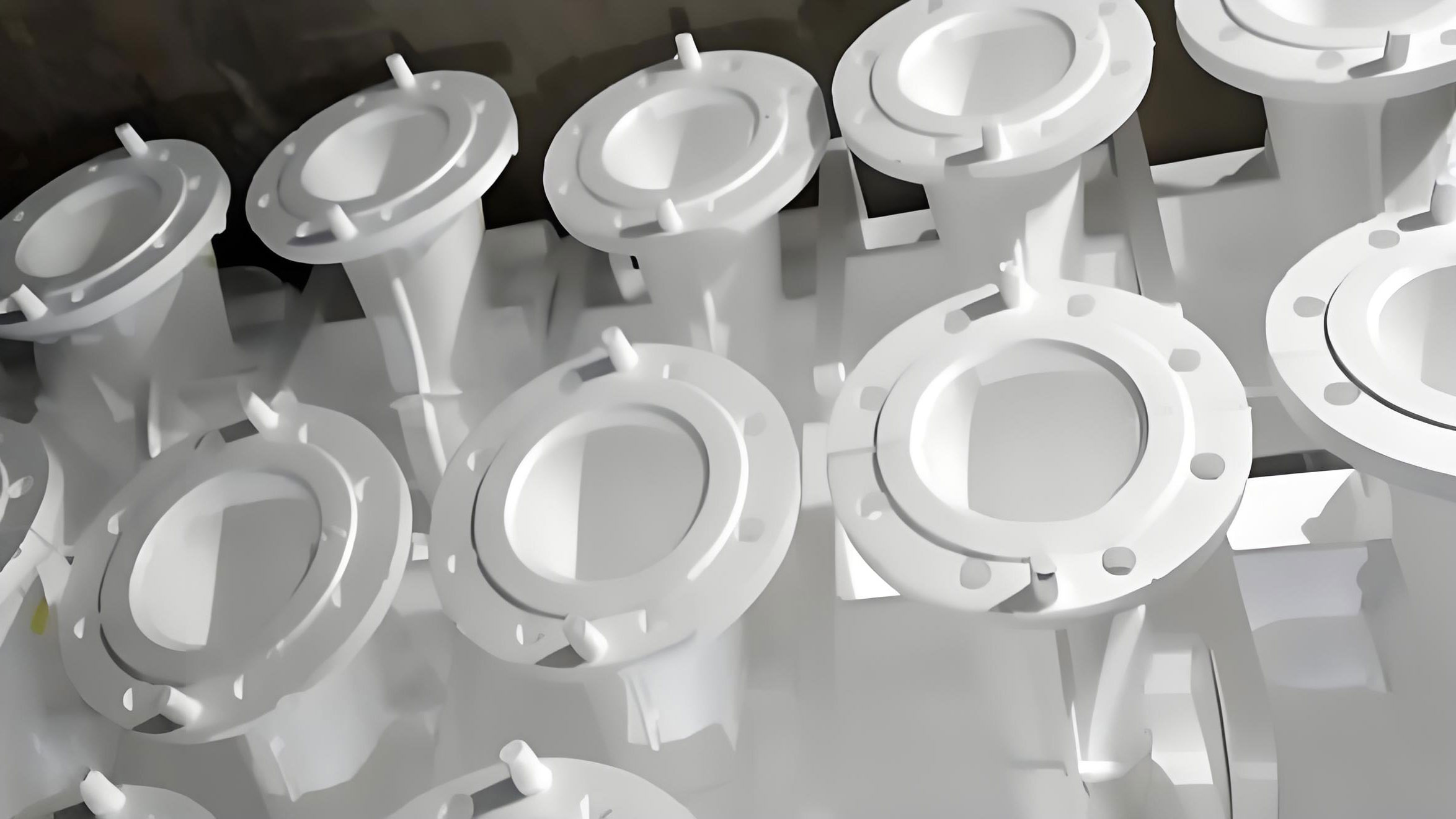
As a practitioner deeply involved in advanced casting technologies, I have extensively studied the lost foam casting process, a revolutionary method that offers significant advantages such as low cost, reduced labor intensity, high surface quality, and a clean production environment. This technique is often regarded as a direction-setting innovation for 21st-century foundry practices, largely due to its simplification of molding processes and equipment, with investments typically only 30% to 70% of those required for conventional sand casting mechanization. However, the success of lost foam casting hinges critically on a well-designed vacuum system, which is paramount for achieving defect-free castings. In my experience, up to 60% of defects in lost foam casting—such as sand sticking, mold wall movement, and collapse—are directly linked to vacuum system performance. Therefore, understanding and optimizing the vacuum system, particularly the parameter known as vacuum degree, is essential for mastering lost foam casting. This article delves into how sand characteristics, including grain size, size distribution, and compaction rate, influence the vacuum degree in lost foam casting, drawing from experimental analyses and theoretical insights.
The vacuum system in lost foam casting serves multiple vital functions: it provides secondary compaction to sand after vibration tightening, enhances static friction between sand grains, creates a balanced vacuum field within the vacuum flask to stabilize dry sand under atmospheric pressure, and evacuates gases generated during the vaporization of foam patterns during pouring, ensuring smooth casting operations. The vacuum degree, typically measured in negative pressure units like MPa, is a key metric for evaluating this system. An optimal vacuum degree range, often between -0.04 MPa and -0.06 MPa, is crucial; deviations can lead to various defects. For instance, too low a vacuum degree may cause wrinkles, carbon black, adhesion, sand sticking, carbon pickup, porosity, and incomplete filling, while too high a vacuum degree can result in white spots, needles, nodules, and similar issues. This relationship underscores the importance of maintaining precise control over the vacuum degree in lost foam casting processes.
In practice, once the vacuum system is established, the vacuum degree is predominantly influenced by molding and pouring parameters, with sand properties playing a significant role. My investigations focus on three primary sand characteristics: grain size, size distribution, and compaction rate. Through controlled experiments, I have quantified their effects on vacuum degree fluctuations, aiming to provide a comprehensive guide for optimizing lost foam casting operations. Below, I present detailed analyses, supported by tables and mathematical formulations, to elucidate these relationships.
Impact of Sand Grain Size on Vacuum Degree in Lost Foam Casting
The grain size of sand directly affects its permeability, which in turn influences how quickly gases escape during pouring in lost foam casting. To assess this, I designed an experimental scheme using different sand grain sizes, as summarized in Table 1. The sands were sourced from the same manufacturer to ensure consistency, with grain sizes specified in millimeters and mesh sizes, and a high concentration of grains within the specified range.
| Scheme ID | Sand Type | Grain Size (mm) [Mesh] | Concentration (%) |
|---|---|---|---|
| 1 | Crushed Silica Sand | 0.900 [20] | 95 |
| 2 | Crushed Silica Sand | 0.224 [70] | 95 |
| 3 | Crushed Silica Sand | 0.106 [140] | 95 |
In these experiments, I monitored the vacuum degree within the mold during pouring for identical casting patterns. The results, depicted conceptually, show that coarser sand (e.g., 0.900 mm) leads to a more rapid decline in vacuum degree at the start of pouring. This is attributed to the higher permeability of larger grains, which allows gases from foam decomposition to be evacuated swiftly, reducing the pressure differential between the mold cavity and the external environment. This rapid gas expulsion helps prevent mold collapse and gas-related defects in lost foam casting. Mathematically, the permeability \( k \) can be related to grain size \( d \) using the Kozeny-Carman equation:
$$ k = \frac{d^2 \phi^3}{180 (1 – \phi)^2} $$
where \( \phi \) is the porosity. For lost foam casting, a higher \( k \) from larger \( d \) enhances gas flow, affecting the vacuum degree \( P_v \) over time \( t \). I approximate the vacuum degree dynamics as:
$$ \frac{dP_v}{dt} = -\alpha \cdot k \cdot (P_v – P_{\text{atm}}) $$
where \( \alpha \) is a process constant, and \( P_{\text{atm}} \) is atmospheric pressure. This differential equation suggests that larger grain sizes accelerate the rate of vacuum degree change, aligning with experimental observations in lost foam casting.
Effect of Sand Grain Size Distribution on Vacuum Degree in Lost Foam Casting
While single-grain-size sands simplify control, they often compromise either surface quality or permeability in lost foam casting. Fine sands yield smooth surfaces but poor permeability, risking mold collapse; coarse sands offer good permeability but may cause sand sticking in intricate areas. To address this, I proposed using blended sands with mixed grain sizes. Table 2 outlines an experimental scheme comparing single and mixed grain sizes, with vibration time held constant.
| Scheme ID | Grain Size Composition (mm) [Mesh] | Vibration Time (min) | Product Type |
|---|---|---|---|
| 4 | 0.900 [20] (100%) | 3 | Identical Castings |
| 5 | 0.355 [50] (50%) + 0.224 [70] (50%) | 3 | Identical Castings |
| 6 | 0.224 [70] (100%) | 3 | Identical Castings |
The trials confirmed that mixed-grain sands result in vacuum degree fluctuations intermediate between those of single-grain sands. This balance leverages the permeability of coarse grains and the surface-finishing ability of fine grains, optimizing lost foam casting outcomes. However, excessive fine particles (e.g., micro-dust) can detrimentally affect vacuum degree by creating non-uniform sand gradients during vibration, where fine particles adhere to the pattern surface, reducing local permeability and leading to defects like mold collapse. To quantify this, I define a size distribution index \( S_d \) as the standard deviation of grain sizes, and model its impact on vacuum stability \( \sigma_{P_v} \):
$$ \sigma_{P_v} = \beta_0 + \beta_1 \cdot S_d + \beta_2 \cdot \overline{d} $$
where \( \overline{d} \) is the mean grain size, and \( \beta \) coefficients are derived from regression analysis of lost foam casting data. Optimal blends minimize \( \sigma_{P_v} \), ensuring consistent vacuum degrees.
Role of Sand Compaction Rate on Vacuum Degree in Lost Foam Casting
The compaction rate of sand, often reflected in mold wall thickness increase after casting, is influenced by vibration time and initial vacuum degree. Higher compaction enhances sand’s compressive strength, reducing mold wall movement and stabilizing vacuum degree. I conducted experiments to explore these relationships, as detailed in Tables 3 and 4.
| Scheme ID | Grain Size Range (mm) [Mesh] | Vibration Time (s) | Product Type | Initial Vacuum Degree (MPa) |
|---|---|---|---|---|
| 7 | 0.900–0.450 [20–40] | 60 | Identical Castings | -0.06 |
| 8 | 0.900–0.450 [20–40] | 180 | Identical Castings | -0.06 |
| 9 | 0.900–0.450 [20–40] | 360 | Identical Castings | -0.06 |
| Scheme ID | Grain Size Range (mm) [Mesh] | Vibration Time (s) | Product Type | Initial Vacuum Degree (MPa) |
|---|---|---|---|---|
| 10 | 0.900–0.450 [20–40] | 180 | Identical Castings | -0.05 |
| 11 | 0.900–0.450 [20–40] | 180 | Identical Castings | -0.04 |
| 12 | 0.900–0.450 [20–40] | 180 | Identical Castings | -0.03 |
The findings indicate that mold wall thickness decrease with increased vibration time and higher initial vacuum degree. This is because longer vibration improves packing density, enhancing interparticle friction and compressive strength, while higher vacuum degrees exert greater compacting force on the sand. I model the compaction rate \( C_r \) as a function of vibration time \( t_v \) and vacuum degree \( P_v \):
$$ C_r = \gamma_1 \cdot \ln(t_v + 1) + \gamma_2 \cdot |P_v| + \gamma_3 $$
where \( \gamma \) constants are determined empirically for lost foam casting sands. Additionally, the fluctuation in vacuum degree during pouring, denoted as \( \Delta P_v \), diminishes with increased compaction, as shown by:
$$ \Delta P_v = \delta_0 \cdot e^{-\lambda C_r} $$
where \( \delta_0 \) and \( \lambda \) are positive constants. This exponential decay highlights how proper sand compaction stabilizes the vacuum environment in lost foam casting.
Comprehensive Mathematical Model for Vacuum Degree in Lost Foam Casting
Integrating the above factors, I propose a holistic model to predict vacuum degree \( P_v(t) \) in lost foam casting as a function of sand properties. Let \( d \) represent effective grain size, \( S_d \) the size distribution, \( C_r \) the compaction rate, and \( t \) the pouring time. The governing equation combines permeability and compaction effects:
$$ \frac{\partial P_v}{\partial t} = -k(d, S_d) \cdot \nabla^2 P_v + f(C_r) \cdot (P_{\text{atm}} – P_v) $$
where \( k(d, S_d) \) is the permeability function derived from grain characteristics, and \( f(C_r) \) is a compaction-dependent damping term. For practical applications in lost foam casting, a simplified steady-state solution under constant pouring conditions yields:
$$ P_v = P_{\text{atm}} – \frac{Q_g}{k(d, S_d) \cdot A} \cdot L + \eta \cdot C_r $$
Here, \( Q_g \) is the gas generation rate from foam decomposition, \( A \) is the cross-sectional area, \( L \) is the sand bed thickness, and \( \eta \) is a correction factor. This equation underscores how optimizing sand grain size, distribution, and compaction can maintain vacuum degree within the desired range for lost foam casting.
Discussion and Practical Implications for Lost Foam Casting
My experiments and models consistently demonstrate that sand characteristics are pivotal in controlling vacuum degree, a critical parameter in lost foam casting. For instance, using coarser sands (e.g., 20 mesh) accelerates initial vacuum drop, beneficial for rapid gas removal but may require balancing with fine sands to prevent surface defects. Blended sands offer a compromise, and I recommend mixtures like 50% 50-mesh and 50% 70-mesh for general lost foam casting applications. Moreover, vibration times should be optimized—typically 180 to 360 seconds—to achieve sufficient compaction without excessive time costs, and initial vacuum degrees should be set near -0.05 MPa for gray iron castings. Regular monitoring of sand properties, including sieving to remove micro-fines, is essential to maintain consistency in lost foam casting processes.
The interplay between sand and vacuum degree also affects other aspects of lost foam casting, such as heat transfer and metal flow. For example, higher compaction reduces mold wall movement, minimizing casting dimensions variations. Future research could explore temperature-dependent sand behavior or integrate real-time sensors for adaptive vacuum control in lost foam casting systems.
Conclusion
In summary, through systematic experimentation and mathematical modeling, I have elucidated the significant influence of sand characteristics on vacuum degree in lost foam casting. Key findings include: (1) larger sand grain sizes cause quicker vacuum degree declines due to enhanced permeability; (2) mixed grain size distributions yield intermediate vacuum fluctuations, optimizing both surface quality and mold stability; and (3) increased sand compaction rate, achieved through longer vibration or higher initial vacuum, stabilizes vacuum degree variations during pouring. These insights provide a foundation for tailoring sand preparations to achieve optimal vacuum performance, thereby reducing defects and improving efficiency in lost foam casting operations. As lost foam casting continues to evolve, mastering such parameters will be crucial for harnessing its full potential in modern foundries.