
The Lost Foam Casting (LFC) process has established itself as a significant manufacturing technique for producing complex near-net-shape castings, particularly within the automotive industry for components like engine cylinder blocks. The process offers distinct advantages over conventional green sand or resin-bonded molding methods, including superior surface finish, the elimination of core-making and its associated defects, simplified molding operations, and significant environmental benefits due to the use of unbonded sand. However, the successful production of high-integrity castings like cylinder blocks, which are characterized by thin walls, complex internal cavities (water jackets), and stringent dimensional and pressure-tightness requirements, presents specific challenges unique to the lost foam casting process.
This article delves into a critical aspect of process design for lost foam casting: the strategic segmentation of the expendable foam pattern. The manner in which the foam replica of the final casting is divided into smaller pieces for molding, and subsequently reassembled, has a profound impact on virtually every stage of the lost foam casting process. It influences pattern production efficiency, dimensional accuracy of the final casting, the propensity for specific defects, and the overall manufacturability. The central thesis is that there is no universal segmentation strategy. An optimal design must be derived from a thorough analysis of the specific cylinder block’s structural features, functional requirements, and the inherent capabilities and limitations of the lost foam casting process itself.
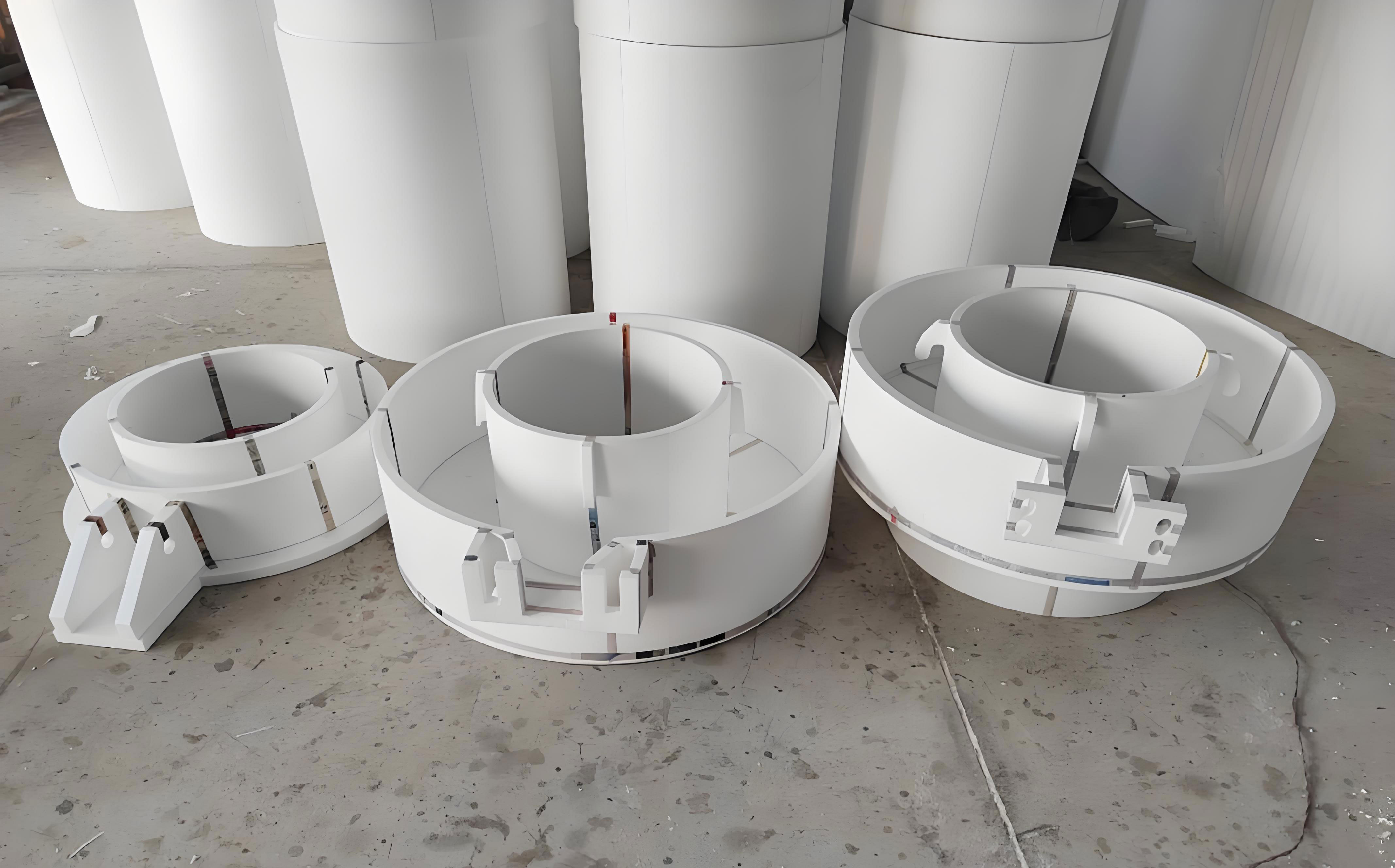
The fundamental challenges in applying lost foam casting to engine cylinder blocks can be summarized into five interconnected areas:
- Pattern Quality and Consistency: Achieving uniform density and flawless surface finish on large, complex foam patterns.
- Dimensional Accuracy: Controlling the dimensional stability of the foam pattern and the subsequent metal casting, particularly for critical features like cylinder bore spacing and geometric tolerances.
- Carbonaceous Defects: Minimizing the formation of lustrous carbon or other carbon-rich inclusions resulting from the pyrolysis of the foam pattern.
- Water Jacket Penetration/Burn-on: Preventing metal penetration and sand adhesion within the narrow, intricate water jacket cavities.
- Pressure-Tightness Failures: Eliminating micro-shrinkage or porosity that leads to leakage during hydrostatic pressure testing.
Pattern segmentation is a primary lever for addressing these issues. By decomposing the complex geometry into manufacturable segments, we can control foam molding parameters, optimize assembly and coating, and influence the dynamics of sand filling and metal filling during the lost foam casting process.
Strategic Pattern Segmentation Based on Cylinder Block Architecture
The design of the cylinder block itself dictates the priorities for the lost foam casting process. We can categorize blocks into three primary types, each demanding a tailored segmentation approach.
1. Wet-Liner Cylinder Blocks
These blocks are designed to accept separate, removable cylinder liners. Consequently, the cast block itself does not contain the final cylinder bore surfaces. The primary casting requirements are structural integrity, accurate mounting features for the liners and other components, and pressure-tightness in the coolant passages.
Segmentation Strategy & Rationale: The priority shifts towards pattern manufacturability, moldability, and cost-effectiveness. A highly effective strategy is to produce the core “crankcase” structure—including the main bearing bulkheads and the lower section—as a single, large foam piece. The outer walls of the block, which form the water jacket envelope, are then produced as separate flat or gently curved plates.
This approach offers several advantages for lost foam casting:
- Simplified Tooling: The main pattern die for the crankcase can be designed with a simpler parting line, improving manufacturability and reducing cost.
- Enhanced Pattern Rigidity: A monolithic core section is less prone to warping or distortion during handling, storage, and coating. To further enhance stiffness, strategic “process ribs” can be designed into open sections of the crankcase (e.g., under the crankcase). These ribs provide structural support during the foam phase and are easily removed during machining. The effect on stiffness can be approximated by the increase in the second moment of area (I) of the beam section. For a simple rectangular section, $$ I = \frac{b \cdot h^3}{12} $$, where adding even a small rib significantly increases the effective height (h), thereby dramatically increasing I and reducing deflection (δ) under load: $$ \delta \propto \frac{F \cdot L^3}{E \cdot I} $$.
- Optimized Casting Orientation: The open structure allows for easy, reliable sand filling. This permits the critical deck face (the head-gasket surface) to be positioned facing downward in the mold. This is the preferred orientation in lost foam casting as it places the most critical surface away from the less-dense cope sand and potential slag/carbon accumulation.
2. Dry-Liner Cylinder Blocks (with Moderate Water Jacket Clearance)
These blocks are cast with the cylinder barrels integral to the structure. A thin, finished liner is later pressed into the machined bore. This design places extreme importance on the dimensional accuracy and geometric tolerances of the as-cast cylinders: bore spacing, bore parallelism, and perpendicularity to the crankshaft axis. Furthermore, the integral water jacket around each bore presents a sand-filling challenge.
Segmentation Strategy & Rationale: Dimensional control becomes the paramount concern. The segmentation must isolate and protect the critical features. The recommended strategy is to mold the cylinder bank—the group of cylinders and the critical “bridge” or “nose” area between them—as a single, unified foam piece. The crankcase and the outer walls of the water jacket are then separate segments attached to this core.
This “monoblock” cylinder core strategy directly addresses key lost foam casting challenges:
- Guaranteed Dimensional Integrity: All critical relationships between cylinders (center distances, parallelism) are now established by a single die cavity. They are no longer subject to variation introduced by the assembly and gluing of multiple individual cylinder segments. The dimensional chain is drastically shortened.
- Reduced Carbon Defect Risk: Eliminating glue joints in the high-integrity cylinder wall area removes a potential source of excess carbonaceous material and gas generation during metal pour.
- Water Jacket Challenge: The success of this design hinges on the water jacket gap (w). For dry sand to flow and compact effectively in the lost foam casting process, a minimum clearance is required. A simple rule of thumb suggests a risk of insufficient compaction if the gap width is less than a critical value relative to the jacket height (H) and sand grain size (d). An empirical relation can be considered: $$ w_{min} \approx k \cdot d_{sand}^{0.5} \cdot H^{0.3} $$ where k is a factor dependent on sand morphology and vibration parameters. For typical foundry sand and vibration, a water jacket clearance of less than 8 mm begins to pose a significant risk of sand-related defects in lost foam casting.
3. Gasoline Engine Blocks & Dry-Liner Blocks with Narrow Water Jackets
These represent the most demanding application for lost foam casting. The blocks are monolithic (no separate liners), have very thin walls, and feature extremely narrow water jacket passages (often 3-8 mm). The requirements for dimensional accuracy, surface finish, material soundness, and freedom from defects are at their highest.
Segmentation Strategy & Rationale: When the water jacket gap falls below the reliable dry-sand filling threshold, a conventional lost foam casting approach becomes untenable due to near-certain burn-on or penetration defects. The solution is a hybrid approach that integrates a precision sand core into the lost foam casting process.
The Hybrid (Foam + Core) Strategy: A thin-shell core, typically made from resin-coated sand using hot-box or cold-box processes, is manufactured to form the internal contour of the water jacket. This core is placed as an insert during the foam pattern assembly stage. The foam pattern segments are then glued around and/or to this pre-formed core.
This hybrid lost foam casting strategy delivers decisive advantages for complex blocks:
- Elimination of Water Jacket Defects: The water jacket cavity is permanently occupied by the high-refractoriness sand core. The issue of dry sand filling and compaction within the narrow gap is completely bypassed.
- Dimensional Control: The core defines the water jacket wall thickness and contributes to the overall dimensional accuracy of the casting.
- Pattern Segmentation Freedom: With the water jacket formed by the core, the foam pattern can be segmented more aggressively for ease of molding and assembly. It may even allow a return to a segmentation scheme more akin to the wet-liner style, facilitating the optimal casting orientation.
- Trade-off: This method introduces the cost and complexity of core manufacturing and core handling into the lost foam casting process, partially offsetting one of its original advantages (corelessness).
| Cylinder Block Type | Primary Quality Focus | Recommended Segmentation Strategy | Key Process Consideration | Primary Defects Addressed |
|---|---|---|---|---|
| Wet-Liner | Structural soundness, pressure tightness, cost. | Monolithic crankcase + attached outer walls. | Design for pattern rigidity and downward deck face orientation. | Pattern distortion, shrinkage porosity. |
| Dry-Liner (w ≥ 8mm) | Dimensional accuracy of cylinder bank. | Monoblock cylinder core + attached crankcase/jacket walls. | Ensure water jacket clearance allows reliable sand fill. Minimize glue joints in critical areas. | Dimensional variation, carbon defects from glue. |
| Monolithic / Narrow Jacket (w < 8mm) | Dimensional accuracy, surface finish, zero penetration. | Hybrid: Precision sand core for water jacket + segmented foam assembly. | Integration of core making and handling into the lost foam casting line. Core coating compatibility. | Water jacket burn-on/penetration, dimensional variation. |
Selection of Key Mold and Pattern Design Parameters
Beyond segmentation, several critical parameters must be correctly defined in the pattern tooling design to ensure success in lost foam casting.
Pattern Material Selection
The choice of foam material directly impacts defect formation and dimensional control in lost foam casting.
- Expandable Polystyrene (EPS): Lower cost, higher carbon content (~92% C). More prone to carbon defect formation. Higher and less predictable shrinkage, typically in the range of 0.3% to 0.5%. Suitable for less critical castings where cost is a major driver and process controls can manage carbon.
- Expandable Polymethyl Methacrylate (EPMMA) & Copolymers (e.g., STMMA): Higher cost, lower carbon content. STMMA (~69% C) generates less lustrous carbon. Shrinkage is lower and more consistent, typically 0.1% to 0.2%. Essential for high-integrity gasoline engine blocks to minimize carbon defects and improve dimensional predictability.
The pattern material contraction (α) must be carefully applied, often differentially across the part geometry based on empirical data: $$ \alpha = f(\text{material}, \text{section thickness}, \text{part geometry}) $$.
Machining Allowance
Allowances in lost foam casting are generally smaller than in conventional sand casting due to better dimensional accuracy, but must account for potential pattern distortion and the “curtain effect” of coating drainage. A typical minimum allowance is 2.5-3.0 mm on most surfaces, increased to 4-6 mm on top-facing surfaces (in the drag) due to cope sand being less densely packed. The allowance (A) can be thought of as: $$ A = A_{base} + A_{orientation} + A_{criticality} $$, where A_base is the standard 3mm, and the other terms are additions for adverse orientation or high-criticality features.
Other Parameters
- Draft Angles: Required for pattern ejection from the die. Should be minimized (often 0.5° to 1.0°) to reduce machining stock and maintain intended geometry.
- Parting-Line Allowance (“Negative Allowance”): A slight reduction (0.3-0.6 mm) in dimension across a parting line or glue joint to compensate for the finite thickness of the adhesive bead, ensuring the final assembled pattern meets the net dimensional target.
Conclusion
The successful application of lost foam casting for demanding components like engine cylinder blocks is not merely a matter of translating an existing design into a foam pattern. It requires a fundamental, front-end engineering analysis where pattern segmentation is a primary design variable. As demonstrated, the optimal strategy is contingent upon the block’s functional architecture: whether it accepts wet liners, incorporates dry liners, or is a monolithic design. For simpler wet-liner blocks, segmentation for manufacturability and rigidity is key. For dimensionally sensitive dry-liner blocks, segmentation must protect critical relationships, often via a monoblock core. For the most challenging monolithic blocks with narrow passages, a hybrid approach integrating sand cores becomes necessary to overcome the inherent limitations of dry sand filling.
Furthermore, the selection of pattern material, allowances, and other tooling parameters must be coherent with the chosen segmentation strategy and the quality goals. This holistic approach to process design—where product function, foundry process capabilities, and tooling design are iteratively considered—is essential. It underscores that effective lost foam casting of complex components is achieved through deep collaboration between product engineers, foundry process engineers, and tooling designers, with pattern segmentation serving as the critical nexus of this collaboration.