
In my extensive research on advanced manufacturing techniques, I have focused on the optimization of lost foam casting processes for internal combustion engine cylinder blocks. The lost foam casting method, known for its precision and efficiency, presents unique challenges when applied to complex components like cylinder blocks. This article delves into the intricacies of gating system design, leveraging numerical simulation and experimental analysis to address common defects and enhance production yields. Through first-hand investigation, I explored various engine block types, including liner-free gasoline, dry-liner gasoline, dry-liner diesel, and wet-liner diesel variants, with a particular emphasis on achieving industrial-scale applicability for wet-liner diesel blocks.
The lost foam casting process involves creating a foam pattern of the desired part, coating it with a refractory material, embedding it in unbonded sand, and then pouring molten metal. The foam vaporizes upon contact, leaving behind a precise casting. However, for internal combustion engine cylinder blocks—critical components requiring high dimensional accuracy and structural integrity—defects such as sand adhesion, inclusions, and scabs in areas like the main oil passage holes and cooling water jackets can compromise quality. My study aimed to mitigate these issues through systematic gating system optimization.
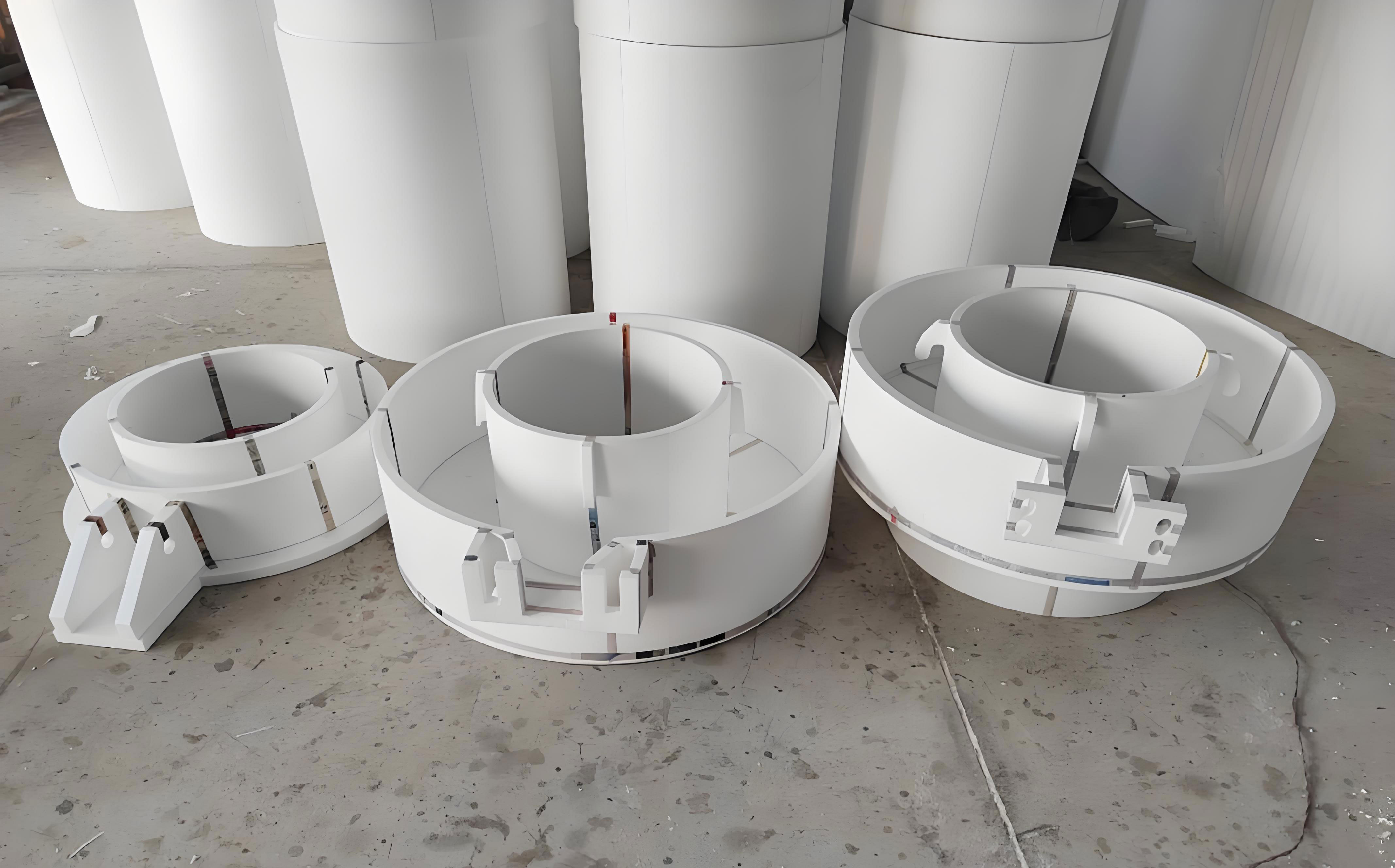
To begin, I employed a solidification simulation and numerical analysis system tailored for lost foam casting. This allowed me to model the temperature fields within the mold during casting. Key representative points were selected in typical cross-sections of the cylinder block, such as the main oil passage walls and cooling water jacket interiors, to monitor thermal behavior. The simulation parameters included material properties for the casting (HT250 gray iron), foam, sand, and air. For instance, the density ($\rho$), thermal conductivity ($k$), specific heat ($c_p$), and latent heat ($L$) were defined as follows for the casting:
$$ \rho_{\text{casting}} = 7.1 \, \text{kg/dm}^3, \quad k_{\text{casting}} = 0.04 \, \text{W/(m·K)}, \quad c_{p,\text{casting}} = 0.16 \, \text{J/(kg·K)}, \quad L = 60 \, \text{J/g} $$
The liquidus and solidus temperatures were set at 1,210°C and 1,140°C, respectively. For dry quartz sand, used as the molding medium in lost foam casting:
$$ \rho_{\text{sand}} = 1.6 \, \text{kg/dm}^3, \quad k_{\text{sand}} = 0.0031 \, \text{W/(m·K)}, \quad c_{p,\text{sand}} = 0.29 \, \text{J/(kg·K)} $$
The interfacial heat resistance between mold and casting was modeled as 1,000 m²·K/W, with a critical solid fraction of 0.6. These parameters enabled accurate prediction of solidification patterns, as shown in the simulation results where thin-walled sections solidified first, while thicker regions like the oil filter mount required design adjustments.
My gating system design centered on a unilateral semi-open intermediate pouring scheme, supplemented by top-dispersed overflow small risers. This configuration was applied to four-cylinder engine blocks with displacements of 1.0 to 2.5 liters. The key elements included a sprue cup (ø70 mm top, ø25 mm bottom, height 70 mm), a vertical sprue (ø25 mm), a horizontal runner (525 mm × 25 mm × 25 mm), and five ingates (22 mm × 6 mm each) attached to the bearing cap seats near the oil filter side. Six small risers were symmetrically placed on the joint surface between the crankcase and oil pan. This design facilitated metal flow, reduced turbulence, and improved yield by collecting cold metal and inclusions. The table below summarizes the gating system dimensions for the wet-liner diesel block, which achieved mass production with a 92.0% qualification rate:
| Component | Dimensions | Function |
|---|---|---|
| Sprue Cup | Top ø70 mm, Bottom ø25 mm, Height 70 mm | Receives molten metal |
| Vertical Sprue | ø25 mm | Channels metal downward |
| Horizontal Runner | 525 mm × 25 mm × 25 mm | Distributes metal laterally |
| Ingates (5 nos.) | 22 mm × 6 mm each | Introduce metal into cavity |
| Small Riser (6 nos.) | Similar to ingates | Overflow for inclusions |
In lost foam casting, the foam pattern’s decomposition and gas evolution complicate fluid dynamics and heat transfer. To analyze defects, I conducted temperature field simulations at specific points. For the crankcase section, Point 1 (in the bearing wall) showed rapid cooling from 1,520°C to 1,210°C in 162 s, followed by a plateau due to latent heat release until solidification at 556 s. Point 2 (in the main oil passage sand core) reached 1,110°C at 463 s and maintained temperatures above 1,008°C post-solidification, exceeding quartz sand phase transformation thresholds. Similarly, for the cylinder liner section, Point 2 (in the cooling water jacket sand) peaked at 873°C. These high temperatures, derived from the heat conduction equation:
$$ \frac{\partial T}{\partial t} = \alpha \nabla^2 T + \frac{L}{c_p} \frac{\partial f_s}{\partial t} $$
where $\alpha = k / (\rho c_p)$ is thermal diffusivity and $f_s$ is solid fraction, indicate sand phase changes that can cause coating cracking and sand adhesion. Quartz sand undergoes $\alpha$-to-$\beta$ transformations at 573°C and 790°C, leading to volume changes and coating failure in confined areas like oil passages and water jackets.
To validate these findings, I performed energy-dispersive X-ray spectroscopy (EDS) using a liquid-nitrogen-cooled silicon drift spectrometer on defect samples from dry-liner blocks. The table below compares elemental compositions for coating layers and inclusion sites:
| Sample Location | Elemental Composition (Mass %) | Inferred Defect Type |
|---|---|---|
| Coating Layer Surface | O: 65.4%, Si: 24.3%, Al: 6.8%, C: 1.6%, Others: 2.0% | Reference baseline |
| Inclusion in Water Jacket (Point 1) | O: 49.17%, Si: 4.65%, Fe: 45.25%, C: 0.93% | Coating inclusion (high Si/O) |
| Inclusion in Cylinder Liner (Point 2) | C: 17.97%, Si: 3.98%, Fe: 76.92%, O: 1.13% | Carbon residue and coating inclusion |
The high silicon and oxygen content in Point 1 suggests silicate-based coating material, while Point 2’s elevated carbon indicates polystyrene foam decomposition residues. In lost foam casting, incomplete foam vaporization and gas entrapment can lead to such inclusions, exacerbated by poor coating integrity under thermal stress.
My experimental trials covered four cylinder block types. The wet-liner diesel block, with its simpler geometry and better sand venting, achieved stable production using the optimized gating system. For dry-liner blocks, however, challenges persisted due to higher thermal loads in confined spaces. The cooling water jacket and main oil passage, with limited sand volume, experienced peak temperatures exceeding 800°C, as predicted by the simulation. This aligns with the Arrhenius-type degradation model for coatings:
$$ k(T) = A \exp\left(-\frac{E_a}{RT}\right) $$
where $k(T)$ is the reaction rate constant, $A$ is the pre-exponential factor, $E_a$ is activation energy, and $R$ is the gas constant. At high temperatures, coating binders degrade, reducing strength and allowing sand penetration.
To address these issues, I proposed several solutions based on lost foam casting principles. First, enhancing coating high-temperature strength and toughness is crucial. This can be achieved by modifying refractory compositions—for example, adding alumina or zirconia to silica-based coatings to improve thermal stability. Second, optimizing sand compaction around critical areas ensures better heat dissipation and reduces gas permeability. The sand compactness ($C_s$) can be expressed as:
$$ C_s = \frac{\rho_{\text{packed}}}{\rho_{\text{bulk}}} $$
where higher $C_s$ values improve thermal conductivity. Third, adjusting pouring parameters, such as temperature and velocity, minimizes thermal shock. The Reynolds number ($Re$) for metal flow should be kept low to avoid turbulence:
$$ Re = \frac{\rho v D}{\mu} $$
where $v$ is velocity, $D$ is hydraulic diameter, and $\mu$ is viscosity. In my design, the semi-open gating system with tapered ingates helped control flow rates.
The success of the wet-liner diesel block in lost foam casting demonstrates the viability of this approach for mass production. With a comprehensive yield of 92.0%, it outperforms traditional sand casting in terms of dimensional accuracy and cost-effectiveness for high-volume runs. The table below summarizes the outcomes for different block types:
| Engine Block Type | Displacement Range | Key Challenges in Lost Foam Casting | Production Status |
|---|---|---|---|
| Liner-free Gasoline | 1.0–2.5 L | High material cost, cooling defects | Experimental stage |
| Dry-liner Gasoline | 1.0–2.5 L | Inclusions in water jacket | Limited production |
| Dry-liner Diesel | 1.0–2.5 L | Sand adhesion in oil passages | Experimental stage |
| Wet-liner Diesel | 1.0–2.5 L | Gas venting, coating integrity | Mass production (92.0% yield) |
In conclusion, my research underscores the importance of integrated simulation and experimental validation in lost foam casting. The unilateral semi-open intermediate pouring system, coupled with dispersed risers, effectively manages metal flow and defect control for wet-liner diesel blocks. For dry-liner variants, further work is needed to improve coating performance and sand compaction in thermally critical zones. The lost foam casting process, with its inherent advantages for complex geometries, holds great potential for engine block manufacturing, provided that gating systems are meticulously optimized based on thermal and material analyses. Future directions may include advanced coating nanomaterials, real-time process monitoring, and machine learning for predictive defect avoidance in lost foam casting applications.
Throughout this study, the repeated emphasis on lost foam casting highlights its centrality to modern foundry practices. By addressing temperature-induced defects through scientific design, lost foam casting can achieve higher efficiency and quality in automotive component production. The principles discussed here—from simulation setup to gating geometry—are broadly applicable to other complex castings, reinforcing lost foam casting as a versatile and evolving technology.