
The development of an engine oil pan, a critical component serving as the lower crankcase and oil sump, using ductile iron material via the lost foam casting process presents a fascinating case study in modern foundry practice. This article details the first-hand experience and technical journey in bringing such a component from initial trial to stable production, addressing key challenges and leveraging the inherent advantages of the lost foam casting method. The component in question had a substantial size and demanding mechanical specifications, including a tensile strength requirement greater than 450 MPa and an elongation exceeding 10%. The choice of lost foam casting over conventional green sand methods was driven by its potential for superior dimensional accuracy, excellent surface finish, and significant cost reduction by eliminating the need for cores and minimizing cleanup.
The core of the lost foam casting process lies in its unique sequence, which fundamentally differs from traditional methods. The workflow can be systematically broken down into four major stages: Pattern Production, Molding & Pouring, Melting, and Cleaning & Inspection. Each stage contains critical control points that ultimately determine the quality of the final casting.
The journey begins in the pattern shop. For this oil pan, expanded polystyrene (EPS) or STMMA beads are pre-foamed to a precise density, typically between 20-22 g/L, and adequately aged. The foam pattern is then molded as a single, integrated piece in a semi-automatic molding machine. This monolithic pattern is a key benefit of lost foam casting, as it eliminates parting lines and core joints. Following molding, the pattern undergoes a rigorous drying cycle to remove moisture, which is crucial to prevent gas-related defects during pouring. The assembly of the gating system is a critical step. For this component, a bottom and intermediate gating system was designed to ensure smooth, progressive filling of the mold cavity. To counteract potential distortion in the large, open face of the pan, reinforcement ribs were added to the pattern assembly. The assembled cluster is then coated with a refractory slurry. The coating process, often involving multiple dips to achieve a thickness of 1.2-1.5 mm, serves multiple purposes: it provides a barrier between the sand and the molten metal, strengthens the pattern, and allows the decomposition gases from the foam to escape. Each coating layer must be thoroughly dried.
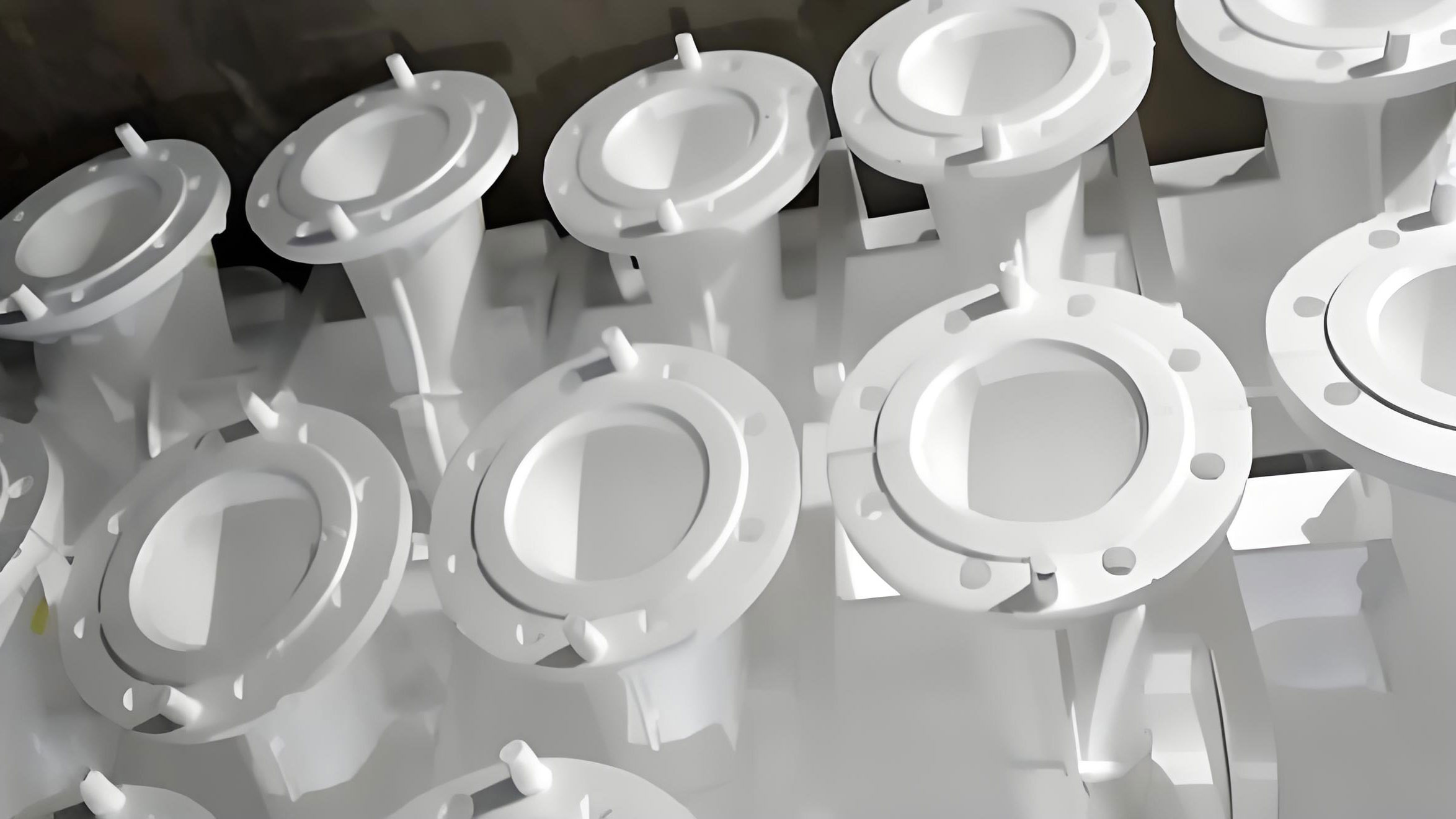
The molding process employs dry, unbonded silica sand. The coated pattern cluster is placed in a flask, and sand is filled around it while applying three-dimensional vibration to achieve optimal compaction and sand fluidity. This ensures the sand fully supports the intricate geometry of the pattern without the need for cores. The pouring practice in lost foam casting is distinctive. The principle of “steady, fast, then slow” is followed to ensure the rising metal front consistently and completely replaces the vaporizing foam without causing turbulence or back-pressure from gases. Key parameters here are pouring temperature and vacuum level. A high enough temperature is required to swiftly gasify the foam, while a controlled vacuum is applied to the flask to rapidly evacuate the decomposition products through the permeable coating and sand. For this ductile iron oil pan, the initial target pouring temperature was set at approximately 1,470°C with a vacuum level between -0.04 to -0.06 MPa during the pour, followed by a holding period to allow solidification under pressure.
The melting and treatment of the ductile iron is another pillar of the process. The base chemistry was carefully designed to achieve the required QT450-10 grade. A significant aspect of the practice was the use of a charge makeup heavily weighted towards steel scrap (60%), complemented by foundry returns and pig iron. This “synthetic” iron route offers advantages in controlling trace elements. The treatment involved a wire feeding method for nodularization and inoculation, which offers excellent reproducibility and minimal environmental disturbance compared to traditional sandwich methods.
Despite the theoretical advantages, the initial production trials for the ductile iron oil pan using lost foam casting revealed several significant challenges that required systematic investigation and resolution.
Challenge 1: Carbon Defect Formation
Carbon defects are a characteristic concern in lost foam casting. They manifest as glossy carbon films or inclusions on or just beneath the casting surface, often appearing as black streaks upon machining. These defects originate from the incomplete pyrolysis of the foam pattern. If the thermal decomposition products (primarily carbon) are not fully evacuated and instead become entrapped at the advancing metal front, they can be incorporated into the casting.
The formation is influenced by the kinetics of foam degradation and metal advancement. The rate of gas production from the foam \( Q_{gas}(t) \) must be matched or exceeded by the evacuation capacity of the system. If the local metal velocity \( v_m \) is too slow relative to the foam degradation rate, a gap can form, allowing pyrolysis residues to accumulate. A simplified view of the condition to avoid defect formation can be expressed as:
$$v_m \geq \frac{\delta}{\tau_{decomp}}$$
where \( \delta \) is a characteristic length (like coating thickness) and \( \tau_{decomp} \) is the local decomposition time of the foam.
To combat this, two primary process parameters were elevated. First, the pouring temperature was increased and tightly controlled. A higher superheat provides more enthalpy to rapidly gasify the foam, reducing \( \tau_{decomp} \). Second, the applied vacuum was optimized. A stronger vacuum enhances the suction force pulling gases through the coating, improving evacuation efficiency \( Q_{evac} \). Furthermore, the gating system was critically re-evaluated. The initial top-gating design was replaced with a combined bottom and intermediate gating system. This modification ensures a more stable, controlled, and progressive fill from the bottom up, maintaining a consistent and robust metal front that pushes gases ahead of it rather than allowing them to become trapped. The pouring time was also controlled to around 46 seconds to balance fill stability and thermal management.
| Parameter | Initial Setting | Optimized Setting | Rationale |
|---|---|---|---|
| Pouring Temperature | ~1,450 °C | 1,470 ± 10 °C | Increase enthalpy for faster foam degradation. |
| Pouring Vacuum | -0.03 MPa | -0.04 to -0.06 MPa | Enhance evacuation of pyrolysis gases. |
| Gating Design | Top Gating | Bottom + Intermediate Gating | Promote stable, progressive filling to prevent gas entrapment. |
| Pouring Time | Variable | Controlled to ~46 s | Ensure consistent fill dynamics. |
Challenge 2: Low Surface Hardness
The initial castings exhibited surface hardness values around 156 HB, which was below the specified range of 160-210 HB. In lost foam casting, the dry sand mold provides excellent insulation, leading to slower cooling rates compared to green sand or metal molds. This slow cooling can promote the formation of a ferritic matrix, which is softer than a pearlitic one. The issue was exacerbated at specific locations with heavier sections (up to 40 mm thick), where the cooling rate is intrinsically lowest.
The cooling rate \( \dot{T} \) in a sand mold can be approximated by solutions to the heat conduction equation. For a thick-section casting, it is particularly slow, favoring graphite formation and ferrite development over pearlite. The hardness \( H \) of ductile iron has a strong dependence on the pearlite fraction \( f_p \), which itself is a function of cooling rate and alloy composition:
$$H \approx H_f(1-f_p) + H_p f_p$$
$$f_p = f(\dot{T}, [Si], [Mn], [Cu], …)$$
where \( H_f \) and \( H_p \) are the hardness contributions of ferrite and pearlite, respectively.
To address this, a two-pronged approach was adopted. First, a process-level adjustment was made by strategically orienting the pattern in the flask to place the heaviest sections lower down, potentially allowing for slightly earlier cooling initiation. More decisively, a microalloying strategy was implemented. A small but potent addition of tin (Sn) alloy, approximately 0.02%, was made to the ladle. Tin is a powerful pearlite promoter that segregates to the austenite grain boundaries during solidification and strongly suppresses the ferrite transformation during cooling, even at slow rates. This effectively shifts the function \( f_p(\dot{T}) \) upward, ensuring sufficient pearlite forms to meet the hardness specification. Post-implementation, hardness values consistently exceeded 170 HB.
| Element | Target Range (wt.%) | Role in Hardness Control |
|---|---|---|
| Carbon Equivalent (CE) | 4.75 – 4.85 | Governs fluidity and graphitization potential. |
| Si (final) | 2.85 ± 0.10 | Ferritizer; content balanced for strength. |
| Mn | ≤ 0.35 | Moderate pearlite promoter, kept low for ductility. |
| Sn (added) | ~0.02 | Strong pearlite promoter, key to achieving hardness in slow-cooled sections. |
Challenge 3: Leakage Due to Microshrinkage
Pressure testing identified leakage in specific areas of the oil pan. Metallurgical analysis traced this to microshrinkage porosity forming at isolated thermal junctions. These were locations where two thicker sections (like ribs or flanges) met, creating a localized hot spot that remained liquid longest. During the final stages of solidification, this isolated pool could not be effectively fed, leading to the formation of interconnected micropores that compromised pressure tightness.
The condition for shrinkage formation is governed by the local feeding dynamics. The famous Niyama criterion, while more applicable to dispersed macroporosity, conceptually relates to the difficulty of feeding distant hot spots. In simple terms, at an isolated junction, the solidification fronts from the adjoining walls meet, creating a closed volume. The volume deficit due to solidification shrinkage (approximately 4-5% for ductile iron) in this last-to-freeze zone cannot be compensated, leading to porosity. The problem is more acute in the well-insulated environment of a lost foam casting mold.
The corrective actions were tailored to this root cause. First, the carbon equivalent (CE) of the iron was carefully adjusted and stabilized within the 4.75-4.85% range. A lower CE reduces the total graphite expansion during eutectic solidification, which can help reduce the overall feeding demand. The primary and most effective solution was the application of external chills. Small metal chills were attached to the foam pattern at the critical hot spot locations using hot-melt adhesive. During pouring, the chills extract heat rapidly from the specific area, increasing the local cooling rate \( \dot{T}_{local} \). This action achieves two goals: it solidifies the problematic junction earlier, synchronizing it with the solidification of surrounding sections, and it promotes directional solidification towards the chills, creating a more favorable temperature gradient for feeding. The chills effectively eliminated the isolated thermal center, resulting in sound, pressure-tight castings.
Additional Process Considerations and Metallurgical Control
Beyond the three primary challenges, the consistent production of high-quality ductile iron via lost foam casting requires meticulous control over the entire metallurgical process. The melting practice, using a high scrap charge, necessitates efficient and reliable graphitizing treatment. The wire feeding process for nodularization and inoculation is highly suited for the reproducible environment needed in lost foam casting. The treatment temperature, wire feed rate and length, and post-inoculation practices must be standardized to ensure consistent nodule count and matrix structure. The target residual magnesium level (0.04-0.06%) is critical to maintain a high nodularizing yield while avoiding dross defects that can be particularly detrimental in the delicate lost foam process. The base microstructure requirement of less than 25% pearlite and over 70% nodularity was consistently achieved through this controlled treatment and the balanced chemistry.
To summarize the interconnected process parameters, the following table outlines the key stages and their optimized conditions for producing this ductile iron oil pan using the lost foam casting method.
| Process Stage | Key Parameters & Materials | Optimized Practice / Specification |
|---|---|---|
| Pattern Making | Bead Material / Density | STMMA / 20-22 g/L |
| Coating Thickness | 1.2 – 1.5 mm (after drying) | |
| Gating Design | Bottom + Intermediate system with anti-distortion ribs | |
| Molding & Pouring | Sand | Dry, unbonded 20/40 mesh silica sand |
| Pouring Temperature | 1,470 ± 10 °C | |
| Vacuum & Time | -0.04 to -0.06 MPa during pour; ~46 s pour time; 10 min hold | |
| Melting & Treatment | Base Charge | 60% Steel Scrap, 20% Returns, 20% Pig Iron |
| Target Chemistry (Key) | C: ~3.8%, Si: ~2.85%, Mn: ≤0.35%, CE: 4.75-4.85% | |
| Nodularizing | Wire Feed (29-31% Mg), 0.9% addition | |
| Alloying | 0.02% Sn addition in ladle for pearlite promotion | |
| Process Aids | Chill Application | External steel chills fixed at isolated thermal junctions |
In conclusion, the adoption of the lost foam casting process for the production of a ductile iron oil pan proved to be a technically sound and economically viable decision. The process successfully enabled the one-piece formation of a complex geometry that would have required cores in conventional sand casting. The challenges encountered—carbon defects, low hardness in slow-cooling sections, and leakage from microshrinkage—are not unique but are characteristic hurdles of the lost foam process when working with ductile iron. Their resolution required a systemic approach, intertwining adjustments in fluid dynamics (gating, pouring parameters), thermal management (chills, orientation), and metallurgy (CE control, microalloying). The final process yielded castings with high dimensional accuracy, excellent surface finish, and consistent mechanical properties meeting all specifications. This practice underscores that lost foam casting is not merely an alternative but a highly competent primary production method for specific classes of castings, offering distinct advantages in integration, precision, and post-casting efficiency when its unique physics are thoroughly understood and managed.