
In the realm of heavy-duty engineering vehicles, the axle shell stands as a critical component, bearing immense loads and transmitting power under harsh operational conditions. The production of high-integrity steel castings for such applications demands precision and reliability. Among various casting methods, the lost foam casting (LFC) process, also known as evaporative pattern casting (EPC), has emerged as a promising technique due to its ability to produce complex geometries with minimal post-processing. However, applying EPC to steel castings, particularly for large, thin-walled components like axle shells, presents significant challenges. In this extensive study, we delve into the intricacies of utilizing EPC for manufacturing heavy-duty steel engineering axle shells, addressing key defects such as carburization, inclusions, cracks, and distortion through systematic process optimizations.
The axle shell is a structurally complex steel casting with varying wall thicknesses, ranging from 12 mm to 60 mm, which complicates the solidification process and increases susceptibility to defects. Traditional sand casting and V-process methods have been prevalent, but EPC offers advantages in dimensional accuracy and reduced machining. Yet, previous attempts at EPC for steel axle shells often failed to meet stringent performance standards, leading to issues like leakage and fatigue failure in service. Our investigation focuses on overcoming these hurdles by refining every aspect of the EPC process, from pattern material selection to pouring techniques. The goal is to produce steel castings that exhibit high strength, toughness, fatigue resistance, and weldability, essential for mining and construction vehicles operating on rugged terrains.
Key technical challenges in EPC for steel castings include carburization from foam decomposition, inclusion entrapment leading to leakage, thermal stress-induced cracking, and distortion during processing. Carburization is particularly problematic in steel castings due to the carbon-rich gases released from foam patterns, which can alter surface chemistry and degrade mechanical properties. For axle shells, with their thick-thin transitions, achieving uniform carbon distribution is difficult even with hollow shell techniques. Inclusions arise from turbulent metal flow and inadequate slag removal, exacerbated by the enclosed cavity of the axle shell that traps impurities. Cracks often initiate at stress concentrators like flange transitions, where differential cooling rates generate high residual stresses. Distortion occurs throughout the pattern drying, coating, and solidification stages, necessitating precise support systems. Addressing these issues requires a holistic approach, combining material science, process engineering, and quality control.
To quantify the target properties, the chemical composition and mechanical requirements for the steel castings are outlined in Tables 1 and 2. These specifications ensure the axle shell meets the demanding service conditions of heavy-duty vehicles.
| Element | Content Range |
|---|---|
| C | 0.20–0.25 |
| Si | 0.3–0.5 |
| Mn | 1.1–1.4 |
| Cr | 0.20–0.35 |
| Mo | 0.15–0.25 |
| S, P | ≤0.025 |
| Al | 0.4–0.8 |
| V, Ni, Cu | ≤0.03 |
The carbon content is kept low to enhance weldability and toughness, while alloying elements like Mn, Cr, and Mo contribute to strength and hardenability. Aluminum is added for deoxidation, critical in steel castings to minimize oxide inclusions. The mechanical properties, as shown in Table 2, are tailored for high load-bearing capacity and impact resistance.
| Property | Value |
|---|---|
| Tensile Strength (σb) | 600–680 MPa |
| Yield Strength (σs) | 420–500 MPa |
| Elongation (δ) | ≥18% |
| Reduction of Area (Ψ) | ≥36% |
| Impact Energy (AK) | ≥35 J/cm² |
| Hardness | 190–240 HB |
Additionally, the steel castings must pass a pressure tightness test at 0.3–0.5 MPa for over 10 minutes, ensuring no leakage in the lubricant-filled cavity. Magnetic particle inspection post-heat treatment verifies surface integrity, and shot peening removes oxide scales to achieve the required hardness. Meeting these criteria with EPC demands meticulous process design.
Our experimental approach involved two distinct gating and risering systems, as illustrated in Figures 1 and 2 from the original study. In Process 1, the axle shell was oriented with the蜗壳 opening upward, using a central pouring gate and risers at both ends to feed the isolated hot spots. The gating ratio was designed to minimize turbulence, expressed as: $$ A_g : A_r : A_p = 1 : 1.2 : 1.5 $$ where \(A_g\) is the gate area, \(A_r\) is the runner area, and \(A_p\) is the pattern cross-sectional area. This ratio promotes steady filling, reducing air entrapment in steel castings. However, this layout risked collapse of the internal sand core due to low vacuum in the upper region of the flask.
In Process 2, the shell was positioned sideways with a 20° tilt, employing one end as the pouring gate and risers at the middle flange and opposite end. The tilt angle facilitated better metal distribution and reduced thermal gradients. To prevent cracking at the flange transition, an anti-crack ring (8 mm × 25 mm) was incorporated, aligning with the internal开口. This ring acts as a stress reliever, redistributing thermal stresses during cooling. The effectiveness of such rings can be modeled using thermal stress analysis: $$ \sigma_{thermal} = E \cdot \alpha \cdot \Delta T $$ where \(E\) is Young’s modulus, \(\alpha\) is the thermal expansion coefficient, and \(\Delta T\) is the temperature difference. By reducing \(\Delta T\) through localized cooling, the ring mitigates crack initiation in steel castings.
Pattern material selection is paramount in EPC for steel castings. We compared EPS (expandable polystyrene) and STMMA (copolymer of styrene and methyl methacrylate) beads, with their carbon contents being 92% and 69.6%, respectively. STMMA was chosen for its lower carbon potential and reduced residue formation upon pyrolysis. The ideal material, EPMMA (polymethyl methacrylate) with 60% carbon, was cost-prohibitive for mass production. The pattern density was controlled at 20–23 g/cm³ to enhance structural rigidity, minimizing distortion during handling. Patterns were produced using a multi-segment mold to avoid longitudinal seams, ensuring smooth internal surfaces critical for fluid flow in steel castings.
A proprietary coating formulation was developed to address the unique demands of steel castings in EPC. The coating must exhibit high green strength, refractory resistance, and good adherence without dripping. The composition is summarized in Table 3.
| Component | Proportion (parts by weight) |
|---|---|
| Sodium Bentonite | 3 |
| CMC (Carboxymethyl Cellulose) | 3 |
| Lignin Fiber | 0.5 |
| Xanthan Gum | 0.5 |
| Water-soluble PVA | 0.5 |
| 85% Alumina (200 mesh) | 80 |
| 99% Quartz Powder (200 mesh) | 20 |
Water content was adjusted for multiple dipping cycles: 40% for the first coat, 35% for the second, and 30% for the third, achieving a thickness of 3–4 mm internally and 2–2.5 mm externally. This coating provided adequate permeability to evacuate pyrolysis gases while preventing sand penetration in steel castings. To combat distortion during drying, custom支架 were designed, supporting the pattern at four points along its length. Initially, eight patterns were dried together, but变形 exceeded tolerances; switching to individual支架 eliminated this issue, showcasing the importance of tailored support for large steel castings.
Melting and pouring operations were rigorously controlled. Steel scrap with low impurity levels (C<0.2%, P,S<0.025%) was melted in a medium-frequency induction furnace. Deoxidation was performed in two stages: in-furnace treatment with silicon-aluminum-barium, followed by ladle treatment with pure aluminum, targeting a total aluminum content of 0.04–0.08% in the steel castings. This dual approach minimizes oxide inclusions, crucial for pressure-tightness. Pouring was executed using a bottom-pour ladle with argon shielding to reduce reoxidation. The argon flow rate \(Q_{Ar}\) is given by: $$ Q_{Ar} = k \cdot \sqrt{\frac{P_{ladle}}{\rho_{steel}}} $$ where \(k\) is a constant, \(P_{ladle}\) is the ladle pressure, and \(\rho_{steel}\) is the steel density. This ensures a protective atmosphere during transfer, preserving the cleanliness of steel castings.
A critical innovation was the implementation of the “burn-out” technique. Prior to pouring, the foam pattern was completely incinerated within the mold using oxygen lances, creating a hollow cavity. This step is essential for steel castings to minimize carburization and gas defects. The process parameters included a vacuum level of 0.05–0.06 MPa during burning, reduced to 0.03–0.04 MPa after burnout, and maintained above 0.02 MPa to prevent mold collapse. The burnout time \(t_b\) depends on pattern volume and oxygen flow: $$ t_b = \frac{V_p \cdot \rho_p}{Q_{O_2} \cdot \eta} $$ where \(V_p\) is pattern volume, \(\rho_p\) is pattern density, \(Q_{O_2}\) is oxygen flow rate, and \(\eta\) is combustion efficiency. For axle shells, burnout ensured no residual foam, leading to clean steel castings with uniform carbon distribution.
Pouring temperature was set at 1600–1620°C, optimized via thermal analysis: $$ T_{pour} = T_{liquidus} + \Delta T_{superheat} $$ where \(T_{liquidus}\) is approximately 1510°C for this steel grade, and \(\Delta T_{superheat}\) accounts for heat loss during filling. High-frequency vibration was applied during the latter stages of pouring until vacuum release (60–120 seconds post-pour). This vibration, at frequencies above 100 Hz, refines the grain structure by disrupting dendritic growth, enhancing the mechanical properties of steel castings. The grain size \(d\) can be related to vibration intensity \(I_v\): $$ d = d_0 \cdot e^{-k_v \cdot I_v} $$ where \(d_0\) is the initial grain size and \(k_v\) is a material constant. Finer grains improve toughness and fatigue resistance in steel castings.
Process validation involved extensive testing. Initially, Process 1 suffered a 20% collapse rate due to inadequate core support; adding a Φ26 mm steel tube as a core reinforcement reduced this to near zero in Process 2. The成功率 of burnout exceeded 95%, with no carburization defects observed in sectioned samples. Mechanical tests on prototypes yielded: tensile strength 605 MPa, yield strength 436 MPa, elongation 19%, reduction of area 38%, impact energy 41 J/cm², and hardness 215 HB, all within specifications. Pressure testing at 0.4 MPa for 15 minutes showed no leakage, confirming the integrity of the steel castings. Fatigue tests under full load met industry standards, demonstrating the viability of EPC for high-performance steel castings.
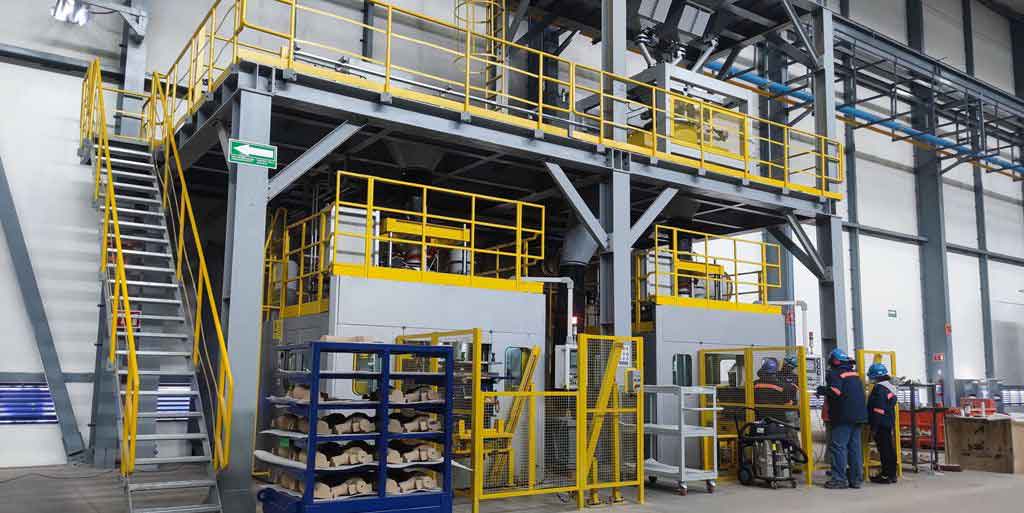
The image above illustrates advanced equipment used in the production of steel castings via EPC, highlighting the integration of technology for quality assurance. In our setup, similar systems were employed to monitor vacuum levels, vibration parameters, and pouring sequences, ensuring consistency across batches of steel castings.
To further optimize the process, we developed a model for predicting defect formation in steel castings. For carburization, the surface carbon increase \(\Delta C_s\) can be estimated as: $$ \Delta C_s = C_f \cdot (1 – e^{-t/\tau}) $$ where \(C_f\) is the carbon potential from foam, \(t\) is exposure time, and \(\tau\) is a time constant dependent on coating permeability. For STMMA, \(C_f\) is lower than EPS, reducing \(\Delta C_s\). Inclusion content \(I\) relates to pouring velocity \(v_p\) and vacuum pressure \(P_v\): $$ I = \frac{k_i \cdot v_p^2}{P_v} $$ where \(k_i\) is an inclusion constant. Bottom-pour ladles minimize \(v_p\), while high \(P_v\) evacuates inclusions, benefitting steel castings. Crack susceptibility \(S_c\) is a function of thermal stress and material strength: $$ S_c = \frac{\sigma_{thermal}}{\sigma_{yield}} $$ where \(\sigma_{yield}\) is the yield strength. Anti-crack rings and controlled cooling keep \(S_c < 1\), preventing failures in steel castings.
Distortion control remained challenging, with about 20% of steel castings requiring press straightening after heat treatment due to residual stresses. Future work could incorporate simulation software to predict distortion patterns, though current tools lack accuracy for EPC of steel castings. Empirical adjustments, such as modified riser designs and optimized cooling rates, are ongoing to reduce this percentage.
In conclusion, the successful production of heavy-duty steel engineering axle shells via EPC hinges on a multifaceted strategy. Key elements include: using STMMA beads for patterns, implementing burn-out to eliminate carburization, applying anti-crack rings and高频 vibration, employing bottom-pour ladles with argon shielding, and utilizing custom支撑 systems to prevent distortion. These measures collectively address the core defects plaguing steel castings in EPC, resulting in components that meet rigorous performance criteria. The process not only enhances the quality of steel castings but also offers economic advantages through reduced machining and improved yield. As EPC technology evolves, its application for complex steel castings like axle shells will expand, driven by continuous innovation in materials and process control. Our experience demonstrates that with meticulous attention to detail, EPC can produce high-integrity steel castings for demanding automotive applications, paving the way for broader adoption in heavy-industry sectors.
The journey from concept to合格 steel castings involved iterative testing and refinement. Each parameter—from foam density to vibration frequency—was fine-tuned based on empirical data and metallurgical principles. The result is a robust process capable of delivering steel castings with consistent mechanical properties and dimensional accuracy. As the demand for durable and lightweight components grows, EPC stands as a viable method for advancing the state-of-the-art in steel castings production. Future research may explore alternative pattern materials, advanced coatings, and real-time monitoring systems to further elevate the quality of steel castings. For now, our work validates that through systematic engineering, the challenges of EPC for steel castings can be overcome, enabling the manufacture of reliable axle shells that withstand the rigors of heavy-duty service.