
In the production of high manganese steel castings, particularly in small to medium-sized foundries, ensuring consistent metallurgical quality is a significant challenge. The reliance on medium-frequency induction furnaces often leads to fluctuations in melt quality, resulting in casting performance issues such as premature wear, dimensional inaccuracies, or early fracture. As a practitioner in this field, I have explored various measures to enhance the metallurgical quality of high manganese steel castings. This article delves into critical strategies, including optimized melting practices, composition control, modification treatments, and pre-pouring inspections, all aimed at stabilizing and improving the properties of high manganese steel castings. The focus is on practical, implementable steps that can be adopted even in resource-limited settings.
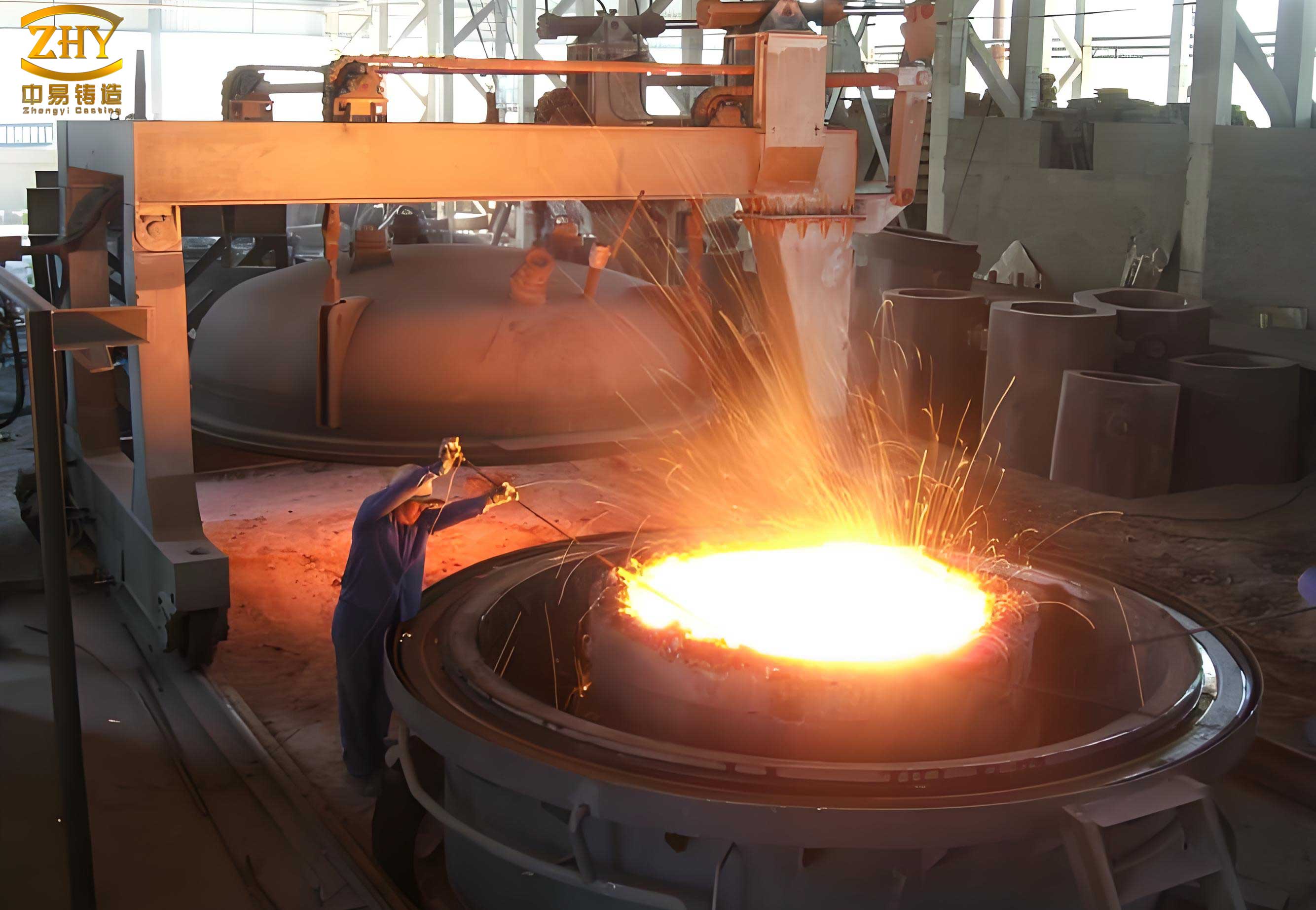
The metallurgical quality of high manganese steel castings directly influences their service life and reliability. Key factors include gas and inclusion content, microstructure refinement, and accurate chemical composition. Through systematic approaches, I have found that the following measures can significantly elevate the quality of high manganese steel castings.
Alloy Melting Process
Controlling the melting process is paramount for producing high-quality high manganese steel castings. The medium-frequency induction furnace, while efficient, requires careful handling to mitigate its limitations in refining. I emphasize several aspects to achieve a cleaner melt.
Slag Formation and Management
Proper slag practice is essential for removing impurities and protecting the melt. In high manganese steel casting production, I recommend using a basic lining with lime-based slag. The slag acts as a barrier against gas absorption and oxidation while collecting inclusions. The process can be summarized in Table 1.
| Step | Operation | Purpose |
|---|---|---|
| 1 | Add lime (1-1.5% of charge weight) at furnace bottom | Initial slag formation to cover melt |
| 2 | Supplement lime during melting | Maintain slag coverage and basicity |
| 3 | Add fluorspar if needed | Adjust slag fluidity and melting point |
| 4 | Remove all slag after meltdown | Prevent phosphorus reversion |
The slag basicity can be expressed as:
$$ \text{Basicity} = \frac{\text{CaO}}{\text{SiO}_2} $$
For effective dephosphorization, a high basicity slag (e.g., >2) is preferred under oxidizing conditions. This is crucial for high manganese steel castings, as phosphorus content should be minimized to avoid brittleness.
Charge Material Purity
The quality of charge materials directly impacts the inclusion level in high manganese steel castings. I insist on using charge materials with minimal oil, rust, or contaminants. A typical charge mix for high manganese steel castings includes up to 70% returns (scrap high manganese steel castings) balanced with low-phosphorus carbon steel. This helps control impurities and ensures consistent chemistry.
Alloying Sequence for Manganese Addition
The timing of manganese addition affects oxide inclusion formation. Adding ferromanganese during melting leads to higher oxidation losses and inclusions. Instead, I prefer adding it after pre-deoxidation, which improves yield and reduces impurities. The recovery rate can be modeled as:
$$ \eta_{\text{Mn}} = \frac{\text{Actual Mn in melt}}{\text{Mn added}} \times 100\% $$
Where pre-deoxidation before adding ferromanganese yields ηMn ≈ 95%, compared to ~90% if added initially. Ferromanganese should be preheated to >750°C and added in 50-100 mm pieces, with stirring between batches to ensure dissolution.
Deoxidation Practices
Deoxidation is critical to reduce oxygen content and inclusion formation in high manganese steel castings. I employ a two-stage process: pre-deoxidation and final deoxidation. Pre-deoxidation uses FeSi75 at 0.5-0.8% of melt weight to rapidly lower oxygen levels before alloying. Final deoxidation uses aluminum (0.1% of melt weight) inserted into the melt via an iron rod just before tapping. The reactions can be represented as:
$$ 2\text{Al} + 3\text{O} \rightarrow \text{Al}_2\text{O}_3 $$
$$ \text{Si} + 2\text{O} \rightarrow \text{SiO}_2 $$
These reactions form inclusions that float into the slag, improving the cleanliness of high manganese steel castings.
Modification Treatment
Modification with rare earth elements (REE) or commercial modifiers enhances the microstructure and properties of high manganese steel castings. I have observed that REE addition, particularly lanthanum-rich alloys, offers multiple benefits:
- Purification of melt by reducing gas and inclusion content.
- Grain refinement and improvement of as-cast structure.
- Enhanced fluidity, reduced casting stress, and better crack resistance.
- Improved mechanical properties, especially yield strength and low-temperature impact toughness.
- Increased wear resistance due to accelerated work-hardening and twin formation.
The optimal addition of REE is around 0.3% by weight. The effect on layer fault energy can be described as:
$$ \Delta \gamma_{\text{SF}} = k \cdot C_{\text{REE}} $$
Where ΔγSF is the change in stacking fault energy, k is a constant, and CREE is the rare earth concentration. Lower stacking fault energy promotes twin formation, enhancing wear resistance in high manganese steel castings.
Holding and Pouring Temperature Control
After tapping, I recommend a holding time of 3-5 minutes to allow gas and inclusions to float out. This simple step significantly improves the metallurgical quality of high manganese steel castings. Pouring temperature is another critical parameter. For conventional sand casting, I maintain temperatures between 1420°C and 1450°C, often using a skim test (e.g., 25-30 seconds for film formation on a sample spoon). For lost foam casting, where heat dissipation is slower, I lower the temperature to 1390-1420°C to implement “low-temperature fast pouring,” which helps minimize coarse grains. The relationship between pouring temperature (Tp) and grain size (d) can be approximated by:
$$ d = A \cdot e^{-B/T_p} $$
Where A and B are material constants. Lower temperatures generally favor finer grains, crucial for the toughness of high manganese steel castings.
Composition Control
Precise composition control is vital for achieving desired performance in high manganese steel castings. Carbon and manganese are the primary alloying elements, but other elements also play roles. I have developed guidelines based on extensive experience, summarized in Table 2.
| Element | Recommended Range (wt%) | Effect on High Manganese Steel Castings | Notes |
|---|---|---|---|
| Carbon (C) | 0.9-1.3 | Promotes austenite formation and work-hardening; higher C increases wear resistance but may reduce toughness | Adjust based on section thickness: 0.9-1.1% for thick/complex castings |
| Manganese (Mn) | 11-14 | Stabilizes austenite; ensures single-phase structure | Maintain Mn/C ratio >10 for toughness; Mn/C=10 for balance |
| Silicon (Si) | 0.3-0.8 | Aids deoxidation; slight solid solution strengthening | Typically from charge materials; not actively alloyed |
| Phosphorus (P) | <0.05 | Harmful; reduces strength, toughness, and wear resistance; increases cracking tendency | Minimize through slag practice and charge control |
| Sulfur (S) | <0.03 | Less harmful due to Mn presence; forms MnS inclusions | Usually low if Mn is adequate |
| Chromium (Cr) | 0-2.5 | Improves wear resistance and yield strength; may reduce toughness | Add intentionally for severe impact conditions |
| Molybdenum (Mo) | 0-1.0 | Reduces carbide precipitation in thick sections | Often combined with Cr |
| Nickel (Ni) | 0-0.7 | Refines grain; improves mechanical and processing properties | Beneficial for complex high manganese steel castings |
| Titanium (Ti) | 0-0.1 | Refines grain; reduces grain boundary carbides | Small additions enhance properties |
| Vanadium (V) | 0-0.3 | Significantly increases yield strength and hardness | Can improve plasticity and toughness at low levels |
The Mn/C ratio is a key parameter for high manganese steel castings. I use the following formula to guide adjustments:
$$ \text{Mn/C ratio} = \frac{\text{Mn \%}}{\text{C \%}} $$
For optimal toughness, Mn/C > 10 is required to avoid pearlite transformation. For balanced properties, Mn/C ≈ 10 is ideal. Deviations can lead to issues: low Mn/C (high C, low Mn) causes early fracture, while high Mn/C (low C, high Mn) results in poor wear resistance or excessive deformation. In production of high manganese steel castings, I often encounter scenarios where scrap returns dominate the charge, leading to composition shifts. To counteract this, I calculate adjustments using mass balance equations. For example, if the current melt has composition C0 and Mn0, and we aim for targets Ct and Mnt, the required additions of ferromanganese (with MnFeMn and CFeMn) and carbon source can be estimated as:
$$ \Delta \text{Mn} = \frac{W_{\text{melt}} \cdot (\text{Mn}_t – \text{Mn}_0)}{100} $$
$$ \Delta \text{C} = \frac{W_{\text{melt}} \cdot (\text{C}_t – \text{C}_0)}{100} $$
Where Wmelt is the melt weight. These calculations help maintain consistency across batches of high manganese steel castings.
Pre-Pouring Inspection and Adjustment
To avoid casting defective high manganese steel castings, I implement a rapid bend test before pouring. This test provides immediate feedback on metallurgical quality. The procedure involves casting a sample using a wet sand mold, water-quenching it, and bending it to a specific angle. Based on the results, I make adjustments as outlined in Table 3.
| Test Result | Observation | Interpretation for High Manganese Steel Castings | Corrective Action |
|---|---|---|---|
| No crack on bending | Smooth bend without fracture | Excellent metallurgical quality; melt is suitable for pouring | Proceed with casting |
| Crack appears on bending | Fracture occurs during bending | Further analysis needed: conduct break and magnetic tests | See sub-cases below |
| Sub-case: Easy break, strong magnetism | Sample breaks with one hammer blow and is strongly magnetic | Non-austenitic structure due to low Mn, high C | Add medium- or low-carbon ferromanganese to adjust Mn/C ratio |
| Sub-case: Easy break, weak magnetism | Sample breaks easily but has weak magnetism | High gas content from contaminated charge | Enhance deoxidation and degassing; improve charge quality |
| Sub-case: Difficult break, low magnetism | Sample requires multiple blows to break | Austenitic structure with some carbides; possible deoxidation issues or coarse grains | Strengthen deoxidation; lower pouring temperature; consider modification |
| Sub-case: Very difficult break, minimal magnetism | Sample is tough to break | Acceptable structure but high inclusion content | Increase slag volume; tap with slag; intensify modification treatment |
| Direct bend fracture | Sample fractures immediately upon bending | Severe composition mismatch or excessive brittleness | Reject melt for critical applications; use for low-toughness castings only |
This inspection method is invaluable for timely correction, ensuring that only qualified melts are used for high manganese steel castings. The bend angle (θ) can be related to material ductility. For a sample of length L and thickness t, the strain at fracture can be estimated as:
$$ \epsilon = \frac{t \cdot \theta}{2L} $$
Where θ is in radians. A higher ϵ indicates better ductility, which correlates with superior metallurgical quality in high manganese steel castings.
Advanced Considerations for Metallurgical Quality
Beyond basic measures, I have explored additional factors that influence the metallurgical quality of high manganese steel castings. These include solidification behavior, heat treatment, and the role of minor elements.
Solidification Modeling
The solidification sequence affects microstructure and defect formation in high manganese steel castings. I often use simplified models to predict cooling rates and grain size. The local solidification time (tf) can be expressed as:
$$ t_f = \frac{\Delta T^2}{4 \alpha \cdot (T_{\text{pour}} – T_{\text{mold}})^2} $$
Where ΔT is the freezing range, α is the thermal diffusivity, Tpour is the pouring temperature, and Tmold is the mold initial temperature. Shorter tf values lead to finer grains, which improve toughness in high manganese steel castings. For lost foam casting, the slower cooling necessitates even tighter temperature control.
Heat Treatment Optimization
High manganese steel castings typically undergo water toughening (solution treatment) to dissolve carbides and achieve a homogeneous austenitic structure. I recommend a temperature range of 1050-1100°C followed by rapid water quenching. The kinetics of carbide dissolution can be described by the Avrami equation:
$$ f = 1 – \exp(-k t^n) $$
Where f is the fraction dissolved, k is a rate constant, t is time, and n is an exponent. Proper heat treatment ensures maximum toughness and work-hardening capacity for high manganese steel castings.
Inclusion Engineering
Controlling inclusion morphology is crucial for high manganese steel castings. Through modification, I aim to transform harmful angular inclusions into globular ones. The effectiveness of modification can be assessed using inclusion shape factors, such as:
$$ \text{Shape factor} = \frac{4\pi A}{P^2} $$
Where A is the inclusion area and P is its perimeter. A value closer to 1 indicates a more spherical inclusion, which is less detrimental to mechanical properties. Regular monitoring of inclusion content and morphology helps maintain the metallurgical quality of high manganese steel castings.
Conclusion
Enhancing the metallurgical quality of high manganese steel castings requires a holistic approach encompassing melting, composition control, modification, and inspection. By implementing proper slag practices, careful deoxidation, and rare earth modification, I have successfully reduced gas and inclusion levels in high manganese steel castings. Precise control of carbon and manganese, along with attention to harmful elements like phosphorus, ensures consistent wear resistance and toughness. The pre-pouring bend test provides a quick and reliable method to avert defective castings. Through these measures, even small foundries can produce high-quality high manganese steel castings with stable performance, minimizing early failures and extending service life. Continuous refinement of these practices, coupled with ongoing education and quality management, will further advance the reliability of high manganese steel castings in demanding applications.
In summary, the key to improving high manganese steel castings lies in meticulous attention to metallurgical details. Every step, from charge selection to final inspection, contributes to the overall quality. By adhering to the strategies discussed, producers can achieve significant improvements in the metallurgical quality of high manganese steel castings, leading to enhanced customer satisfaction and reduced operational costs. The journey toward excellence in high manganese steel castings is ongoing, but with dedicated effort, consistent high quality is attainable.