
In my extensive experience within the foundry industry, the production of high manganese steel casting components, particularly liner plates for chutes and similar abrasive applications, presents unique challenges and opportunities. High manganese steel, renowned for its exceptional work-hardening capability and impact resistance, derives its properties from a specific microstructure achieved through water toughening. The adoption of the Expendable Pattern Casting (EPC) process for such castings offers advantages in design flexibility and reduced machining, but it demands precise control over every stage to ensure surface quality and mechanical integrity. This article details my firsthand journey in optimizing the EPC process for high manganese steel casting, encompassing significant improvements in gating design and a revolutionary approach to heat treatment utilizing as-cast waste heat. The continuous pursuit of excellence in high manganese steel casting is vital for industrial efficiency.
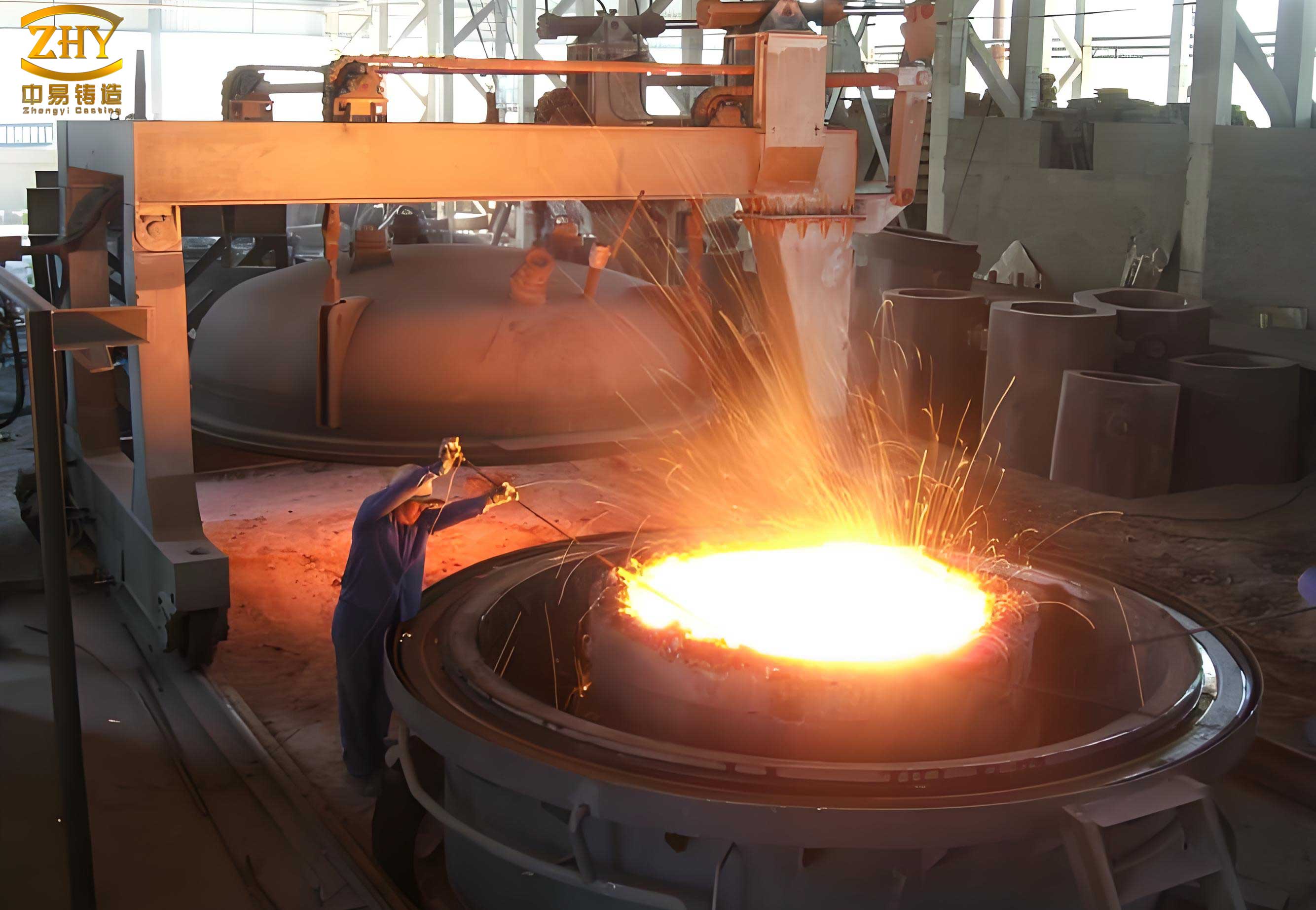
The fundamental allure of high manganese steel casting lies in its metallurgical composition. The standard grade often referenced is ZG120Mn13, where the key to performance is the ratio of manganese to carbon. The target is a ratio (w(Mn)/w(C)) greater than 10 to suppress the formation of brittle carbides and ensure a fully austenitic matrix after solution treatment. In our production, the actual composition was slightly below this ideal, yet through process control, we achieved the desired properties. The chemical composition is foundational to any discussion on high manganese steel casting.
| Element | Symbol | Target Range | Actual Production | Role in Microstructure |
|---|---|---|---|---|
| Carbon | C | 1.05 – 1.35 | 1.27 | Solid solution strengthener; affects hardness and carbide formation. |
| Manganese | Mn | 11.0 – 14.0 | 11.55 | Stabilizes austenite; key for work-hardening. |
| Silicon | Si | 0.3 – 0.8 | 0.74 | Deoxidizer; influences fluidity and solidification. |
| Phosphorus | P | < 0.06 | 0.028 | Impurity; reduces toughness if excessive. |
| Sulfur | S | < 0.04 | 0.016 | Impurity; can form inclusions. |
The manganese to carbon ratio is a critical parameter, calculable by the formula:
$$ \text{Mn/C Ratio} = \frac{w_{\text{Mn}}}{w_{\text{C}}} $$
For our high manganese steel casting, this calculated to 9.05 (11.55 / 1.27). While slightly below 10, proper heat treatment compensates to achieve the required microstructure. The success of any high manganese steel casting project hinges on understanding these relationships.
Pattern Making and Cluster Assembly for EPC
The initial phase in EPC for high manganese steel casting is the creation of the expendable pattern. We selected Expandable Polystyrene (EPS) foam with a density between 16 and 19 kg/m³. A crucial, often overlooked step is the conditioning of this foam. It requires storage in a dry environment for approximately six months to allow natural drying and stabilization of its moisture content, preventing gas generation and subsequent defects during pouring. The liner plates in question were relatively thin-walled (20 mm thick) with planar dimensions around 300-370 mm square. The pattern making process involved precise cutting to drawing specifications with a shrinkage allowance of 2.5% to accommodate the solidification contraction of high manganese steel casting. For any bolt holes or mounting features, we added a unilateral machining allowance of 1 mm to the pattern diameter to ensure final dimensional accuracy post-casting.
Cluster assembly is where the gating system takes shape. Initially, we faced significant surface quality issues. The patterns were grouped in clusters of six pieces. A critical design parameter is the inter-pattern spacing. We determined that a spacing of 150 mm is essential. A smaller spacing increases the risk of “flash flooding” or premature pattern collapse due to intense local heat from adjacent metal streams, a phenomenon described by the thermal degradation kinetics of EPS. The rate of pattern decomposition can be modeled approximately as:
$$ \frac{dm}{dt} = -A e^{-E_a / (R T)} $$
where \( dm/dt \) is the mass loss rate, \( A \) is a pre-exponential factor, \( E_a \) is the activation energy for foam degradation, \( R \) is the universal gas constant, and \( T \) is the local temperature. Closer spacing raises \( T \) through thermal interaction, accelerating degradation and potentially causing mold wall instability. The gating system was designed with a downsprue, a horizontal runner for flow distribution, and multiple ingates. The initial, problematic design employed a top-gating approach.
| Parameter | Specification | Rationale |
|---|---|---|
| Foam Density | 16-19 kg/m³ | Balances strength for handling and minimal gas generation. |
| Pattern Shrinkage Allowance | 2.5% | Accounts for linear contraction of high manganese steel upon cooling. |
| Hole Diameter Allowance | +1 mm (unilateral) | Ensures clearance for installation after possible minor casting inaccuracies. |
| Patterns per Cluster | 6 | Optimizes yield per mold and thermal balance. |
| Inter-pattern Spacing | 150 mm | Prevents thermal interaction and mold wall failure. |
| Ingate Cross-section | 15 mm x 30 mm (approx.) | Provides sufficient flow area while minimizing heat concentration. |
Gating System Optimization: From Top-Pour to Side-Gating
The pivotal improvement in our high manganese steel casting process came from re-engineering the gating system. The original top-pour method, while simple, led to poor surface finish characterized by uneven “wash marks” or “erosion traces” below the ingates. The underlying physics involves fluid dynamics and heat transfer. In a top-gating system, the molten metal falls with significant kinetic energy, impinging directly on the mold wall coated with refractory coating. The dynamic pressure \( P_d \) at the impingement point can be estimated from Bernoulli’s principle:
$$ P_d = \frac{1}{2} \rho v^2 $$
where \( \rho \) is the density of liquid high manganese steel (approximately 7200 kg/m³) and \( v \) is the flow velocity. This high pressure can scour the coating, exposing loose sand and causing surface imperfections. Furthermore, the rapid, concentrated delivery of hot metal causes violent thermal decomposition of the EPS pattern. The gaseous and liquid pyrolysis products are trapped and卷入 (entrained) into the ascending metal front, leading to carbonaceous inclusions and surface folds.
Our solution was a shift to a side-gating system. In this configuration, the metal enters the mold cavity horizontally through ingates attached to the side of the patterns. The horizontal runner acts as a flow buffer, dissipating kinetic energy and ensuring a more tranquil, upward filling of the mold cavity. This reduces the impingement velocity \( v \) and consequently the dynamic pressure \( P_d \) on the coating. The filling process becomes more controlled, allowing pyrolysis gases to escape through the coating and the sand matrix via the applied vacuum. The improvement in surface quality for our high manganese steel casting was dramatic.
However, gating design alone was insufficient. We had to synergistically optimize pouring parameters. For EPC of steel, and particularly for high manganese steel casting, the pouring temperature must be higher than in conventional sand casting to compensate for the energy absorbed in decomposing the foam pattern. We established an optimal range of 1550°C to 1560°C, which is about 30-50°C above typical sand casting temperatures. The pouring speed was rigorously controlled to be less than or equal to 17 seconds per mold box. This control is vital; too fast a pour exacerbates turbulence, while too slow a pour risks premature freezing of thin sections. The negative pressure (vacuum) applied to the sand mold was maintained between 0.03 MPa and 0.05 MPa to stabilize the mold and extract decomposition products.
| Factor | Top-Pour Gating (Initial) | Side-Gating (Optimized) | Impact on High Manganese Steel Casting Quality |
|---|---|---|---|
| Metal Entry | Vertical, direct impingement | Horizontal, buffered flow | Reduces kinetic energy and coating erosion. |
| Flow Character | Turbulent, high velocity | Laminar, controlled rise | Minimizes entrapped pyrolysis residues and air. |
| Pattern Degradation | Rapid, concentrated | Gradual, distributed | Allows smoother gas evolution and evacuation. |
| Surface Defect Rate | 32.9% (estimated) | 0.4% (achieved) | Direct measure of quality improvement. |
The data in Table 3 underscores the transformative effect of this optimization on the high manganese steel casting process. The defect rate plummeted from nearly one-third to less than half a percent, a testament to the correctness of the fluid flow principles applied.
Mold preparation also saw refinement. The cluster assembly was performed inside the flask. To boost productivity, two clusters were often connected via a common pouring basin and sprue. A critical practice was the meticulous sealing of all joints in the foam gating system using a refractory paste or “coating slurry.” Any gap could lead to coating fracture during pouring, allowing sand to infiltrate the metal and create hard, detrimental “sand inclusions” or “metal-sand fusion” defects. Furthermore, a lifting frame was always placed in the flask before backfilling with sand. This frame is indispensable for the subsequent heat treatment step, as it allows the entire cluster of hot, fragile castings to be lifted as a unit after solidification without relying on the weak gates.
The Science and Practice of Water Toughening for High Manganese Steel Casting
The defining transformation for high manganese steel casting is the water toughening (quenching) heat treatment. In the as-cast condition, the microstructure consists of austenite with a network of brittle carbides at grain boundaries, rendering the material hard but unusably brittle. The objective of water toughening is to dissolve these carbides into the austenitic matrix and then rapidly quench to retain a supersaturated, single-phase austenite at room temperature. This structure is tough and readily work-hardens under impact.
The conventional water toughening process for high manganese steel casting is energy and time-intensive. It involves a two-stage heating cycle. First, the castings, after cleaning and grinding, are loaded cold into a furnace. They are heated slowly (at a rate less than 100°C per hour) to an intermediate temperature of 650-700°C. This stage, known as the pre-heat or stress-relieving stage, allows uniform heating and reduces thermal stresses. The holding time \( t_1 \) at this temperature is a function of casting thickness \( d \), often empirically determined: \( t_1 (hours) \approx d(inches) \) or scaled accordingly. For our 20 mm (~0.8 inch) thick liners, a hold of 1 to 1.5 hours was typical.
Following this, the temperature is raised again at a controlled rate (<100°C/h) to the solution treatment temperature, between 1050°C and 1100°C. At this temperature, the carbides dissolve into the austenite. The holding time \( t_2 \) is critical to achieve complete dissolution, governed by diffusion kinetics. The diffusion distance \( x \) can be approximated by Fick’s law:
$$ x \approx \sqrt{D t} $$
where \( D \) is the diffusion coefficient for carbon in austenite at that temperature, and \( t \) is time. A hold of 0.75 to 1.5 hours ensures sufficient homogenization for thin-section high manganese steel casting. Finally, the castings are rapidly quenched in water. The quench must be vigorous, with water circulation to keep the bath temperature below 50°C, and the casting temperature upon entry must not fall below 1040°C to prevent carbide reprecipitation during cooling. The total cycle time often exceeds 13 hours. The conventional thermal cycle can be represented as a piecewise function:
$$ T_{\text{conv}}(t) =
\begin{cases}
T_{\text{room}} + \beta_1 t & \text{for } 0 \leq t \leq t_{650}, \quad \beta_1 < 100 \, ^\circ\text{C/h} \\
650 \, ^\circ\text{C} & \text{for } t_{650} \leq t \leq t_{650} + t_1 \\
650 \, ^\circ\text{C} + \beta_2 (t – (t_{650}+t_1)) & \text{for } … \leq t \leq t_{1050}, \quad \beta_2 < 100 \, ^\circ\text{C/h} \\
1050 \, ^\circ\text{C} & \text{for } t_{1050} \leq t \leq t_{1050} + t_2 \\
\text{Quench to } T_{\text{water}} & \text{at } t = t_{1050} + t_2
\end{cases} $$
This process, while effective, consumes considerable electrical energy and occupies furnace capacity for extended periods.
Revolutionizing Treatment: As-Cast Waste Heat Utilization
In our pursuit of efficiency for high manganese steel casting, we pioneered a method leveraging the inherent heat of the casting after solidification—the as-cast waste heat treatment. The core challenge is timing: the castings must be quenched from a temperature high enough to have the carbides in solution (above ~1000°C) before significant reprecipitation occurs. The kinetics of carbide precipitation upon cooling from the solidification temperature are time-dependent. The continuous cooling transformation (CCT) behavior for high manganese steel indicates that a window of about 10-15 minutes exists after solidification where the casting temperature remains above 1000°C and carbide formation is minimal, provided cooling is not excessively slow.
Our EPC setup used zircon sand (also called “pearl sand” or “宝珠砂” – referred to here as high-grade silica-alumina sand) with excellent refractory and insulating properties. This sand acts as a thermal blanket, slowing down the cooling rate of the castings within the mold. By carefully controlling the post-pouring operations, we could extract the castings at the perfect moment for direct quenching. The procedural steps were refined as follows:
- Elevated Pouring Temperature: We maintained the upper end of our optimized range, 1550-1560°C. This provided a higher thermal mass, compensating for heat loss during mold filling and extending the time the casting stayed above the critical temperature.
- Mandatory Lifting Frame: As mentioned earlier, the embedded lifting frame was non-negotiable. It enabled quick, safe extraction of the entire cluster of red-hot castings (gates and all) from the sand mold without damaging them.
- Batch Management: For a 1.5-ton melt, we divided it into two ladles, each pouring three mold boxes. This allowed us to process one batch immediately after pouring while the next was being poured, streamlining the workflow for high manganese steel casting.
- Precise Timing Protocol: The mold was kept under vacuum (0.03-0.05 MPa) for exactly 3 minutes after pouring to ensure solidification integrity. The vacuum was then released, and the entire box was opened. The castings, still clustered, were lifted out using the frame and transferred to the quench tank. The critical metric was the total time from end-of-pour to immersion in water. We aimed for, and consistently achieved, a time of less than 10 minutes. The relationship between waiting time \( t_w \) and final quench-start temperature \( T_q \) can be modeled by Newton’s law of cooling, simplified as:
$$ T_q = T_{\text{env}} + (T_{\text{pour}} – T_{\text{env}}) e^{-k t_w} $$
where \( T_{\text{env}} \) is the ambient/sand temperature, \( T_{\text{pour}} \) is the effective casting temperature after solidification (~1300-1400°C), and \( k \) is a cooling constant dependent on sand properties and casting geometry. Our process ensured \( t_w \) was short enough that \( T_q > 1040^\circ C \).
- Quenching Infrastructure: Two large water tanks (approx. 5 m³ each) were placed near the pouring line. They were used alternately and kept cool by continuous circulation with an external cooling pond, ensuring the quench water temperature never exceeded 50°C.
The results were conclusive. Castings quenched within 10 minutes emerged from the sand visibly incandescent (bright red-hot), with temperatures measured above 1000°C. Those delayed beyond 10 minutes appeared dull red, indicating temperatures between 800-900°C. Microstructural analysis told the definitive story.
| Aspect | Conventional Furnace Treatment | As-Cast Waste Heat Treatment | Implication for High Manganese Steel Casting |
|---|---|---|---|
| Energy Input | High (Electrical resistance heating) | Negligible (Utilizes solidification heat) | Major cost savings and reduced carbon footprint. |
| Cycle Time | 13-15 hours | ~10 minutes (post-pour) | Dramatically increases production throughput. |
| Casting Handling | Cold loading, multiple handlings | Single hot handling from mold to quench | Reduces labor and potential for damage. |
| Key Control Parameter | Furnace temperature ramp and soak | Time from pour to quench (tw) | Simplifies process control to timing. |
| Microstructure (if tw < 10 min) | Austenite + minimal carbides | Austenite + minimal carbides | Meets performance specification. |
| Microstructure (if tw > 10 min) | N/A (process controlled) | Austenite + grain boundary carbides | Unacceptable; demonstrates process sensitivity. |
Metallographic examination confirmed that samples quenched in under 10 minutes exhibited a microstructure primarily of austenite with only fine, intra-granular carbides—identical to a properly executed conventional treatment. Samples with longer delays showed pronounced networks of carbides at grain boundaries, which would impair toughness. This empirical data validated the as-cast waste heat method as a viable, high-quality alternative for high manganese steel casting production.
Economic and Operational Impact
The integration of these two major improvements—optimized side-gating and as-cast waste heat treatment—creates a synergistic advancement for high manganese steel casting. The surface quality issue is resolved, eliminating rework and scrap. The heat treatment revolution delivers staggering economic benefits. Based on our calculations, eliminating the 13-15 hour furnace cycle saves approximately 286 kWh per ton of castings (assuming an average furnace power rating and load). Translated to cost, this can mean savings of hundreds of currency units per ton, depending on local electricity rates. Furthermore, the production cycle time is compressed from days to hours, freeing up capital-intensive furnace equipment for other tasks and increasing overall foundry capacity. The reliability and properties of the final high manganese steel casting components were confirmed through standard hardness and impact testing, meeting all service requirements for abrasive impact environments.
In conclusion, the journey of refining the high manganese steel casting process using EPC technology demonstrates the power of applied fundamentals. By understanding and controlling fluid flow, heat transfer, and solid-state transformation kinetics, we transformed a problematic production line into a model of efficiency and quality. The shift from top-pour to side-gating eradicated surface defects, while the innovative use of as-cast waste heat for water toughening unlocked significant energy and time savings without compromising the legendary performance of high manganese steel. These practices offer a compelling blueprint for foundries worldwide seeking to enhance their competitiveness in producing demanding wear-resistant castings. The future of high manganese steel casting is undoubtedly intertwined with such intelligent, resource-efficient methodologies.