
In our foundry operations, we have extensively explored advanced techniques to improve the production of high manganese steel casting components. One significant breakthrough involved the use of a novel core technology, referred to as the “July 1” core, which enabled the casting of complex aluminum and steel parts with excellent results. This core has proven particularly effective for intricate components, such as impellers for fertilizer equipment, where traditional investment casting methods failed due to narrow blade sections. The “July 1” core offers simplicity in manufacturing compared to insoluble ceramic cores, which require complex processes, and outperforms soluble cores like urea or aluminum sulfate in terms of dimensional accuracy and surface finish. For instance, it can produce bent-hole parts with diameters as small as a few millimeters, showcasing its versatility. This experience has underscored the potential of innovative core technologies in enhancing high manganese steel casting applications.
Building on this, we shifted focus to metal mold casting for high manganese steel casting, aiming to overcome limitations of sand casting. Metal molds offer faster cooling rates, improved dimensional control, and higher productivity. Initially, we faced challenges such as mold clamping issues and cracking defects, but through iterative experiments, we optimized the process. The key was to analyze each aspect critically—for example, we debated the need for preheating metal molds. While literature suggests preheating to 200–300°C for cast iron to prevent chill zones and gas porosity, we applied a dialectical approach. Since high manganese steel casting does not form chill zones like cast iron, and we avoided coatings that introduce moisture, we experimented with cold mold casting. This reduced cycle times and enhanced grain refinement, as confirmed by metallurgical analysis. The cooling rate in metal molds can be approximated by Newton’s law of cooling: $$ \frac{dT}{dt} = -k(T – T_{\text{env}}) $$ where \( T \) is the temperature, \( t \) is time, \( k \) is the cooling constant, and \( T_{\text{env}} \) is the environmental temperature. For high manganese steel casting, this rapid solidification favors finer microstructures, improving toughness and wear resistance.
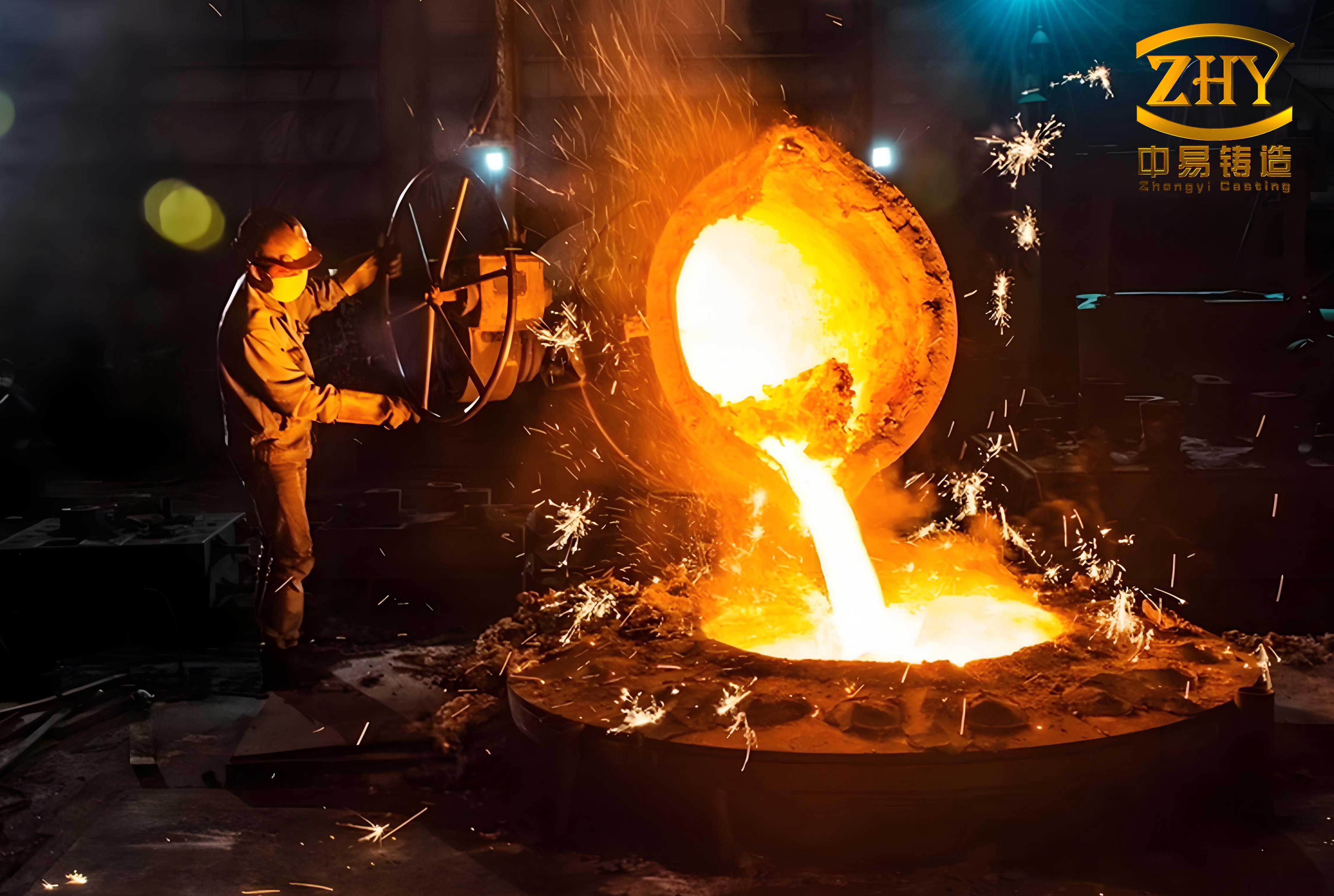
To quantify our improvements, we systematically compared metal mold and sand casting for high manganese steel casting. The table below summarizes internal quality metrics, including grain size and defect rates, highlighting the superiority of metal molds.
| Quality Parameter | Sand Casting | Metal Mold Casting |
|---|---|---|
| Grain Size (ASTM Number) | 3-4 | 5-6 |
| Porosity Incidence (%) | 5-10 | 1-2 |
| Dimensional Accuracy (mm) | ±2.0 | ±0.5 |
| Surface Roughness (Ra, μm) | 12.5 | 6.3 |
These gains are crucial for high manganese steel casting, where wear resistance depends on fine austenitic structures. The Hall-Petch relationship reinforces this: $$ \sigma_y = \sigma_0 + \frac{k_y}{\sqrt{d}} $$ where \( \sigma_y \) is yield strength, \( \sigma_0 \) is friction stress, \( k_y \) is a constant, and \( d \) is grain diameter. Finer grains from metal molds boost strength, extending component life in abrasive environments.
Our metal mold design evolved through trial and error. Initially, clamping with iron braces caused mold separation, leading to thickened castings. We iterated through various clamps—high manganese steel bow clamps and trapezoidal thread clamps—before settling on medium-sized trapezoidal thread clamps that balanced ease of use and sealing force. The clamping force \( F \) required can be estimated as: $$ F = P \times A $$ where \( P \) is the molten metal pressure and \( A \) is the projected area. For high manganese steel casting, with density \( \rho \approx 7.8 \, \text{g/cm}^3 \) and pouring height \( h \), pressure is \( P = \rho g h \). Optimizing this prevented defects like flashing and ensured consistent dimensions.
Casting parameters were rigorously controlled. We used a 5-ton electric furnace and 3-ton ladles for high manganese steel casting, with pouring temperature maintained at 1380–1420°C. Lower temperatures risked misruns, while higher ones promoted cracking and mold erosion. Pouring speed followed a “fast-then-slow” pattern to fill molds uniformly. After pouring, clamps were loosened within 30–60 seconds to relieve stress, and molds were dismantled in 0.5–2 minutes to minimize thermal stress cracking. These steps are vital for high manganese steel casting, given its high linear shrinkage of 2.5–3.0%, which we expressed as: $$ \text{Shrinkage} = \frac{L_{\text{mold}} – L_{\text{casting}}}{L_{\text{mold}}} \times 100\% $$ where \( L \) denotes length. To manage this, we modified part designs—for example, increasing fillet radii and flattening non-critical sections to reduce mechanical restraint. Product standardization further streamlined production; similar components like trapezoidal liners were grouped with unified dimensions, adjustable via core box changes.
Defect analysis revealed that cracking accounted for 60% of scrap in high manganese steel casting. Causes included mechanical hindrance and thermal gradients. Solutions involved design tweaks, use of sand cores in restrictive areas, and strategic gating. Porosity, at 20% incidence, was mitigated by ensuring vent channels were clear. Misruns, at 15%, resulted from low pouring temperatures or speeds. Other defects like mold lift were avoidable with proper clamping. The table below breaks down defect rates and corrective actions.
| Defect Type | Incidence Rate (%) | Primary Cause | Solution |
|---|---|---|---|
| Cracking | 60 | High shrinkage stress | Design modifications, rapid mold removal |
| Porosity | 20 | Blocked vents | Improve venting design |
| Misrun | 15 | Low temperature/speed | Optimize pouring parameters |
| Other (e.g., lift) | 5 | Human error | Standardize procedures |
The economic impact of adopting metal molds for high manganese steel casting was substantial. Productivity jumped from 0.5 tons per worker daily with sand casting to 2.0 tons with metal molds. Yield rates improved from 60% to 85%, notably for hammer heads in crushers, where we eliminated large risers and cast multiple pieces per gating system. Material savings were significant: per ton of high manganese steel casting, we saved 1.5 tons of natural sand, 50 kg of water glass, 10 kg of charcoal, and 5 kg of nails, cutting costs by approximately 120 currency units per ton. The formula for cost reduction \( \Delta C \) is: $$ \Delta C = \sum (S_i \times P_i) + \Delta L \times W $$ where \( S_i \) is saved material quantity, \( P_i \) is price, \( \Delta L \) is labor efficiency gain, and \( W \) is wage rate. These savings, coupled with reduced transportation, made high manganese steel casting more sustainable.
Service life comparisons demonstrated the durability of metal mold-cast high manganese steel components. In field tests, hammer heads produced via metal molds lasted 150 days versus 90 days for sand-cast ones, crushing 50,000 tons of material compared to 30,000 tons. Similarly, liner plates in ball mills showed less wear: metal mold plates lost 8.5 kg over two years versus 15.0 kg for sand-cast plates, while processing 200,000 tons of cement clinker. The wear resistance can be modeled using Archard’s equation: $$ V = K \frac{W \cdot L}{H} $$ where \( V \) is wear volume, \( K \) is a wear coefficient, \( W \) is load, \( L \) is sliding distance, and \( H \) is hardness. Finer grains from metal molds increase hardness \( H \), reducing wear \( V \). This validates the technical superiority of high manganese steel casting with metal molds.
Looking ahead, we aim to expand high manganese steel casting to smaller-batch products and carbon steel components, leveraging our metal mold expertise. Mechanization of clamping and quenching processes is planned to reduce labor and enable direct heat treatment, saving energy. For carbon steel, preliminary trials on hollow shafts have succeeded, and we intend to scale up to large parts like 10-ton hoppers. The generalized cooling curve for high manganese steel casting in metal molds can be described as: $$ T(t) = T_{\text{pour}} \cdot e^{-\alpha t} + T_{\text{env}} (1 – e^{-\alpha t}) $$ where \( \alpha \) is a heat transfer coefficient dependent on mold material and geometry. By optimizing \( \alpha \) through mold design, we can enhance properties across steel grades.
In conclusion, the integration of innovative cores and metal mold technology has revolutionized our high manganese steel casting capabilities. Through continuous实践 and refinement, we have achieved higher quality, efficiency, and cost-effectiveness. The “July 1” core and metal mold processes exemplify how simplicity and precision can coexist in foundry work, paving the way for broader industrial adoption. As we advance, we remain committed to pushing the boundaries of high manganese steel casting, ensuring robust and economical solutions for demanding applications.