
In my extensive work within the foundry industry, I have focused on the development and optimization of large high manganese steel castings, which are critical components in heavy-duty applications such as mining and dredging equipment. The high manganese steel casting exhibits exceptional wear resistance and toughness due to its unique ability to work-harden under impact, making it ideal for harsh environments. However, producing large-scale high manganese steel castings presents significant challenges, particularly in avoiding defects like shrinkage porosity and ensuring consistent mechanical properties. This article details my firsthand research and implementation of a comprehensive process for manufacturing a large high manganese steel casting, specifically a bucket used in underwater operations, emphasizing compositional adjustments, process design, and rigorous testing.
The foundation of successful high manganese steel casting production lies in a meticulous casting process. For a component weighing approximately 3200 kg with an average wall thickness of 35 mm and maximum sections up to 100 mm, controlling solidification is paramount. I designed a casting scheme that strategically placed four insulating and easily removable risers at the thickest sections. This was complemented by the use of external chills in localized areas to promote directional solidification and enhance feeding. The primary goal was to achieve a dense, sound casting free from shrinkage cavities and hot tears, which are common pitfalls in large high manganese steel castings. The solidification sequence can be modeled using Chvorinov’s rule, where the solidification time \( t \) is proportional to the square of the volume-to-surface area ratio:
$$ t = k \left( \frac{V}{A} \right)^2 $$
Here, \( k \) is the mold constant, \( V \) is the volume, and \( A \) is the surface area. By optimizing riser placement and chill usage, I aimed to minimize \( t \) variations, ensuring uniform cooling and reducing defect formation in the high manganese steel casting.
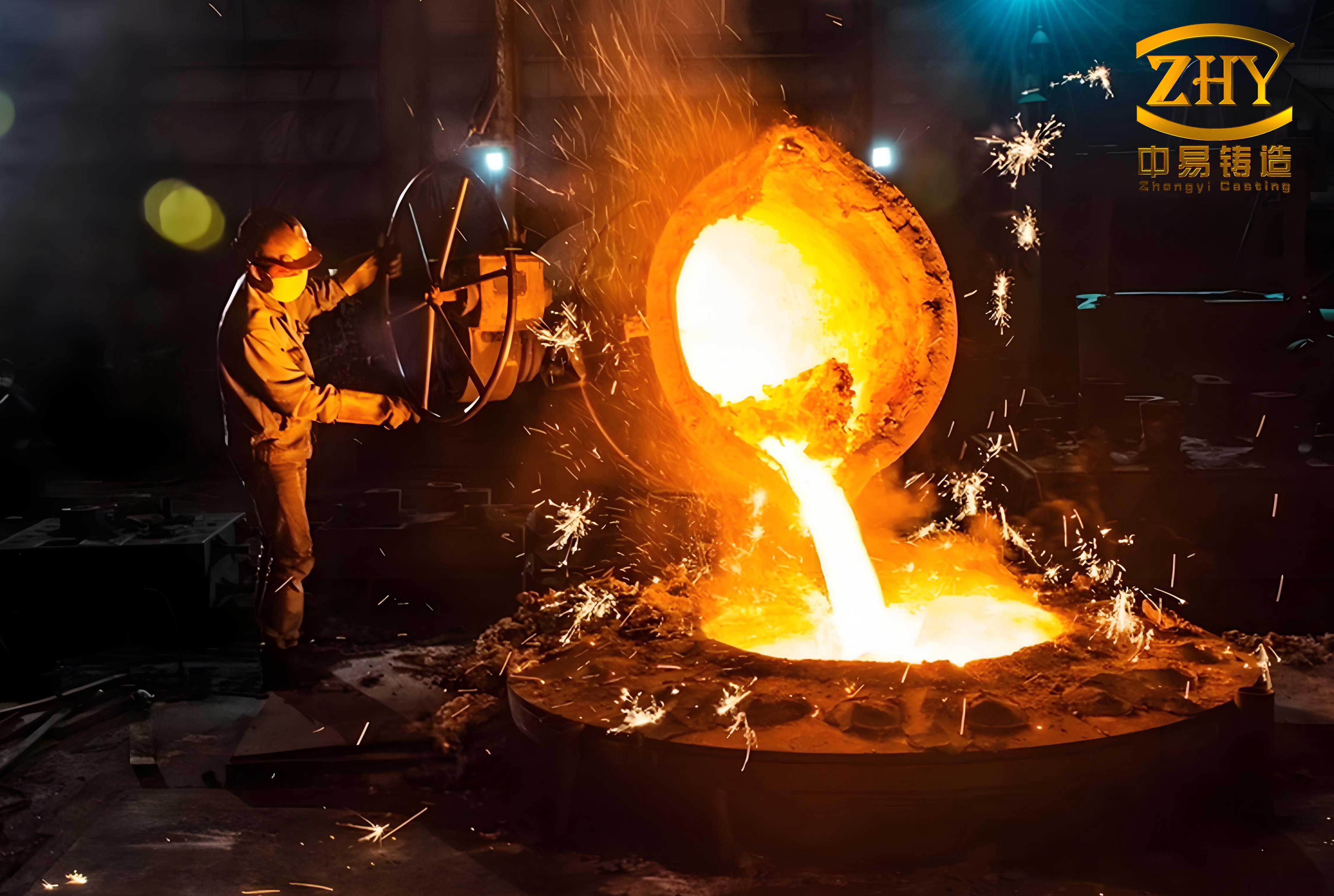
Following casting, the heat treatment of high manganese steel casting is crucial to dissolve harmful carbides and achieve a fully austenitic microstructure. As-cast high manganese steel contains network carbides along grain boundaries, which embrittle the material. I implemented a solution treatment process where the casting was heated to the austenitizing temperature range of 1050–1100°C. The holding time at this temperature is critical for carbide dissolution and homogenization, which can be described by the diffusion-controlled kinetics using Fick’s second law:
$$ \frac{\partial C}{\partial t} = D \frac{\partial^2 C}{\partial x^2} $$
Where \( C \) is the carbon concentration, \( t \) is time, \( D \) is the diffusion coefficient, and \( x \) is distance. To prevent carbide reprecipitation, the high manganese steel casting was rapidly quenched in water, maintaining an entry temperature above 1000°C and water temperature below 50°C. This process ensures a single-phase austenite structure, granting the high manganese steel casting its renowned toughness and work-hardening capability.
Initial trials of the high manganese steel casting revealed suboptimal mechanical properties, with low elongation and impact resistance. Microstructural analysis showed residual carbides within grains and at boundaries. I traced this to the chemical composition, particularly the levels of chromium (Cr) and molybdenum (Mo). These elements are carbide formers, and their excessive presence can stabilize carbides even after solution treatment. To understand this, consider the thermodynamic stability of carbides, often expressed using activity coefficients. The effect of alloying elements on carbide solubility can be approximated by:
$$ \log K = \frac{- \Delta G^\circ}{RT} $$
Where \( K \) is the equilibrium constant, \( \Delta G^\circ \) is the standard Gibbs free energy change, \( R \) is the gas constant, and \( T \) is temperature. By adjusting Cr and Mo content, I aimed to shift the equilibrium toward carbide dissolution. The original and modified compositions are summarized in the table below, highlighting the targeted reduction in Cr and optimization of Mo.
| Element | Original Specification (wt.%) | Adjusted Specification (wt.%) |
|---|---|---|
| C | 0.90–1.30 | 0.90–1.30 |
| Si | ≤0.08 | ≤0.08 |
| Mn | 11.0–14.0 | 11.0–14.0 |
| P | ≤0.07 | ≤0.06 |
| S | ≤0.04 | ≤0.03 |
| Cr | 1.50–2.50 | 0.50–1.00 |
| Mo | Not specified | 0.90–1.20 |
The adjustment was based on metallurgical principles: reducing Cr decreases the driving force for carbide formation, thereby improving ductility, while adding Mo in controlled amounts enhances grain refinement and dispersion strengthening without promoting excessive carbide precipitation. This refinement can be quantified using the Hall-Petch relationship for yield strength:
$$ \sigma_y = \sigma_0 + k_y d^{-1/2} $$
Where \( \sigma_y \) is yield strength, \( \sigma_0 \) is a material constant, \( k_y \) is the strengthening coefficient, and \( d \) is the grain diameter. By optimizing composition, I achieved a finer austenite grain structure in the high manganese steel casting, leading to better mechanical performance. The table below compares mechanical properties from single-cast test bars before and after compositional adjustment, demonstrating significant improvements.
| Sample | Tensile Strength, \( \sigma_b \) (MPa) | Yield Strength, \( \sigma_s \) (MPa) | Elongation, \( \delta \) (%) | Reduction of Area, \( \phi \) (%) | Hardness (HB) |
|---|---|---|---|---|---|
| Before Adjustment 1 | 741 | 499 | 25 | 26 | 212 |
| Before Adjustment 2 | 762 | 503 | 28 | 30 | 223 |
| After Adjustment 1 | 872 | 422 | 45 | 38 | 212 |
| After Adjustment 2 | 888 | 450 | 43 | 40 | 217 |
To validate the integrity of the actual high manganese steel casting, I conducted comprehensive non-destructive and destructive testing. Non-destructive evaluation included penetrant testing on the cleaned and shot-blasted surface, which revealed no surface defects such as cracks or linear indications. This confirmed the effectiveness of the casting process in producing a sound high manganese steel casting. For destructive analysis, sections were cut from critical areas like the front and rear eye positions. Bending test specimens were extracted, with dimensions of 25 mm thickness, and tested using a bend die diameter of 62.5 mm. The bending strain \( \epsilon \) can be calculated as:
$$ \epsilon = \frac{t}{2R + t} $$
Where \( t \) is specimen thickness and \( R \) is bend radius. The specimens endured up to 28% deformation on the tension side without crack initiation, demonstrating exceptional ductility. Microstructural samples from these bent specimens showed a fully austenitic matrix with negligible carbides, aligning with the single-cast test results and proving the homogeneity of the high manganese steel casting.
The success of this high manganese steel casting project underscores the importance of an integrated approach combining process design, heat treatment, and compositional control. By refining the chemical makeup, I mitigated carbide-related brittleness while preserving wear resistance. The adjusted high manganese steel casting exhibited a balanced property profile, with tensile strength exceeding 870 MPa and elongation over 40%, which are remarkable for large-scale components. Furthermore, the implementation of optimized risering and chilling eliminated shrinkage defects, ensuring structural reliability. Field reports indicated that the service life of this high manganese steel casting doubled compared to conventional counterparts, validating the research outcomes. This experience highlights that for large high manganese steel castings, a synergy between alloy design and process engineering is essential to achieve superior performance in demanding applications.
In conclusion, my research on large high manganese steel castings has demonstrated that targeted compositional adjustments, particularly in Cr and Mo levels, coupled with robust casting and heat treatment protocols, can significantly enhance mechanical properties and defect resistance. The high manganese steel casting produced through this methodology meets rigorous standards for toughness and durability, making it suitable for extreme operational environments. Future work may explore computational modeling to predict solidification patterns or advanced alloying strategies for further improvement. Nonetheless, this study provides a proven framework for manufacturing high-quality high manganese steel castings that deliver longevity and reliability in industrial service.