
The evolution of domestic machine tool manufacturing from rapid expansion to high-quality development marks a critical transition. As the industry advances from relatively mature three-axis machines to sophisticated five-axis machining centers and gantry-type centers, persistent challenges emerge, including subpar machining accuracy and poor long-term precision retention. A significant bottleneck remains the continued heavy reliance on imported, high-end machine tool components. The casting part, serving as the foundational bedrock of any machine tool, is central to this issue. Conventionally produced casting parts have long been plagued by high residual stresses, low elastic modulus, susceptibility to deformation, and poor stability. These shortcomings represent major pain points for downstream customers and significant technical hurdles within the foundry sector. This article details a comprehensive research and development initiative focused on systematically overcoming these limitations to produce a new generation of superior casting parts.
For an extended period, the prevailing methodology for machine tool casting parts involved employing low carbon equivalent (CE) compositions to achieve high strength. This approach, however, induces significant shrinkage and a pronounced tendency towards chill formation (white iron). The consequences extend beyond the core issues of high stress and low stiffness, often manifesting as internal shrinkage porosity, cavities, poor hardness uniformity, and in severe cases, casting cracks leading to scrap. The traditional process thus presents a multi-faceted problem set that compromises the performance and reliability of the final machine tool.
Research Methodology and Process Control
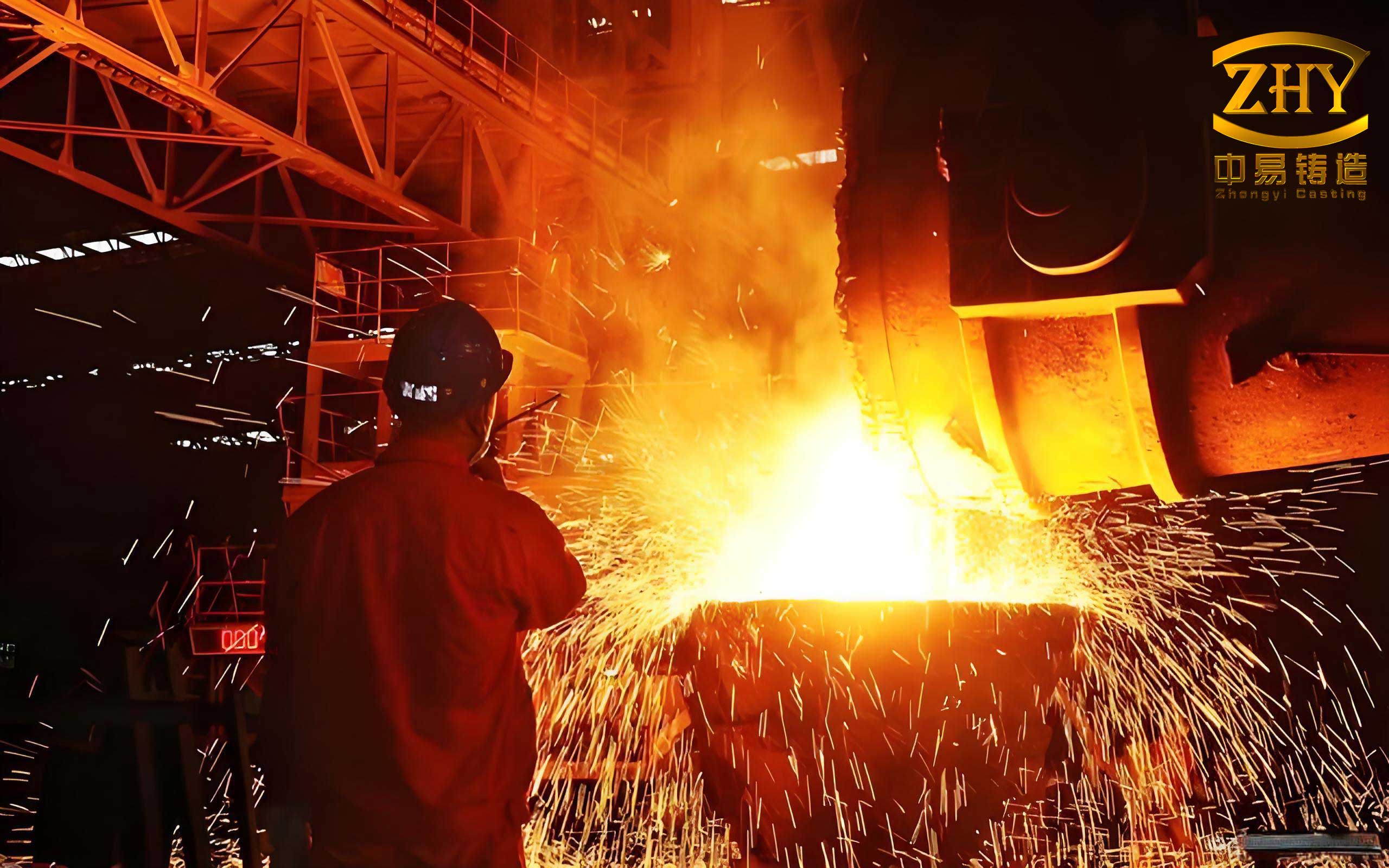
Our production is specialized for machine tool casting parts. The molding and core-making processes utilize resin sand technology. Melting is conducted in a 6-ton medium-frequency induction furnace system, capable of producing casting parts weighing up to 20 tons. The foundry is equipped with advanced analytical instruments including direct-reading spectrometers, nitrogen/oxygen analyzers, and thermal analysis devices, enabling precise chemical composition control. Casting process simulation is performed using AnyCasting software for optimization. Residual stress measurement is carried out using a blind-hole drilling strain gage method.
Chemical Composition Strategy
The melting process adopts a synthetic iron approach, with a charge predominantly consisting of steel scrap. High-quality recarburizers and silicon carbide (SiC) are used for carburizing and silicon addition. Nitrogen is introduced via manganese-nitride ferroalloy. The molten metal is superheated to 1500–1530°C, held at temperature for a period to homogenize, and then tapped for pouring. The research centered on several key interconnected parameters: high carbon equivalent, high silicon-to-carbon ratio (Si/C), micro-alloying, and enhanced inoculation.
- CE and Si/C Control: The carbon equivalent is targeted above 3.8%, specifically within the range of 3.8%–3.85%. Concurrently, the Si/C ratio is tightly controlled between 0.69 and 0.74.
- Alloying Element Selection: A combination of elements including Manganese (Mn), Chromium (Cr), Tin (Sn), Copper (Cu), and Nitrogen (N) is used for strengthening and matrix stabilization.
- Process Control: This encompasses strict regulation of melting and pouring temperatures, high-temperature holding of the molten metal, preconditioning of the melt, employing multiple-stage inoculation practices, and rigorous control over pouring parameters.
- Microstructure Targets: The goal is to achieve a microstructure comprising over 90% Type A graphite, ensuring favorable graphite size and distribution, and a pearlite content exceeding 98%.
The target chemical composition required by our international clients and our internal production control ranges are summarized in Table 1 and Table 2, respectively. This highlights the shift towards higher CE and controlled alloying.
| Grade | CE | C | Si | Mn | P | S | Cu | Cr |
|---|---|---|---|---|---|---|---|---|
| HT300 | 3.8 | 3.0-3.25 | 1.8-2.0 | 0.8-1.2 | <0.12 | <0.12 | 0.4-0.6 | 0.2-0.4 |
| Grade | C | Si | Mn | P | S | Cr | N | Sn |
|---|---|---|---|---|---|---|---|---|
| HT300 | 3.1-3.15 | 2.0-2.2 | 0.7-1.0 | <0.1 | <0.1 | 0.1-0.3 | 0.0075-0.0095 | trace |
Experimental Results and Analysis
The implemented strategy successfully produced casting parts meeting the target specifications: tensile strength ≥ 300 MPa, hardness 200–240 HBW, elastic modulus 120–135 GPa, and as-cast residual stress ≤ 50 MPa. Over 400 heats were trials conducted, validating the feasibility of high-CE, high-Si/C gray iron for medium-to-large machine tool casting parts. The following sections present and analyze the collected data on chemical composition, mechanical properties, metallurgical quality indices, machinability, and residual stress.
Chemical Composition and Mechanical Properties
A summary of key results from 31 representative heats is presented in Table 3. The data confirms the consistent achievement of the target CE (~3.82) and Si/C ratio (~0.69). The tensile strength averages 334 MPa, well above the HT300 threshold, with a concurrent average hardness of 235 HBW. Measured elastic modulus values are in the high range of 120-135 GPa, indicating high stiffness for the casting part.
| Heat No. | CE (%) | Si/C | C (%) | Si (%) | Mn (%) | Sn (%) | Cr (%) | N (%) | Tensile (MPa) | Hardness (HBW) | E (GPa) |
|---|---|---|---|---|---|---|---|---|---|---|---|
| 1 | 3.81 | 0.68 | 3.10 | 2.12 | 0.894 | 0.017 | 0.072 | 0.0092 | 330 | 232 | – |
| 2 | 3.82 | 0.67 | 3.12 | 2.10 | 0.923 | 0.016 | 0.222 | 0.0090 | 340 | 237 | 132 |
| 3 | 3.84 | 0.67 | 3.14 | 2.09 | 0.970 | 0.015 | 0.221 | 0.0096 | 334 | 241 | 120 |
| 4 | 3.82 | 0.71 | 3.09 | 2.19 | 0.723 | 0.074 | 0.221 | 0.0094 | 345 | 239 | 129 |
| … | … | … | … | … | … | … | … | … | … | … | … |
| 31 | 3.79 | 0.68 | 3.09 | 2.10 | 1.025 | 0.013 | 0.186 | 0.0083 | 343 | 230 | – |
| Avg. | 3.82 | 0.69 | 3.10 | 2.15 | 0.811 | 0.040 | 0.168 | 0.0084 | 334 | 235 | ~130 |
Metallurgical Quality Indices
The quality of the casting part can be further assessed using established metallurgical indices. Table 4 presents calculations for key parameters including eutectic saturation (Sc), relative strength (maturity, RG), relative hardness (hardening degree, HG), and quality factor (Qi). These are calculated as follows:
Carbon Equivalent: $$CE = \%C + \frac{\%Si}{3} + \frac{\%P}{3}$$
Eutectic Saturation: $$S_c = \frac{\%C}{4.26 – \frac{\%Si + \%P}{2}}$$
Maturity (Relative Strength): $$R_G = \frac{\sigma_b}{1000 – 800 \times S_c}$$
Where $\sigma_b$ is the tensile strength in MPa.
Hardening Degree (Relative Hardness): $$H_G = \frac{HBW}{530 – 344 \times S_c}$$
Quality Factor: $$Q_i = R_G \times H_G$$
The data in Table 4 shows an average maturity (RG) of 1.12, indicating the achieved strength is approximately 12% higher than the theoretical strength for the given composition. The average hardening degree (HG) is 0.85. Crucially, the quality factor (Qi) averages 1.32, consistently exceeding 1.0. A Qi > 1 signifies an excellent combination of strength and hardness relative to the iron’s composition, reflecting high metallurgical quality and efficient use of carbon and silicon in the casting part.
| Heat No. | CE (%) | Si/C | Tensile (MPa) | Hardness (HBW) | Sc | RG | HG | Qi |
|---|---|---|---|---|---|---|---|---|
| 1 | 3.81 | 0.68 | 330 | 232 | 0.87 | 1.10 | 0.83 | 1.32 |
| 2 | 3.82 | 0.67 | 340 | 237 | 0.88 | 1.15 | 0.86 | 1.33 |
| 3 | 3.84 | 0.67 | 334 | 241 | 0.88 | 1.14 | 0.89 | 1.29 |
| 4 | 3.82 | 0.71 | 345 | 239 | 0.88 | 1.16 | 0.86 | 1.34 |
| … | … | … | … | … | … | … | … | … |
| 31 | 3.79 | 0.68 | 343 | 230 | 0.87 | 1.13 | 0.82 | 1.39 |
| Avg. | 3.82 | 0.69 | 334 | 235 | 0.88 | 1.12 | 0.85 | 1.32 |
Machinability Parameter (m-value)
A critical performance indicator for a machine tool casting part is its machinability, often related to the ratio of tensile strength to hardness. A higher ratio (m-value) generally indicates better machinability, as it suggests higher strength per unit hardness. Table 5 presents the m-value calculated for each heat: $$m = \frac{Tensile\ Strength\ (MPa)}{Hardness\ (HBW)}$$
The average m-value achieved is 1.42, with a relatively narrow range. This favorable and consistent ratio is a direct result of the optimized microstructure—predominantly Type A graphite in a fine pearlitic matrix—enabled by the high-CE, high-Si/C, micro-alloyed composition. This confirms the improved machinability of the new generation casting part compared to traditional low-CE, high-hardness variants.
| Heat No. | CE (%) | Si/C | Tensile (MPa) | Hardness (HBW) | m-value |
|---|---|---|---|---|---|
| 1 | 3.81 | 0.68 | 330 | 232 | 1.42 |
| 2 | 3.82 | 0.67 | 340 | 237 | 1.43 |
| 3 | 3.84 | 0.67 | 334 | 241 | 1.39 |
| … | … | … | … | … | … |
| 31 | 3.79 | 0.68 | 343 | 230 | 1.49 |
| Avg. | 3.82 | 0.69 | 334 | 235 | 1.42 |
Microstructural Analysis
Metallographic examination of samples taken from separately cast test bars, attached test bars, and the actual guideway body of the HT300 casting part consistently revealed the targeted microstructure. The graphite morphology was predominantly Type A (exceeding 95%), with a size rating of 4 to 5. The matrix consisted of over 98% fine pearlite. This uniform and desirable microstructure across different sections of the casting part is fundamental to achieving the high stiffness, good strength, low stress, and excellent machinability.
Production Validation and Performance
The new production technology has been successfully implemented for the serial production of over two thousand tons of machine tool casting parts supplied to domestic and international customers. The weight of individual casting parts produced ranges from 2.2 to 20 tons, covering various structural configurations for beds, columns, and saddles.
The performance of these production casting parts has been rigorously verified. Hardness uniformity, a critical metric for consistent machining behavior and wear resistance, was measured across the guideways of different casting part geometries. Results consistently showed minimal variation, typically within a 15-20 HBW range across complex sections, thin walls, and thick sections, eliminating the traditional problem of hard spots and soft areas.
Residual stress measurements on the as-cast casting parts, prior to any stress-relief annealing, confirmed the success of the low-stress design. Measured stresses were consistently below 50 MPa, with a more uniform distribution, significantly reducing the risk of distortion during machining and in service. This represents a major advancement over the high and uneven residual stresses characteristic of the old low-CE工艺。
Conclusions
Based on the extensive data from over 400 production heats, the high carbon equivalent, high silicon-to-carbon ratio, and micro-alloyed gray iron process has proven to be a robust and reliable method for producing HT300 and higher-grade casting parts for machine tools. The analysis confirms several distinct advantages of this approach for the final casting part:
- Enhanced Castability: The higher CE significantly improves the fluidity of the molten iron. This allows for a lower pouring temperature after the necessary high-temperature holding period, reducing the total heat input into the sand mold and consequently lowering the potential for casting stresses.
- Reduced and Uniform Residual Stress: The combination of improved feeding characteristics (reduced shrinkage tendency) and lower thermal gradients results in casting parts with significantly lower and more uniformly distributed as-cast residual stresses. This directly translates to reduced distortion and a lower risk of cracking for the casting part.
- Superior Hardness Uniformity: The controlled solidification and minimized chilling tendency ensure consistent hardness throughout the casting part, even across significant variations in section thickness. This is paramount for the machining and long-term performance of precision machine tool components.
- Stable and Favorable Graphite Morphology: The process reliably produces a high percentage of Type A graphite, which is optimal for damping capacity, thermal conductivity, and machinability. The graphite distribution is more uniform within the casting part.
- Improved Machinability: The near-elimination of chill (carbides) at thin sections and the favorable strength-to-hardness ratio (m-value ~1.42) directly enhance the machinability of the casting part, reducing tool wear and improving surface finish.
In summary, the shift from traditional low-carbon equivalent philosophies to a high-CE, high-Si/C, and micro-alloyed strategy represents a paradigm shift in producing high-performance machine tool casting parts. It successfully addresses the core triad of requirements: high stiffness (via high elastic modulus and strength), low stress, and excellent uniformity, thereby enabling the production of more stable, precise, and reliable machine tools.