
The development of high-performance wear parts is a critical challenge in heavy industrial sectors like mining. Bucket teeth, subjected to extreme abrasive wear and high-impact loads during excavation, represent one such component. Their failure leads to significant operational downtime and replacement costs. To address this, a robust material and a precisely controlled manufacturing process are essential. High manganese steel casting is the material of choice due to its renowned work-hardening capability and excellent toughness. However, the final properties of a high manganese steel casting are profoundly sensitive to its chemical composition and the foundry process parameters. This article details the systematic application of the orthogonal design method to optimize the production process for bucket teeth made from high manganese steel casting, leading to a significant enhancement in product quality and manufacturing economics.
The primary challenge was to transition from purchasing these consumable parts to establishing a reliable in-house production capability. The goal was not merely replication but optimization—to produce a high manganese steel casting that consistently met the stringent requirements for surface integrity, resistance to hot tearing, and stability during heat treatment, ultimately ensuring superior service life in the field.
System Design and Process Definition
The first phase involved a comprehensive system design, mapping the entire production journey for the high manganese steel casting bucket tooth. Every step, from pattern making to the final heat treatment, was scrutinized. The core process flow was established as follows:
- Pattern Design & Manufacturing
- Mold and Core Preparation
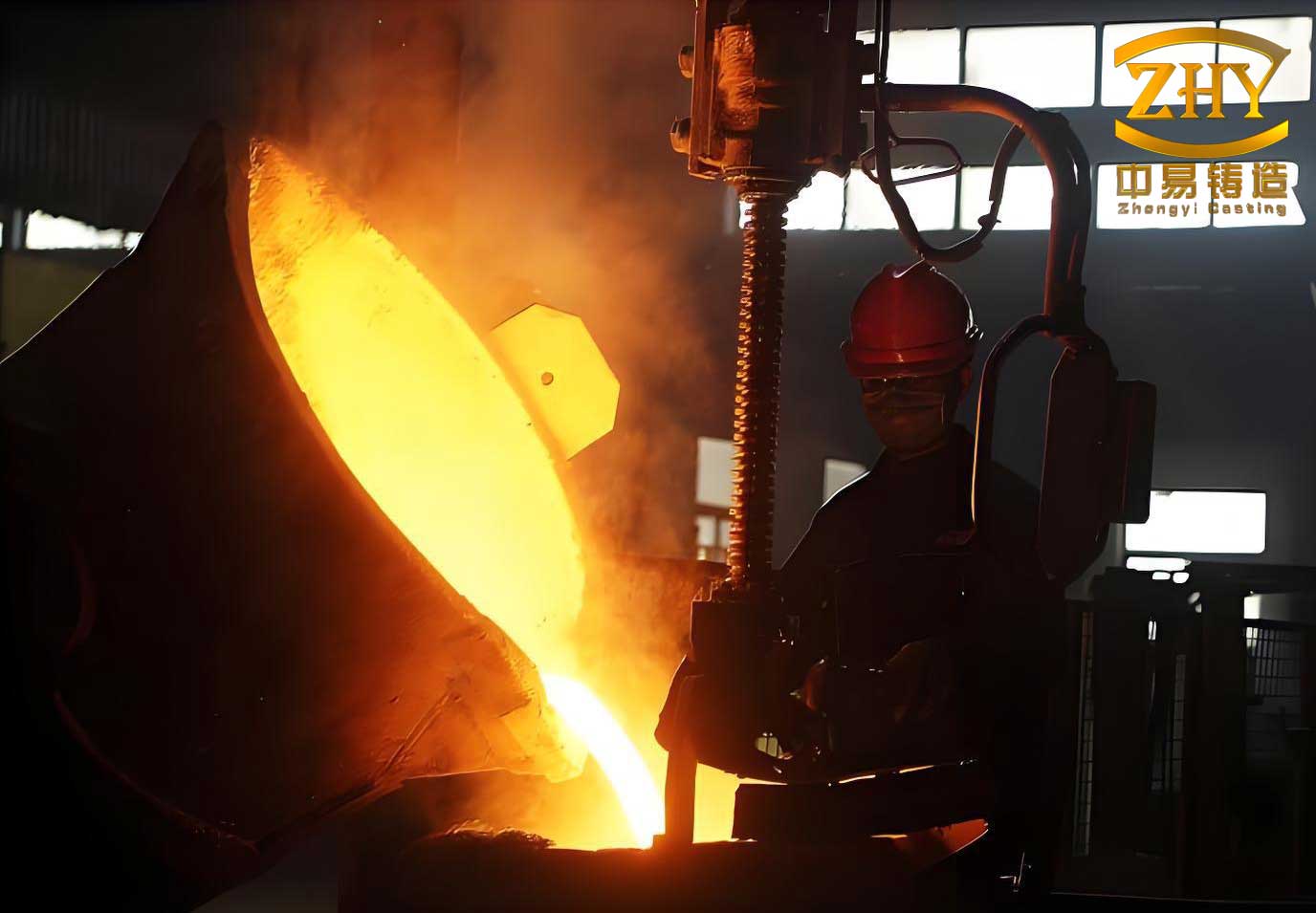
- Melting and Alloying in Medium-Frequency Induction Furnace
- Pouring and Solidification
- Shakeout and Cleaning
- Heat Treatment (Water Quenching / Solution Treatment)
- Final Inspection and Quality Control
Through preliminary analysis and prior experience with similar high manganese steel casting components like mill liners, four key controllable factors were identified as having the most significant influence on the final casting quality: Molding Method, Carbon (C) Content, Silicon (Si) Content, and Manganese (Mn) Content. Each factor was assigned three potential levels or parameters for investigation.
| Factor | Symbol | Level 1 | Level 2 | Level 3 |
|---|---|---|---|---|
| Molding Method | A | Green Sand (Clay-bonded) | Sodium Silicate (CO₂) Sand | Composite Mold (Green Sand lower part / Sodium Silicate Sand upper part) |
| Carbon Content (wt.%) | B | 0.95 | 1.15 | 1.25 |
| Silicon Content (wt.%) | C | 0.40 | 0.45 | 0.60 |
| Manganese Content (wt.%) | D | 11.0 | 13.0 | 14.0 |
Orthogonal Experimental Design and Methodology
A full factorial experiment testing all possible combinations of these factors and levels would require $3^4 = 81$ separate trials, which is prohibitively time-consuming and costly. The orthogonal design method provides a powerful statistical tool to evaluate the main effects of each factor with a drastically reduced number of experiments. For this four-factor, three-level study, an $L_9(3^4)$ orthogonal array was selected, requiring only 9 strategically designed trials.
To quantitatively evaluate the outcome of each trial, a scoring system was established based on three critical quality metrics observed during production and post-heat treatment:
| Quality Attribute | Rating (Score) | Qualitative Description |
|---|---|---|
| Surface Finish (Qs) | 10 | Smooth, clean surface |
| 5 | Acceptable, minor surface imperfections | |
| 0 | Poor, excessive burns or sand adhesion | |
| Hot Tear Tendency (Qh) | 10 | No visible hot tears or cracks |
| 5 | Minor, acceptable micro-cracks | |
| 0 | Major cracking present | |
| Post-Quench Integrity (Qq) | 10 | No cracking after water quenching |
| 5 | Minor subsurface checking | |
| 0 | Severe cracking or disintegration |
The Total Composite Score (S) for each trial is calculated as:
$$ S = Q_s + Q_h + Q_q $$
A higher score indicates superior overall quality of the high manganese steel casting.
Experiment Execution and Data Analysis
The nine trials were conducted according to the $L_9$ array, and the resulting castings were evaluated. The experimental layout and results are summarized below.
| Trial No. | A: Molding | B: %C | C: %Si | D: %Mn | Qs | Qh | Total Score (S) | |
|---|---|---|---|---|---|---|---|---|
| 1 | 1 | 1 | 1 | 1 | 8 | 10 | 6 | 24 |
| 2 | 1 | 2 | 2 | 2 | 5 | 7 | 8 | 20 |
| 3 | 1 | 3 | 3 | 3 | 7 | 6 | 9 | 22 |
| 4 | 2 | 1 | 2 | 3 | 9 | 8 | 5 | 22 |
| 5 | 2 | 2 | 3 | 1 | 6 | 6 | 8 | 20 |
| 6 | 2 | 3 | 1 | 2 | 8 | 7 | 7 | 22 |
| 7 | 3 | 1 | 3 | 2 | 10 | 8 | 6 | 24 |
| 8 | 3 | 2 | 1 | 3 | 9 | 8 | 7 | 24 |
| 9 | 3 | 3 | 2 | 1 | 6 | 9 | 5 | 20 |
1. Intuitive Analysis: Examining the total scores, Trial 7 achieved the highest score of 24. The parameter combination for this trial was A3, B1, C3, D2 (Composite Mold, 0.95% C, 0.60% Si, 13.0% Mn). This provides a preliminary optimal combination from the conducted trials.
2. Calculation-Based Optimization: A more robust analysis involves calculating the average score (mean effect) for each factor at each level, and then determining the range (R) for each factor. The range indicates the factor’s influence on the result; a larger R signifies a greater impact.
First, the sum of scores for each level of every factor is calculated (K1, K2, K3). For Factor A (Molding):
$$ K_{A1} = S_1 + S_2 + S_3 = 24 + 20 + 22 = 66 $$
$$ K_{A2} = S_4 + S_5 + S_6 = 22 + 20 + 22 = 64 $$
$$ K_{A3} = S_7 + S_8 + S_9 = 24 + 24 + 20 = 68 $$
The mean effects (k) are: $k_{A1} = 66/3 = 22.0$, $k_{A2} = 64/3 \approx 21.3$, $k_{A3} = 68/3 \approx 22.7$.
The range R for Factor A is: $R_A = \max(k_{A1}, k_{A2}, k_{A3}) – \min(k_{A1}, k_{A2}, k_{A3}) = 22.7 – 21.3 = 1.4$.
This process is repeated for all factors. The results are compiled below.
| Factor | Mean Effect: Level 1 (k1) | Mean Effect: Level 2 (k2) | Mean Effect: Level 3 (k3) | Range (R) | Optimal Level |
|---|---|---|---|---|---|
| A: Molding | 22.0 | 21.3 | 22.7 | 1.4 | A3 |
| B: %C | 23.3 | 21.3 | 21.3 | 2.0 | B1 |
| C: %Si | 23.3 | 20.7 | 22.0 | 2.6 | C1 |
| D: %Mn | 21.3 | 22.0 | 22.7 | 1.4 | D3 |
The analysis reveals:
- Molding Method (A): The composite mold (A3) yields the best average result. Practically, using green sand for the lower, more complex part of the tooth and sodium silicate sand for the upper cope offers a good balance of dimensional accuracy, collapsibility, and cost-effectiveness compared to using a single sand system throughout.
- Carbon Content (B): The lowest level, 0.95% C (B1), shows a markedly higher mean score. Higher carbon, while increasing hardness, can promote carbide precipitation and reduce toughness, making the high manganese steel casting more prone to cracking during and after heat treatment. Operating at the lower specification limit is optimal.
- Silicon Content (C): The lowest level, 0.40% Si (C1), gives the highest score. Silicon is a ferrite strengthener but can increase the susceptibility to cracking during the water-quenching process in a high manganese steel casting. Minimizing silicon content is crucial for quench crack resistance.
- Manganese Content (D): The highest level, 14.0% Mn (D3), provides the best result. Manganese is vital for austenite stability and enhancing hardenability, ensuring a fully austenitic matrix after solution treatment, which is the foundation of the work-hardening property in a high manganese steel casting.
The calculated optimal parameter set is therefore: A3, B1, C1, D3. This combination (Composite Mold, 0.95% C, 0.40% Si, 14.0% Mn) was not explicitly part of the original nine trials.
Verification Trial and Final Process Determination
A confirmation trial was conducted using the optimized parameters derived from the orthogonal analysis (A3B1C1D3). The resulting high manganese steel casting exhibited exceptional quality, achieving a near-perfect composite score. This validation confirmed the predictive power of the orthogonal design. The final, optimized production specification for the high manganese steel casting bucket tooth was firmly established:
- Molding: Composite mold (Green Sand lower part / Sodium Silicate Sand upper part).
- Target Chemical Composition: Carbon (C) = 0.95%, Silicon (Si) = 0.40%, Manganese (Mn) = 14.0%.
- Heat Treatment: Standard solution treatment (water quenching) at 1050-1100°C, with careful control of heating and cooling rates to minimize thermal stress.
This systematic approach ensured the production of a high manganese steel casting with an optimal balance of surface quality, as-cast soundness, and heat-treatment stability.
Technical and Economic Impact
The implementation of the optimized process led to a consistent production of high-quality bucket teeth. The primary economic benefit was the elimination of external procurement, resulting in direct cost savings. A simplified cost structure for producing one ton of optimized high manganese steel casting melt is shown below:
| Cost Category | Key Components | Relative Cost Contribution |
|---|---|---|
| Raw Materials | High-C FeMn, SiMn, Steel Scrap, Foundry Returns | ~65-75% |
| Energy | Electricity for Melting & Heat Treatment | ~15-20% |
| Consumables & Labor | Molding Sand, Binders, Direct Labor | ~10-15% |
By achieving a high yield and consistent quality, the internal production cost per piece was significantly lower than the market purchase price. Scaling this to annual production volumes translated into substantial financial savings for the manufacturing unit and the end-user mining operations. Furthermore, the reliability of the supply chain was greatly enhanced.
Conclusion
The orthogonal design method proved to be an exceptionally effective tool for the development and optimization of the high manganese steel casting process for bucket teeth. It enabled a scientifically guided exploration of a multi-parameter space with minimal experimental runs, efficiently identifying the complex interactions between molding practice and chemical composition. The key outcome was the establishment of a robust, data-driven production specification: a composite molding system coupled with a lean alloy chemistry targeting lower carbon and silicon levels with high manganese. This optimized formula for the high manganese steel casting directly addressed the quality failure modes of surface defects, hot tearing, and quench cracking. The success of this project underscores the value of applying structured experimental design methodologies in foundry practice to solve complex production challenges, improve product performance, and achieve significant economic benefits in the manufacture of critical wear components like high manganese steel castings.