
In the field of industrial manufacturing, ductile iron has gained widespread adoption due to its excellent mechanical properties and cost-effectiveness, particularly in automotive, machinery, and engine applications. This material’s unique solidification characteristics, however, present challenges such as shrinkage porosity and slag inclusions, which can compromise the integrity of the final casting part. In our production line, we encountered persistent defects in a specific QT450-10 ductile iron turbine shell casting part, characterized by black spot formations on machined surfaces. This article details our first-person investigation into the root causes, primarily secondary oxidation slag inclusion, and the comprehensive improvements implemented to enhance the quality and reliability of these critical casting parts.
The turbine shell casting part under discussion is a complex component with varying wall thicknesses. The main body features a wall thickness of approximately 12 mm, while the upper and lower flanges measure about 50 mm. The overall weight of a single casting part is 500 kg. This casting part is designed for high-performance applications, requiring stringent material specifications. The material is QT450-10, with metallographic and mechanical requirements including a spheroidization grade above level 3, graphite ball size of levels 6-7, tensile strength ≥ 450 MPa, elongation ≥ 10%, and a Brinell hardness between 140-180 HBW. The matrix structure should be predominantly ferritic. Furthermore, the internal structure must be dense, passing UT inspection at level 2, and the casting part must withstand pressure tightness tests after machining without any leakage.
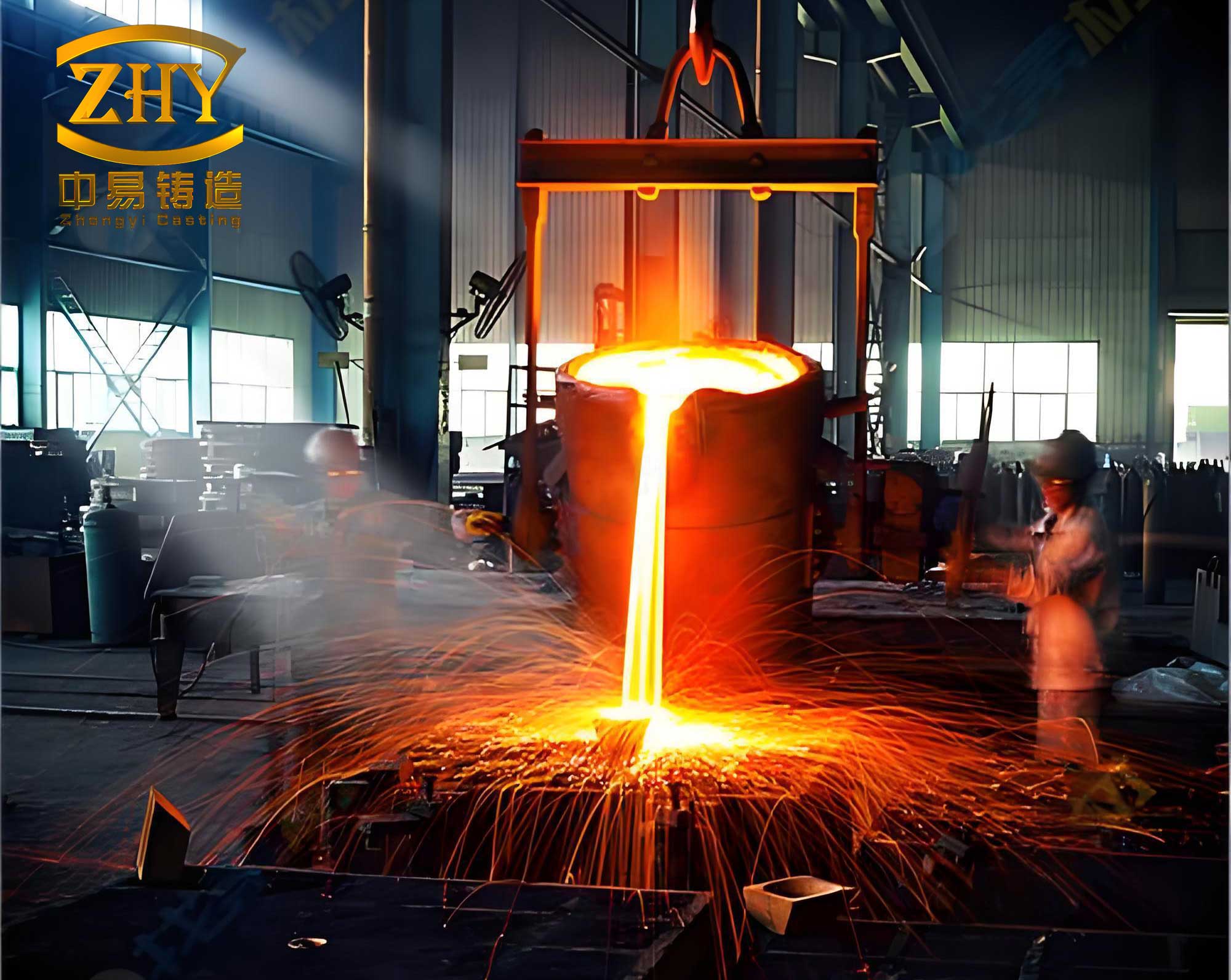
Our initial production process for this casting part utilized a furan resin sand molding method with a two-part flask system. The parting line was set at the middle of the casting part, employing a horizontal pouring technique. The gating system consisted of three ceramic pipes with a diameter of 20 mm for bottom pouring, combined with traditional ingates. To address potential shrinkage in the thick flanges, chill plates were placed on the lower flask’s flange, and four dark insulated risers (ϕ80 mm × 110 mm) were positioned on the upper flask’s flange, complemented by graphite chills. Six filters (10 PPI, dimensions 80 mm × 80 mm × 22 mm) were installed at the junctions between the runner and the six ingates to trap inclusions during mold filling.
The melting process was conducted in a 2-ton medium-frequency induction furnace. The charge composition consisted of 20% pig iron, 60% steel scrap, and 20% returns. Carbon and silicon levels were adjusted using carbon raisers and silicon carbide. The target chemical composition for the casting part is summarized in the table below.
| Element | Target Range |
|---|---|
| Carbon Equivalent (CE) | 4.5 – 4.6 |
| Carbon (C) | 3.7 – 3.8 |
| Silicon (Si) | 2.5 – 2.6 |
| Manganese (Mn) | < 0.4 |
| Phosphorus (P) | ≤ 0.03 |
| Sulfur (S) | ≤ 0.015 |
| Magnesium (Mg) | ≤ 0.05 |
The melting procedure involved heating the charge to 1500–1520 °C, holding for 3–5 minutes for homogenization, followed by slag removal and tapping. The treatment was performed using a covered ladle with a La-based nodulizer added at 1.0%. Inoculation involved 0.3% high-barium inoculant and 0.4% 75% ferrosilicon, with 0.3% 25% ferrosilicon used as a covering agent. The pouring temperature was maintained between 1370–1400 °C, with a secondary stream inoculation using sulfur-oxygen inoculant at 0.07–0.1%. The total pouring time was controlled within 20–25 seconds.
During initial sample and small-batch production, the casting part met all quality standards. However, upon scaling up to mass production, a significant issue emerged. After machining by the customer, black spot defects appeared on the back surface of the lower flange of the casting part. These defects varied in size and distribution, leading to rejection rates as high as 30% in some batches. Smaller defects were sometimes submitted for concession if no leakage was detected during pressure testing, but larger ones resulted in outright scrap, causing substantial financial loss for both our company and the customer.
To diagnose the problem, we conducted energy-dispersive X-ray spectroscopy (EDS) on samples extracted from the defective areas of the returned casting part. The analysis revealed that these black spots were not shrinkage porosity but slag inclusions. The defect interiors contained high levels of oxygen, often exceeding 50 atomic percent, along with other elements like silicon, magnesium, and surprisingly, fluorine (F). This composition pointed towards oxide-based slag formation, specifically secondary oxidation slag, rather than primary slag from the melting process. The presence of F suggested contamination from unburned residues of insulating riser sleeves, which were inadvertently recycled through returns.
The formation of secondary oxidation slag in a casting part is a complex phenomenon influenced by several factors. When molten iron enters the mold cavity, it can react with oxygen from the air trapped in the mold or from moisture decomposition, forming oxides. The reaction can be simplified as:
$$ \text{Fe} + \frac{1}{2}\text{O}_2 \rightarrow \text{FeO} $$
Furthermore, other elements like silicon and magnesium in ductile iron are highly reactive and can form oxides such as SiO2 and MgO. The overall slag formation tendency can be related to the oxidation potential during pouring. In our initial gating design, the combination of middle and bottom ingates likely caused turbulent flow and air entrainment. Numerical flow simulation of the original system indicated significant velocity fluctuations and air inclusion at the ingate junctions, as illustrated conceptually by the following relation for Reynolds number (Re) in turbulent flow:
$$ Re = \frac{\rho v D}{\mu} $$
where $\rho$ is the density of the molten iron, $v$ is the flow velocity, $D$ is the hydraulic diameter, and $\mu$ is the dynamic viscosity. High Re values indicate turbulence, which promotes oxidation. For our casting part, the initial gating design led to Re values exceeding the critical threshold in several regions, causing oxide film formation that was entrapped as slag in the solidifying casting part.
The thermodynamic driving force for oxidation is governed by the Gibbs free energy change. For the oxidation of iron during pouring, the reaction feasibility depends on temperature and oxygen partial pressure. The standard free energy change for FeO formation is:
$$ \Delta G^\circ_{\text{FeO}} = -RT \ln K_{\text{eq}} $$
where $R$ is the gas constant, $T$ is the temperature in Kelvin, and $K_{\text{eq}}$ is the equilibrium constant. At pouring temperatures around 1670 K (1397 °C), the reaction is highly favorable if oxygen is present. Moisture in the mold sand can decompose to provide oxygen, exacerbating the problem. The reaction with moisture is:
$$ \text{H}_2\text{O} + \text{Fe} \rightarrow \text{FeO} + \text{H}_2 $$
This hydrogen can also lead to gas-related defects, but in our case, the predominant issue was oxide slag.
To systematically address the defect, we optimized both the gating system and the production process. The guiding principle was to achieve a quiescent, rapid fill of the mold cavity to minimize turbulence and oxidation. We adopted an open, fully bottom-gated system, inspired by Campbell’s theories on running system design. The modified gating system for the turbine shell casting part eliminated all ingates on the parting plane. Instead, we implemented multiple bottom-pouring points via ceramic pipes connected to an enlarged runner. Four high-efficiency foam filters (100 mm × 100 mm, 10 PPI) were placed in the runner to capture any primary inclusions. Additionally, three conical dark insulated risers (70 mm × 100 mm) were strategically placed on the interior large flat surfaces of the lower flange. These risers serve a dual purpose: they act as reservoirs for the initial, potentially contaminated “dirty” metal front, and they provide supplementary feeding to the thick flange sections, reducing shrinkage tendency. The revised layout significantly improved the flow dynamics, as confirmed by subsequent simulation showing a more uniform velocity field and reduced air entrainment.
The table below compares key parameters of the original and optimized gating systems for this casting part.
| Parameter | Original Design | Optimized Design |
|---|---|---|
| Gating Type | Mixed (Bottom + Parting Line) | Fully Bottom Gated |
| Number of Ingates | 6 | 0 (Multiple Bottom Points) |
| Filter Placement | 6 small filters at ingates | 4 large filters in runner |
| Riser Configuration | 4 risers on top flange | 3 risers on internal flat surface + 4 on top |
| Estimated Reynolds Number at Key Points | > 4000 (Turbulent) | < 2000 (Laminar Transition) |
Parallel to the gating redesign, we overhauled several production practices. To eliminate the source of fluorine contamination, we mandated shot blasting of all return scrap before charging into the furnace. This ensures that any residual insulating sleeve material is removed, preventing F pickup in the molten metal for the next casting part. The chemical reaction leading to F inclusion can be complex, but the preventative measure is straightforward: clean returns.
Another critical improvement was mold cavity drying. Even with resin-bonded sand, residual moisture can be present, especially in large or complex molds. We introduced a post-molding drying procedure using hot air blowers. After mold assembly, the entire mold is heated with hot air until the internal cavity temperature reaches at least 80 °C, maintained for 1-2 hours before pouring. This reduces the water vapor pressure inside the mold, thereby decreasing the likelihood of the reaction between molten iron and moisture. The effectiveness of drying can be estimated using the Arrhenius equation for vapor pressure reduction:
$$ P_{\text{H}_2\text{O}} = P_0 \exp\left(-\frac{\Delta H_{\text{vap}}}{R}\left(\frac{1}{T} – \frac{1}{T_0}\right)\right) $$
where $P_{\text{H}_2\text{O}}$ is the vapor pressure at mold temperature $T$, $P_0$ is the reference vapor pressure at temperature $T_0$, and $\Delta H_{\text{vap}}$ is the enthalpy of vaporization. Lower vapor pressure directly reduces the driving force for the oxidation reaction via moisture.
We also refined our melting and treatment parameters. While the base composition remained similar, we tightened control over the treatment process to minimize slag formation. The nodulizing and inoculation reactions are exothermic and can produce dross if not properly managed. The kinetics of nodulization can be described by:
$$ \frac{d[\text{Mg}]}{dt} = -k [\text{Mg}] [\text{O}] $$
where $k$ is the rate constant, and [Mg] and [O] are the concentrations of magnesium and oxygen, respectively. By ensuring better slag removal after treatment and using effective covering agents, we reduced the oxygen content in the treated metal before it enters the casting part mold.
The carbon equivalent (CE) is a crucial parameter for ductile iron, influencing both castability and mechanical properties. For our casting part, we maintain CE within a narrow range. The carbon equivalent is calculated using a common formula:
$$ CE = C + \frac{1}{3}(Si + P) $$
For our target composition, CE calculates to approximately 4.5–4.6, which is suitable for ensuring good fluidity and reducing shrinkage tendency in this casting part. Maintaining this balance is vital for producing sound casting parts.
After implementing these changes, we produced a trial batch of 10 casting parts. Non-destructive testing (UT) on all pieces revealed no indications of slag inclusions or shrinkage. Upon machining by the customer, the surfaces were clean and free of the previously observed black spots. Encouraged by these results, we proceeded with a production run of over 100 casting parts. The feedback was consistently positive, with defect rates dropping to near zero. The table below summarizes the improvement in quality metrics for the casting part before and after optimization.
| Metric | Before Optimization | After Optimization |
|---|---|---|
| Rejection Rate Due to Black Spots | Up to 30% | < 1% |
| UT Inspection Pass Rate (Level 2) | ~70% | > 99% |
| Pressure Test Leakage Incidence | High on defective parts | Negligible |
| Customer Reported Surface Quality | Black spots present | Clean, no defects |
The success of this project underscores the importance of a holistic approach to solving casting defects. For a critical casting part like the turbine shell, every stage from melting to mold preparation must be meticulously controlled. Secondary oxidation slag, while seemingly a surface defect, can originate from systemic issues in gating design, mold conditions, and material handling. The integration of analytical techniques like EDS and flow simulation was instrumental in diagnosing the problem accurately. By understanding the metallurgical and physical principles involved—such as turbulence-induced oxidation, the role of mold moisture, and contamination from returns—we were able to devise effective countermeasures.
In conclusion, the optimization of the gating system to promote laminar flow, the addition of strategic risers to capture contaminated metal, the thorough drying of molds, and the cleaning of return scrap collectively eliminated the secondary oxidation slag inclusion defects in our QT450-10 ductile iron turbine shell casting part. This experience highlights that producing high-integrity casting parts requires continuous attention to detail and a willingness to refine processes based on scientific analysis. The reliability of the final casting part is paramount, and through such improvements, we not only enhanced product quality but also strengthened our capability to deliver dependable casting parts for demanding applications. The lessons learned are applicable to a wide range of ductile iron casting parts, emphasizing that defect prevention is always more efficient than correction in the complex art and science of metal casting.