
In the field of foundry engineering, the production of high manganese steel casting components is critical for applications requiring exceptional toughness and wear resistance, such as in mining equipment, crushers, and ball mills. However, the presence of non-metallic inclusions in these castings can severely degrade mechanical properties, leading to premature failure and reduced service life. Through extensive investigation and practical experience in melting operations, I have identified key measures to control inclusion levels during intermediate frequency furnace melting, which is widely adopted by small and medium-sized enterprises due to its flexibility and cost-effectiveness. This article delves into the systematic approach for enhancing metallurgical quality, focusing on slag management, alloying sequences, deoxidation practices, and process optimization, all aimed at minimizing inclusions in high manganese steel casting.
The intermediate frequency induction furnace offers rapid melting and precise temperature control, but without proper工艺 measures, it can lead to excessive oxidation and inclusion formation. My observations reveal that the choice of furnace lining, protection of molten steel, and timing of alloy additions are pivotal. For high manganese steel casting, a basic lining is preferred because it resists acid slag attack and facilitates deoxidation reactions. The remelting method, where scrap steel and returns are melted together, is common, but it requires careful control to avoid high oxygen content. Below is a summary of the core melting parameters for high manganese steel casting in an intermediate frequency furnace.
| Parameter | Specification | Rationale |
|---|---|---|
| Furnace Lining | Basic (MgO-based) | Compatible with basic slag, reduces lining erosion, and aids in inclusion removal. |
| Melting Method | Remelting (charge of scrap and returns) | Simplifies operation, reduces cost, but requires controlled oxidation. |
| Initial Slag Formation | Lime addition at 1% of charge weight | Forms protective slag cover to minimize air exposure and oxidation. |
| Slag Modifier | Fluorspar (CaF₂) at lime-to-fluorspar ratio of 4:1 to 5:1 | Lowers slag melting point and viscosity, improving fluidity for easier slag removal. |
| Molten Steel Temperature Range | 1610°C to 1640°C for deoxidation | Optimal for reaction kinetics without excessive refractory wear. |
| Pouring Temperature | 1430°C to 1450°C | Balances fluidity for casting and minimizes gas solubility. |
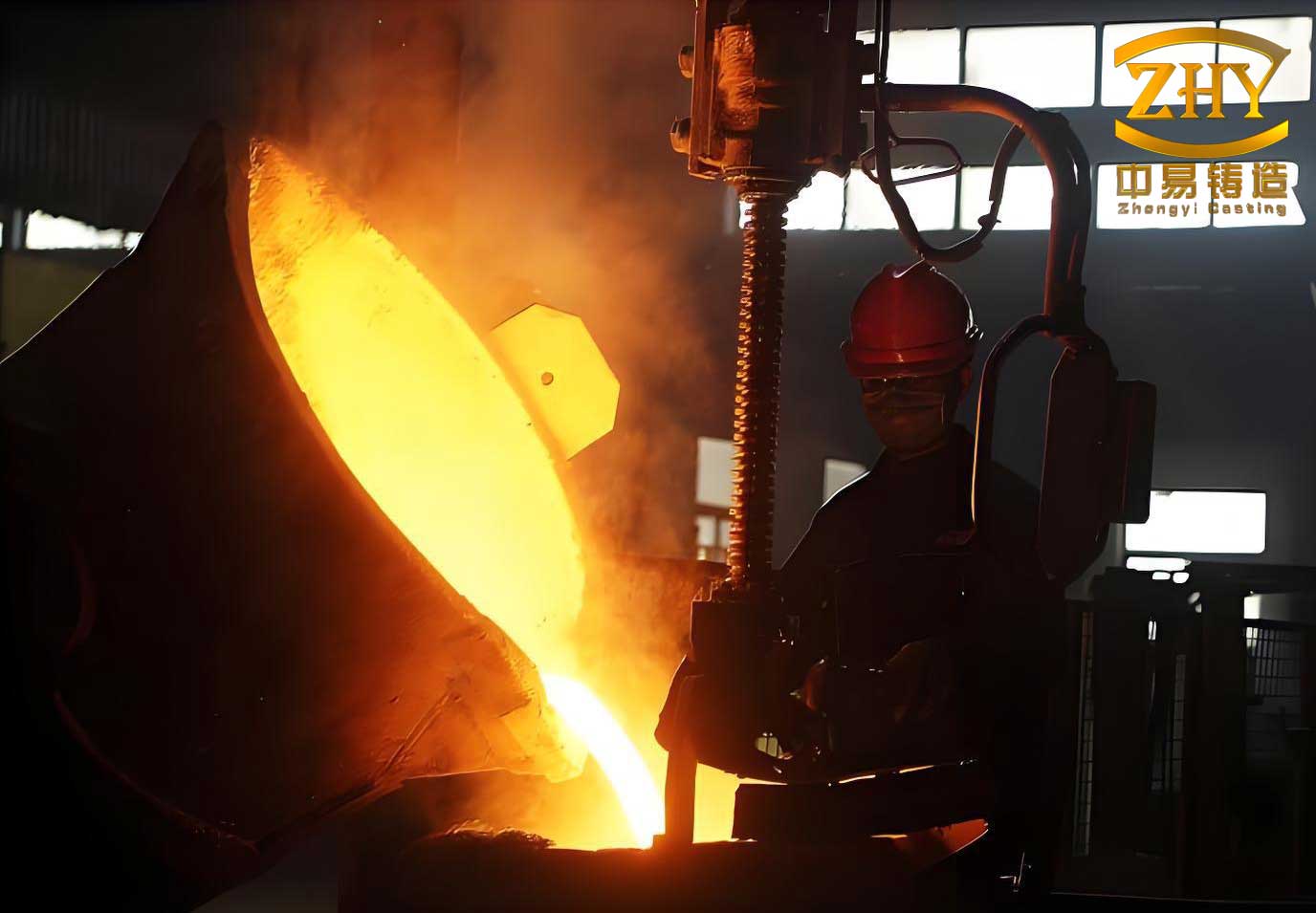
Protection of the molten steel from atmospheric oxidation is a cornerstone in producing clean high manganese steel casting. At the start of melting, I recommend placing a layer of lime (CaO) at the furnace bottom, approximately 1% of the metallic charge weight. As melting proceeds, this lime forms a basic slag that floats on the steel surface, acting as a barrier against oxygen and hydrogen pickup. The slag also serves as a collector for non-metallic inclusions, which float up and are absorbed. To maintain proper slag properties, fluorspar (CaF₂) is added intermittently; its role can be quantified by the following empirical relation for slag viscosity reduction: $$\eta_{\text{slag}} = \eta_0 \exp\left(-\frac{k \cdot X_{\text{CaF}_2}}{T}\right)$$ where $\eta_{\text{slag}}$ is the effective viscosity, $\eta_0$ is the base viscosity of lime slag, $k$ is a constant, $X_{\text{CaF}_2}$ is the mole fraction of fluorspar, and $T$ is the temperature in Kelvin. This ensures the slag remains fluid enough to be skimmed off easily, thereby removing entrapped inclusions from the high manganese steel casting melt.
The sequence of adding ferromanganese for alloying is critical, as premature addition can lead to excessive manganese oxidation and inclusion generation. Thermodynamic principles indicate that during the early melting phase, when steel temperature is lower, manganese has a high affinity for oxygen, forming MnO inclusions. In my practice, I avoid charging ferromanganese with the initial scrap. Instead, after the steel is fully molten and pre-deoxidized, I add preheated ferromanganese (FeMn75C7.5) in batches. Preheating to above 750°C prevents thermal shock and maintains melt temperature. The blocks, sized 50–100 mm, are added when the steel temperature reaches 1610–1640°C, with thorough stirring after each addition to ensure dissolution and homogeneity. This approach boosts manganese yield to about 95%, compared to 90% if added at charge, directly reducing oxide inclusion content in the final high manganese steel casting. The reaction for manganese oxidation can be expressed as: $$\text{Mn} + \text{FeO} \rightarrow \text{MnO} + \text{Fe}$$ with the equilibrium constant $$K_{\text{Mn}} = \frac{a_{\text{MnO}}}{a_{\text{Mn}} \cdot a_{\text{FeO}}}$$ where $a$ denotes activity. By lowering $a_{\text{FeO}}$ through pre-deoxidation, the formation of MnO is minimized.
Deoxidation plays a pivotal role in inclusion control for high manganese steel casting. I employ a two-stage process: pre-deoxidation and final deoxidation. Pre-deoxidation is conducted using high-carbon ferromanganese (FeMn75C7.5), added at about 1% of the melt weight. Carbon acts as a strong deoxidizer, reacting with oxygen to form CO gas, which bubbles out, carrying away impurities. The reaction is: $$\text{C} + \text{FeO} \rightarrow \text{CO} \uparrow + \text{Fe}$$ The Gibbs free energy change for this reaction is given by: $$\Delta G = \Delta H – T\Delta S$$ where at typical melting temperatures, $\Delta G$ is negative, favoring deoxidation. This pre-deoxidation reduces oxygen content to a low level, setting the stage for alloy addition with minimal oxidation. Final deoxidation is performed after composition adjustment, using aluminum as a strong deoxidizer. I add aluminum at 0.2% of the melt weight, slightly higher than the usual 0.1%, to compensate for the limitations of precipitation deoxidation and ensure thorough oxygen removal. The aluminum deoxidation reaction is: $$2\text{Al} + 3\text{FeO} \rightarrow \text{Al}_2\text{O}_3 + 3\text{Fe}$$ The alumina particles formed tend to agglomerate and float up into the slag, but residual micro-inclusions can affect the high manganese steel casting quality; hence, calming is essential.
| Stage | Deoxidizer | Addition Rate (% of melt weight) | Temperature Range | Expected Oxygen Reduction | Resulting Inclusion Type |
|---|---|---|---|---|---|
| Pre-deoxidation | High-carbon Ferromanganese (FeMn75C7.5) | 1.0% | 1610–1640°C | High (removes bulk FeO) | MnO, CO bubbles |
| Final Deoxidation | Aluminum (Al) | 0.2% | ~1600°C | Low (removes residual oxygen) | Al₂O₃ clusters |
After deoxidation, the molten high manganese steel casting must be allowed to calm to permit the flotation of gas bubbles and non-metallic inclusions. I recommend a holding time of 3 to 5 minutes after tapping, during which the steel temperature drops from tapping temperature (1480–1500°C) to pouring temperature (1430–1450°C). This calming period is crucial for improving metallurgical quality, as it allows inclusions to rise to the slag layer based on Stokes’ law: $$v = \frac{2g(\rho_{\text{steel}} – \rho_{\text{inclusion}})r^2}{9\eta}$$ where $v$ is the rising velocity, $g$ is gravitational acceleration, $\rho$ denotes densities, $r$ is the inclusion radius, and $\eta$ is the steel viscosity. Larger inclusions rise faster, so optimizing holding time and temperature ensures effective removal. The following table outlines the calming and pouring parameters for high manganese steel casting.
| Process Step | Temperature Range (°C) | Time Duration | Key Objective |
|---|---|---|---|
| Tapping from Furnace | 1480–1500 | Immediate | Transfer to ladle with slag cover |
| Calming in Ladle | 1450–1480 | 3–5 minutes | Inclusion flotation and gas escape |
| Pouring into Molds | 1430–1450 | As per casting size | Fill molds without turbulence or reoxidation |
The effectiveness of these measures is evident in production outcomes for high manganese steel casting. In one application, after implementing the above practices, the inclusion rating was controlled to not exceed level 4A or 4B according to standard inspection methods (e.g., ASTM E45). This led to the elimination of crack-type defects in castings and significantly improved service life. For instance, in ball mill liners for mineral processing, the specific consumption of high manganese steel casting was reduced to 76 grams per ton of ore, compared to 83–93 grams per ton from other producers. This translates to enhanced durability and cost savings, underscoring the importance of inclusion control. The inclusion rating can be correlated with mechanical properties using empirical formulas such as: $$\sigma_{\text{fatigue}} = \sigma_0 – k_I \cdot \sqrt{\text{Inclusion Density}}$$ where $\sigma_{\text{fatigue}}$ is the fatigue strength, $\sigma_0$ is the base strength, and $k_I$ is a material constant. Lower inclusion density directly boosts performance in high manganese steel casting components.
Moreover, the slag composition and its interaction with the melt are vital for inclusion removal. A basic slag with appropriate fluidity can absorb alumina and manganese oxide inclusions. The capacity of slag to absorb inclusions can be modeled using partition coefficients. For example, the partition coefficient for alumina between slag and steel is: $$L_{\text{Al}_2\text{O}_3} = \frac{(\% \text{Al}_2\text{O}_3)_{\text{slag}}}{[\% \text{Al}]^2_{\text{steel}}}$$ By maintaining a high $L_{\text{Al}_2\text{O}_3}$ through basic slag and low steel oxygen activity, inclusions are effectively transferred to the slag phase. Regular slag sampling and adjustment ensure optimal performance throughout the melting process for high manganese steel casting.
In summary, controlling inclusions in high manganese steel casting during intermediate frequency furnace melting involves a holistic approach encompassing furnace lining selection, slag management, optimized alloy addition sequences, staged deoxidation, and adequate calming. Each step interlinks to reduce oxygen content and non-metallic particles. The use of basic linings and lime-fluorspar slags protects the melt, while pre-deoxidation with high-carbon ferromanganese followed by aluminum final deoxidation minimizes oxide formation. Adding ferromanganese after pre-deoxidation prevents excessive manganese loss and inclusion generation. Finally, a calming period allows residual inclusions to float out, resulting in cleaner steel. These measures, grounded in thermodynamic and kinetic principles, have proven effective in industrial settings, leading to high-quality high manganese steel casting with improved mechanical properties and longer service life. Future advancements may focus on real-time monitoring of inclusion populations using advanced sensors, but the core practices outlined here remain foundational for any foundry aiming to excel in high manganese steel casting production.