
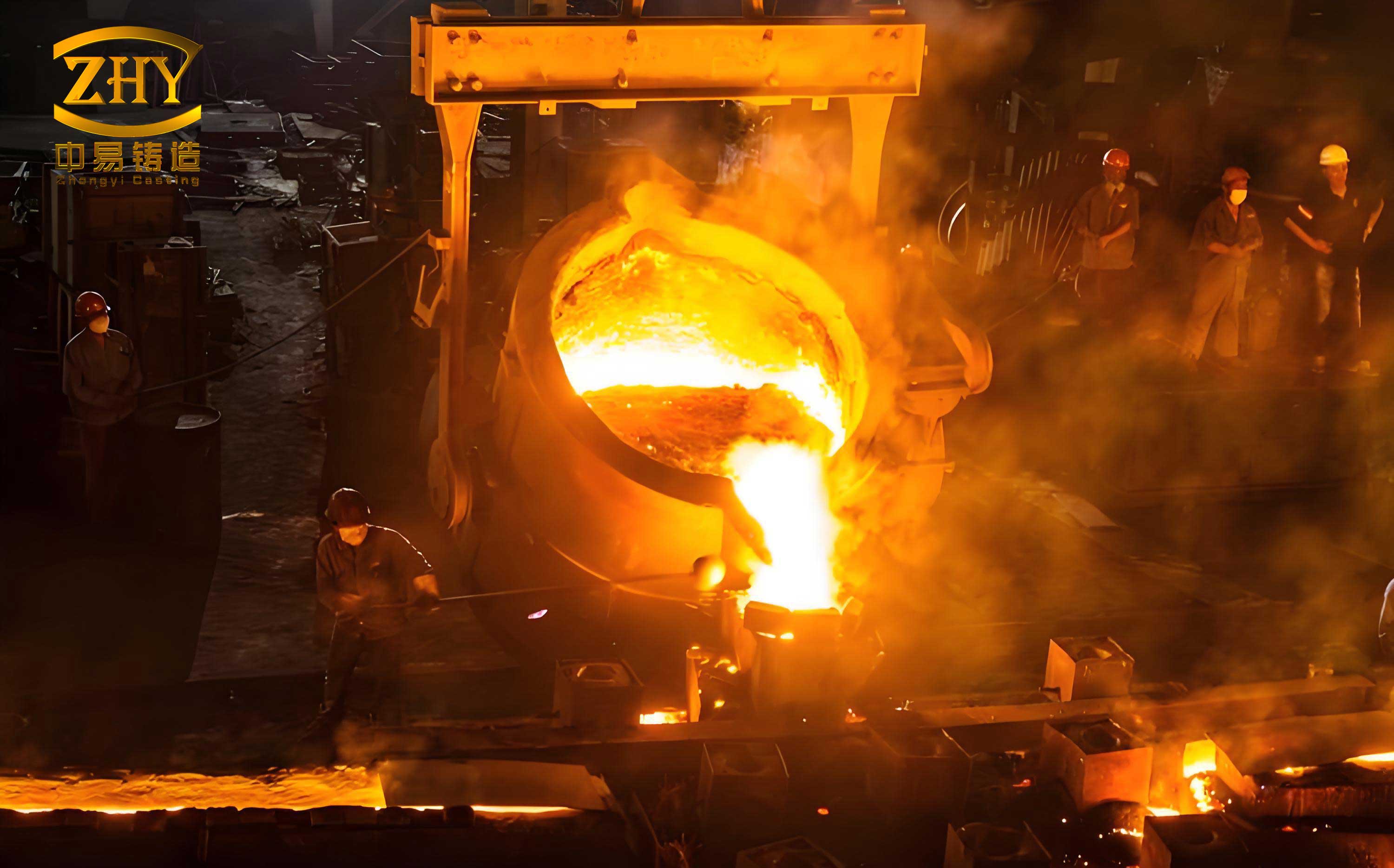
In the modern manganese steel casting foundry, the quest for efficient and cost-effective molding processes is perpetual. The V.R.H. (Vacuum Replacement Hardening) process, initially developed in Japan, has emerged as a promising technique, particularly for its potential to enhance the collapsibility of sodium silicate-bonded sands. However, when adapting this process to high manganese steel castings—especially in large and medium-sized applications using magnesium olivine sand—several technical challenges arise. As an engineer involved in the implementation and optimization of this process at a manganese steel casting foundry, I have encountered and studied these issues firsthand. This article delves into the core problems of mold strength and surface stability, collapsibility, sand reclamation, and mixing efficiency, offering analytical insights, experimental data, and practical solutions. Throughout this discussion, the focus remains on the unique demands of a manganese steel casting foundry, where material properties and production scale dictate process parameters.
The V.R.H. process combines chemical hardening via CO₂ with dehydration hardening under vacuum, theoretically allowing for reduced sodium silicate addition (typically 2.5–3.5%) while achieving higher mold strengths compared to conventional sodium silicate sand methods. In a standard manganese steel casting foundry, the target values post-hardening are often set at a compressive strength of 1.5 MPa and a surface stability exceeding 85% after 2 hours of curing. However, our trials with domestic magnesium olivine sand (55/100 mesh) and sodium silicate (modulus 2.1–2.3, 48–52 Bé) revealed significant deviations. For instance, at 2.5% sodium silicate addition, the mold strength was critically low, rendering it unsuitable for molding. Even at 3.5%, the strength only reached 0.7–0.8 MPa, with surface stability around 75%, far below the targets. This discrepancy underscores the sensitivity of the V.R.H. process to raw material quality, a key concern in any manganese steel casting foundry.
To quantify the impact of raw sand properties, we conducted a series of tests focusing on bulk density. The bulk density of sand is a critical factor, as it influences the coating uniformity of sodium silicate and, consequently, the mold strength. Domestic magnesium olivine sand often exhibits a bulk density of 1.5–1.6 g/cm³, whereas for optimal V.R.H. performance, a bulk density above 1.8 g/cm³ is desirable. This lower density is attributed to mineral impurities and porous structure, reflecting broader challenges in domestic sand mining and processing. The relationship between bulk density ($\rho_b$), sodium silicate addition ($w_{ss}$), and compressive strength ($\sigma_c$) can be approximated by the empirical formula derived from our experiments:
$$ \sigma_c = k \cdot \rho_b \cdot \ln(w_{ss}) + C $$
where $k$ is a material constant (approximately 0.4 for magnesium olivine sand) and $C$ is an intercept term. For a manganese steel casting foundry, this highlights the need for stringent raw material specifications. The table below summarizes our findings on mold strength and surface stability under varying conditions, emphasizing the role of sand quality in a manganese steel casting foundry.
| Sand Type | Bulk Density (g/cm³) | Sodium Silicate Addition (%) | Compressive Strength (MPa) | Surface Stability (%) |
|---|---|---|---|---|
| Domestic Olivine | 1.5–1.6 | 2.5 | 0.2–0.3 | 60–65 |
| Domestic Olivine | 1.5–1.6 | 3.5 | 0.7–0.8 | 70–75 |
| Imported Olivine (High Quality) | 1.8–2.0 | 2.5 | 1.2–1.4 | 80–85 |
| Imported Olivine (High Quality) | 1.8–2.0 | 3.5 | 1.8–2.0 | 90–95 |
Beyond mold strength, collapsibility is a paramount issue in the V.R.H. process for a manganese steel casting foundry. Collapsibility refers to the ease with which the mold disintegrates after casting, affecting shakeout efficiency, sand reclamation, and even casting integrity (e.g., risk of hot tearing). Our studies indicate that collapsibility is primarily governed by sodium silicate addition and the shakeout time (or sand temperature at shakeout). For manganese steel castings, which often have complex geometries and require precise dimensional control, poor collapsibility can lead to extended cleaning cycles and increased labor costs. At 3.5% sodium silicate addition, shakeout at 24 hours (sand temperature ~20°C) yielded a core removal rate of 85%, whereas at 16 hours (sand temperature ~50°C), the rate dropped to 60–70%. This can be modeled using a temperature-dependent decay function for bond strength:
$$ R_c(t) = R_0 \cdot e^{-\lambda (T – T_0)} $$
where $R_c(t)$ is the collapsibility rate at time $t$, $R_0$ is the initial rate, $\lambda$ is a degradation constant, $T$ is the sand temperature, and $T_0$ is a reference temperature. For a typical manganese steel casting foundry, optimizing this balance is essential to maintain productivity without compromising casting quality. Increasing sodium silicate addition improves strength but degrades collapsibility, creating a trade-off that must be managed through precise process control. The table below illustrates the interplay between these factors in a manganese steel casting foundry context.
| Sodium Silicate Addition (%) | Shakeout Time (hours) | Sand Temperature at Shakeout (°C) | Core Removal Rate (%) | Notes for Manganese Steel Casting Foundry |
|---|---|---|---|---|
| 3.0 | 16 | 50 | 65–70 | Risk of sand sticking to castings |
| 3.0 | 24 | 20 | 80–85 | Acceptable for most applications |
| 3.5 | 16 | 50 | 60–65 | Poor collapsibility, may cause casting defects |
| 3.5 | 24 | 20 | 85–90 | Good balance, but requires longer cycle time |
Sand reclamation is another critical aspect in the V.R.H. process for a manganese steel casting foundry, as it impacts economic viability and environmental sustainability. Inefficient reclamation leads to high residual Na₂O levels, moisture-laden fines, and equipment fouling—issues exacerbated in colder seasons. Our analysis traced these problems to two main causes: high sand temperatures at shakeout and suboptimal dust collection system design. When shakeout occurs at elevated temperatures, moisture evaporation creates steam that condenses on fine particles, forming damp aggregates that clog pipes and containers. This not only reduces reclamation efficiency but also increases maintenance downtime. For a manganese steel casting foundry, where large volumes of sand are processed daily, this can escalate operational costs. The residual Na₂O content ($C_{Na_2O}$) in reclaimed sand can be expressed as a function of initial addition ($w_{ss}$), reclamation efficiency ($\eta_r$), and moisture content ($M$):
$$ C_{Na_2O} = \frac{w_{ss} \cdot (1 – \eta_r)}{1 + M} \cdot \alpha $$
where $\alpha$ is a conversion factor. To mitigate this, we recommend extending shakeout times to lower sand temperatures or installing sand cooling units post-shakeout. Additionally, upgrading dust collection systems to achieve filtration efficiencies above 99% can significantly reduce fine particle accumulation. The following table outlines key parameters for sand reclamation optimization in a manganese steel casting foundry.
| Parameter | Target Value | Impact on Manganese Steel Casting Foundry |
|---|---|---|
| Shakeout Temperature | <30°C | Reduces steam formation, improves fines handling |
| Residual Na₂O in Reclaimed Sand | <0.3% | Ensures consistent mold properties and reduces waste |
| Dust Collection Efficiency | >99% | Minimizes environmental contamination and equipment wear |
| Sand Cooling Rate | 10–15°C/hour | Balances productivity and reclamation quality |
Mixing uniformity is a often-overlooked yet vital factor in the V.R.H. process for a manganese steel casting foundry. Given the low sodium silicate addition (2.5–3.5%), achieving a homogeneous coating on sand grains is crucial for consistent mold strength. We compared two types of mixers: continuous mixers and roller-type (wheel mill) mixers. The results revealed stark differences. Continuous mixers exhibited strength non-uniformity above 16%, with compressive strength values 0.15–0.2 MPa lower than those from roller-type mixers, which showed non-uniformity of only 1.5%. This disparity stems from feed mechanism inconsistencies in continuous mixers, particularly when using gravity-fed gates with vibrating dischargers—a common setup in many foundries. The non-uniformity ($U$) can be modeled based on feed rate variance ($\sigma_f$) and mixing time ($t_m$):
$$ U = \frac{\sigma_f}{\sqrt{t_m}} \cdot \beta $$
where $\beta$ is a system constant. For a manganese steel casting foundry, where large batches are mixed for high-volume production, such non-uniformity can lead to defective castings due to weak spots in molds. While roller-type mixers offer superior uniformity, they require daily cleaning to prevent sand buildup, increasing labor intensity. Thus, a trade-off exists between operational ease and quality assurance. We propose redesigning feed mechanisms in continuous mixers to incorporate precision feeders or auger systems, coupled with real-time monitoring of sand flow rates. The table below compares mixer performance in the context of a manganese steel casting foundry.
| Mixer Type | Strength Non-uniformity (%) | Average Compressive Strength (MPa) | Labor Requirements | Suitability for Manganese Steel Casting Foundry |
|---|---|---|---|---|
| Continuous Mixer | 16–20 | 0.6–0.8 | Low (minimal cleaning) | Poor due to inconsistency |
| Roller-type Mixer | 1.5–2.0 | 0.8–1.0 | High (daily cleaning needed) | Good if labor is manageable |
| Modified Continuous Mixer (with precision feeder) | 5–8 | 0.7–0.9 | Moderate | Acceptable with adjustments |
In summary, the adoption of the V.R.H. process in a manganese steel casting foundry presents distinct technical hurdles that demand tailored solutions. The core issues—mold strength and surface stability, collapsibility, sand reclamation, and mixing uniformity—are interconnected and heavily influenced by raw material quality and process parameters. From my experience, the sensitivity to domestic sand properties, such as low bulk density in magnesium olivine sand, necessitates stringent material selection or preprocessing steps. Collapsibility must be balanced against production cycle times, requiring careful control of shakeout conditions. Sand reclamation efficiency hinges on temperature management and dust collection, while mixing uniformity calls for equipment upgrades or operational adaptations. For any manganese steel casting foundry considering the V.R.H. process, a holistic approach involving rigorous testing, continuous monitoring, and iterative improvements is essential. By addressing these challenges, foundries can harness the benefits of reduced sodium silicate usage and enhanced collapsibility, ultimately boosting productivity and sustainability in high manganese steel casting production.
Looking ahead, further research could explore additive modifications to sodium silicate or alternative binder systems tailored for V.R.H. applications in manganese steel casting foundries. Additionally, digital tools like real-time sensors and predictive analytics could optimize process variables dynamically. As the industry evolves, the lessons learned from implementing V.R.H. in a manganese steel casting foundry will undoubtedly contribute to broader advancements in casting technology, ensuring that these specialized foundries remain competitive and innovative in a global market.