
In my extensive experience within the manganese steel casting foundry environment, few challenges are as persistent and costly as the occurrence of heat cracks. These defects, which manifest as intergranular fractures during or just after solidification, are the most common form of failure in high manganese steel castings. While factors like molding design, gating systems, and heat treatment play their part, I have consistently observed that the most volatile and influential variable in this equation is the chemical composition of the melt. The intricate balance of elements directly dictates the material’s behavior in its most vulnerable state—the effective solidification range. This article delves deep into the mechanisms by which chemistry governs heat cracking and outlines a comprehensive, practical strategy for the manganese steel casting foundry to overcome this defect through precise compositional control, advanced melting practices, and targeted melt treatments.
The superior work-hardening capability and toughness of austenitic manganese steel make it indispensable for demanding applications like crusher liners, rail crossings, and dredger buckets. However, this very alloy is notoriously susceptible to casting defects, with heat cracking sitting at the top of the list. The fundamental reasons lie in its inherent physical properties: low thermal conductivity (approximately one-third that of carbon steel), high coefficient of thermal expansion, and significant total linear shrinkage (2.5–3.0%). These properties combine to generate substantial thermal stresses during cooling. When the alloy’s inherent “hot strength” during solidification is insufficient to withstand these stresses, a crack initiates. This “hot strength” is almost entirely a function of microstructure at the grain boundaries in the final stages of solidification, which is meticulously engineered by chemistry.
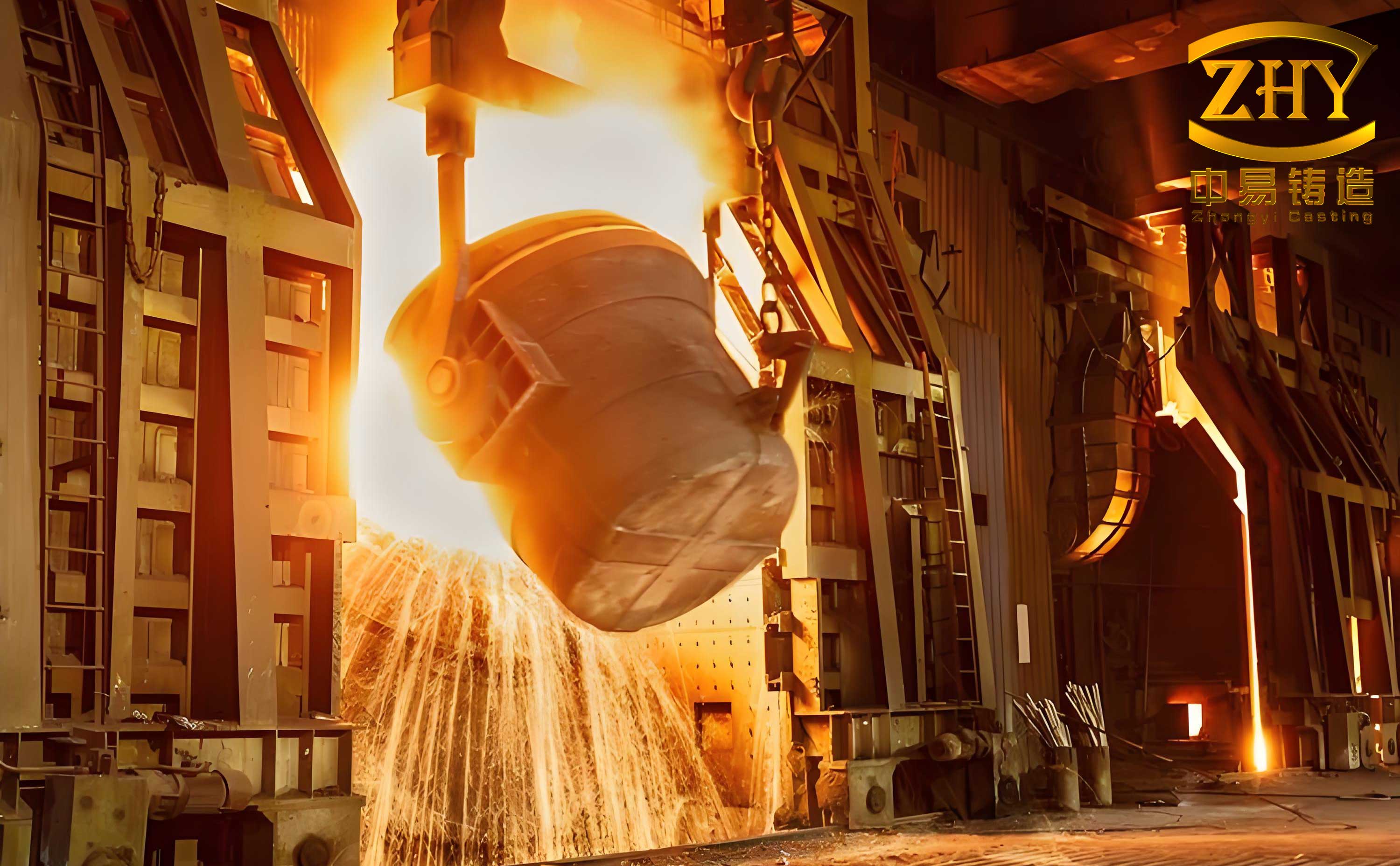
The battle against heat cracking is fought in what we call the “Effective Solidification Temperature Range.” This is the critical zone where the alloy possesses little to no ductility, existing as a mixture of solid grains and residual liquid films. For a typical high manganese steel, this range lies between approximately 1350°C and a point just below the non-equilibrium solidus temperature. It is within this shadowy region, visualized in the concept below, where the fate of the casting is often sealed.
$$ T_{effective} = T_{coherency} – T_{solidus}^{non-eq} $$
Where $T_{coherency}$ is the temperature at which grains begin to form a continuous network capable of transmitting tensile stress, and $T_{solidus}^{non-eq}$ is the practical solidus temperature under foundry cooling conditions. A wider $T_{effective}$ generally increases hot tearing susceptibility.
The Core Mechanism: Liquid Film Integrity and Grain Boundary Cohesion
To manage heat cracking in a manganese steel casting foundry, one must first understand the two-pronged attack launched by unfavorable chemistry. The failure occurs in two sequential, interrelated stages: the formation of a crack nucleus and its subsequent propagation.
Stage 1: Nucleation at the Liquid Film. In the final stages of solidification, the remaining liquid is relegated to thin films between dendrite arms and grain boundaries. The ability of this film to withstand tensile stress (from thermal contraction) is described by a simplified version of the liquid film theory. The critical tensile stress ($P_{critical}$) required to rupture this film can be expressed as:
$$ P_{critical} = \frac{\gamma \cdot F}{\delta} $$
Where:
- $\gamma$ is the surface tension of the liquid film (N/m),
- $F$ is the total contact area between the solid grains and the liquid (m²),
- $\delta$ is the average thickness of the liquid film (m).
This equation reveals our primary levers for control in the manganese steel casting foundry. Surface Tension ($\gamma$): Certain elements, known as surface-active elements, drastically reduce $\gamma$. The chief villains in steel are sulfur (S), phosphorus (P), and absorbed oxygen (O). Their presence at the grain boundary liquid film weakens its cohesive force, making it tear more easily under lower stress. Film Thickness ($\delta$) and Contact Area ($F$): These are governed by grain size. A fine, equiaxed grain structure results in a larger total grain boundary area ($F$) and forces the residual liquid into thinner, more discontinuous films ($\delta$ decreases). This combination significantly raises $P_{critical}$. Therefore, anything that refines the as-cast grain structure inherently fights heat cracking.
Stage 2: Propagation Along Weakened Grain Boundaries. Even if a micro-crack initiates, it may not become a detrimental defect if the surrounding solid material is strong enough to blunt its progress. This is where the second chemical influence strikes. In manganese steels, the grain boundaries in the as-cast state are rarely clean. They are decorated with various secondary phases:
- Brittle Carbides: The (Fe,Mn)₃C carbides that precipitate during solidification. If they form a continuous or coarse network along boundaries, they create easy pathways for crack propagation.
- Non-Metallic Inclusions: Oxides (MnO, SiO₂), sulfides (MnS), and phosphides. These are inherently brittle. Especially harmful are films of low-melting-point phosphides or silicate-based inclusions that wet the grain boundaries, effectively “gluing” the grains together with a brittle ceramic.
A crack, once initiated, will propagate with minimal energy expenditure through these brittle boundary networks. The role of chemistry is to minimize the amount and, more importantly, control the morphology and distribution of these grain-boundary constituents.
| Element | Primary Role/Effect | Impact on Liquid Film (Stage 1) | Impact on Grain Boundary (Stage 2) | Practical Control Target for Foundry |
|---|---|---|---|---|
| Carbon (C) | Austenite stabilizer; forms (Fe,Mn)₃C. | Minor direct effect. Governs solidification range. | MAJOR. High C increases carbide volume, promoting networked brittle boundaries. Low C reduces strength/hardenability. | 0.90% – 1.10% (Balance strength & crack resistance) |
| Manganese (Mn) | Austenite stabilizer; modifies carbides. | Neutral. MnO inclusions can reduce surface tension if present. | CRITICAL. High Mn/C ratio promotes austenite stability, suppressing carbide networks. Combines with S to form MnS. | 11.0% – 13.0%. Maintain Mn/C ≥ 10. |
| Silicon (Si) | Deoxidizer; solid solution strengthener. | Neutral to slightly negative if excessive (forms low-melting silicates). | High Si reduces C solubility in austenite, promoting carbide precipitation. Can form brittle silicate inclusions. | 0.30% – 0.60% (Aim for lower end for heavy sections) |
| Phosphorus (P) | Impurity (tramp element). | SEVERE. Strong surface-active element, drastically reduces liquid film surface tension ($\gamma$). | SEVERE. Forms low-melting Fe-Mn-P films on grain boundaries, creating ultra-brittle paths. | Absolute Minimization. < 0.04% (Aim for < 0.03% for critical castings). |
| Sulfur (S) | Impurity (tramp element). | SEVERE. Strong surface-active element, reduces $\gamma$. | Forms MnS inclusions. Morphology is key (globular is OK, films are bad). | < 0.025%. Control via Mn/S ratio > 50. |
Mastering the Base Composition: The Foundry’s Blueprint
Preventing heat cracks starts with a disciplined approach to the base chemistry in the manganese steel casting foundry. Here is a detailed breakdown based on practical foundry evidence:
1. The Carbon Dilemma: Carbon is the linchpin. While it is essential for hardness and wear resistance through work-hardening, it is a double-edged sword. The data is clear: in the range of 0.8% to 1.15%, the sensitivity to hot tearing is relatively low. However, crossing the 1.15% threshold brings rapidly diminishing returns and escalating risk. The volume fraction of eutectic carbide (Fe,Mn)₃C increases non-linearly. In the as-cast structure of a high-carbon heat, these carbides create a continuous, brittle skeleton. Even after solution heat treatment (water quenching), there is a risk. The dissolution of massive carbides leaves behind microscopic voids due to the significant difference in specific volume between the carbide and the austenite matrix (carbide volume is ~15% larger). These voids act as potent stress concentrators and micro-crack nuclei under service loads. Therefore, my firm recommendation for a general-purpose, crack-resistant manganese steel casting foundry practice is to target **0.90% to 1.05% C**. For extremely complex or heavy-section castings, leaning toward the lower end of this range is prudent.
2. The Manganese Guardian and the Mn/C Ratio: Manganese’s primary role is to ensure a fully austenitic structure at room temperature after heat treatment. Its more subtle, yet crucial, role concerning heat cracks is defined by the Mn/C ratio. A high ratio (≥10:1) enhances the stability of austenite, even at elevated temperatures during cooling. This stability suppresses the precipitation and growth of pro-eutectoid carbides along grain boundaries in the critical temperature range just below solidification. It promotes a cleaner, carbide-free boundary in the as-cast state, which dramatically increases the grain boundary strength against crack propagation. Furthermore, manganese acts as a scavenger for sulfur, forming manganese sulfide (MnS) inclusions. While inclusions are generally undesirable, globular MnS is less harmful than the iron sulfide (FeS) films that would form in a low-manganese environment. The target for manganese is typically 11.5% to 12.5%, ensuring the Mn/C ratio remains robust.
3. Silicon – The Necessary Compromise: Silicon is essential for proper deoxidation of the steel melt; a minimum of 0.30% is required to prevent porosity from residual oxygen. However, silicon is a ferrite stabilizer and reduces the solubility of carbon in austenite. Excessive silicon (>0.80%) pushes more carbon out of solution to form carbides, negating the benefits of a good Mn/C ratio. It can also lead to the formation of complex silicate inclusions that weaken grain boundaries. The optimal window is narrow: **0.30% to 0.50%**. This ensures adequate deoxidation without significant negative impact on carbide precipitation or inclusion content.
4. The Enemies: Phosphorus and Sulfur: Control of these tramp elements is non-negotiable for a quality-focused manganese steel casting foundry. Phosphorus is public enemy number one. Its solubility in solid steel is minuscule. During solidification, it is violently rejected to the last-solidifying liquid, ending up as thin, continuous films of a phosphide eutectic (e.g., (Fe,Mn)₃P) that perfectly wet the grain boundaries. This creates an almost pre-cracked condition. The embrittling effect is synergistic with carbon; high carbon and high phosphorus together guarantee cracking. The absolute upper limit should be 0.04%, with strenuous efforts made to achieve <0.03% for high-integrity castings. Sulfur behaves similarly as a surface-active element in the liquid film. Its harm is mitigated by maintaining a high manganese content to ensure MnS formation, but the total S should be kept below 0.025%.
Advanced Metallurgy: Modification and Inoculation as Foundry Tools
While controlling base elements is foundational, the next level of mastery in a modern manganese steel casting foundry involves active melt treatment—modification and inoculation. These are not mere additives; they are strategic tools to manipulate solidification at the microscopic level.
The Goal of Modification (Inclusion Control): This process aims to alter the morphology, size, and distribution of non-metallic inclusions, particularly sulfides and oxides. We want to transform harmful, sharp, film-like inclusions into harmless, small, and globular ones. This is achieved by adding strong sulfide/oxide formers that have a higher affinity for sulfur and oxygen than manganese. The most effective agents are rare earth metals (REM) like Cerium (Ce) and Lanthanum (La), or alkaline earth metals like Calcium (Ca).
A composite modifier containing both REM and Ca is often most effective. The reactions can be summarized as:
$$ x[RE] + yS \rightarrow RE_xS_y \quad \text{(globular)} $$
$$ [Ca] + [O] + [S] \rightarrow CaO \cdot xCaS \quad \text{(complex, spherical)} $$
These newly formed compounds are solid at steelmaking temperatures and act as inert particles. They do not wet the grain boundaries as liquid films do, thus removing a major source of boundary weakness.
The Power of Inoculation (Grain Refinement): Recall from the liquid film theory that finer grains increase the grain boundary area (F) and decrease film thickness (δ), raising $P_{critical}$. Since high manganese steel undergoes no phase transformation in the solid state, its final grain size is determined during primary solidification. Inoculation introduces numerous, finely dispersed, heterogeneous nucleation sites into the melt, promoting a dramatic shift from coarse columnar grains to a fine, equiaxed structure.
Effective inoculants for manganese steel include:
- Vanadium-bearing slags/inoculants: Adding 0.10-0.20% Vanadium (often via a slag containing V₂O₅) forms high-melting-point vanadium carbonitrides (VN, VC) that are excellent nucleation substrates.
- Controlled Titanium additions: Small additions of Titanium (0.05-0.10%) form TiN and TiC particles, which are potent grain refiners.
- Recycled manganese steel returns: A practice I have validated involves adding a small percentage (1-2%) of finely crushed, high-grade manganese steel returns to the ladle just before pouring. The partially dissolved micro-fragments act as effective nucleation sites.
The combined effect of modification and inoculation is transformative. It leads to a casting with:
- Cleaned grain boundaries (free of liquid films and brittle networks).
- Strengthened grain boundaries (due to finer grain size and globular inclusions).
- Enhanced feeding characteristics in the mushy zone.
| Treatment Type | Typely Added Agent | Primary Mechanism | Key Benefit for Heat Crack Resistance | Implementation Point & Notes |
|---|---|---|---|---|
| Modification (Inclusion Control) | Rare Earth (Ce, La) alloys, Calcium alloys (CaSi). | Chemical bonding to S and O to form high-melting-point, globular compounds. | Eliminates grain-boundary wetting by low-melting sulfides/oxides; increases grain boundary cohesion. | Ladle treatment after final deoxidation. Must control timing and atmosphere to prevent reoxidation. |
| Inoculation (Grain Refinement) | Ferro-Vanadium, Vanadium slag, Ferro-Titanium. | Provides heterogeneous nucleation sites (VN, VC, TiN, TiC) for austenite grains. | Refines as-cast grain structure, increasing grain boundary area and reducing liquid film continuity/thickness. | Late addition to ladle or stream during pouring. Grain refinement effect is sensitive to cooling rate. |
| Combined Treatment | REM-Ca composite wires or cored wires. | Simultaneous modification and inoculation. | Synergistic effect: Cleaner boundaries + finer grains = maximum resistance to both crack initiation and propagation. | Requires precise wire feeding equipment. Reproducible and efficient for high-volume foundry production. |
An Integrated Foundry Strategy: From Charge to Casting
Implementing this knowledge requires a systemic approach in the manganese steel casting foundry. It’s not just about hitting a chemical specification on a lab report; it’s about controlling the entire process chain to ensure that specification is meaningful in the final solidified structure.
1. Charge Material Selection: Start clean. Use high-quality, low-residual raw materials. Select low-phosphorus pig iron or direct reduced iron (DRI). Use clean steel scrap with known, low levels of P and S. This upfront investment drastically reduces the burden on the melting and refining processes.
2. Melting and Refining Practice: A basic arc furnace melt is insufficient. A two-slag practice or argon-oxygen decarburization (AOD) refining is highly beneficial for a quality-focused manganese steel casting foundry. The key is to achieve a strong, reducing slag in the final stages to deeply deoxidize and desulfurize the bath. The sequence should be: melt down → oxidizing slag to remove phosphorus → tap oxidizing slag → create reducing (lime-alumina) slag → deoxidize with Fe-Mn and Fe-Si → final alloy adjustments → perform modification/inoculation treatment in the ladle.
3. Pouring and Solidification Control: Chemistry sets the potential, but solidification conditions realize it. Even the best-modified steel can crack if poured into a rigid, poorly designed mold. The casting process must work in concert with the metallurgy:
- Use exothermic or insulating risers to ensure directional solidification and feed the vulnerable mushy zone.
- Design molds and cores with adequate collapsibility to minimize mechanical hindrance to contraction during the effective solidification range.
- Control pouring temperature—avoid excessive superheat which coarsens grains and widens the mushy zone.
4. The Role of Alloying (Cr, Mo, V): While not part of the standard ASTM A128 specification, strategic microalloying can provide an extra layer of defense against heat cracking, especially in thick sections. Additions of 1.5-2.0% Chromium (Cr) or 0.5-1.0% Molybdenum (Mo) provide solid solution strengthening to the austenite matrix. This slightly elevates the high-temperature strength of the grains themselves, making them more resistant to deformation under thermal stress. More importantly, these elements modify the carbide morphology, making carbides more discrete and less networked even if they do precipitate. Vanadium (V), in small amounts (0.1-0.3%), not only refines grains but also forms fine, secondary carbides that can strengthen the matrix without creating continuous brittle boundaries.
Conclusion: A Philosophy of Control
Mastering heat cracking in the manganese steel casting foundry is an exercise in mastering chemistry’s influence on solid-state physics. It requires moving beyond simplistic compositional ranges to a profound understanding of mechanisms: how elements affect liquid film cohesion, how they orchestrate the precipitation of secondary phases, and how we can intervene with advanced melt treatments to rewrite the solidification script.
The successful strategy is holistic and sequential:
- Minimize Harm: Ruthlessly control the enemies—Phosphorus and Sulfur—through charge selection and refining.
- Optimize the Foundation: Carefully balance Carbon, Manganese, and Silicon to achieve the desired service properties while maximizing austenite stability (high Mn/C) during cooling.
- Engineer the Microstructure: Employ modification to cleanse the grain boundaries of brittle films and inoculation to refine the grain structure, thereby intrinsically strengthening the alloy in its most vulnerable state.
- Support with Process: Ensure the molding, pouring, and feeding practices are designed to minimize stress development during the critical effective solidification range.
By adopting this comprehensive, metallurgically-driven approach, the manganese steel casting foundry transforms from a battleground with heat cracks into a controlled environment where sound, reliable, and high-performance castings are the standard output. The goal is not just to avoid a scrap defect, but to build inherent robustness into the very grain structure of the metal, ensuring it can withstand the rigors of both its birth in the mold and its demanding life in service.