
In my years of experience in the manufacturing industry, I have observed that sand casting parts play a pivotal role in heavy machinery, particularly in mining equipment such as hydraulic support systems. These sand casting parts, like the column socket in hydraulic supports, are critical for ensuring safety and operational efficiency. The column socket, typically a steel casting, bears immense pressure from the mine roof, and any defect can compromise the entire structure, posing significant risks. Therefore, maintaining high-quality standards in sand casting parts is paramount. In our facility, we primarily use sodium silicate sand molding, which offers good fluidity and rapid hardening but presents challenges like poor collapsibility and shrinkage resistance. This article delves into the common defects in sand casting parts, specifically focusing on shrinkage cavities, gas pores, and sand sticking, with detailed analyses and preventive measures. I will incorporate tables and formulas to summarize key points, emphasizing the term ‘sand casting parts’ throughout to underscore its importance.
Sand casting parts, such as those made from ZG30Cr06 low-carbon alloy steel, exhibit high shrinkage tendencies due to their composition. This can lead to defects if not managed properly. The process involves molding with water glass sand, where the sodium silicate content, sand quality, and casting design interplay. To ensure optimal results, we must understand the root causes of defects. For instance, shrinkage cavities often form in the last solidifying sections, like the cross-rib areas of column sockets, due to inadequate feeding. Gas pores arise from entrapped or dissolved gases, while sand sticking results from metal penetration into the mold. By leveraging modern techniques like computer simulation, we can enhance the quality of sand casting parts. Below, I explore each defect in detail, starting with shrinkage cavities.
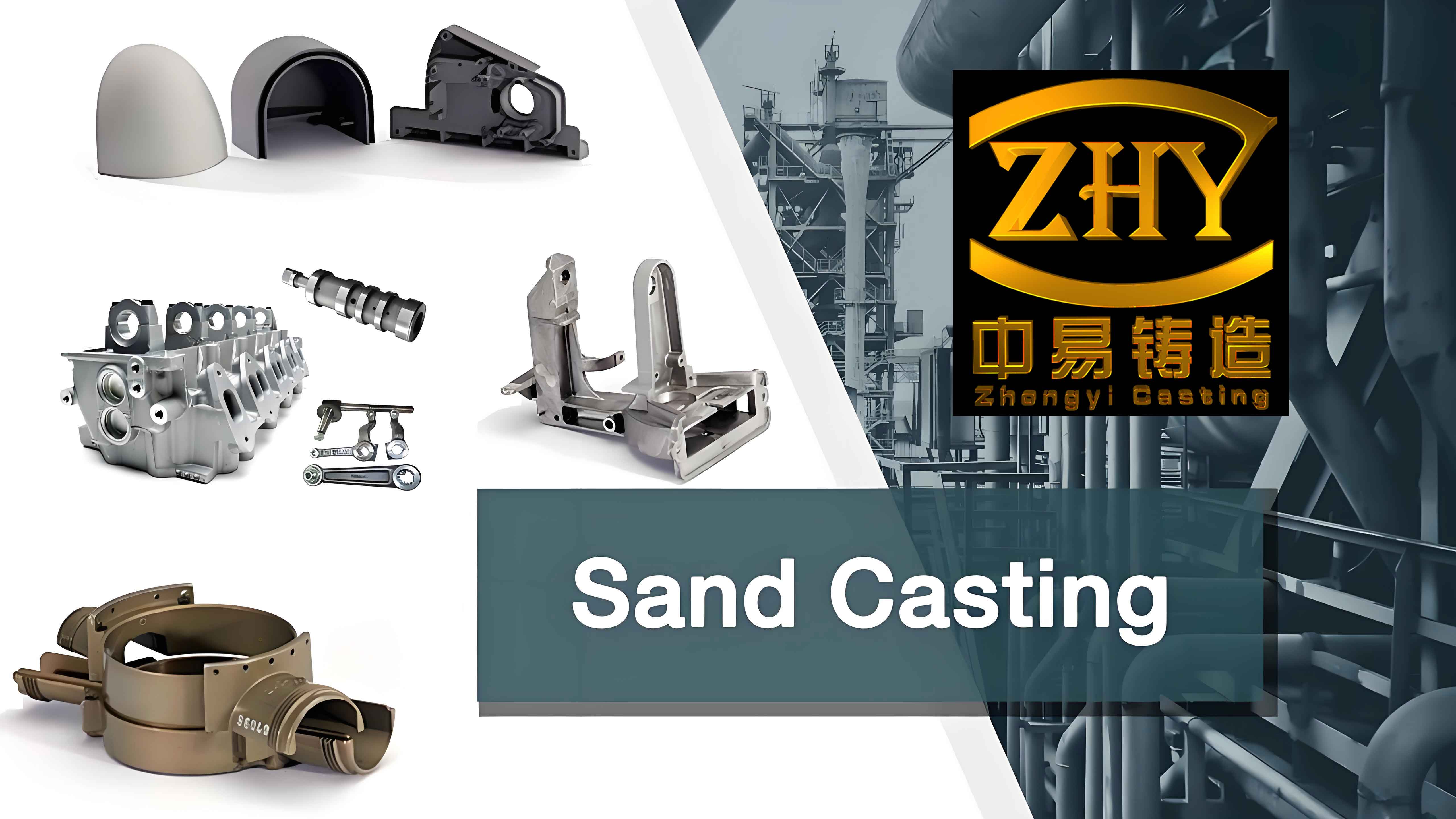
Shrinkage cavities in sand casting parts are void spaces that form during solidification when insufficient molten metal feeds into the final freezing zones. These cavities typically appear near riser roots or on the surface, characterized by irregular shapes and rough walls. In sand casting parts like column sockets, this defect reduces effective cross-sectional areas and mechanical strength. The primary causes include blocked feeding channels, inappropriate riser design, high pouring temperatures, and poor riser insulation. From a theoretical perspective, shrinkage relates to the volumetric change during phase transition. The volume shrinkage can be expressed as: $$ \Delta V = V_0 \cdot \alpha \cdot \Delta T $$ where \( \Delta V \) is the volume change, \( V_0 \) is the initial volume, \( \alpha \) is the thermal contraction coefficient, and \( \Delta T \) is the temperature drop. For steel sand casting parts, \( \alpha \) is approximately 0.00001 to 0.00002 per °C, leading to significant contraction. Additionally, the solidification time \( t \) for a section can be estimated using Chvorinov’s rule: $$ t = B \cdot \left( \frac{V}{A} \right)^2 $$ where \( B \) is the mold constant, \( V \) is the volume, and \( A \) is the surface area. This highlights the importance of designing risers with adequate modulus \( \left( \frac{V}{A} \right) \) to ensure directional solidification. To mitigate shrinkage in sand casting parts, we employ various strategies, such as using insulating risers or exothermic materials. Below is a table summarizing the causes and preventive measures for shrinkage cavities in sand casting parts.
| Cause of Shrinkage Cavity | Preventive Measure | Impact on Sand Casting Parts |
|---|---|---|
| Blocked feeding channels in cross-rib areas | Optimize gating and riser design to ensure sequential solidification | Improves integrity of sand casting parts by enhancing metal feed |
| Inadequate riser size or number | Use risers with proper diameter and height, often calculated as \( D_r = k \cdot D_c \) where \( D_r \) is riser diameter, \( D_c \) is casting thickness, and \( k \) is a factor (typically 1.2-1.5) | Ensures sufficient molten metal reserve for sand casting parts |
| High pouring temperature | Adhere to “high tapping, low pouring” principle; control temperature based on casting geometry | Reduces thermal contraction in sand casting parts |
| Poor riser insulation | Apply insulating covers or exothermic compounds to risers | Prevents premature freezing in risers, aiding feeding of sand casting parts |
Moving on, gas pores are another prevalent issue in sand casting parts. These pores form due to gas accumulation, either from dissolved gases in the metal or from mold gases invading the melt. They appear as smooth-walled cavities with oxidation tints, distributed internally or on the surface. For sand casting parts like column sockets, gas pores degrade density and mechanical properties. I classify them into two main types: precipitation pores and invasion pores. Precipitation pores result from gases like hydrogen or nitrogen dissolving in the liquid metal during melting and precipitating upon cooling. The solubility of gas in metal follows Henry’s law: $$ C = k \cdot P $$ where \( C \) is the gas concentration, \( k \) is the solubility constant, and \( P \) is the partial pressure. As temperature drops during solidification of sand casting parts, solubility decreases, leading to gas bubble formation. The number of bubbles \( N \) can be approximated by: $$ N = \frac{C_0 – C_s}{V_b} $$ where \( C_0 \) is initial gas content, \( C_s \) is solubility at solidus, and \( V_b \) is bubble volume. Invasion pores, on the other hand, occur when mold gases from water glass decomposition enter the metal. The gas generation rate \( G \) from sand molds can be modeled as: $$ G = A \cdot e^{-E/(R T)} $$ where \( A \) is a pre-exponential factor, \( E \) is activation energy, \( R \) is gas constant, and \( T \) is temperature. To prevent gas pores in sand casting parts, we focus on melt treatment and mold ventilation. The table below outlines key aspects.
| Type of Gas Pore | Mechanism | Preventive Measure for Sand Casting Parts |
|---|---|---|
| Precipitation pores | Gas dissolution and precipitation during cooling | Degas molten metal using argon purging or vacuum treatment; add deoxidizers like aluminum |
| Invasion pores | Mold gases invading due to poor permeability | Enhance mold ventilation with adequate vent holes; control sand moisture and binder content |
| Both types | Combined effects of melt and mold | Use dry charge materials; preheat ladles; design open gating systems for smooth filling |
Furthermore, sand sticking defect in sand casting parts involves metal or oxide penetration into mold surfaces, forming a hard, adherent layer that complicates cleaning and welding. This is common in sand casting parts with complex geometries. The penetration depth \( d \) can be described by Darcy’s law for fluid flow in porous media: $$ d = \sqrt{\frac{2 K \cdot \Delta P \cdot t}{\mu}} $$ where \( K \) is sand permeability, \( \Delta P \) is metal pressure, \( t \) is time, and \( \mu \) is metal viscosity. Factors contributing to sand sticking include low mold compactness, high pouring temperature, and poor sand refractoriness. For sand casting parts, we address this by optimizing sand composition and process parameters. The refractive index of sand, related to its SiO2 content, affects resistance; higher SiO2 improves performance. A formula for critical metal penetration pressure \( P_c \) is: $$ P_c = \frac{2 \gamma \cos \theta}{r} $$ where \( \gamma \) is surface tension, \( \theta \) is contact angle, and \( r \) is sand pore radius. By controlling these variables, we reduce sticking in sand casting parts. Below is a table summarizing prevention strategies.
| Cause of Sand Sticking | Preventive Measure | Benefit for Sand Casting Parts |
|---|---|---|
| Low mold compactness | Increase sand ramming density to reduce porosity; aim for compactness >85% | Enhances surface finish of sand casting parts |
| High pouring temperature | Lower pouring temperature based on casting thickness; use thermocouples for monitoring | Reduces thermal attack on mold in sand casting parts production |
| Poor sand refractoriness | Select high-purity silica sand with low clay content; control sodium silicate addition (<8%) | Improves mold stability for sand casting parts |
| Uncleaned mold cavities | Thoroughly remove loose sand before closing molds | Prevents inclusions in sand casting parts |
In addition to these defects, the overall quality of sand casting parts depends on integrated process control. From my experience, implementing preventive measures requires a holistic approach. For shrinkage prevention in sand casting parts, we often use feeder design software to calculate riser dimensions. The feeding efficiency \( \eta \) can be expressed as: $$ \eta = \frac{V_f}{V_c} \times 100\% $$ where \( V_f \) is fed metal volume and \( V_c \) is casting volume. For gas pore avoidance in sand casting parts, we monitor melt quality using spectral analysis and ensure proper deoxidation. The aluminum addition for deoxidation follows stoichiometry: $$ 3[O] + 2[Al] \rightarrow Al_2O_3 $$ where [O] and [Al] are dissolved oxygen and aluminum. This reaction reduces gas content in sand casting parts. For sand sticking, we apply coatings like zircon-based paints to mold surfaces, which increase refractoriness. The coating thickness \( \delta \) optimizes as: $$ \delta = 0.1 \cdot T_m $$ where \( T_m \) is metal temperature in °C. These technical details underscore the complexity of producing high-integrity sand casting parts.
Moreover, modern advancements have revolutionized the production of sand casting parts. Computer-aided design (CAD) and simulation tools allow us to predict defect formation before actual casting. For instance, finite element analysis (FEA) models solidification patterns using the heat transfer equation: $$ \rho C_p \frac{\partial T}{\partial t} = \nabla \cdot (k \nabla T) + Q $$ where \( \rho \) is density, \( C_p \) is specific heat, \( k \) is thermal conductivity, and \( Q \) is latent heat release. This helps optimize riser placement for sand casting parts. Additionally, rapid prototyping and 3D printing enable quick mold fabrication, reducing lead times. The integration of IoT sensors in foundries monitors parameters like temperature and humidity, enhancing consistency for sand casting parts. We also employ statistical process control (SPC) to track defect rates, using control charts with limits: $$ UCL = \bar{x} + 3\sigma, \quad LCL = \bar{x} – 3\sigma $$ where \( \bar{x} \) is mean and \( \sigma \) is standard deviation. These technologies elevate the reliability of sand casting parts in critical applications.
To further elaborate, let’s consider the economic and safety implications of defects in sand casting parts. In mining equipment, a faulty column socket can lead to catastrophic failures, emphasizing the need for rigorous quality checks. We conduct non-destructive testing (NDT) methods like ultrasonic testing to detect internal flaws in sand casting parts. The sound velocity \( v \) in steel is given by: $$ v = \sqrt{\frac{E}{\rho}} $$ where \( E \) is Young’s modulus. Discontinuities cause reflections, revealing defects. For sand casting parts, we also perform mechanical testing to ensure compliance with standards like ASTM A148. The yield strength \( \sigma_y \) often correlates with microstructure, described by Hall-Petch equation: $$ \sigma_y = \sigma_0 + k_y d^{-1/2} $$ where \( \sigma_0 \) is friction stress, \( k_y \) is constant, and \( d \) is grain size. By refining grains through controlled cooling, we improve the performance of sand casting parts.
In conclusion, the production of sand casting parts, especially for demanding applications like hydraulic supports, requires meticulous attention to detail. Through systematic analysis of defects—shrinkage cavities, gas pores, and sand sticking—and the implementation of science-based preventive measures, we can significantly enhance quality. The use of tables and formulas, as presented, aids in summarizing complex relationships. As technology evolves, embracing digital tools and advanced materials will further optimize sand casting parts manufacturing. I am confident that by adhering to these principles, we can deliver sand casting parts that meet the highest standards of safety and durability, supporting industries worldwide. The journey from traditional methods to modern casting is continuous, and our commitment to excellence in sand casting parts remains unwavering.