
As someone deeply engaged in the field of casting process design, I have always been fascinated by the intricate journey from a conceptual part to a tangible casting. This transformation is not merely a technical procedure but a synthesis of engineering principles, practical expertise, and innovative thinking. Through my involvement in various national-level competitions focused on casting process design, I have garnered invaluable experience that highlights the critical steps in converting a part into a viable casting. In this article, I aim to elaborate on the key design process, emphasizing fundamental principles such as minimum cast-out holes and grooves, required machining allowances, and pattern drafts. The casting part is central to this discussion, and its design dictates the success of the entire manufacturing sequence. By integrating tables and formulas, I will provide a comprehensive guide that underscores the importance of meticulous planning in casting part production.
The journey begins with understanding the part’s geometry, material specifications, and functional requirements. Every casting part must be analyzed for its structural characteristics, including wall thickness variations, presence of holes, slots, and intricate features. These elements influence the casting’s manufacturability and final quality. In competitions, participants are often given part drawings and must devise a complete casting process, considering factors like gating system design, riser placement, core making, and heat treatment. However, the foundational step—transforming the part into a casting—is where many challenges arise. This process involves applying design rules to ensure the casting part can be produced efficiently, with minimal defects and optimal material usage. I recall instances where overlooking basic principles led to flawed designs, underscoring the need for a systematic approach.
Before delving into the design specifics, it’s worth noting that such competitions serve as a powerful platform for nurturing engineering skills. They foster problem-solving abilities, system thinking, and a hands-on understanding of casting complexities. While I cannot reference specific names or institutions due to guidelines, the essence of these events lies in their emphasis on real-world applications. Participants learn to balance technical requirements with economic considerations, a skill crucial for any casting part designer. The casting part, as the end product, must meet dimensional accuracy, mechanical properties, and surface finish standards, all while being cost-effective to produce.
Now, let’s explore the core design principles. The transformation from part to casting part involves three primary considerations: minimum cast-out holes and grooves, required machining allowance (RMA), and pattern draft. Each of these factors interacts with the casting part’s geometry and material properties, and they must be applied judiciously to avoid issues during molding, pouring, and finishing.
First, determining which holes and grooves should be cast or left for machining is pivotal. Casting small features can increase complexity and defect risk, whereas machining them later might be more economical. For a casting part, the decision hinges on the hole’s diameter, depth, and the alloy’s characteristics. A general guideline can be expressed through a formula that relates the minimum castable diameter to wall thickness and production volume. For instance, for steel castings, the minimum cast-out hole diameter \( D_{\text{min}} \) can be approximated as:
$$ D_{\text{min}} = k \times \sqrt{T} $$
where \( T \) is the wall thickness in millimeters, and \( k \) is a coefficient dependent on the alloy and process conditions. Typical values of \( k \) range from 1.5 to 3.0 for sand casting. This formula helps in quickly assessing whether a hole should be cast or machined. Additionally, slots and grooves follow similar rules, with their width and depth ratios influencing castability. Table 1 summarizes recommended minimum dimensions for cast-out features in common casting materials, based on industry standards.
| Alloy Type | Minimum Hole Diameter (mm) | Minimum Slot Width (mm) | Depth-to-Diameter Ratio Limit |
|---|---|---|---|
| Cast Steel | 60 | 30 | 2:1 |
| Gray Iron | 40 | 25 | 3:1 |
| Ductile Iron | 35 | 20 | 2.5:1 |
| Aluminum Alloys | 25 | 15 | 4:1 |
When applying this to a casting part, I typically review all features and mark those below thresholds for filling in the casting. This reduces mold complexity and minimizes defects like sand inclusion. For example, in a complex casting part with numerous threaded holes, I would cast them shut if their diameters are less than the specified minima, as machining them post-casting is more efficient. This step is crucial for ensuring the casting part’s integrity and reducing cleanup efforts.
Second, the required machining allowance (RMA) must be added to surfaces that will undergo finishing operations. The casting part often has inherent dimensional variations due to shrinkage, mold shifts, and other process variables. RMA compensates for these, ensuring the final part meets tolerances. The amount of allowance depends on the casting part’s size, casting method, and material. A standard approach uses grades from A to K, with each grade corresponding to a specific RMA value based on the largest dimension of the casting part. The relationship can be modeled as:
$$ \text{RMA} = G \times L^{0.5} $$
where \( \text{RMA} \) is the machining allowance in millimeters, \( G \) is the grade factor (e.g., 0.1 for fine tolerances, 0.3 for coarse), and \( L \) is the casting part’s maximum轮廓尺寸 in millimeters. For manual sand casting, a common grade is G, which assigns allowances as per Table 2. Note that top surfaces often require extra allowance due to potential slag accumulation, so a supplementary factor \( S \) is added, leading to:
$$ \text{RMA}_{\text{top}} = \text{RMA} + S $$
where \( S \) typically ranges from 1 to 3 mm. In my designs, I meticulously apply RMA to all machining surfaces, using color-coding in CAD models to avoid omissions. This ensures the casting part has sufficient material for finishing without compromising its structural soundness.
| Maximum Casting Part Dimension (mm) | RMA per Surface (mm) | Additional Top Surface Allowance (mm) |
|---|---|---|
| ≤ 100 | 2.0 | 1.0 |
| > 100 – 250 | 2.5 | 1.5 |
| > 250 – 500 | 3.0 | 2.0 |
| > 500 – 1000 | 4.0 | 2.5 |
| > 1000 – 1500 | 5.0 | 3.0 |
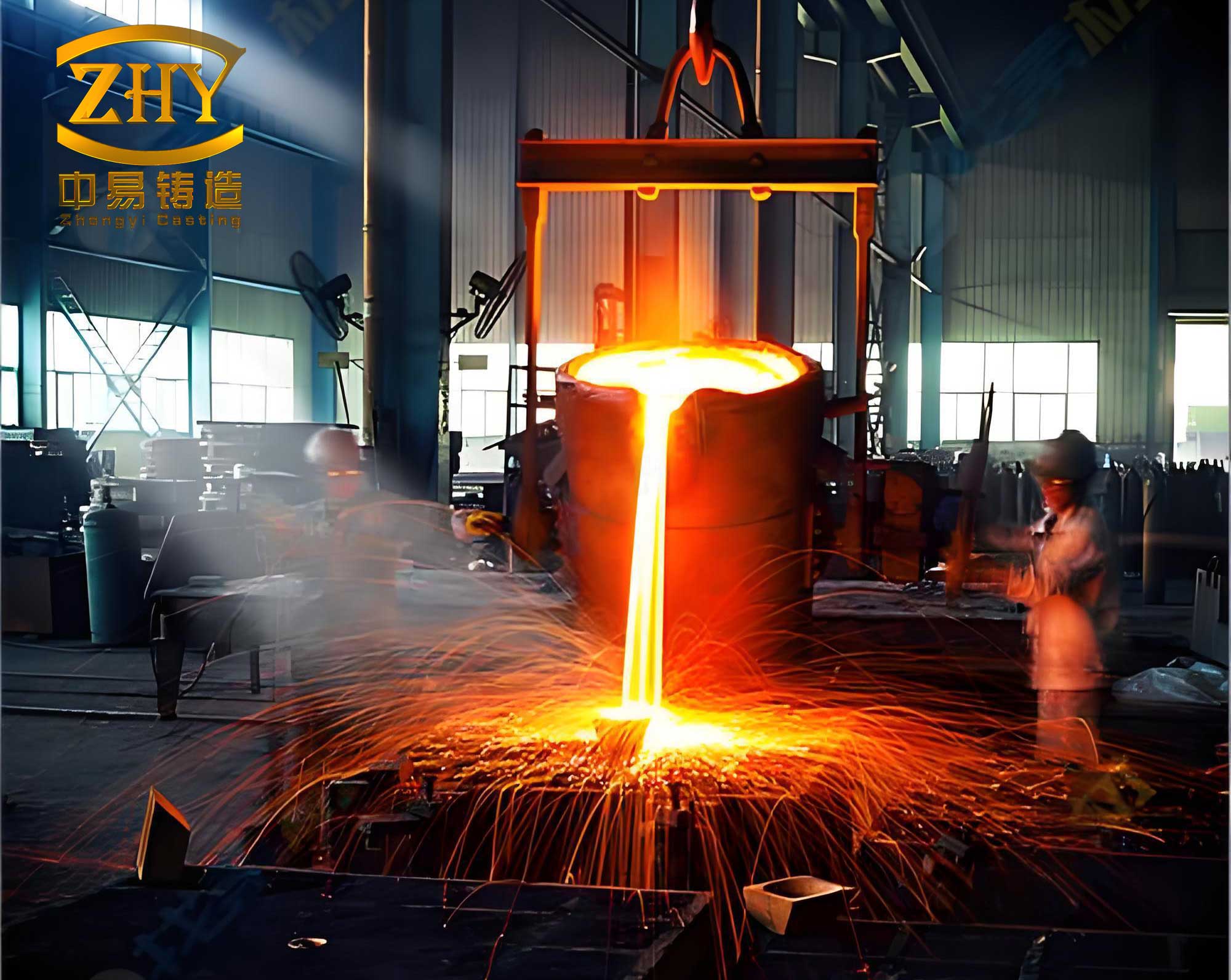
Third, pattern draft is essential for facilitating mold removal without damaging the casting part. Draft angles are added to vertical surfaces, and their magnitude depends on the pattern material, mold type, and surface height. For a casting part, insufficient draft can cause drags or breaks during pattern withdrawal, leading to defects. The draft angle \( \alpha \) in degrees can be determined using empirical formulas based on surface height \( h \) in millimeters. One common relation is:
$$ \alpha = \tan^{-1}\left( \frac{a}{h} \right) $$
where \( a \) is the draft allowance in millimeters, often standardized for different height ranges. For wooden patterns in self-setting sand molds, typical values are given in Table 3. I apply draft using the “increase thickness” method, where surfaces are tilted outward, ensuring the casting part’s dimensions remain within tolerance zones. This step is iterative, as draft affects adjacent features and must be balanced with machining allowances.
| Surface Height \( h \) (mm) | Draft Angle \( \alpha \) (degrees) | Draft Allowance \( a \) (mm) |
|---|---|---|
| > 10 – 40 | 2.0 | 1.6 |
| > 40 – 100 | 1.0 | 1.6 |
| > 100 – 160 | 0.67 | 2.0 |
| > 160 – 250 | 0.58 | 2.6 |
To illustrate these principles in action, I will describe two hypothetical casting part examples inspired by competition scenarios. The first is a large cast steel lifting box, and the second is a small ductile iron enclosure. These examples demonstrate how the design process adapts to different sizes, materials, and complexities.
For the cast steel lifting box casting part, the initial part model shows uneven wall thickness, multiple holes, and machined surfaces. After analysis, I identify all holes below 60 mm diameter and shallow slots as non-cast, filling them in the 3D model. This minimizes mold complexity for the casting part. Next, I apply RMA: since the largest dimension is 1040 mm, using Table 2, I assign 4 mm allowance to side surfaces and an additional 2.5 mm to the top surface, resulting in 6.5 mm there. This ensures the casting part has enough material for machining. For draft, with surface heights around 150 mm, I select an angle of 0.67 degrees per Table 3, adding it to all vertical faces. The final casting part model incorporates these changes, ready for gating and riser design. Throughout, I verify that the casting part’s weight and volume are calculated accurately, using formulas like:
$$ \text{Volume} = \sum V_{\text{features}} – V_{\text{holes}} $$
and
$$ \text{Weight} = \text{Volume} \times \rho $$
where \( \rho \) is the material density. This casting part exemplifies how systematic design prevents issues like shrinkage porosity in thick sections.
The small ductile iron enclosure casting part presents different challenges. It has numerous small holes and thin walls. Here, I cast shut holes under 35 mm diameter per Table 1, and apply RMA of 3 mm to most surfaces, with 5 mm to inner cavities due to deeper machining. Draft is set at 0.58 degrees for metal patterns, as heights are around 200 mm. This casting part requires careful core design for internal passages, but the initial transformation ensures a sound base. I often use simulation software to validate the casting part’s solidification pattern, but the manual calculations provide a reliable starting point. The key is to iterate until the casting part model balances all constraints.
In both examples, the casting part’s design directly influences subsequent steps like mold making and pouring. I emphasize that these principles are interdependent; for instance, draft affects RMA distribution, and hole decisions impact core needs. Therefore, a holistic view is essential. Competitions teach this through hands-on projects, where teams must submit complete process plans, including CAD drawings and cost analyses. The casting part is the centerpiece, and its transformation from part to casting sets the tone for success.
Beyond technical aspects, this process cultivates a mindset of precision and innovation. Each casting part design is a puzzle where economic and technical pieces must fit. I recall designing a complex casting part with internal channels: by optimizing hole cast-out decisions, I reduced core count, lowering costs without compromising function. Such experiences highlight the artistry in casting part design. Moreover, using standards and formulas—like those above—brings consistency, but creativity in applying them to unique casting part geometries is what distinguishes excellent designs.
In conclusion, the journey from part to casting part is a foundational phase in casting process design, demanding attention to minimum cast-out features, machining allowances, and draft angles. Through competitions and practical work, I have learned that mastering these elements ensures a robust casting part that meets quality and economic goals. The casting part, as the physical manifestation of design intent, benefits from rigorous application of these principles, supported by tables and formulas for efficiency. As casting technologies evolve, these fundamentals remain timeless, guiding engineers in producing reliable casting parts for diverse industries. I hope this detailed exploration aids others in navigating this critical design process, fostering excellence in casting part creation.