
In my extensive experience in industrial manufacturing, I have observed that high-temperature valves play a pivotal role in sectors such as petroleum, chemical, power, and metallurgy. These valves are critical components in fluid control systems, requiring exceptional sealing performance, corrosion resistance, and long-term stability under harsh conditions of high temperature and pressure. Therefore, I will delve into the key technologies and practical applications of high-temperature valve casting part manufacturing, aiming to provide valuable insights for practitioners and researchers. The casting part, as the foundational element, must withstand extreme environments, and its manufacturing involves intricate processes that demand precision and innovation.
High-temperature valves are defined as those operating above specific thresholds, typically exceeding 400°C. They can be classified based on application, structure, and actuation method. For instance, gate valves, globe valves, ball valves, and check valves each serve unique functions in controlling fluid flow. The working principle varies; for example, a globe valve regulates flow by raising or lowering a plug via a stem, while a ball valve uses a rotating sphere to open or close passages. Understanding these fundamentals is essential for designing casting parts that meet operational demands. In my analysis, the casting part’s integrity directly influences valve performance, making manufacturing techniques paramount.
The manufacturing of high-temperature valve casting parts hinges on several core technologies. I will explore these in detail, incorporating tables and formulas to summarize key points.
Material Selection and Pre-Treatment
Selecting appropriate materials is the first step in ensuring the durability of casting parts. Common materials include stainless steels, heat-resistant steels, nickel-based alloys, and cobalt-based alloys. Each offers distinct advantages under high-temperature conditions. For example, carbon steel is cost-effective for temperatures up to 425°C, while low-alloy steels like 1.25Cr-0.5Mo suit ranges of 425–600°C due to enhanced creep resistance. Above 600°C, nickel-based alloys such as Inconel are preferred for their superior oxidation resistance. The table below compares material properties for casting parts.
| Material Type | Typical Temperature Range (°C) | Key Properties | Common Applications in Casting Parts |
|---|---|---|---|
| Carbon Steel | ≤ 425 | Good strength, low cost | Valve bodies in moderate-temperature systems |
| Low-Alloy Steel (e.g., 2.25Cr-1Mo) | 425–600 | Enhanced creep strength, corrosion resistance | High-pressure valve components |
| Stainless Steel (e.g., CF8C) | Up to 800 | Excellent corrosion resistance, moderate high-temperature strength | Chemical processing valve casting parts |
| Nickel-Based Alloy (e.g., Inconel 718) | > 600 | Outstanding oxidation resistance, high tensile strength | Extreme-temperature valve casting parts in aerospace |
| Cobalt-Based Alloy | > 700 | Superior wear resistance, thermal stability | Valve seats and trim in abrasive environments |
Pre-treatment of materials is crucial to minimize defects in the casting part. This involves controlling composition during melting, removing impurities, and ensuring uniform distribution of alloying elements. For a CF8C stainless steel casting part, harmful elements like sulfur and phosphorus must be reduced—typically below 0.015% and 0.020%, respectively. This can be achieved through techniques such as ladle refining or vacuum degassing. The effectiveness of pre-treatment can be modeled using segregation coefficients, where the distribution of an element in the solid casting part relates to its concentration in the liquid melt: $$ C_s = k C_l $$ Here, \( C_s \) is the solid concentration, \( C_l \) is the liquid concentration, and \( k \) is the partition coefficient. By optimizing this, the casting part achieves homogeneity and enhanced performance.
Casting Process Design
Casting process design is central to producing high-quality casting parts. It encompasses decisions on parting lines, gating systems, risers, and chills. For a three-way pipe-shaped casting part, I recommend parting along the plane through the centers of the three pipe openings. This minimizes core usage and improves dimensional accuracy. The gating system should facilitate smooth metal flow; a bottom-gating design is often employed to reduce turbulence and oxidation. The flow rate \( Q \) in the gating system can be expressed as: $$ Q = A \cdot v $$ where \( A \) is the cross-sectional area of the gate and \( v \) is the flow velocity. Proper design ensures the casting part fills uniformly without defects.
Risers and chills are essential for controlling solidification. Risers are placed at hot spots to compensate for shrinkage, while chills accelerate cooling in thick sections. The riser size can be estimated using Chvorinov’s rule, where solidification time \( t \) is proportional to the volume-to-surface area ratio: $$ t = C \left( \frac{V}{A} \right)^2 $$ Here, \( C \) is a mold constant, \( V \) is the volume of the casting part, and \( A \) is its surface area. By positioning risers strategically, the casting part solidifies sequentially, reducing porosity. The table below outlines design parameters for a typical high-temperature valve casting part.
| Design Element | Parameter | Value/Range | Impact on Casting Part |
|---|---|---|---|
| Parting Line | Plane through pipe centers | Minimizes cores | Improves dimensional precision |
| Gating System | Bottom-gating, multiple ingates | Flow velocity: 0.5–1.0 m/s | Reduces turbulence and oxide inclusion |
| Riser Design | Top riser on valve body | Riser volume: 20% of casting part volume | Ensures adequate feeding for shrinkage |
| Chill Placement | Indirect chills at pipe intersections | Chill thickness: 30–50 mm of chromite sand | Promotes directional solidification |
Sand Casting Technology
Sand casting is widely used for high-temperature valve casting parts due to its versatility. Various binder systems offer distinct advantages. Green sand uses bentonite and requires no drying, but may lead to defects like scabbing. Dry sand employs clay binders and is baked for better permeability, reducing gas holes. Sodium silicate sand hardens through chemical reactions, yet reclaimability is limited. Furan resin no-bake sand provides high dimensional accuracy and smooth surfaces, though it demands high-quality raw materials and involves higher costs. The choice depends on the specific requirements of the casting part. I often evaluate these using a performance matrix, as shown below.
| Sand Type | Binder | Advantages | Disadvantages | Suitability for Casting Part |
|---|---|---|---|---|
| Green Sand | Bentonite | No drying needed, good collapsibility | Prone to moisture-related defects | Medium-complexity casting parts |
| Dry Sand | Clay | High permeability, reduced gas defects | Energy-intensive drying process | Large, thick-walled casting parts |
| Sodium Silicate Sand | Water glass | Fast hardening, good surface finish | Poor reclaimability, environmental concerns | High-volume production of casting parts |
| Furan Resin Sand | Furan resin | Excellent dimensional accuracy, easy shakeout | High cost, emissions during pouring | Precision casting parts with complex geometries |
In practice, for a high-integrity casting part, I favor furan resin sand due to its ability to capture fine details. The mold strength \( \sigma_m \) can be approximated by: $$ \sigma_m = k_b \cdot C_b $$ where \( k_b \) is a binder constant and \( C_b \) is the binder concentration. Optimizing this ensures the mold withstands metal pressure during pouring, preserving the casting part’s shape.
Investment Casting Technology
Investment casting, or lost-wax casting, is ideal for producing precision casting parts with excellent surface finish and tight tolerances. Two primary methods exist: the low-temperature wax process using water-glass shells, and the medium-temperature resin process with silica sol shells. The latter achieves dimensional accuracies up to CT4-6 per ISO standards. The process involves creating a wax pattern, building a ceramic shell, dewaxing, and pouring. The shell’s thermal conductivity \( k_s \) affects cooling rates, critical for the casting part’s microstructure. This can be modeled via Fourier’s law: $$ q = -k_s \frac{dT}{dx} $$ where \( q \) is heat flux, and \( \frac{dT}{dx} \) is the temperature gradient. By controlling shell composition, the casting part solidifies with minimal residual stress.
The dimensional accuracy of an investment-cast part often follows a normal distribution, where the tolerance \( \Delta \) relates to process variables: $$ \Delta = \sqrt{ \sum_{i=1}^n ( \alpha_i x_i )^2 } $$ Here, \( \alpha_i \) are sensitivity coefficients for factors like wax shrinkage or shell expansion, and \( x_i \) are process parameters. For high-temperature valve casting parts, this technique ensures complex internal passages are reproduced faithfully, enhancing performance.
Heat Treatment Technology
Heat treatment is vital for enhancing the mechanical properties of casting parts. Processes include annealing, normalizing, quenching, and tempering. Annealing relieves internal stresses from solidification, while normalizing refines grain structure. Quenching and tempering improve hardness and toughness. The kinetics of phase transformations during heat treatment can be described using the Avrami equation: $$ f = 1 – \exp(-k t^n) $$ where \( f \) is the fraction transformed, \( k \) is a rate constant, \( t \) is time, and \( n \) is an exponent. For a CF8C stainless steel casting part, I typically apply a solution treatment at 1050°C followed by aging to precipitate carbides, boosting high-temperature strength.
The table below summarizes heat treatment parameters for common casting part materials.
| Material | Heat Treatment Type | Temperature (°C) | Holding Time (hours) | Cooling Method | Effect on Casting Part |
|---|---|---|---|---|---|
| Carbon Steel | Normalizing | 900–950 | 1–2 | Air cool | Refines grain, increases strength |
| Low-Alloy Steel | Quench & Temper | Quench: 850, Temper: 650 | 2, 4 | Oil quench, air cool | Enhances toughness and creep resistance |
| CF8C Stainless Steel | Solution Treatment & Aging | Solution: 1050, Aging: 700 | 2, 4 | Water quench, air cool | Improves corrosion and high-temperature performance |
| Nickel-Based Alloy | Stress Relieving | 870–900 | 4–6 | Furnace cool | Reduces residual stresses in the casting part |
Manufacturing Practice: A Case Study
I will now detail a practical example of manufacturing a high-temperature valve casting part. The component is a three-way pipe valve made of CF8C stainless steel, with overall dimensions of 1538 mm × 1310 mm × 840 mm, a wall thickness of 115 mm, and a weight of 4300 kg. It is intended for high-pressure, high-temperature service, demanding exceptional quality.
The goal was to produce a casting part with precise dimensions, sound internal structure, and compliant material properties. Material selection followed ASTM A351 standards, with sulfur and phosphorus controlled below 0.015% and 0.020%, respectively. Pre-treatment included drying and deslagging to minimize inclusions.
The casting process design involved parting on the plane of pipe centers. A bottom-gating system with multiple ingates was used to ensure stable filling. Risers were placed atop the valve body, supplemented by indirect chills at pipe junctions to promote directional solidification. The gating time was set at 105 seconds, with flow velocity calculated using: $$ v = \frac{Q}{A} = \frac{4300 \, \text{kg} / \rho}{105 \, \text{s} \cdot A} $$ where \( \rho \) is the metal density. This ensured smooth mold filling for the casting part.
Furan resin quartz sand was employed for molding. The mold coating consisted of zircon flour-based alcohol coatings followed by magnesite-based coatings, applied in two layers to prevent burn-on. After molding and core assembly, the mold was carefully closed to avoid misalignment.
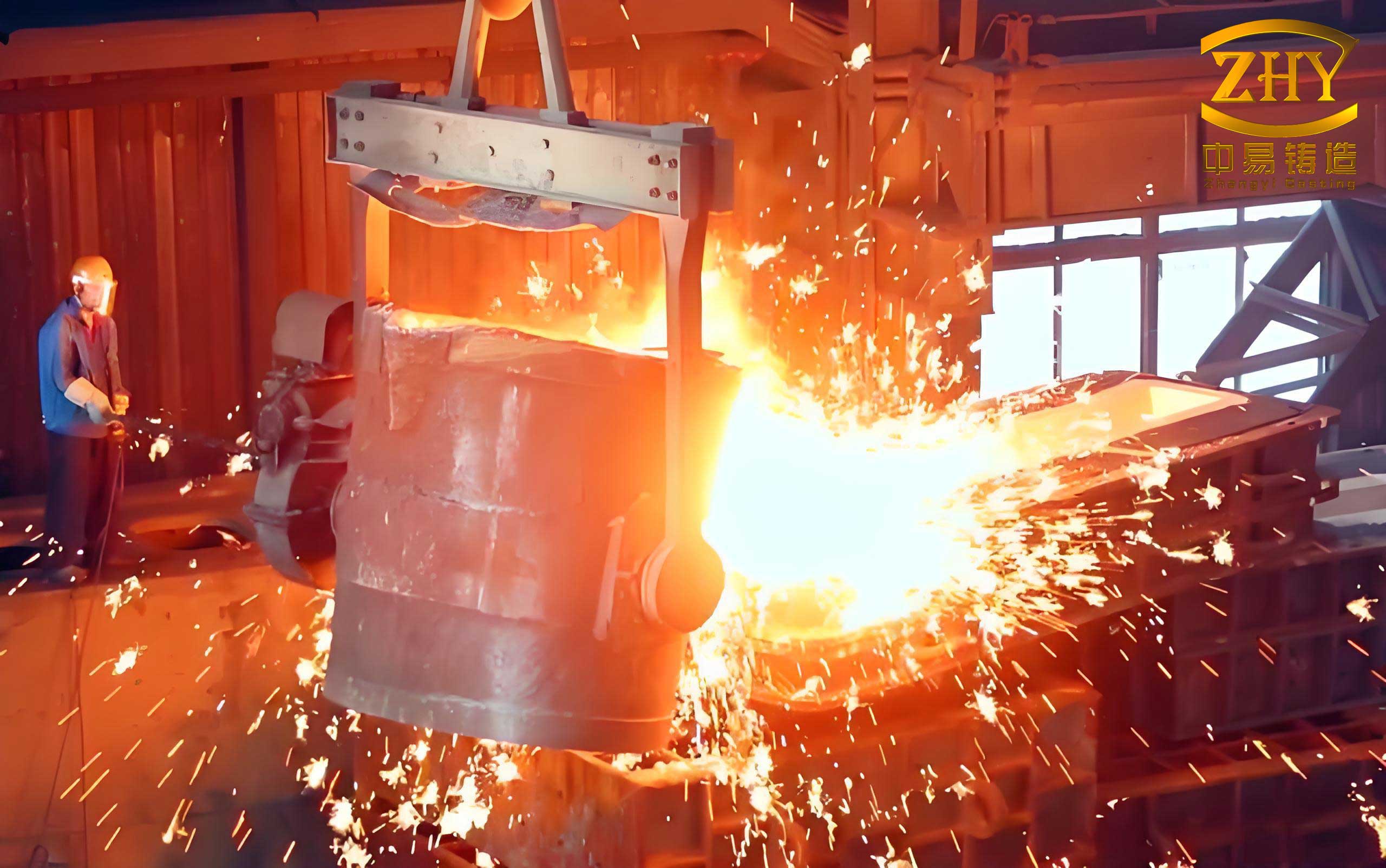
The pouring was conducted using a preheated ladle, with metal temperature monitored at 1580°C. The casting part solidified under controlled conditions, with risers providing adequate feeding. Post-casting, the part was cleaned by removing gates and risers, then subjected to heat treatment: normalizing at 950°C for 2 hours and tempering at 700°C for 4 hours. This cycle relieved stresses and optimized the microstructure of the casting part.
Quality verification included dimensional checks, chemical analysis, mechanical testing, and non-destructive examination. The casting part met all specifications, with no defects detected via ultrasonic testing. The success of this practice underscores the importance of integrated technologies in producing reliable high-temperature valve casting parts.
Future Perspectives and Conclusion
Reflecting on these technologies, I believe the future of high-temperature valve casting part manufacturing lies in advancements in simulation and additive manufacturing. Computational fluid dynamics (CFD) can optimize gating designs, while finite element analysis (FEA) predicts thermal stresses. For instance, the heat transfer during solidification can be simulated using: $$ \frac{\partial T}{\partial t} = \alpha \nabla^2 T $$ where \( \alpha \) is thermal diffusivity. Such tools enable proactive defect reduction in casting parts.
Additionally, the integration of 3D printing for mold making allows rapid prototyping of complex casting parts. This aligns with industry trends toward customization and efficiency. The casting part, as a critical component, will continue to evolve with material innovations—such as ceramic matrix composites for ultra-high temperatures.
In conclusion, manufacturing high-temperature valve casting parts is a multifaceted endeavor requiring meticulous attention to material science, process design, and quality control. Through practices like sand casting, investment casting, and tailored heat treatments, we can achieve casting parts that endure extreme conditions. I hope this exploration provides a comprehensive reference, highlighting that every casting part is a testament to precision engineering and technological synergy.